
LES-112 · Lesson 5 of 12 · 20 min
Investigative detention in practice
▶ Video coming soon A video version of this lesson is on the way.
Desjardins plays body-worn camera footage from a Port Ardent stop, with faces blurred. An officer pulls up beside a young man walking quickly away from a convenience store that had just been robbed. The officer gets out, says 'Hold on a second, I need to talk to you,' explains that the store was just robbed by a man in a gray jacket, and asks the young man where he is coming from. The young man is wearing a gray jacket. Two minutes later, the store clerk arrives in another cruiser, looks at him and says it is not the man. The officer thanks the young man, explains why he was stopped, gives him a card and lets him go. The whole encounter takes four minutes. 'That,' Desjardins says, 'is investigative detention done properly. Brief, focused, explained, and ended as soon as the reason for it disappeared.'
LES-111 covered the constitutional framework for detention: when a person is detained, the standards for stops and arrests, and the leading cases. This lesson is about doing it: the practical steps, the limits on scope and duration, protective searches, vehicle stops, and the records that let a supervisor and a court see what happened.
The legal basis in brief
Investigative stops rest on Terry v. Ohio (1968) and the cases that followed it. An officer may stop a person briefly when they have reasonable suspicion, based on specific and articulable facts, that criminal activity is afoot, and may frisk the outer clothing for weapons if they reasonably believe the person is armed and dangerous. Miranda warnings are not required during an ordinary stop, because a Terry stop is not custody, as Berkemer v. McCarty (1984) held for traffic stops, though a stop can become custodial if it takes on the features of an arrest. Ohio's stop-and-identify statute, Revised Code 2921.29, requires a person reasonably suspected of crime to give their name, address and date of birth on request, but not to answer other questions.
Starting a detention well
Most of what goes wrong in a detention goes wrong in the first thirty seconds. An officer who approaches with a hand on their holster and a demand for identification creates a detention immediately, whether or not they have grounds for one. An officer who wants only to ask questions should say so and make clear that the person may leave. When an officer does have grounds, the best practice is to say three things at once: who you are, that the person is being detained, and why. 'I'm Constable Patel with Port Ardent police. I need you to stop for a few minutes. A store was just broken into two blocks from here, and you match the description of the person we're looking for.' That single sentence tells the person what is happening, sets the scope of the stop, and starts the clock, and procedural justice research shows that explaining the reason is the most effective way to gain cooperation.
Desjardins asks the class to imagine being on the other side of that encounter. Linh Tran says her cousin Bao was never told why he was stopped, and assumed it was because of how he looked. Jesse Morningstar says people in his community often assume the worst when an officer does not explain. Both say that an explanation, even a brief one, would have changed how the stop felt. Desjardins agrees and adds that it changes how a court sees it too: an officer who explained the reason at the start has made a clear record of the grounds they relied on.
Scope: what a detention allows
A detention allows the officer to hold the person briefly while they investigate the suspicion that justified it: to ask questions, to check identification if the person offers it or the law requires it, to bring a witness for a quick identification, or to make database checks. It does not allow a general search for evidence, a search of a bag or pockets beyond a protective pat-down, a trip to the station, or questioning about unrelated matters as a fishing expedition. If the person declines to answer, the officer must work with what they have; refusing to answer is not itself grounds for arrest.
Moving a detained person is a sensitive question. In Dunaway v. New York (1979), the Supreme Court held that taking a person to the station for questioning without probable cause was an unlawful seizure even if it was not called an arrest, and Florida v. Royer (1983) held that moving a traveler to a small room and keeping his ticket and luggage turned a stop into an arrest. Placing a person briefly in a cruiser for safety or weather may be reasonable, but it must be justified and recorded.
Handcuffing during a detention is another hard question. Handcuffs are not automatically an arrest, but they are a significant restraint that must be justified by a real safety concern, such as reasonable grounds to believe the person is armed, a struggle, or a high-risk situation like a robbery with a weapon. Officers who handcuff routinely during detentions invite findings that the detention became arbitrary or unreasonable. The decision should be recorded with the reasons, and the handcuffs removed as soon as the safety concern passes.
Protective searches during a detention
Terry allows a frisk of the outer clothing for weapons when the officer reasonably believes the person is armed and dangerous; it is not a search for evidence. Under Minnesota v. Dickerson (1993), if during a lawful frisk an officer feels an object whose contour or mass makes its identity as contraband immediately apparent, the officer may seize it under the plain-feel doctrine, but manipulating an object after concluding it is not a weapon goes beyond the frisk. In Michigan v. Long (1983), the Court allowed a protective search of the passenger area of a car during a stop, limited to places a weapon could be hidden, when the officer reasonably believes the suspect is dangerous and may gain immediate control of a weapon.
Desjardins demonstrates a pat-down on a training dummy, explaining each movement: hands on the outside of clothing, flat palms, starting at the areas where weapons are most often carried, never reaching into pockets unless a hard object that could be a weapon is felt. He tells the class that their notes must explain both why they believed a pat-down was needed and what they felt that justified going further, because a court will examine both.
Duration: keeping detentions brief
The law does not set a fixed time limit on a detention, but every court that has looked at the question has said the same thing: the detention must last no longer than needed to confirm or dispel the suspicion, and the officer must pursue the investigation diligently. In Rodriguez v. United States (2015), the Supreme Court held that police may not extend a completed traffic stop, even for a few minutes, to conduct a dog sniff without reasonable suspicion; in United States v. Sharpe (1985), it upheld a twenty-minute stop where the officers acted diligently and the delay was caused by the suspect's evasive driving. Haddad's quarterly review of investigative detentions in Port Ardent records how long each lasted and whether new grounds arose during it, which can justify a longer detention.
# 200 Port Ardent investigative detentions in one quarter, by duration
bands = ["under 10 min", "10 to 20 min", "20 to 30 min", "over 30 min"]
detentions = [118, 52, 19, 11]
new_grounds = [0, 6, 9, 8]      # detentions where new grounds were recorded during the stop
total = sum(detentions)
for b, d, g in zip(bands, detentions, new_grounds):
    print(f"{b:13} {d:4}  {d / total:.2f}  new grounds recorded: {g}")
long_ = detentions[2] + detentions[3]
long_with = new_grounds[2] + new_grounds[3]
print("over 20 minutes:", long_, "with new grounds:", long_with, "without:", long_ - long_with)under 10 min 118 0.59 new grounds recorded: 0 10 to 20 min 52 0.26 new grounds recorded: 6 20 to 30 min 19 0.10 new grounds recorded: 9 over 30 min 11 0.06 new grounds recorded: 8 over 20 minutes: 30 with new grounds: 17 without: 13
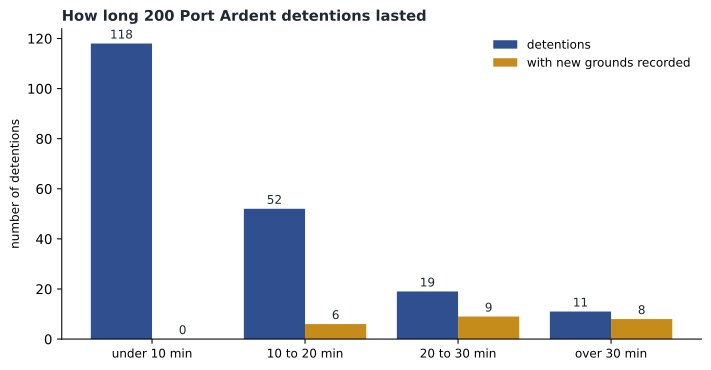
Most detentions were short: 170 of 200 lasted under twenty minutes. Of the 30 that lasted longer, 17 had new grounds recorded, such as a witness identifying the person or contraband found in plain view, which can justify a longer detention or an arrest. The other 13 are the ones Haddad reviews in detail, because each is a detention that went on with no recorded reason. Some will turn out to have good explanations that were not written down. Others will be coaching conversations.
Traffic stops
Traffic stops are the most common police contact. A stop requires probable cause of a traffic violation or reasonable suspicion of a crime; in Whren v. United States (1996) the Supreme Court held that the officer's subjective motive does not matter if a violation occurred, and in Heien v. North Carolina (2014) that a reasonable mistake of law can support reasonable suspicion. Officers may order the driver out of the car under Pennsylvania v. Mimms (1977) and passengers out under Maryland v. Wilson (1997), and passengers are seized along with the driver under Brendlin v. California (2007). Random stops of individual cars without suspicion are not allowed under Delaware v. Prouse (1979), though sobriety checkpoints run under neutral rules are allowed under Michigan v. Sitz (1990). Ohio requires drivers to show a license on request under Revised Code 4507.35.
Desjardins tells the class that vehicle stops carry particular risks of bias, because officers have a lot of discretion about which cars to stop. Port Ardent records the reason for every stop, the outcome, and the officer's perception of the driver's race, and publishes the summary each year. The data are not perfect, but they let the service and the public see whether stops fall more heavily on some groups than the driving population would explain, and they have led to changes in how officers choose which minor violations to enforce.
Ending a detention and recording it
A detention ends in one of three ways: the suspicion is dispelled and the person is released; new grounds arise and the person is arrested; or the officer decides the matter is better handled another way, such as a summons or a referral. In each case, the officer should tell the person clearly that the detention is over. Port Ardent officers give every person they stop a card with the officer's name and badge number, the incident number, and the reason for the stop, a practice the department adopted in 2018 at the recommendation of the civilian review board. The detention record should show the time it started, the grounds, any protective search and why, any new grounds, and the time and manner it ended.
Worked problem
A detention that went on too long
At 21:05 an officer stops a man on foot who matches the description of a person who just stole a purse two blocks away. The officer tells him why. A check shows no warrants. At 21:12 the victim, brought to the scene, says she is not sure; it could be him or it could not. The officer keeps the man there while waiting for a canine unit to track from the scene, which arrives at 21:48. The dog does not lead to the man. Was the detention lawful throughout?
Show solution
- The start was lawful: a matching description close in time and place gave reasonable suspicion.
- At 21:12 the victim's uncertainty weakened but did not eliminate the suspicion; a short further step, such as checking the route for the purse, could be justified.
- Waiting thirty-six minutes for a canine unit with no new facts is the problem: the delay came from the investigation's choices, not the man's conduct, and nothing new connected him to the crime.
- Ask what diligent investigation looked like: a quick search of the route, a check with other units, and then a decision to release with a card or to arrest if new facts appeared.
- Record the timeline and the reasons for each decision; a court will compare times.
Answer: The stop was lawful at the start, but holding him for over half an hour after the identification failed, without new suspicion, likely exceeded the reasonable duration of a Terry stop.
Common mistakes
MistakeA protective search allows checking pockets for evidence.
InsteadA Terry frisk is for weapons only; manipulating an object after concluding it is not a weapon exceeds it (Dickerson).
MistakeHandcuffing during a detention is routine.
InsteadHandcuffs must be justified by a real safety concern and removed when it passes.
MistakeA person who refuses to answer questions can be arrested for that.
InsteadSilence is not grounds for arrest; the officer must work with the facts they have.
MistakeA detention can last as long as it takes to find something.
InsteadDetentions must be brief and pursued diligently; delays without new grounds count against the officer.
Summary and key terms
- Terry stops require reasonable suspicion; Miranda does not apply to ordinary stops (Berkemer), and Ohio's stop-and-identify law requires name, address and date of birth only.
- Start by saying who you are, that the person is detained, and why.
- Detentions allow questions and quick checks, not general searches or station trips.
- Frisks are pat-downs for weapons; plain feel allows seizure of obvious contraband (Dickerson); car protective searches follow Michigan v. Long.
- Detentions must be brief and diligently pursued; long detentions need new grounds.
- End the detention clearly and record its start, grounds, search, new grounds and end.
- Terry stop
- A brief investigative stop based on reasonable suspicion.
- Frisk
- A pat-down of outer clothing for weapons when the person is reasonably believed armed and dangerous.
- Plain feel
- Seizing an object during a lawful frisk whose identity as contraband is immediately apparent.
- Stop and identify
- A law requiring a lawfully stopped person to give their name and certain details.
- Mimms order
- An order for a driver to get out of a lawfully stopped car.
- Detention record
- The written record of a stop's grounds, timing, searches and outcome.
Practice problems
Work each problem on paper first, then reveal the answer to check.
What three things should an officer say at the start of a detention?
Show answer
Who they are, that the person is being detained, and why.
What did Minnesota v. Dickerson decide?
Show answer
An object felt during a frisk may be seized only if its identity as contraband is immediately apparent; manipulating it further exceeds the frisk.
In the code example, how many detentions over 20 minutes had no new grounds recorded?
Show answer
30 - 17 = 13.
How should a detention end?
Show answer
With a clear statement that it is over, a card or explanation, and a record of the outcome.
Lesson quiz · 5 questions
Score 60% or more to complete this lesson.
Create a free account to save your progress, take quizzes and earn a certificate.