
LES-112 · Lesson 11 of 12 · 19 min
Release, pretrial release and custody
▶ Video coming soon A video version of this lesson is on the way.
By 04:10 on March 14, Kyle Brandt had spoken to a public defender on the department's after-hours line, declined to give a statement, and was sitting in a cell at Port Ardent headquarters. Sergeant Haddad, as the shift supervisor, had to make a decision that Desjardins calls one of the most consequential in policing: should Brandt be released, and if so on what terms, or held for a court appearance and bail decision? Desjardins tells the class that the arrest is often the most dramatic moment of a case, but the release decision usually affects the person's life more. A person held for days or weeks can lose a job, housing or custody of children before any court has decided whether they did anything wrong.
The presumption of release
The Eighth Amendment prohibits excessive bail, and in Stack v. Boyle (1951) the Supreme Court held that bail set higher than an amount reasonably calculated to ensure the defendant's appearance is excessive. In United States v. Salerno (1987), it upheld preventive detention without bail for dangerous defendants after a full adversarial hearing with procedural protections, describing liberty as the norm and detention before trial as the carefully limited exception. Ohio's Criminal Rule 46, amended in 2020, tells courts to impose the least restrictive conditions that will reasonably assure the defendant's appearance, public safety and the integrity of the process, and to consider the defendant's ability to pay. In 2022 Ohio voters amended Article I, Section 9 of the state constitution to require courts setting bail to consider public safety, including the seriousness of the offense and the defendant's record.
Release by the police
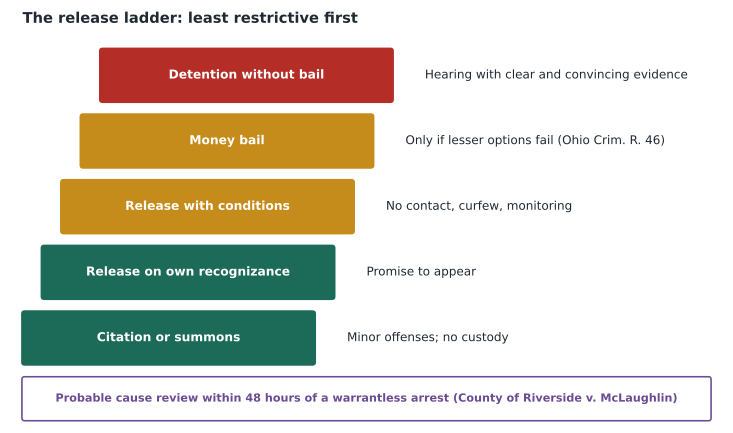
Officers can release most people they arrest. For minor misdemeanors, Revised Code 2935.26 requires a citation. For other misdemeanors, Criminal Rule 4 allows officers to issue a summons or citation, and many departments release people at the station on a summons after booking. A person arrested without a warrant who is not released must be brought before a court without unnecessary delay; Criminal Rule 5 governs the initial appearance, and in County of Riverside v. McLaughlin (1991) the Supreme Court held that a judicial determination of probable cause within 48 hours of a warrantless arrest is generally prompt, while a longer delay shifts the burden to the government to show an emergency. Many Ohio counties use bond schedules for common misdemeanors that allow release on payment at the jail, though courts increasingly review them for fairness.
Haddad considered the department's release criteria: Brandt's identity was confirmed, the evidence was secured, the store owner was not known to him, he had a fixed address and a job, and he had no record of missing court. Breaking and entering is a felony in Ohio, so release was a decision for the court; she recommended release on his own recognizance with a no-contact and stay-away condition for the store. At his initial appearance that afternoon, a magistrate agreed. Desjardins notes that a condition not to possess tools would have been tempting but unreasonable, because Brandt worked as a laborer and needed them.
Pretrial release by the court
When the police do not release, a judge or magistrate decides at the initial appearance. Under Criminal Rule 46, the court may release on personal recognizance, an unsecured bond, conditions such as reporting, no contact, curfew or electronic monitoring, or a secured bond, and must consider the nature of the offense, the weight of the evidence, the defendant's history of appearances, ties to the community, record, and danger to any person. Revised Code 2937.222 allows a court to deny bail for certain serious offenses, such as aggravated murder and some felonies of violence, after a hearing at which the prosecution shows by clear and convincing evidence that the defendant poses a substantial risk of serious harm and no conditions will reasonably assure safety. Under Salerno, such detention is constitutional when these protections are in place.
Officers play an important role at these hearings even though they do not decide them. The prosecutor relies on the arrest report and any pretrial services report to describe the offense, the defendant's record and any risks. Desjardins tells the class that the report must be accurate and fair: it should include facts that favor release, such as employment and family ties, as well as risks. An exaggerated report that leads to an unnecessary detention is an ethical failure, and a misleading one can lead to findings against the officer.
Port Ardent release data
Port Ardent publishes its release data every year, as part of its commitment to the principle that release should be the norm. The program below summarizes one year of decisions for people arrested and brought to headquarters, and checks how many people held for court were brought before a judge within 48 hours.
# Port Ardent release decisions for people brought to headquarters, one year
decisions = {"released by officer, no conditions": 1210,
             "released by officer, with conditions": 690,
             "held for court": 420}
total = sum(decisions.values())
for k, v in decisions.items():
    print(f"{k:38} {v:5}  {v / total:.2f}")
held = decisions["held for court"]
hours_to_court = [  # hours from arrest to appearance, grouped
    (12, 155), (18, 140), (22, 96), (30, 21), (40, 8)]
within = sum(n for h, n in hours_to_court if h <= 24)
print("held for court:", held, "seen within 24 hours:", within, f"({within / held:.3f})")
print("seen after 24 hours:", held - within)released by officer, no conditions 1210 0.52 released by officer, with conditions 690 0.30 held for court 420 0.18 held for court: 420 seen within 24 hours: 391 (0.931) seen after 24 hours: 29
More than four in five people were released by officers, two thirds of them without conditions. Of the 420 held for court, 391 appeared within 24 hours, and 29 waited longer, mostly on weekends when the court's schedule was reduced. The 48-hour McLaughlin limit was met in every case, but the department sets itself a 24-hour target, and each late case is reviewed. Haddad's review found that most delays came from a weekend court schedule, and the service has asked the court to add a Sunday sitting.
Care of people in custody
While a person is in custody, the police are responsible for their safety and wellbeing. People in cells may be intoxicated, injured, ill, withdrawing from drugs or suicidal, and deaths in custody are among the most serious incidents a service can face. Port Ardent's cells policy requires a health screening at booking, checks at intervals set by risk, with physical checks every 15 minutes for intoxicated people and constant observation for anyone at risk of self-harm, and immediate medical attention for anyone who cannot be roused, has a head injury or shows signs of overdose. Belts, shoelaces and other items that could be used for self-harm are removed and recorded. Juveniles must be kept separate from adults under Ohio law and federal standards.
Desjardins tells the class about a man he arrested for being drunk in public early in his career. The man said he had fallen and hit his head. Desjardins wrote it down and booked him. The cells officer, following the head-injury rule, called an ambulance; the man had a bleed on the brain and survived because of the call. 'The rules feel like paperwork until the night they save someone,' he says.
Conditions that set people up to fail
Desjardins spends time on conditions because they are where good intentions most often cause harm. A condition that seems sensible at three in the morning can be impossible to follow for the next six months. An absolute ban on alcohol for a person with an addiction, a curfew for a person who works night shifts, a requirement to live at an address where the person is no longer welcome, or a condition not to enter a whole area of the city that includes the person's doctor or child's school can all lead to breaches that have nothing to do with the original offense. Each breach can bring a new charge, a new arrest and a harder road to release.
Ohio courts, following the 2020 amendments to Criminal Rule 46, are expected to impose only conditions that are reasonably necessary to assure appearance and protect the public, and many counties now use pretrial services to help people meet their conditions rather than simply setting them. Haddad's review of Port Ardent's releases with conditions found that the most common condition was not to contact the victim, which almost always made sense, and the second most common was a blanket alcohol ban, which often did not.
Officers also have a role after release. When a person breaches a condition in a minor way, such as arriving home twenty minutes after curfew, officers have discretion about how to respond. A warning and a note to the file may serve the purpose of the condition better than an arrest. A serious breach, such as contacting a victim the person was ordered to avoid, calls for a firm response. Desjardins tells the class that thinking about the purpose of each condition is the best guide to enforcing it sensibly.
Release and victims
Release decisions also affect victims. A person who has been assaulted by a partner, for example, may be terrified that the accused will return home the same night. Ohio's constitution, as amended by Marsy's Law in 2017, gives victims the right to be notified of release proceedings, to be heard at them, and to have their safety considered. Officers should tell victims what conditions were imposed, how to report a breach, and where to find support. In the Lakeshore case, Ruth Lindqvist was told about Brandt's condition not to attend the store, and Haddad gave her a card with the file number in case he came back.
Desjardins ends the lesson with a reminder about time. Every hour a person spends in custody before a release decision is an hour they did not need to spend if the decision could have been made sooner. Officers who finish the paperwork for the release decision before they start the rest of the file, and supervisors who make the decision as soon as they have what they need, keep that time short. Port Ardent's target is a release decision within four hours of arrival at the station for anyone who is not being held for court, and Haddad reports the result to the service every month. In the year shown in the lesson, the median was a little under three hours, and the longest waits were almost all on nights when the cells were full and the booking room had a queue.
Worked problem
Deciding on release
At 23:00, officers arrest a 19-year-old for shoplifting a jacket worth about 150 dollars from a department store. She has no record, gives her name and address, which are confirmed, and lives with her parents. The store wants her banned. Should she be held, and what conditions, if any, are appropriate?
Show solution
- Start with the presumption of release: theft of this value is a misdemeanor, and Criminal Rule 46 favors the least restrictive conditions.
- Check each concern: identity is confirmed, the evidence (the jacket and video) is secured, there is no ongoing offense, and she has ties and no history of missing court.
- Choose the release: a citation or summons is likely enough; if the store's concern is real, a stay-away condition can be requested at her first appearance.
- Avoid unnecessary conditions: a curfew, a ban on all stores, or a requirement to live with her parents would not be connected to any real risk.
- Record the reasons for the decision.
Answer: She should be released, most likely on a citation or summons, with at most a stay-away condition for that store.
Common mistakes
MistakeHolding people in custody is the safe choice.
InsteadLiberty is the norm under Salerno and Criminal Rule 46 favors the least restrictive conditions.
MistakeMore conditions make release safer.
InsteadConditions must be the least restrictive that reasonably assure appearance and safety.
MistakeThe arrest report only needs to describe the risks.
InsteadReports for release decisions must be accurate and fair, including facts that favor release.
MistakeCells checks are just paperwork.
InsteadHealth screening and regular checks prevent deaths in custody.
Summary and key terms
- The Eighth Amendment forbids excessive bail; Salerno makes liberty the norm; Criminal Rule 46 favors the least restrictive conditions.
- Officers cite or release on summons; those held must get a probable cause determination within 48 hours (McLaughlin).
- Courts set the least restrictive conditions and may deny bail for serious offenses after a hearing under Revised Code 2937.222.
- Conditions must be reasonable and connected to appearance and safety.
- Reports for release decisions must be accurate and fair.
- Police are responsible for the safety of people in custody.
- Citation
- A written order to appear in court, issued instead of custody.
- Own recognizance
- Release on a promise to appear without money bail.
- Initial appearance
- The first court appearance after arrest, where release is decided.
- Bond schedule
- A list of standard bail amounts for common offenses.
- Preventive detention
- Holding a defendant without bail because of danger, after a hearing.
- Least restrictive conditions
- The mildest conditions that reasonably assure appearance and safety.
Practice problems
Work each problem on paper first, then reveal the answer to check.
What did County of Riverside v. McLaughlin decide?
Show answer
A probable cause determination within 48 hours of a warrantless arrest is generally prompt; longer delays must be justified.
In the code example, what share of people held for court were seen within 24 hours?
Show answer
391 of 420, about 0.931.
What must the prosecution show to deny bail under Revised Code 2937.222?
Show answer
By clear and convincing evidence, that the defendant poses a substantial risk of serious harm and no conditions will reasonably assure safety.
Why was a condition not to possess tools inappropriate for Brandt?
Show answer
He worked as a laborer and needed tools, so the condition was not reasonably practicable or necessary.
Lesson quiz · 5 questions
Score 60% or more to complete this lesson.
Create a free account to save your progress, take quizzes and earn a certificate.