
LES-112 · Lesson 2 of 12 · 19 min
Grounds and standards: reasonable suspicion and probable cause
▶ Video coming soon A video version of this lesson is on the way.
Desjardins hands each student a card describing one fact about a man walking down a street at two in the morning. One card says the man is wearing a dark hoodie. Another says he is carrying a backpack. Another says he is limping. Another says he is three blocks from a hardware store whose alarm went off fifteen minutes ago. Another says a witness described the burglar as thin with short dark hair, limping and carrying a black backpack. He asks each student, holding only their own card, whether they could stop the man. Nobody can. Then he puts all the cards together on the desk and asks again. Now most of the class says yes, and some say they could arrest. 'That,' he says, 'is the totality of the circumstances.'
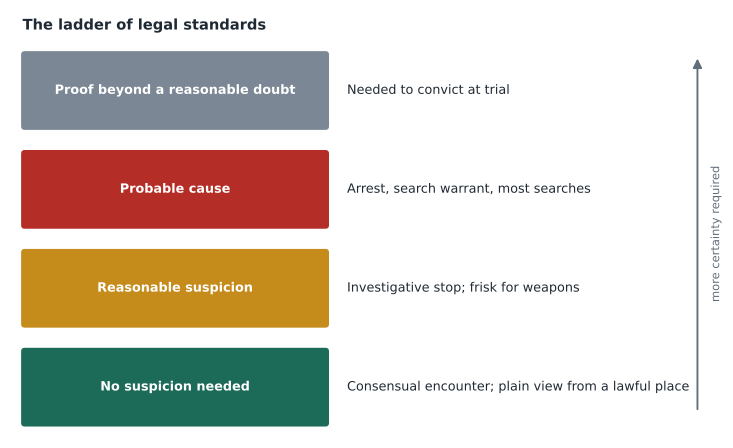
Every power in this course is tied to a standard of grounds: a level of certainty the officer must reach before using it. The standards form a ladder. At the bottom, no grounds are needed to talk to someone who is free to leave. One rung up, reasonable suspicion allows a brief investigative detention. Higher still, probable cause allows an arrest and supports a search warrant. At the top, proof beyond a reasonable doubt is what a court needs to convict. The officer's job is to know which rung each power requires and to be able to show, with facts, that they reached it.
Probable cause
The Supreme Court has repeatedly declined to give probable cause a precise number. In Illinois v. Gates (1983), it described probable cause as a fair probability that contraband or evidence of a crime will be found, judged on the totality of the circumstances. In Maryland v. Pringle (2003), it said probable cause is a practical, nontechnical concept that deals with probabilities, not certainties, and upheld the arrest of all three occupants of a car where drugs were found behind the back-seat armrest and no one claimed them. In District of Columbia v. Wesby (2018), it held that officers may draw reasonable inferences from the circumstances, including the implausibility of suspects' explanations, and that innocent explanations for some facts do not defeat probable cause when the facts are viewed together.
Two features of the standard trip up new officers. The first is that it is assessed on the facts known at the time, not on what was learned later. If an arrest turns out to be of the wrong person, it was still lawful if the grounds were there; if a search turns up evidence, it is still unlawful if the grounds were not there before it began. The second is that the officer's training and experience count, but only if they can be explained. Courts give weight to an officer's experience, but only when the officer can articulate how that experience connects the facts to the conclusion; a bare statement that something was consistent with criminal activity in the officer's experience is not enough.
Reasonable suspicion
In Terry v. Ohio (1968), the Supreme Court allowed a brief stop and frisk based on specific and articulable facts which, taken together with rational inferences, reasonably warrant the intrusion. In United States v. Cortez (1981) and United States v. Arvizu (2002), it emphasized that reasonable suspicion is judged on the whole picture, and that courts should not dismiss each fact separately as innocent when the combination is suspicious. In Illinois v. Wardlow (2000), unprovoked flight on seeing police in a high-crime area supported a stop. In Alabama v. White (1990) and Florida v. J.L. (2000), the Court drew the line on anonymous tips: a tip that predicted future behavior later confirmed by police could support suspicion, but a bare anonymous report that a person at a bus stop had a gun, with nothing more, could not.
Desjardins stresses that suspicion must attach to a person and to a crime. A general sense that something is wrong in a neighborhood, or that a group of young people looks out of place, is not suspicion of anyone in particular. Equally, membership in a racial or ethnic group is never a ground. Using it, even as one factor among many, risks an unlawful detention and a discrimination finding, as the class saw in LES-111 and LES-105. Haddad's audits in Port Ardent check specifically for detentions where the only recorded factors were location, time of night and the person's appearance.
Sources of grounds
Grounds come from several kinds of information, each with its own strengths and risks. The officer's own observations are usually the most reliable, because the officer can describe them in detail and be cross-examined. Information from other officers, dispatch and databases can be relied on, but the officer receiving it must have reason to believe it is reliable, and if the information turns out to be wrong, the grounds may fall with it. Under Gates, courts weigh the informant's veracity, reliability and basis of knowledge as part of the totality of the circumstances, and police corroboration of details can make up for an unknown source. Witness descriptions are powerful but fragile: as the class learned in LES-104, memory fades and can be contaminated.
Desjardins uses the Lakeshore Hardware broadcast to show how grounds build. At 02:22:30 dispatch broadcast Mira Osei's description: a thin man, short dark hair, limping, carrying a black backpack, heading east. That gave every officer in the area the start of grounds about anyone matching it. When Officer Patel saw Kyle Brandt three blocks east at 02:29:15, the match on description, direction, distance and timing gave reasonable suspicion. When the unit 12 officers arrived and saw drill handles in the open backpack, the combination crossed into probable cause. Each step added facts, and each fact was recorded with its time.
Weighing facts: a simple scoring exercise
Courts do not use points systems, and Desjardins is careful to say so. But to help the class think about how independent facts combine, he uses a teaching exercise. Each fact known about a person is given a rough weight according to how strongly it points to involvement in the crime, and how many innocent people would share it. The program adds the weights for the Lakeshore facts at each moment of the night and shows which teaching threshold the total passes. The thresholds are illustrative, not legal tests, and the point of the exercise is the discussion about why some facts weigh more than others.
# Teaching exercise only: courts weigh the totality of the facts, they do not add points.
facts = [
    ("02:22", "matches height and build", 1),
    ("02:22", "short dark hair", 1),
    ("02:22", "limping, as the witness described", 2),
    ("02:29", "black backpack", 1),
    ("02:29", "three blocks east, seven minutes after broadcast", 2),
    ("02:29", "walking away from the scene in the reported direction", 1),
    ("02:30", "drill handles visible in open backpack", 4),
]
SUSPICION, BELIEF = 4, 9      # illustrative teaching thresholds
total = 0
for time, fact, weight in facts:
    total += weight
    level = "grounds to believe" if total >= BELIEF else "suspicion" if total >= SUSPICION else "not yet"
print(f"{time} +{weight} {fact:50} total {total:2} {level}")02:22 +1 matches height and build total 1 not yet 02:22 +1 short dark hair total 2 not yet 02:22 +2 limping, as the witness described total 4 suspicion 02:29 +1 black backpack total 5 suspicion 02:29 +2 three blocks east, seven minutes after broadcast total 7 suspicion 02:29 +1 walking away from the scene in the reported direction total 8 suspicion 02:30 +4 drill handles visible in open backpack total 12 grounds to believe
The class argues about the weights, which is the purpose of the exercise. Marco DiSanto thinks the limp deserves more weight, because few people walking at that hour limp. Priya Sandhu thinks the backpack deserves less, because many people carry one. Everyone agrees that the drill handles change the picture dramatically: they connect the man not just to the description but to the crime itself. Desjardins points out that a judge would make the same kind of judgment, only in words rather than numbers, and that the officer's notes are what allow the judge to do it.
Articulation: explaining the grounds
Articulation is the officer's ability to explain, in plain language, what they saw, what they knew and why it led to their decision. It happens three times: in the moment, when the officer tells the person why they are being stopped or arrested; in the notes and report, written as soon as practical; and in court, often a year later. A good articulation lists the facts, explains any that need context, and connects them to the standard. It avoids jargon, avoids conclusions presented as facts, and avoids adding facts learned later. Desjardins plays two recordings of officers explaining the same arrest on the witness stand. The first says the suspect was acting suspiciously and fit the profile. The second lists six observations and the time of each. The class has no trouble telling which officer the judge believed.
He gives the class a template they will use throughout the course: what was I doing and why was I there; what did I see, hear and know, with times; what did those facts mean to me, based on what training or experience; what standard did I believe I had reached; and what did I do as a result. In court, an officer may refresh memory from notes and reports, as LES-104 explained, so the template is most useful when it is followed in the report written that night.
When grounds disappear
Grounds are not permanent. If new information undermines the facts an officer relied on, the grounds may vanish, and continuing the detention or arrest becomes unlawful. If Brandt had turned out to be carrying gardening tools rather than drills, and a quick check showed that the burglar had been caught elsewhere, the officers would have had to release him at once. Desjardins describes a case from his career where a robbery suspect matched a description perfectly, until a store video arrived ten minutes later showing a different man. The officers released him with an apology and an explanation. Holding him longer while they looked for some other reason would have been an unreasonable seizure.
Worked problem
Did the officer have reasonable suspicion?
At 11:40 p.m., an officer receives an anonymous call through dispatch reporting that a man in a red jacket outside a convenience store on King Street has a gun in his waistband. The caller gives no name and hangs up. The officer arrives two minutes later and sees a man in a red jacket standing outside the store. He is talking on his phone, there is no visible bulge, and he does nothing unusual. Can the officer detain him?
Show solution
- List the facts: an anonymous report, a matching red jacket, the matching location and time.
- Apply Florida v. J.L.: a bare anonymous tip that a person at a location has a gun, with only innocent details confirmed, does not provide reasonable suspicion.
- Consider what more the officer could do: observe, approach and speak with the man without detaining him, ask the store staff what they saw, and look for facts that would add to or remove suspicion.
- Consider safety: the officer can position themselves safely and call for backup, and if new facts appear, such as a visible weapon or a furtive movement toward the waistband, the picture changes.
- Record the facts and the decision, including why no detention was made at that point.
Answer: On these facts alone, the officer lacks reasonable suspicion under J.L.; they may conduct a consensual encounter and investigate further, and stop the man only if new facts give grounds.
Common mistakes
MistakeEach fact must be suspicious on its own.
InsteadCourts look at the totality; facts that are innocent alone can together give grounds.
MistakeAn arrest is lawful if evidence is found afterward.
InsteadGrounds are judged on what the officer knew before acting; evidence found later cannot justify an unlawful step.
MistakeMy experience tells me he is guilty, so I have grounds.
InsteadExperience counts only when it is explained and connected to specific facts.
MistakeOnce grounds exist, they last until the case is over.
InsteadNew information can remove grounds, and the person must then be released.
Summary and key terms
- Probable cause is a fair probability judged on the totality of the circumstances (Gates, Pringle, Wesby).
- Reasonable suspicion requires specific and articulable facts and rational inferences (Terry, Arvizu).
- Grounds are judged on facts known at the time and must attach to a person and a crime, never to group membership.
- Tips are weighed for veracity, reliability and basis of knowledge; bare anonymous tips are not enough (J.L.).
- Articulation turns facts into a reasoned explanation in the moment, in the notes and in court.
- Grounds can disappear, and the person must then be released.
- Probable cause
- A fair probability, judged on the totality of the circumstances; the standard for arrest and warrants.
- Reasonable suspicion
- Specific and articulable facts suggesting criminal activity; the standard for a Terry stop.
- Totality of the circumstances
- Assessing all the facts together rather than each fact on its own.
- Articulation
- Explaining in plain language the facts and reasoning behind a decision.
- Corroboration
- Independent confirmation of details in a tip or statement.
- Basis of knowledge
- How an informant came to know the information they gave.
Practice problems
Work each problem on paper first, then reveal the answer to check.
How did Illinois v. Gates describe probable cause?
Show answer
A fair probability that contraband or evidence of a crime will be found, judged on the totality of the circumstances.
Why is a bare anonymous tip usually not enough?
Show answer
Its source cannot be assessed and corroboration of innocent details does not show the caller knew about the crime.
In the teaching exercise, at which fact did the total first reach the suspicion threshold of 4?
Show answer
At the limp: 1 + 1 + 2 = 4.
Name three of the five parts of the articulation template.
Show answer
Why I was there; what I saw, heard and knew with times; what the facts meant to me; what standard I reached; what I did.
Lesson quiz · 5 questions
Score 60% or more to complete this lesson.
Create a free account to save your progress, take quizzes and earn a certificate.