
LES-112 · Lesson 4 of 12 · 19 min
Arrest warrants and making a lawful arrest
▶ Video coming soon A video version of this lesson is on the way.
Two weeks after the Lakeshore Hardware break-in, Port Ardent detectives connected Kyle Brandt to an earlier break-in at a bicycle shop. By then he had been released, and he did not answer when officers called. Desjardins uses the case to show the other half of arrest powers: the arrest warrant. Where an officer lacks grounds or authority to arrest without a warrant, or where the suspect cannot be found, the officer files a complaint and asks a judge or magistrate to issue an arrest warrant or a summons. A warrant transfers the decision from the officer to a judicial officer, and gives every officer who finds the person the authority to arrest them.
Complaints, summonses and warrants
Under Criminal Rule 4, a judge, magistrate or clerk issues a warrant or summons when a complaint, and any supporting affidavits, establish probable cause that an offense was committed and that the defendant committed it. A summons must be issued instead of a warrant unless the complaint is for a felony, or there is reason to believe the defendant will not appear, or the prosecutor requests a warrant. The warrant must be signed, describe the offense, name or describe the defendant, and command that the defendant be arrested and brought before the court without unnecessary delay. A grand jury indictment is another route, after which a warrant or summons is issued on the indictment. Ohio warrants are entered in the state and national databases so they can be found during any police contact.
Warrants are not just for absent suspects. They also allow officers to compel attendance when an accused fails to appear in court, when a person breaches release conditions, and when a court orders a person committed to custody after sentence. Bench warrants issued by courts when a defendant fails to appear, or capias warrants, are among the most common warrants officers encounter. Desjardins notes that a large share of warrant arrests in Port Ardent are for missed court dates, and that a phone call and a new date often solve the problem without an arrest when the service has a warrant resolution program.
Executing a warrant: confirming identity and validity
The warrant gives the authority, but the officer still has duties. First, they must confirm that the person in front of them is the person named. Mistaken identity on warrants is one of the most common causes of wrongful detentions: two people with the same name and similar dates of birth, an alias, a wrong address in the database. Officers should compare the description, date of birth, photographs and identifying marks, and confirm the warrant is still active with the issuing agency or records unit before relying on it. In Herring v. United States (2009), the Supreme Court held that evidence found during an arrest on a warrant that had been recalled, because of negligent record-keeping by another agency, need not be suppressed; but in Arizona v. Evans and later cases the Court made clear that the exclusionary rule still applies to deliberate, reckless or systemic errors, and civil liability can follow an arrest where obvious differences were ignored.
Second, the officer should know what the warrant actually authorizes. A warrant to arrest is not a warrant to search a house, and a warrant from another jurisdiction may need extra steps before it can be executed. Desjardins shows the class a warrant record from Port Ardent's system and walks through each field: the issuing court, the offense, the type of warrant, the date issued, any endorsements, whether it is a extraditable warrant, and the instructions for release.
# Checking a person against a warrant record before arrest
warrant = {"name": "Kyle Brandt", "dob": "2002-09-17", "height_cm": 173,
           "marks": {"scar right eyebrow"}, "status": "active"}
person = {"name": "Kyle Brandt", "dob": "2002-09-17", "height_cm": 175,
          "marks": {"scar right eyebrow", "tattoo left wrist"}}
checks = {
    "name matches": warrant["name"] == person["name"],
    "date of birth matches": warrant["dob"] == person["dob"],
    "height within 5 cm": abs(warrant["height_cm"] - person["height_cm"]) <= 5,
    "recorded marks present": warrant["marks"] <= person["marks"],
    "warrant still active": warrant["status"] == "active",
}
for name, ok in checks.items():
    print(f"{name:24} {'yes' if ok else 'NO'}")
print("confirmed:", all(checks.values()))name matches yes date of birth matches yes height within 5 cm yes recorded marks present yes warrant still active yes confirmed: True
All five checks pass. The extra tattoo is not a problem, because a warrant record lists marks known when it was created, and people acquire new ones. A different date of birth or a missing scar would be a reason to stop and check further before arresting. Desjardins tells the class that the five minutes spent confirming identity is the best investment an officer can make on a warrant call.
Entering a home to arrest: Payton and Steagald
In Payton v. New York (1980), the Supreme Court held that the Fourth Amendment forbids police from making a warrantless, nonconsensual entry into a suspect's home to make a routine felony arrest; an arrest warrant founded on probable cause carries with it the limited authority to enter the suspect's home when there is reason to believe the suspect is inside. In Steagald v. United States (1981), it held that to enter a third party's home to look for a suspect, officers need a search warrant for that home, because the arrest warrant protects only the suspect's interests, not the homeowner's. Exigent circumstances, such as hot pursuit or an imminent threat, can justify entry without a warrant, as Lesson 10 explains. Revised Code 2935.12 requires officers executing an arrest or search warrant to give notice of their intention and purpose before breaking down a door, unless an exception applies.
The practical effect is that an officer who knows a suspect is at home and has grounds to arrest usually cannot simply walk in. They can ask the person to come out, wait for them to leave, obtain consent to enter, or apply for the right warrant. Desjardins describes a stand-off from his career where officers surrounded a house for four hours while a detective drafted a warrant; the suspect walked out to buy cigarettes before it was signed and was arrested on the sidewalk without incident.
Making the arrest: the practical steps
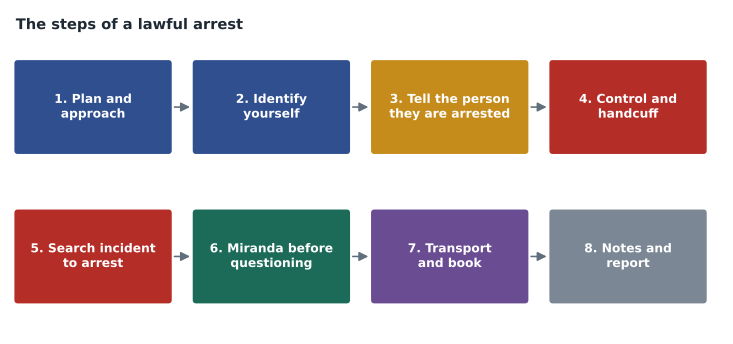
Desjardins walks the class through the steps of an arrest as they will be taught in the academy, emphasizing the legal duty attached to each. Planning comes first: where possible, officers decide in advance who will speak, who will control the person, where the arrest will happen and what the risks are, including weapons, other people present and escape routes. Officers identify themselves as police unless they are obviously in uniform. They then tell the person clearly that they are under arrest and why. Control and handcuffing follow, using only the force reasonably necessary, which LES-204 covers in depth; handcuffing is not automatic and should be justified by the risk, though most services require it for prisoners being transported.
Revised Code 2935.07 requires an officer arresting without a warrant to inform the person of the cause of the arrest, unless the person is taken in the commission of the offense or while fleeing. Under Revised Code 2935.10 and Criminal Rule 4, an officer executing a warrant need not have it in hand, but must inform the person of the offense and that a warrant has been issued, and must show the warrant on request as soon as possible. Miranda warnings are required before custodial interrogation, not at the moment of arrest, as LES-111 explained, but many departments give them at arrest as a matter of practice.
The search incident to arrest follows, which Lesson 7 covers in detail. Transport and booking come next: the person is placed in a cruiser, ideally with a camera recording, and taken to the station or court. Throughout, the officer is responsible for the person's safety. People in custody can be injured, intoxicated, suicidal or ill, and the officer who made the arrest is the first person who can notice. Finally, the officer records every step with times, as Lesson 3 described.
Arrests of youths and vulnerable people
Arrests of young people follow additional rules. Under Ohio law and juvenile court rules, an officer who takes a child into custody must notify a parent, guardian or custodian, and Revised Code 2151.31 lists the grounds for taking a child into custody. Courts examine juvenile waivers of Miranda rights with special care, considering the child's age, experience and understanding, as J.D.B. v. North Carolina (2011) emphasized when it held that a child's age is relevant to whether they are in custody. People with mental health conditions, intellectual disabilities or language barriers may not understand what is happening; the officer's duty to inform and to give rights in a way the person understands applies to them too.
Warrant resolution and voluntary surrender
Not every warrant needs to be executed at the front door at dawn. Many people with outstanding warrants, especially for missed court dates, have simply moved, forgotten or been afraid to call. Port Ardent runs a warrant resolution program with the local court: people can call to arrange a new court date or surrender at a set time, often at the courthouse rather than the police station, with a lawyer present if they wish. Desjardins describes the effect: in the program's first year, several hundred warrants were resolved without a single forced entry or roadside arrest, and the number of people who missed their new court date was lower than among those arrested on the street.
When a person with a serious warrant wants to surrender through a lawyer, officers should arrange it rather than rush to arrest. A planned surrender removes the risk of a confrontation, gives the person a chance to arrange child care and work, and usually produces a calmer interview if the person chooses to speak. Detectives in the Lakeshore case used this approach for the bicycle shop warrant: once Brandt's lawyer called, they agreed on a time, and he walked into the station with her the next morning.
Officers should still verify the warrant on the day, because warrants are sometimes canceled by a court in the meantime. And they should record the arrangement and the time of the surrender, so that any later question about delay can be answered. Desjardins tells the class that the best measure of an officer's skill with warrants is not how many arrests they make, but how many warrants they resolve safely.
Worked problem
Executing a warrant at a third party's home
Detectives have an arrest warrant for Kyle Brandt for the bicycle shop break-in. A neighbor tells them Brandt is staying at his friend Nolan's apartment. The detectives want to go there and arrest him. What do they need?
Show solution
- Recognize that Nolan's apartment is a third party's home, so under Steagald the arrest warrant alone does not authorize entry.
- Options: wait for Brandt to come out; knock and ask Nolan for consent to enter; or obtain a search warrant for Nolan's apartment, which requires probable cause that Brandt is inside.
- If Brandt comes to the door and steps outside, he can be arrested on the warrant in a public place.
- If entry is authorized, announce presence and purpose before entering unless the authorization or the circumstances allow otherwise.
- Confirm identity and that the warrant is still active before making the arrest, and record each step.
Answer: The detectives need Nolan's consent, a search warrant for the apartment, or exigent circumstances; otherwise they should arrest Brandt when he leaves.
Common mistakes
MistakeA database hit is all an officer needs to arrest.
InsteadConfirm identity and that the warrant is still active; ignoring obvious differences can make the arrest unlawful.
MistakeAn arrest warrant lets officers enter any home to find the person.
InsteadAn arrest warrant allows entry only into the suspect's own home with reason to believe they are inside; a third party's home needs a search warrant (Steagald).
MistakeHandcuffing is required for every arrest.
InsteadHandcuffing must be justified by risk, though most policies require it for transport.
MistakeTelling the person why can wait until the station.
InsteadRevised Code 2935.07 requires informing the person of the cause of the arrest, and doing so promptly builds cooperation.
Summary and key terms
- Complaints under Criminal Rule 4 lead to a warrant or summons; summonses are preferred for misdemeanors unless there is reason to believe the person will not appear.
- Before executing a warrant, confirm identity and that it is still active.
- Entry into a home to arrest needs a warrant (Payton), and a third party's home needs a search warrant (Steagald), unless exigent circumstances exist.
- The arrest steps are planning, identifying, informing, controlling, searching, rights, transport and records.
- Revised Code 2935.07 and 2935.10 set duties to inform of the cause and the warrant; Miranda applies before custodial interrogation.
- Youths and vulnerable people are entitled to rights explained in a way they understand.
- Complaint
- A sworn written statement of the facts of an offense, filed with a court.
- Summons
- An order to appear in court, served without arrest.
- Arrest warrant
- A judicial order directing officers to arrest a person and bring them before the court.
- Bench warrant
- A warrant issued by a court when a defendant fails to appear.
- Payton rule
- Entry into a suspect's home to arrest requires an arrest warrant and reason to believe the suspect is inside.
- Knock and announce
- Giving notice of identity and purpose before forcing entry.
Practice problems
Work each problem on paper first, then reveal the answer to check.
When does Criminal Rule 4 prefer a summons to a warrant?
Show answer
Unless the offense is a felony, there is reason to believe the defendant will not appear, or the prosecutor asks for a warrant.
What five checks did the code example run before arrest?
Show answer
Name, date of birth, height within 5 cm, recorded marks present, and warrant still active.
What did Steagald v. United States decide?
Show answer
Officers need a search warrant to enter a third party's home to look for a suspect named in an arrest warrant.
Why confirm a warrant is still active?
Show answer
Warrants are executed, recalled or entered in error; arresting on a dead warrant can be an unlawful detention.
Lesson quiz · 5 questions
Score 60% or more to complete this lesson.
Create a free account to save your progress, take quizzes and earn a certificate.