
LES-112 · Lesson 7 of 12 · 19 min
Search incident to arrest
▶ Video coming soon A video version of this lesson is on the way.
At 02:29:40 on March 14, Constable Malhotra's partner handcuffed Kyle Brandt on Pine Street and, within a minute, searched him. She patted down his clothing, emptied his pockets onto the hood of the cruiser, opened the backpack fully and photographed its contents: three cordless drills, a reciprocating saw, a pair of gloves, a flashlight and a phone. No warrant was needed for any of it. Desjardins asks the class why. The answer is the most commonly used search power in policing: search incident to arrest. It is so routine that officers sometimes forget it has limits, and the limits are where cases are won and lost.
The common law power: Cloutier and Caslake
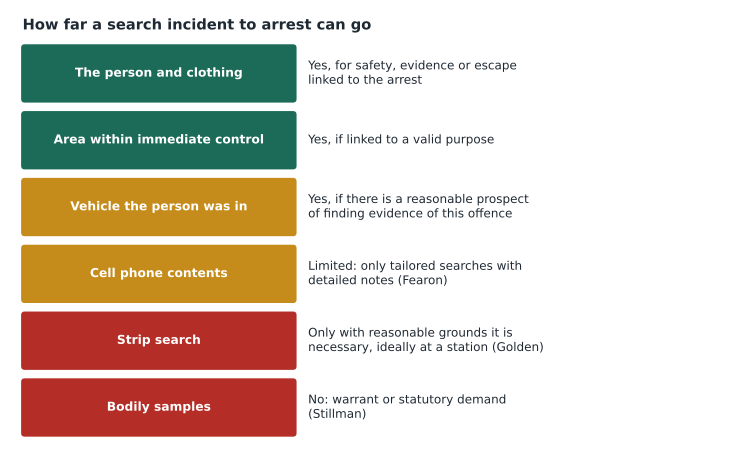
Search incident to arrest is a common law power. In Cloutier v. Langlois (1990), the Supreme Court held that police may search a lawfully arrested person and the area within their immediate control without a warrant, for purposes such as ensuring the safety of the police and the public, preventing escape, and preserving or discovering evidence of the offence. The search must be for a valid objective connected to the arrest and must not be conducted abusively. In R. v. Caslake (1998), the Court added two requirements: the arrest must be lawful, and the search must be truly incidental to it, meaning the officer must have been searching for a purpose related to the arrest, that purpose must be reasonable, and the officer must be able to explain it. In Caslake itself, an officer searched a car six hours after the arrest for what he called inventory purposes; the Court held the search was not incidental to the arrest because the officer was not looking for evidence or for safety reasons connected to it.
The difference matters. In Canada, every search incident to arrest needs a purpose the officer can explain. An officer who says 'I always search everyone I arrest' has described a habit, not a purpose, and a court may find the search unreasonable even though the arrest was lawful. The purpose need not be a strong belief that something will be found; Caslake requires only that the purpose be reasonable, and the standard is lower than reasonable grounds. Either way, the search depends entirely on the arrest being lawful. If the arrest falls, so does the search.
Timing and place
A search incident to arrest normally happens at the time and place of the arrest. Courts allow some flexibility: a search of the person may be delayed a short time for safety reasons, for instance until the person is in a better-lit place or more officers arrive, or repeated at the station. Caslake accepted that a search need not be immediately contemporaneous, but the longer the delay, the harder it is to show the search was truly incidental to the arrest. Desjardins describes a case where officers returned to a house the day after an arrest to search the bedroom where the man had been arrested. The search was not incidental to anything by then, and the evidence was excluded.
Searching the person
The basic search of the person after arrest is thorough: pockets, waistband, shoes, bags carried, and anything that could hide a weapon, a means of escape or evidence. Officers should search in a consistent pattern, wear gloves, and be careful of sharp objects. Items removed should be bagged, labelled and recorded, and any evidence photographed where it was found. Searches should be done by an officer of the same gender where practicable, and in any case with respect for the person's dignity. Searches of transgender and non-binary people should follow the service's policy, which in many services lets the person state a preference about the gender of the searching officer.
Desjardins stresses the safety purpose. More officers are hurt by weapons missed in a search than by any other kind of prisoner incident he knows of. He tells the story of a prisoner who was searched on the street, then again at the station, and a third time when a jail officer found a razor blade taped inside his belt. 'Search as if your life depends on it,' he says, 'because sometimes it does. And search as if a judge is watching, because sometimes one will.'
Strip searches and bodily samples
A strip search is far more intrusive than a frisk or a search of pockets, and the Supreme Court set strict limits in R. v. Golden (2001). A strip search incident to arrest is lawful only if the arrest is lawful, the search is related to the reasons for the arrest, and the officer has reasonable and probable grounds to believe the strip search is necessary in the particular circumstances, for instance because the person may be concealing weapons or evidence on their body. Strip searches should generally be done at a police station, by officers of the same gender, in private, with as little exposure as possible, with supervisor authorization, and with a record of the reasons and the manner. Routine strip searches of everyone held in cells, regardless of the reason for the arrest, are unreasonable. Searches of body cavities need a warrant or medical involvement. Bodily samples such as hair, saliva or blood cannot be taken as a search incident to arrest: in R. v. Stillman (1997), the Court excluded hair samples and dental impressions taken without consent or a warrant, and DNA must be obtained by warrant under section 487.05 or by consent. In R. v. Saeed (2016), the Court allowed a penile swab incident to arrest in a sexual assault investigation, but only with reasonable grounds and in a manner that respected the person's dignity.
Port Ardent's cells unit keeps a log of every strip search, and Haddad reviews it every month. The program below summarizes the log for one quarter and checks each of the safeguards the service's policy requires.
# Port Ardent strip search log, one quarter (one record per search)
log = [
    # (grounds recorded, supervisor approved, private room, same-gender officer, items found)
    (True, True, True, True, True), (True, True, True, True, False), (True, True, True, True, False),
    (True, True, True, False, False), (False, True, True, True, False), (True, True, True, True, True),
    (True, False, True, True, False), (True, True, True, True, False), (True, True, True, True, False),
    (True, True, False, True, False), (True, True, True, True, True), (True, True, True, True, False),
]
names = ["grounds recorded", "supervisor approved", "private room", "same-gender officer"]
n = len(log)
print("strip searches:", n)
for i, name in enumerate(names):
    ok = sum(1 for r in log if r[i])
    print(f"{name:22} {ok}/{n}")
fully = sum(1 for r in log if all(r[:4]))
found = sum(1 for r in log if r[4])
print("all four safeguards met:", fully, "of", n)
print("items found:", found, "of", n)strip searches: 12 grounds recorded 11/12 supervisor approved 11/12 private room 11/12 same-gender officer 11/12 all four safeguards met: 8 of 12 items found: 3 of 12
Eight of the twelve searches met every safeguard. The other four each missed one: no grounds recorded, no supervisor approval, no private room, or no same-gender officer. Items were found in three of twelve searches, which Haddad notes is a reminder that most strip searches find nothing, and therefore that each one must be genuinely necessary. Her coaching goes to the officers involved in the four incomplete records, and the result goes into the service's annual report to the police service board.
Phones: R. v. Fearon
In R. v. Fearon (2014), a narrow majority of the Supreme Court held that police may search a cell phone incident to arrest, but only under strict conditions: the arrest must be lawful; the search must be truly incidental to the arrest, for a valid law enforcement purpose such as protecting police or the public, preserving evidence, or discovering evidence, including locating additional suspects, where the investigation would be stymied or significantly hampered without the ability to promptly search; the nature and extent of the search must be tailored to the purpose, which in practice means only recently sent or drafted emails, texts, photos and the call log may generally be examined; and the police must take detailed notes of what they examined and how. A general rummage through a phone is not allowed, and in most cases officers should seize the phone, secure it and get a warrant.
Malhotra's partner did exactly what Desjardins recommends. She photographed the phone where it was found, did not open it, placed it in a signal-blocking bag, recorded the time, and handed it to the detectives, who later obtained a warrant to examine it. Desjardins tells the class that this approach is almost never wrong, and that an officer who browses a phone at the roadside, even in Canada under Fearon's conditions, takes a risk with the whole case.
Vehicles after an arrest
Caslake applies to vehicles: police may search a vehicle incident to an arrest if the search is for a purpose related to the arrest, such as finding evidence of the offence or ensuring safety. An arrest for an unpaid traffic fine will rarely justify a search of the car for evidence, because there is no evidence of that offence to find; an arrest for a robbery committed minutes earlier often will. Lesson 9 covers vehicle searches in more detail.
Searching people in custody at the station
After arrest, a person is usually searched again when they arrive at the station, before they are placed in a cell. This search has a different purpose from the roadside search: protecting the person, other prisoners and the staff, and keeping a record of the person's property. Items such as belts, shoelaces, jewellery, phones, money and medication are removed, listed on a property form, sealed and stored until release. The person should see the list and be asked to sign it. Port Ardent's booking room has a camera that records the search and the property count, a practice the service adopted after a complaint about missing cash several years ago.
Medication raises special care. A person who needs medication for diabetes, a heart condition or a mental health condition should not be left without it because it was taken at booking. The cells policy requires the booking officer to ask about medical needs and to arrange for a nurse or doctor to assess any medication. Desjardins tells the class that the officers who take this seriously are not being soft; they are preventing medical emergencies in their own cells.
Officers should also remember that the station search is not a second chance to look for evidence that the roadside search missed for lack of authority. If a roadside search was limited, for example because the officer had no reason to look beyond a pat-down, the station search can protect safety and inventory property, but it does not create authority to examine phone contents or read private papers for evidence. That still needs a warrant.
Worked problem
Was the backpack search lawful?
Kyle Brandt was arrested at 02:29:40 for the Lakeshore Hardware break-in. The backpack was on his back. The officer removed it, opened it and found the drills, saw, gloves and flashlight. Was the search lawful, and what made it so?
Show solution
- Check the arrest: it was supported by grounds, as Lesson 2 showed, so it was lawful.
- Check the purpose: the officer was looking for evidence of the break-in, stolen property and tools, and for weapons; both purposes are directly related to the arrest and reasonable.
- Check the timing and place: the search happened at the scene, within a minute of the arrest.
- Check the manner: the officer photographed the contents in place and recorded each item.
- Separate the phone: the backpack search did not extend to the phone's contents, which were left for a warrant.
Answer: The search was lawful: the arrest was lawful, the search was truly incidental to it for reasonable purposes, and it was done promptly and properly.
Common mistakes
MistakeA lawful arrest allows any search the officer wants.
InsteadThe search must be truly incidental to the arrest, for a purpose the officer can explain (Caslake).
MistakeStrip searches are routine for anyone held in cells.
InsteadGolden requires reasonable grounds that a strip search is necessary in the particular case.
MistakeLooking through a phone at the roadside is harmless.
InsteadFearon allows only narrow, tailored searches with detailed notes; seizing and getting a warrant is safer.
MistakeA search can be done hours later as long as the person was arrested.
InsteadThe longer the delay, the harder it is to show the search was incidental to the arrest.
Summary and key terms
- Search incident to arrest requires a lawful arrest and a search truly incidental to it, for a reasonable purpose (Cloutier, Caslake).
- Searches should be prompt, systematic, recorded and respectful of dignity.
- Strip searches need reasonable grounds of necessity and safeguards (Golden); bodily samples need a warrant or statutory power (Stillman).
- Phone searches incident to arrest are narrow and must be tailored and recorded (Fearon).
- Vehicle searches incident to arrest must relate to the arrest (Caslake).
- When in doubt, seize, secure and apply for a warrant.
- Search incident to arrest
- A warrantless search of an arrested person and their surroundings for purposes related to the arrest.
- Truly incidental
- Conducted for a purpose connected to the arrest that the officer can explain.
- Strip search
- Removing or rearranging clothing to inspect private areas, regulated by Golden.
- Tailored search
- A phone search limited to the data connected to the purpose, as Fearon requires.
- Signal-blocking bag
- A bag that prevents a seized phone from connecting to a network.
- Bodily sample
- Hair, saliva, blood or similar material, obtainable only by warrant, statute or consent.
Practice problems
Work each problem on paper first, then reveal the answer to check.
What did Caslake add to Cloutier?
Show answer
The arrest must be lawful and the search truly incidental to it, for a reasonable purpose the officer can explain.
In the strip search log, how many searches met all four safeguards?
Show answer
8 of 12.
What conditions did Fearon set for phone searches?
Show answer
Lawful arrest, truly incidental purpose, a search tailored to that purpose, and detailed notes.
Why can a search incident to arrest not be done the next day at the place of arrest?
Show answer
By then it is no longer incidental to the arrest; the reason for it has passed.
Lesson quiz · 5 questions
Score 60% or more to complete this lesson.
Create a free account to save your progress, take quizzes and earn a certificate.