
LES-112 · Lesson 12 of 12 · 19 min
Capstone: a powers review of the Lakeshore Hardware case
▶ Video coming soon A video version of this lesson is on the way.
For the capstone, Desjardins gives each student the complete Lakeshore Hardware file: the call log, the broadcast, body-worn camera summaries, the notes of every officer, the arrest report, the property reports, the phone seizure record, the information to obtain and warrant for the Birch Lane garage, the warrant report, the release record and the prosecutor brief. Their task is to write a powers review: for every use of a police power in the file, identify the power, its source, the grounds required, the facts that supplied them, and whether the power was used lawfully. 'This is what a good supervisor does before a file goes to the prosecutor,' he says, 'and what defense counsel will do the day it arrives on their desk. Better that you find the problems first.'
The method
Desjardins gives the class a five-part method for each step. First, describe the step in one sentence with its time: what the officer did. Second, name the power and its source: the statute, rule or case that authorized it. Third, state the standard: no grounds, reasonable suspicion, probable cause, a warrant or a specific condition. Fourth, list the facts in the file that met or failed to meet the standard, with their times and sources. Fifth, give a rating: lawful, needs explanation, or problem, and say what the consequence of any problem would be. He tells them to be fair to the officers, who were making decisions at two in the morning, and honest about the law, which does not grade on a curve.
Amara Okafor asks whether a powers review is the same as the constitutional review the class did at the end of LES-111. Desjardins says they overlap but differ in focus: the LES-111 review asked whether rights were respected, while this one asks whether each power was properly founded and properly used. A search can be done respectfully but without authority, or with authority but beyond its scope. The two reviews together give the fullest picture of a file.
Step 1: the broadcast and the stop
At 02:22:30 dispatch broadcast Mira Osei's description. At 02:29:15 Officer Patel saw Kyle Brandt on Pine Street, three blocks east of the store, matching the description and walking away from the scene in the reported direction with a black backpack, and told him to stop because of a break-in. The power was a Terry stop, which needs reasonable suspicion based on specific and articulable facts. The facts, as Lesson 2 showed, were specific, fresh and connected to the crime: description, limp, backpack, distance, direction and timing. Patel told Brandt the reason at once. Rating: lawful.
Step 2: the arrest
At 02:29:40, when the unit 12 officers arrived and saw drill handles sticking out of the open backpack, they arrested Brandt for breaking and entering. The power was Revised Code 2935.03, which allows a warrantless arrest on reasonable ground to believe a felony was committed and the person committed it; breaking and entering under Revised Code 2911.13 is a felony. The added fact of tools visible in the bag, together with everything Patel already knew, crossed into probable cause. The officers told Brandt why he was arrested. Rating: lawful.
Step 3: the backpack search
Within a minute of the arrest, the officer removed and searched the backpack, finding the drills, the saw, gloves, a flashlight and a phone. The power was search incident to arrest under Chimel and Robinson. The arrest was lawful and custodial, and the backpack on Brandt's back was part of his person or within his immediate control. The contents were photographed in place and recorded. Rating: lawful.
Step 4: the phone
The phone was seized from the backpack. The officer did not open it, placed it in a signal-blocking bag and handed it to investigators, who later obtained a warrant to examine it. The seizure itself was lawful as part of the search incident to arrest, and the decision not to search its contents without a warrant was correct. But the property record shows the phone was bagged at 02:31 and not logged into the property room until 06:40, and the officer's notes do not say where it was between 03:15, when she left the station for another call, and 06:40. A defense lawyer could use that gap to question whether the phone was handled properly, which matters because its location data supported the garage warrant. Rating: needs explanation. The fix is a supplementary note from the officer about where the phone was, which she can make honestly if she remembers, and a reminder at the next briefing about logging exhibits before leaving the station.
Step 5: the look into the garage
On the morning of March 14, before any warrant was drafted, a patrol officer opened the unlocked side door of Brandt's rented garage on Birch Lane and looked inside with a flashlight, seeing boxes with a hardware store logo. As Lesson 10 explained, Brandt had a reasonable expectation of privacy in the garage, opening the door to look in was a search, and no warrant, consent or exigency applied: the garage could easily have been watched from the street. Rating: problem. The observation must be excluded from the probable cause analysis, and the warrant must stand on independent facts; the officer's conduct could also support a civil claim. The case does not collapse, because of what Detective Sergeant Ali did next.
Step 6: the warrant application
Ali's affidavit disclosed the garage observation, explained that the officer had acted without authority, and did not rely on it. It rested on three independent grounds: the neighbor's statement about boxes being carried in two days before the break-in, the lease found in Brandt's wallet, and the phone location data placing Brandt in the area of the garage at 02:20, obtained under a separate court order. It disclosed the neighbor's old conviction, the limits of the location data and Brandt's denial. It described the garage and the missing items precisely. Under Murray v. United States and Franks, a reviewing court would set aside the improper observation and ask whether the remaining facts established probable cause; they did. The warrant was executed in daylight within its period, and the items were reported to the court. Rating: lawful.
Step 7: the release decision
Brandt was released within hours on terms tied to the risks: release on his own recognizance with a stay-away condition for the store. His identity was confirmed, the evidence secured, he had ties to the community, and the conditions were minimal and practicable. Rating: lawful.
Step 8: notes and times
Most of the notes in the file are detailed and timed. But two problems carried over from earlier lessons remain. The probationary officer's detention note at 02:31 was out of order and corrected later with a late entry, as LES-104 discussed; the late entry was properly marked, but it will draw questions. And the record of the cruiser conversation before Miranda warnings at 02:37 is thin, and while Brandt's remark was unprompted, the notes should show that no one asked him questions before the warnings. Rating: needs explanation.
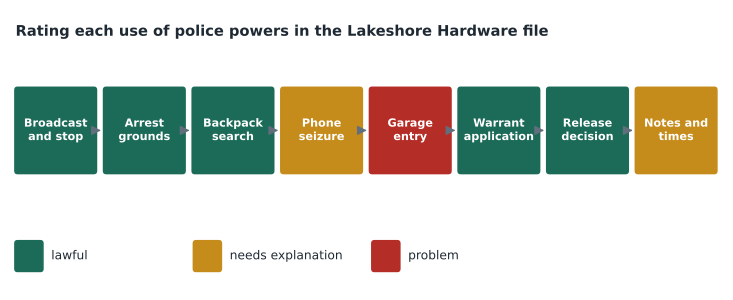
Scoring the file
Desjardins asks the class to score each step: two points for lawful, one for needs explanation, zero for a problem. The scores are a teaching tool, not a legal test, but they make the shape of the file clear at a glance.
# Powers review of the Lakeshore Hardware file: 2 lawful, 1 needs explanation, 0 problem
steps = [("broadcast and stop", 2), ("arrest grounds", 2), ("backpack search", 2),
         ("phone seizure", 1), ("garage entry", 0), ("warrant application", 2),
         ("release decision", 2), ("notes and times", 1)]
labels = {2: "lawful", 1: "needs explanation", 0: "problem"}
for name, s in steps:
    print(f"{name:20} {labels[s]}")
score = sum(s for _, s in steps)
print("score:", score, "of", 2 * len(steps))
print("steps needing follow-up:", [n for n, s in steps if s < 2])broadcast and stop lawful arrest grounds lawful backpack search lawful phone seizure needs explanation garage entry problem warrant application lawful release decision lawful notes and times needs explanation score: 12 of 16 steps needing follow-up: ['phone seizure', 'garage entry', 'notes and times']
The file scores 12 of 16. Five of eight steps are clean, two need explanation, and one is a clear problem. Desjardins tells the class that this is a realistic file: most real cases have a few soft spots, and the difference between a case that survives and one that does not is often whether someone found them early and dealt with them honestly. The garage entry was a real breach, but Ali's full disclosure meant the warrant could stand. Had he hidden it, the case might have collapsed when it came out in cross-examination.
What the prosecutor said
The prosecutor assigned to the case reviewed the file the week after the break-in. She accepted the charges, asked for a supplementary note about the phone's custody, flagged the garage entry for disclosure to the defense, and asked the service to address it with the officer involved, which the service did through coaching and a training bulletin on private places. She also asked for a fuller note on the cruiser conversation. Brandt later pleaded guilty to the two break-ins, and the garage entry was never litigated. Desjardins tells the class that this is the best outcome a powers review can produce: not a perfect file, but one whose weaknesses were found, disclosed and fixed before they could do harm.
Lessons for practice
The class closes the course by building a list of habits that would have prevented every soft spot in the file. Know which power you are using before you use it. Record the facts that give you grounds, with times, as you learn them. Tell people why at once. Search only within the power's scope, and seize and secure rather than search when a warrant is the normal route. Watch private places from outside while a warrant is obtained. Log exhibits before you leave the station. Disclose your mistakes. And remember that the release decision affects a person's life as much as the arrest. Desjardins says that if they carry these habits into the academy and the street, they will be the officers whose files come back from the prosecutor with no questions.
Presenting the review
Each student presents one step of the review to the class, as if briefing a supervisor. Desjardins gives them three minutes. The best briefings follow the five-part method in order, speak in plain language, and end with a clear recommendation. Jesse Morningstar's briefing on the release decision is singled out: he explains the conditions, why each was tied to a real risk, and what he would have done differently if Brandt had lived with the store owner's family, all in under two minutes.
Worked problem
Writing one entry of the powers review
Write the powers review entry for the backpack search, using the five-part method.
Show solution
- Describe: at 02:30, after Brandt's arrest at 02:29:40, the arresting officer removed his backpack and searched it at the scene, finding three drills, a saw, gloves, a flashlight and a phone.
- Power and source: search incident to arrest under Chimel v. California and United States v. Robinson.
- Standard: a lawful custodial arrest, with the search limited to the person and the area within immediate control.
- Facts: the arrest was lawful and custodial; the backpack was on Brandt's back; the search was done within a minute at the scene and photographed.
- Rating: lawful; the phone's contents were correctly left for a warrant.
Answer: A complete entry names the power and its source, states the standard, lists the facts with times, and gives a rating with reasons; this one is lawful.
Common mistakes
MistakeA powers review only needs to look at the arrest.
InsteadEvery use of a power in the file, from the first stop to the release, needs its own review.
MistakeIf the evidence was found, the step was lawful.
InsteadLawfulness depends on the power and grounds before the step, not on what was found.
MistakeHiding a weak step protects the case.
InsteadDisclosing it, as Ali did, is what lets the rest of the case stand.
MistakeA file with any problem will be thrown out.
InsteadMost files have soft spots; finding and addressing them early is what matters.
Summary and key terms
- A powers review examines every use of a police power in a file: the step, the power and source, the standard, the facts and a rating.
- In the Lakeshore file, the stop, arrest, backpack search, warrant and release were lawful.
- The phone's custody gap and the notes and rights timing need explanation.
- The look into the garage was an unlawful search, but full disclosure in the warrant application meant the warrant stood on independent grounds.
- The file scored 12 of 16, a realistic result for a real case.
- Good habits prevent soft spots: know the power, record grounds and times, explain, stay in scope, secure rather than search, log exhibits and disclose mistakes.
- Powers review
- A step-by-step review of every use of a police power in a file.
- Supplementary report
- An additional, clearly marked report made later to explain or complete the record.
- Independent source
- Evidence or facts obtained without relying on an improper step (Murray).
- Disclosure
- Providing the defense with all relevant information, including weaknesses.
- Property log
- The record of when and where seized property was stored.
- Franks review
- Testing whether a warrant would stand without improper information.
Practice problems
Work each problem on paper first, then reveal the answer to check.
What are the five parts of the powers review method?
Show answer
Describe the step with its time; name the power and source; state the standard; list the facts; give a rating.
In the code example, what was the file's score and which steps needed follow-up?
Show answer
12 of 16; phone seizure, garage entry, and notes and times.
Why did the warrant survive despite the garage entry?
Show answer
Ali disclosed the entry and relied only on independent grounds: the neighbor's statement, the lease and the location data.
What was the problem with the phone?
Show answer
A gap in its documented custody between 03:15 and 06:40, which could be used to question its handling.
Lesson quiz · 5 questions
Score 60% or more to complete this lesson.
Create a free account to save your progress, take quizzes and earn a certificate.