
LES-112 · Lesson 1 of 12 · 19 min
Police powers and the rule of law: where authority comes from
▶ Video coming soon A video version of this lesson is on the way.
Professor Desjardins opens the course by putting a pair of handcuffs on the desk. 'Every one of you will be able to buy a pair of these online for less than the price of a textbook,' he says. 'What you cannot buy is the authority to use them. That comes from the law, and only from the law.' He tells the class that this course is about the moments when a police officer interferes most directly with someone's freedom: stopping them, arresting them, searching them, their car, their phone or their home, and deciding whether they go home or to a cell. In LES-111 the class studied the rights that limit police. Here they study the powers themselves, one at a time, and the practical steps that make each use of a power lawful.
He writes a single sentence on the board: government agents may act only within the authority the law gives them, while private citizens may do anything the law does not forbid. The rule of law, he explains, turns that sentence into a daily discipline. Before an officer stops, arrests or searches, they should be able to answer three questions: what power am I using, where does it come from, and what facts give me the grounds the power requires? An officer who cannot answer all three is not exercising a police power. They are guessing, and a court will treat the result accordingly.
Why police powers are limited
The class discusses why a free society limits the powers of the people it pays to protect it. Jesse Morningstar points out that his community has a long memory of police powers used without limits, from the enforcement of laws that controlled where First Nations people could live and travel to the removal of children. Linh Tran adds that her cousin Bao, stopped four times in a year while walking home, never understood which power was being used or why. Desjardins agrees that both experiences explain why the law insists on clear powers, clear grounds and clear records. Limits on power are not obstacles to good policing. They are what makes police authority legitimate, and legitimacy is what makes people call the police, give statements and testify.
There is also a practical reason. Evidence obtained by an unlawful arrest or search may be excluded, a lawful charge may collapse, and the officer may face a complaint, discipline or a lawsuit. The exclusionary rule can suppress evidence obtained by an unconstitutional search or seizure, and federal law at 42 USC 1983 allows people to sue officers who violate their constitutional rights, subject to the defense of qualified immunity. Desjardins tells the class that he has watched strong cases fall apart, not because the accused was innocent, but because an officer could not explain which power they used.
Statutes and court rules
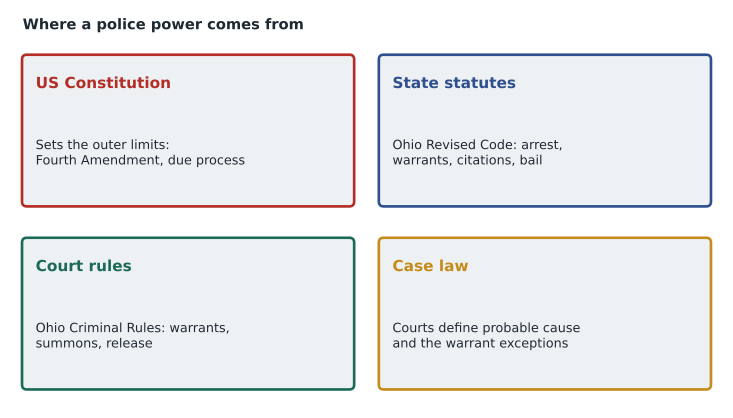
Most police powers in Ohio are written in the Revised Code and the Ohio Rules of Criminal Procedure. Revised Code 2935.03 gives officers the power to arrest without a warrant, 2935.04 allows a private person to arrest for a felony, 2935.26 requires a citation instead of arrest for most minor misdemeanors, and 2933.21 to 2933.26 govern search warrants. Criminal Rule 4 governs arrest warrants and summons, Criminal Rule 41 governs search warrants, and Criminal Rule 46 governs pretrial release. Revised Code 5122.10 allows officers to take a person to a hospital for an emergency mental health examination, often called a pink slip. Federal statutes add powers for federal agents, and officers who work on joint task forces may be sworn as federal deputies.
Desjardins tells the class to read the statute itself, not a summary, when a power matters. Statutes use precise words, and the precise words set the limits. A power to arrest a person who commits an offense in the officer's presence is narrower than a power to arrest a person the officer believes has committed an offense, and the difference has decided many cases. He shows how the service's legal advisor annotates the training binder with the exact wording of each power and the leading decisions that interpret it, and recommends that each student build a pocket version for the powers they will use most.
Constitutional limits and case law
In the United States, police powers come from state law, but the Constitution sets the outer limits. The Fourth Amendment protects against unreasonable searches and seizures, and the courts have built a large body of case law defining when a stop, arrest or search is reasonable: probable cause, reasonable suspicion, the warrant requirement and its exceptions. Ohio's own constitution has a search and seizure clause, Article I, Section 14, which the Ohio Supreme Court has generally read in step with the Fourth Amendment, but which it has occasionally read to give more protection. The practical result is that an officer must satisfy two tests for every intrusion: a source of authority in state law, and compliance with the constitutional standard.
Desjardins warns the class that case law changes. A practice approved by one court can be narrowed by another, and the Supreme Court revisits Fourth Amendment questions every year. Caniglia v. Strom in 2021 is his favorite example: many officers believed a community caretaking power allowed them to enter homes to check on people, but the Court held unanimously that the community caretaking idea from vehicle cases does not extend to warrantless entry into a home. Officers who relied on the old understanding were suddenly on uncertain ground.
Powers, duties and discretion
A power is permission, not an obligation. Most powers are framed as may, not shall: an officer may arrest, may search, may stop. Discretion fills the space between what the law allows and what the situation needs. LES-105 explored the ethics of discretion; here the class looks at its legal shape. Revised Code 2935.26 requires officers to issue a citation instead of arresting for most minor misdemeanors unless the person needs medical care, cannot or will not provide satisfactory identification, refuses to sign the citation, or has failed to appear before. Many departments add policy that favors citations for other low-level offenses. Ohio's 2020 amendments to Criminal Rule 46 tell courts to use the least restrictive conditions that will reasonably assure appearance and public safety.
Some situations remove discretion. Policies on intimate partner violence often require or strongly prefer an arrest when there are grounds, and officers must follow a valid court order such as an arrest warrant. Desjardins notes that a policy cannot create a power the law does not give: a department can tell officers to arrest whenever there are grounds, but it cannot authorize an arrest without grounds. A policy can, however, restrict a power: a department can forbid certain searches, require supervisor approval for others, or require body-worn camera recording.
Grounds, records and accountability
Every power in this course depends on grounds, the facts that justify using it. The class will study the different standards in Lesson 2. For now Desjardins stresses one habit: write down the facts, not the conclusion. 'He looked suspicious' is a conclusion; 'he matched the broadcast description, was three blocks from the scene four minutes after the alarm, and was carrying a backpack with drill handles sticking out' is a list of facts a court can assess. Officers who record facts at the time can explain their decisions months later. Officers who record conclusions are left trying to remember.
He also describes the records that the service keeps on the use of powers. Port Ardent tracks arrests, investigative detentions, searches of persons and vehicles, strip searches, warrants applied for and executed, and releases, along with the time each step happened. Sergeant Lisa Haddad uses the data to find officers who need coaching and practices that need review. The program below shows the kind of summary she prepares each month from the service's records of arrests and the power used for each.
# Port Ardent arrests in one month, by the authority relied on
arrests = {
    "warrantless, grounds to believe": 168,
    "found committing": 74,
    "arrest warrant": 41,
    "breach of release conditions": 29,
    "mental health apprehension": 22,
}
total = sum(arrests.values())
print("total arrests:", total)
for power, n in sorted(arrests.items(), key=lambda kv: -kv[1]):
    print(f"{power:34} {n:4}  {n / total:.2f}")
with_warrant = arrests["arrest warrant"]
print("share made on a warrant:", round(with_warrant / total, 3))total arrests: 334 warrantless, grounds to believe 168 0.50 found committing 74 0.22 arrest warrant 41 0.12 breach of release conditions 29 0.09 mental health apprehension 22 0.07 share made on a warrant: 0.123
Only about one arrest in eight was made on a warrant. Most were made on the officer's own assessment of the grounds, which is why the training in Lessons 2 and 3 matters so much: in the large majority of arrests, the officer is the first and often the only person who decides whether the grounds exist before a person loses their liberty. Mental health apprehensions are a different power entirely, under the emergency hospitalization statute, and Desjardins notes that they are not arrests for an offense at all, though they involve the same physical restraint and the same need to record grounds.
A course roadmap
Desjardins walks the class through the course. Lessons 2 to 5 cover powers over the person: the standards of grounds, arrest without a warrant, arrest warrants and the practical steps of an arrest, and investigative detention. Lessons 6 to 10 cover searches: search warrants, searches incident to arrest, consent and the other exceptions, vehicles and digital devices, and entry into homes. Lesson 11 covers release, pretrial release and the care of people in custody. Lesson 12 brings everything together in a powers review of the Lakeshore Hardware file the class has followed since LES-104.
He reminds the class that the night of March 14, 2026, involved almost every power in the course. Officer Patel detained Kyle Brandt on Pine Street at 02:29:15. Constable Dev Malhotra's unit arrested him at 02:29:40. The officers searched his backpack and found three cordless drills and a reciprocating saw with serial numbers matching the store's records. They seized his phone. Investigators later obtained a warrant to search a garage he rented. A decision was made about his release. Each step used a different power with different requirements, and each will be examined in the lessons ahead.
Worked problem
Identifying the power and its source
A Port Ardent officer is called to a bar where a man has refused to leave after being asked by the owner. The man is calm but will not go. The officer wants to remove him and, if he resists, arrest him. Which power applies, where does it come from, and what facts must the officer record?
Show solution
- Identify the power: Ohio's criminal trespass statute, Revised Code 2911.21, makes it an offense to remain on premises after being told to leave, and Revised Code 2935.03 allows an officer to arrest without a warrant for a misdemeanor committed in the officer's presence.
- Identify the facts needed: who the owner or person in charge is, that they told the man to leave, when they told him, and that he refused.
- Consider restraint: trespass is a misdemeanor, and many departments prefer a warning or citation; arrest is for when the person still refuses or becomes a danger.
- Record the facts: the owner's name and words, the time, the officer's own direction to leave, the man's response, and any resistance.
- Check the outer limits: the man is not detained or arrested simply for being rude; the power exists only because he is refusing to leave premises he has been told to leave.
Answer: The officer is using the state trespass statute and the misdemeanor arrest power, which require facts showing the owner's direction and the man's refusal in the officer's presence; arrest is a last step if he will not leave.
Common mistakes
MistakeA police officer can do anything that is not forbidden.
InsteadOfficers may do only what the law authorizes; every intrusion needs a source of authority.
MistakeDepartment policy can authorize an arrest.
InsteadPolicy can restrict or direct how powers are used, but it cannot create a power the law does not give.
MistakeA practice approved in the past is always safe.
InsteadCase law changes; Caniglia shows that the courts can narrow a widely relied-on practice.
MistakeWriting 'suspicious' in the notes explains the grounds.
InsteadGrounds are facts; record what was seen, heard and known, not conclusions.
Summary and key terms
- Police may act only within the authority the law gives them; the rule of law requires a source, a purpose and grounds for every intrusion.
- Most powers are in state statutes and court rules; the Fourth Amendment and the state constitution set the outer limits.
- Unlawful use of a power can lead to excluded evidence, collapsed cases, complaints and civil liability.
- Powers are permissions, not obligations; discretion and restraint shape how they are used.
- Policy can restrict powers but cannot create them.
- Grounds are facts, and recording them at the time is the officer's best protection.
- Rule of law
- The principle that everyone, including government and police, is subject to the law and acts only within legal authority.
- Fourth Amendment
- The constitutional protection against unreasonable searches and seizures.
- Qualified immunity
- A defense that shields officers from personal liability unless they violated clearly established law.
- Citation
- A written order to appear in court, issued instead of a custodial arrest.
- Grounds
- The facts that justify using a particular police power.
- Emergency hospitalization
- Taking a person to hospital for examination under a mental health statute, not for an offense.
Practice problems
Work each problem on paper first, then reveal the answer to check.
What three questions should an officer be able to answer before using a power?
Show answer
What power am I using, where does it come from, and what facts give me the grounds it requires?
What two tests must every intrusion satisfy in Ohio?
Show answer
A source of authority in state law, and compliance with the Fourth Amendment and the Ohio Constitution.
In the code example, what share of arrests were made on a warrant?
Show answer
41 of 334, about 0.123.
Can a department policy authorize an arrest without grounds?
Show answer
No. Policy can restrict or direct the use of powers but cannot create them.
Lesson quiz · 5 questions
Score 60% or more to complete this lesson.
Create a free account to save your progress, take quizzes and earn a certificate.