
LES-112 · Lesson 3 of 12 · 20 min
Arrest authority without a warrant
▶ Video coming soon A video version of this lesson is on the way.
Desjardins starts with a question that sounds simple: what is an arrest? Amara Okafor says it is when the handcuffs go on. Marco DiSanto says it is when the officer says 'you're under arrest'. Desjardins tells them both are usually true but neither is the legal test. Canadian courts describe an arrest as the actual seizure or touching of a person's body with a view to detention, or the pronouncing of words of arrest to a person who submits to the arrest, as the Supreme Court explained in R. v. Whitfield (1970). An arrest is the most serious step most officers take in an ordinary shift, and in Canada and the United States the majority are made without a warrant, on the officer's own judgment.
Section 495: the main police arrest power
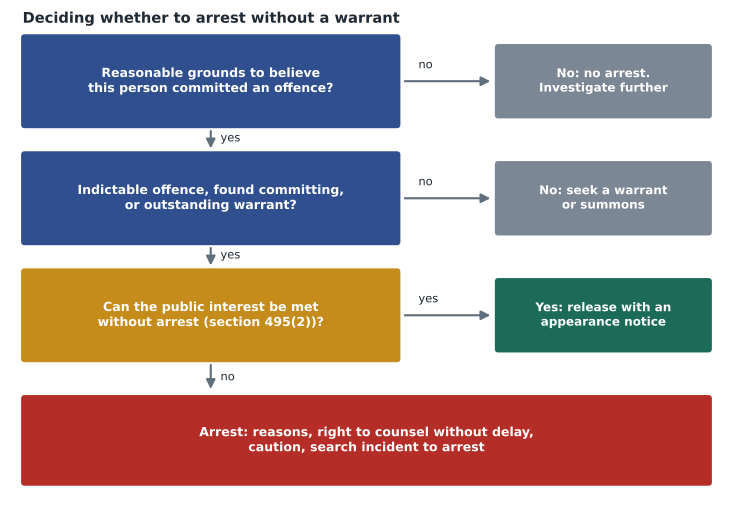
Section 495(1) of the Criminal Code gives a peace officer three separate powers to arrest without a warrant. Under paragraph (a), the officer may arrest a person who has committed an indictable offence, or who, on reasonable grounds, the officer believes has committed or is about to commit an indictable offence. Under paragraph (b), the officer may arrest a person whom the officer finds committing a criminal offence of any kind. Under paragraph (c), the officer may arrest a person whom the officer has reasonable grounds to believe is the subject of a warrant of arrest or committal in force within the territorial jurisdiction. Hybrid offences, which the Crown may prosecute either way, are treated as indictable for this purpose until the Crown elects, under section 34(1)(a) of the Interpretation Act, so most common offences such as theft under 5,000 dollars, assault and mischief fall under paragraph (a).
The words of each power matter. Paragraph (b) applies only when the officer finds the person committing the offence, which the courts read as seeing or perceiving the offence in progress, or being apparently in progress on reasonable grounds; it is the main route for arresting for summary conviction offences such as causing a disturbance. If the officer arrives after a summary offence is over, paragraph (b) does not apply and the officer will usually have to proceed by summons or warrant. Paragraph (a) is broader for indictable and hybrid offences because it extends to offences the officer reasonably believes were committed in the past or are about to be committed.
The public interest and section 495(2)
Section 495(2) tells officers not to arrest without a warrant for a summary conviction offence, a hybrid offence, or an indictable offence within the absolute jurisdiction of a provincial court judge, where the officer believes on reasonable grounds that the public interest can be satisfied without arresting the person, having regard to all the circumstances including the need to establish the person's identity, secure or preserve evidence, and prevent the continuation or repetition of the offence or the commission of another offence, and where the officer has no reasonable grounds to believe that the person will fail to attend court if not arrested. Section 495(3) adds an important twist: an arrest made in breach of subsection (2) is still deemed lawful for most purposes unless the person challenges it and proves the officer did not comply. Desjardins tells the class not to rely on that safety net. Unnecessary arrests cost the person their liberty, cost the service officer hours, and erode trust.
The reasons for restraint are practical. Each arrest takes a patrol officer off the street for hours of transport, booking and paperwork; it exposes the person to the risks of custody, and it can cost them a job or housing even if the charge is later withdrawn. Port Ardent's data, which Haddad shares with the class, show that almost one arrest in five for a minor property or public order offence ends in release at the station within two hours, suggesting the arrest may not have been needed in the first place. Officers who release on the street with an appearance notice spend the time back on patrol.
# Port Ardent: minor property and public order arrests in one quarter
arrests = 412
released_at_station_within_2h = 79
avg_hours_per_arrest = 3.4          # transport, booking, paperwork
avg_hours_per_street_release = 0.9  # appearance notice or citation on scene
share = released_at_station_within_2h / arrests
saved = released_at_station_within_2h * (avg_hours_per_arrest - avg_hours_per_street_release)
print("released within 2 hours:", released_at_station_within_2h, "of", arrests, f"({share:.2f})")
print("officer hours that street release could have saved:", round(saved, 1))
print("about", round(saved / 12, 1), "twelve-hour shifts")released within 2 hours: 79 of 412 (0.19) officer hours that street release could have saved: 197.5 about 16.5 twelve-hour shifts
Almost two hundred officer hours, about sixteen full shifts in a quarter, could have gone back to patrol if those cases had been handled by release on the street. Desjardins is careful to add that some of those arrests may have been needed to establish identity or stop a continuing offence; the data raise a question for supervisors rather than prove a mistake. But they show why the law asks officers to consider release first.
Arrest by any person: section 494
Section 494 allows anyone, not only a peace officer, to arrest without a warrant a person found committing an indictable offence, or a person who, on reasonable grounds, they believe has committed a criminal offence and is escaping from and freshly pursued by persons with lawful authority to arrest. Since the 2012 amendments made after the Chen case in Toronto, the owner or person in lawful possession of property, and anyone they authorize, may also arrest a person found committing a criminal offence on or in relation to that property, either at the time or within a reasonable time afterward if they believe on reasonable grounds that making the arrest by a peace officer is not feasible. Anyone who arrests under section 494 must deliver the person to a peace officer forthwith. Security guards and loss prevention staff rely on this power, and officers called to a store must assess whether the citizen's arrest was lawful before taking custody.
Desjardins tells the story of a loss prevention officer who held a teenager in a back room for two hours because she suspected him of taking earbuds she could not find on him. The responding officer found no evidence, released the teenager, and wrote a report that later supported a complaint against the store. Officers called to a citizen's arrest should treat the person's account as information, check it, and make their own decision. If the arrest was not lawful, the officer should not continue it.
Arrest for breaches and other statutory powers
Several other powers lead to arrests that look like ordinary arrests but rest on different authority. Section 524 allows an officer to arrest a person, without a warrant, whom the officer believes on reasonable grounds has contravened or is about to contravene a release order or undertaking, or has committed an indictable offence while on release. Provincial statutes create their own powers: Ontario's Highway Traffic Act allows arrest for some driving offences such as driving while suspended, the Liquor Licence and Control Act allows arrest of an intoxicated person in a public place in some circumstances, and the Mental Health Act allows apprehension, which is not an arrest for an offence. Each power has its own words and its own conditions, and the officer's notes should name the power used.
Arresting outside your jurisdiction and off duty
Police powers usually stop at the edge of the officer's jurisdiction. In Ontario, police officers have authority throughout the province under the Community Safety and Policing Act, but a municipal officer's ordinary duties are in their own municipality, and outside it they generally act only in emergencies or with the cooperation of the local service. Off duty, an officer is still a peace officer and may use section 495, but services discourage off-duty enforcement except where life is at risk, because the officer has no radio, no backup and often no visible identification. Desjardins tells the class that one of the most dangerous situations in policing is an off-duty officer in plain clothes intervening in a crime and being mistaken for the offender by arriving officers.
Recording the arrest
The officer's notes on an arrest should answer, in order: the time and place; the power used and the offence; the facts that gave grounds, with the time each was known; the words used to tell the person they were arrested and why; the time rights to counsel and the caution were given, and the response; any force used and why; any search and what was found; and the decision on release. Haddad's quarterly audit checks each arrest report for these points. Reports that name the offence but not the power, or the conclusion but not the facts, go back to the officer.
Arrests that go wrong: three patterns
Desjardins closes the section on arrest powers with three patterns he has seen go wrong most often in reviews of Port Ardent files. The first is the arrest that runs ahead of the grounds. An officer who arrives at a scene, hears one side of a story, and arrests the person the complainant points to has not yet formed a belief of their own. The fix is simple but takes discipline: speak to both parties, look at whatever physical evidence is available, and decide only when the facts support a belief. In a fast-moving situation, a short investigative detention while those steps happen is often the right tool, and an arrest can follow if the facts support it.
The second pattern is the arrest for the wrong offence. An officer who arrests for an offence that does not allow a warrantless arrest in the circumstances, when a different offence on the same facts would have, can find the arrest challenged even though they had the power all along. Naming the right offence matters because it is how the officer shows which power they used. Desjardins advises officers to think through the possible offences before they say the words of arrest, and to tell the person about every offence they have in mind, so that a later change of charge does not leave a gap.
The third pattern is the arrest that never ends. An officer who arrests and then forgets about the release decision, leaving a person in cells for hours while the paperwork waits, has turned a lawful arrest into an unreasonably long one. Section 498 requires the officer in charge to consider release as soon as practicable, and section 503 sets an outer limit. The release decision, covered in Lesson 11, is part of the arrest, not an afterthought, and the record of an arrest should show when it was made and by whom.
Marco DiSanto asks how officers are supposed to keep all of this straight in a fight outside a bar at two in the morning. Desjardins admits that it is hard, and that no officer gets every decision perfect. But he points out that most arrests are not made in a fight. Most happen after a call, a conversation and a few minutes of investigation, when there is time to think about which power applies. The officers who think it through in those minutes are the ones who can act quickly and correctly when there is no time at all.
Worked problem
Choosing the arrest power
At 1:15 a.m., Constable Malhotra is called to a bar on Water Street where a man is shouting, swearing and refusing to leave. By the time Malhotra arrives, the man is outside on the sidewalk, still shouting at people walking past and blocking the entrance. Staff say he punched a doorman ten minutes earlier; the doorman has a red mark on his cheek. What powers does Malhotra have?
Show solution
- Assault is a hybrid offence, treated as indictable for arrest purposes. Malhotra can arrest under section 495(1)(a) if the staff account, the doorman's injury and the man's behaviour give reasonable grounds to believe he committed it.
- The continuing shouting in a public place may be causing a disturbance, a summary offence; Malhotra finds him committing it, so section 495(1)(b) also applies.
- Consider section 495(2): the man is intoxicated, the offence is continuing, and identity may be uncertain, so the public interest probably requires arrest to prevent continuation.
- Warn first if it is safe: a clear request to stop and move away gives the man a chance to comply and strengthens the grounds if he does not.
- Record the power used, the facts known, and the time of each step.
Answer: Malhotra can arrest for the assault under 495(1)(a) or for the disturbance under 495(1)(b); the public interest supports arrest if the man will not stop.
Common mistakes
MistakeAny offence can lead to a warrantless arrest at any time.
InsteadSummary offences allow warrantless arrest only when the officer finds the person committing them; otherwise the route is a summons or warrant.
MistakeA citizen's arrest means the officer must take the person into custody.
InsteadThe officer must make their own decision based on their own grounds and release the person if the arrest was not lawful.
MistakeSection 495(3) means section 495(2) does not matter.
InsteadAn unnecessary arrest still harms the person and the service, and the deeming provision can be rebutted.
MistakeThe notes only need to say the person was arrested for an offence.
InsteadNotes must name the power, the facts that gave grounds and the time each step happened.
Summary and key terms
- An arrest is a seizure or touching with a view to detention, or words of arrest followed by submission (Whitfield).
- Section 495(1) allows arrest for indictable offences on reasonable grounds, any offence the officer finds being committed, and outstanding warrants.
- Section 495(2) directs officers not to arrest when the public interest can be met by release.
- Section 494 allows citizen's arrests, including by property owners within a reasonable time.
- Breach of release, traffic, liquor and mental health powers each have their own conditions.
- The notes must name the power, the grounds, the times and the release decision.
- Arrest
- Seizing or touching a person with a view to detention, or words of arrest to a person who submits.
- Found committing
- Perceiving an offence in progress, required for warrantless arrest for a summary offence.
- Hybrid offence
- An offence the Crown may prosecute by indictment or summarily; treated as indictable for arrest until the Crown elects.
- Public interest
- The factors in section 495(2) that may require arrest: identity, evidence and preventing repetition.
- Citizen's arrest
- An arrest by a private person under section 494.
- Appearance notice
- A document given by an officer releasing a person with a date to attend court.
Practice problems
Work each problem on paper first, then reveal the answer to check.
What are the three powers in section 495(1)?
Show answer
Arrest for indictable offences committed or about to be committed on reasonable grounds; arrest of a person found committing any offence; arrest on reasonable grounds of an outstanding warrant.
In the code example, how many officer hours might street release have saved?
Show answer
79 x (3.4 - 0.9) = 197.5 hours.
What must a private person do after making an arrest?
Show answer
Deliver the person to a peace officer forthwith.
Why do services discourage off-duty enforcement?
Show answer
The officer lacks radio, backup and visible identification, and may be mistaken for the offender.
Lesson quiz · 5 questions
Score 60% or more to complete this lesson.
Create a free account to save your progress, take quizzes and earn a certificate.