
LES-112 · Lesson 11 of 12 · 19 min
Release, judicial interim release and custody
▶ Video coming soon A video version of this lesson is on the way.
By 04:10 on March 14, Kyle Brandt had spoken to duty counsel, declined to give a statement, and was sitting in a cell at Port Ardent headquarters. Sergeant Haddad, as the officer in charge, had to make a decision that Desjardins calls one of the most consequential in policing: should Brandt be released, and if so on what terms, or held for a bail hearing? Desjardins tells the class that the arrest is often the most dramatic moment of a case, but the release decision usually affects the person's life more. A person held for days or weeks can lose a job, housing or custody of children before any court has decided whether they did anything wrong.
The principle of restraint
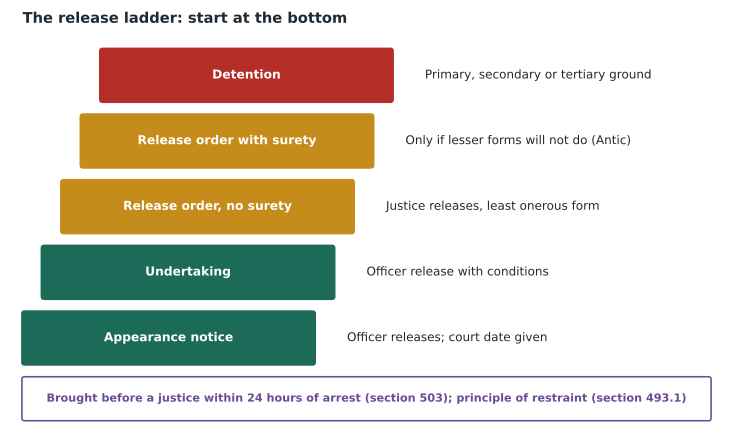
Part XVI of the Criminal Code was rewritten in 2019. Section 493.1 now tells police officers and justices to give primary consideration to the release of the accused at the earliest reasonable opportunity and on the least onerous conditions that are appropriate in the circumstances, including conditions that are reasonably practicable for the accused to comply with. Section 493.2 adds that they must give particular attention to the circumstances of Indigenous accused and accused from vulnerable populations that are overrepresented in the criminal justice system and disadvantaged in obtaining release. These provisions codify what the Supreme Court said in R. v. Antic (2017): release is the default, and every step up the ladder of release must be justified.
Release by the police
Police officers themselves can release most accused people. Under section 497, the arresting officer may release the person with an appearance notice, a summons application, or without charge. Under section 498, the officer in charge at the station may release on an appearance notice, an undertaking, or with the intention of applying for a summons. An undertaking under section 501 may include conditions, such as reporting to police, staying within a territory, not contacting the victim, abstaining from alcohol or drugs where linked to the offence, or not going to a specified place, but only conditions that are necessary and reasonable. A person who is not released by the police must be taken before a justice without unreasonable delay and, under section 503, within 24 hours if a justice is available, or as soon as possible if not.
Haddad considered three questions about Brandt, following the criteria in section 498(1.1): was detention necessary to establish his identity, secure evidence, prevent the continuation or repetition of the offence, or ensure the safety of a victim or witness; did she have reasonable grounds to believe he would not attend court; and could conditions in an undertaking address any concerns? His identity was confirmed; the evidence was seized; the store owner was not a known person to him; and he had a fixed address and job. She released him on an undertaking with two conditions: not to attend Lakeshore Hardware, and to keep the peace. Desjardins notes that a condition not to possess tools would have been tempting but unreasonable, because Brandt worked as a labourer and needed them.
Judicial interim release
When the police do not release, a justice decides under section 515. The default is release on an undertaking without conditions, and the Crown must show cause for anything more onerous, moving up the ladder one step at a time: an undertaking with conditions, a release order without a surety or deposit, a release order with a surety, and only exceptionally a cash deposit. Detention is justified only on one of three grounds in section 515(10): the primary ground, to ensure attendance in court; the secondary ground, for the protection or safety of the public, including any substantial likelihood that the accused will commit an offence or interfere with justice; and the tertiary ground, to maintain confidence in the administration of justice, which R. v. St-Cloud (2015) held is not limited to rare cases but must be assessed with the factors in that section. In some situations, such as offences committed while on release or certain firearms and violent offences, the onus is reversed under section 515(6) and the accused must show why detention is not justified; amendments in 2023 added reverse onus for some repeat violent offending involving weapons. In R. v. Zora (2020), the Court held that release conditions must be minimal, necessary and connected to the risks, and that a conviction for breaching a condition requires proof the accused knew of it and breached it knowingly or recklessly.
Officers play an important role at these hearings even though they do not decide them. The Crown relies on the police synopsis, sometimes called the show-cause report, to describe the offence, the accused's record and any risks. Desjardins tells the class that the synopsis must be accurate and fair: it should include facts that favour release, such as employment and family ties, as well as risks. An exaggerated synopsis that leads to an unnecessary detention is an ethical failure, and a misleading one can lead to findings against the officer.
Port Ardent release data
Port Ardent publishes its release data every year, as part of its commitment to the principle that release should be the norm. The program below summarizes one year of decisions for people arrested and brought to headquarters, and checks how many people held for court were brought before a justice within 24 hours.
# Port Ardent release decisions for people brought to headquarters, one year
decisions = {"released by officer, no conditions": 1210,
             "released by officer, with conditions": 690,
             "held for court": 420}
total = sum(decisions.values())
for k, v in decisions.items():
    print(f"{k:38} {v:5}  {v / total:.2f}")
held = decisions["held for court"]
hours_to_court = [  # hours from arrest to appearance, grouped
    (12, 155), (18, 140), (22, 96), (30, 21), (40, 8)]
within = sum(n for h, n in hours_to_court if h <= 24)
print("held for court:", held, "seen within 24 hours:", within, f"({within / held:.3f})")
print("seen after 24 hours:", held - within)released by officer, no conditions 1210 0.52 released by officer, with conditions 690 0.30 held for court 420 0.18 held for court: 420 seen within 24 hours: 391 (0.931) seen after 24 hours: 29
More than four in five people were released by officers, two thirds of them without conditions. Of the 420 held for court, 391 appeared within 24 hours, and 29 waited longer, mostly on weekends when the court's schedule was reduced. Section 503 sets the 24-hour limit unless a justice is not available, so each late case must be explained. Haddad's review found that most delays came from a weekend court schedule, and the service has asked the court to add a Sunday sitting.
Care of people in custody
While a person is in custody, the police are responsible for their safety and wellbeing. People in cells may be intoxicated, injured, ill, withdrawing from drugs or suicidal, and deaths in custody are among the most serious incidents a service can face. Port Ardent's cells policy requires a health screening at booking, checks at intervals set by risk, with physical checks every 15 minutes for intoxicated people and constant observation for anyone at risk of self-harm, and immediate medical attention for anyone who cannot be roused, has a head injury or shows signs of overdose. Belts, shoelaces and other items that could be used for self-harm are removed and recorded. Young persons under the Youth Criminal Justice Act must be held separately from adults.
Desjardins tells the class about a man he arrested for being drunk in public early in his career. The man said he had fallen and hit his head. Desjardins wrote it down and booked him. The cells officer, following the head-injury rule, called an ambulance; the man had a bleed on the brain and survived because of the call. 'The rules feel like paperwork until the night they save someone,' he says.
Conditions that set people up to fail
Desjardins spends time on conditions because they are where good intentions most often cause harm. A condition that seems sensible at three in the morning can be impossible to follow for the next six months. An absolute ban on alcohol for a person with an addiction, a curfew for a person who works night shifts, a requirement to live at an address where the person is no longer welcome, or a condition not to enter a whole area of the city that includes the person's doctor or child's school can all lead to breaches that have nothing to do with the original offence. Each breach can bring a new charge, a new arrest and a harder road to release.
In Zora, the Supreme Court described this cycle and told police and justices to impose only conditions that are clearly necessary to address a specific risk of failing to attend, endangering public safety, or undermining confidence in the administration of justice, and that are reasonable and practicable for the accused to follow. Haddad's review of Port Ardent's releases with conditions found that the most common condition was not to contact the victim, which almost always made sense, and the second most common was a blanket alcohol ban, which often did not.
Officers also have a role after release. When a person breaches a condition in a minor way, such as arriving home twenty minutes after curfew, officers have discretion about how to respond. A warning and a note to the file may serve the purpose of the condition better than an arrest. A serious breach, such as contacting a victim the person was ordered to avoid, calls for a firm response. Desjardins tells the class that thinking about the purpose of each condition is the best guide to enforcing it sensibly.
Release and victims
Release decisions also affect victims. A person who has been assaulted by a partner, for example, may be terrified that the accused will return home the same night. The Canadian Victims Bill of Rights gives victims the right to information about the release of the accused and the conditions imposed, and section 515(13) requires a justice to state that they considered the safety and security of victims. Officers should tell victims what conditions were imposed, how to report a breach, and where to find support. In the Lakeshore case, Ruth Lindqvist was told about Brandt's condition not to attend the store, and Haddad gave her a card with the file number in case he came back.
Desjardins ends the lesson with a reminder about time. Every hour a person spends in custody before a release decision is an hour they did not need to spend if the decision could have been made sooner. Officers who finish the paperwork for the release decision before they start the rest of the file, and supervisors who make the decision as soon as they have what they need, keep that time short. Port Ardent's target is a release decision within four hours of arrival at the station for anyone who is not being held for court, and Haddad reports the result to the service every month. In the year shown in the lesson, the median was a little under three hours, and the longest waits were almost all on nights when the cells were full and the booking room had a queue.
Worked problem
Deciding on release
At 23:00, officers arrest a 19-year-old for shoplifting a jacket worth about 150 dollars from a department store. She has no record, gives her name and address, which are confirmed, and lives with her parents. The store wants her banned. Should she be held, and what conditions, if any, are appropriate?
Show solution
- Start with restraint: section 493.1 favours release at the earliest opportunity on the least onerous conditions, and section 498(1.1) lists the concerns that could justify holding her.
- Check each concern: identity is confirmed, the evidence (the jacket and video) is secured, there is no ongoing offence, and she has ties and no history of missing court.
- Choose the release: an appearance notice is likely enough; if the store's concern is real, an undertaking with a single condition not to attend that store is the most that is justified.
- Avoid unnecessary conditions: a curfew, a ban on all stores, or a requirement to live with her parents would not be connected to any real risk.
- Record the reasons for the decision.
Answer: She should be released, most likely on an appearance notice, with at most a no-attend condition for that store.
Common mistakes
MistakeHolding people in custody is the safe choice.
InsteadRelease is the default under section 493.1 and Antic; detention must be justified.
MistakeMore conditions make release safer.
InsteadConditions must be minimal, necessary and connected to the risks (Zora).
MistakeThe arrest report only needs to describe the risks.
InsteadReports for release decisions must be accurate and fair, including facts that favour release.
MistakeCells checks are just paperwork.
InsteadHealth screening and regular checks prevent deaths in custody.
Summary and key terms
- Section 493.1 requires primary consideration of release at the earliest opportunity on the least onerous conditions; section 493.2 adds attention to Indigenous and overrepresented accused.
- Officers can release with an appearance notice or undertaking; those not released must see a justice within 24 hours (section 503).
- Justices follow the Antic ladder; detention needs the primary, secondary or tertiary ground (St-Cloud), with reverse onus in some cases.
- Conditions must be minimal and connected to risk (Zora).
- Reports for release decisions must be accurate and fair.
- Police are responsible for the safety of people in custody.
- Appearance notice
- A document given by an officer releasing a person with a court date.
- Undertaking
- A promise by the accused to attend court and comply with conditions, given to police or a justice.
- Release order
- A justice's order releasing the accused, with or without conditions or a surety.
- Surety
- A person who promises to supervise the accused and may forfeit money if they fail.
- Reverse onus
- A situation where the accused must show why detention is not justified.
- Ladder principle
- The rule that each more onerous form of release must be justified (Antic).
Practice problems
Work each problem on paper first, then reveal the answer to check.
What does section 493.1 require?
Show answer
Primary consideration of release at the earliest reasonable opportunity and on the least onerous appropriate conditions.
In the code example, what share of people held for court were seen within 24 hours?
Show answer
391 of 420, about 0.931.
Name the three grounds for detention in section 515(10).
Show answer
Primary: attendance; secondary: public safety; tertiary: confidence in the administration of justice.
Why was a condition not to possess tools inappropriate for Brandt?
Show answer
He worked as a labourer and needed tools, so the condition was not reasonably practicable or necessary.
Lesson quiz · 5 questions
Score 60% or more to complete this lesson.
Create a free account to save your progress, take quizzes and earn a certificate.