
LAWU-314 · Lesson 9 of 12 · 21 min
NextGen question sets and performance tasks
▶ Video coming soon A video version of this lesson is on the way.
This session is Hannah's, though Vantreese insists that everyone stay. She projects one of the sample integrated question sets that NCBE has published and walks through it on the screen, then shows the class an original set she wrote in the same format. Daniel, who will take the legacy UBE, says the counseling question looks like something his supervising lawyer asked him last summer: a client wants to do something, the law allows part of it, and the answer has to explain the options in plain English. "Exactly," Vantreese says. "NCBE studied what new lawyers do, and then wrote questions that look like it. If you can do these, you can also do a good MPT."
The building blocks of a NextGen session
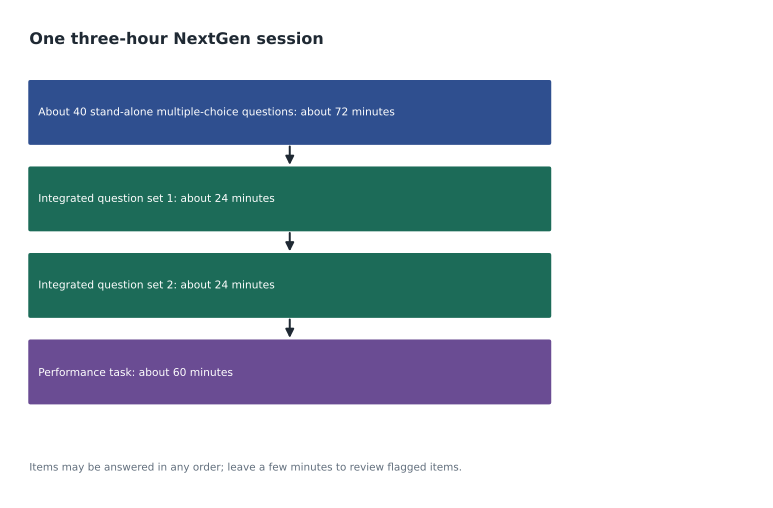
Each of the three NextGen sessions lasts three hours and contains the same mix: about 40 stand-alone multiple-choice questions, two integrated question sets and one performance task. Within a session, applicants may answer in any order, and the software lets them flag items, move between them and see a timer. NCBE's blueprint suggests a time allocation of roughly 1.8 minutes per multiple-choice question, about 24 minutes per integrated question set and about 60 minutes for the performance task. Each administration also includes unscored pretest items, about 20 multiple-choice questions and one integrated question set across the exam, which look like scored items.
Integrated question sets
An integrated question set begins with a scenario, often a page or less, describing a client matter. It may include a document, such as a contract clause, an excerpt of a complaint or a short email. Several questions follow. Some are multiple choice; some ask for a short answer of a sentence or two; and some ask for a short written product. NCBE describes several kinds of sets. Drafting sets ask the applicant to revise or write part of a document, such as an allegation in a complaint, an answer to a complaint, a contract term or a paragraph of a letter. Counseling sets follow a newly licensed lawyer through a client matter as circumstances change, asking what to advise at each stage. Other sets test investigation and evaluation, such as deciding what facts to gather or what a document shows, and negotiation and dispute resolution.
Integrated question sets are where NextGen tests skills on the foundational subjects, so the applicant needs both the law and the skill. A drafting question on a complaint for breach of warranty requires knowing the elements of the claim under Article 2 and knowing how to plead them clearly. A counseling question about a client's tenant requires knowing the landlord's duties and explaining them so that the client can decide. Integrated sets on skills may also test the rules of professional conduct that NCBE lists in its content scope, such as competence, communication, confidentiality, conflicts and the duties of candor and truthfulness.
Scoring integrated sets
Stand-alone multiple-choice questions on NextGen are worth one point if answered correctly; select-two questions are worth up to two, with partial credit. Short-answer responses in integrated sets are scored against rubrics, typically on small point scales, and drafting tasks are scored on larger scales, up to 8 points for some. Graders look for whether the response does what was asked, uses the relevant facts, states the law accurately where needed and is clear. Integrated question sets together count for about 21 percent of the total NextGen score.
The practical lesson is that short answers should be short and complete. If a question asks for the strongest argument for the defendant in two sentences, the answer should state the argument and the reason, not a paragraph of background. If a drafting question asks for a revised contract term, the answer should be the term, written precisely, perhaps with a one-line explanation if requested.
A method for integrated sets
Vantreese adapts the MBE method. First, read the scenario and every question in the set quickly before answering any, so that you know what the set is about and where it is going; later questions sometimes reveal facts that matter for earlier ones. Second, answer the questions in order unless one is clearly faster, because sets often build on themselves. Third, for written responses, decide in a phrase what the answer is before writing. Fourth, write the shortest complete answer. Fifth, flag and move on if a question takes more than its share of time, since the session's clock is shared.
Worked problem
An original counseling set
Scenario: A client, Radomir Kittering, owns a two-unit house in Westmarch and lives in one unit. His tenant in the other unit has paid rent late three times and has a dog, which the lease prohibits. Kittering wants to change the locks while the tenant is at work. Question 1 (multiple choice): Which statement best describes Kittering's legal position? Question 2 (short answer): In two sentences, explain to Kittering what he should do instead. Question 3 (drafting): Draft the first sentence of a notice to the tenant about the dog. Question 4 (short answer): Kittering then tells you he sent the tenant a text saying, "Get rid of the dog by Friday or you're out." What, if anything, should you advise about the text?
Show solution
- Question 1: the generally accepted rule is that a landlord may not use self-help to remove a residential tenant, such as changing the locks, and must use the judicial eviction process. The best answer says that Kittering must give notice and use the court process, not change the locks.
- Question 2: "You cannot lock the tenant out; you must give written notice of the lease violations as the lease and law require and, if they are not cured, file an eviction case in court. Changing the locks could expose you to liability for wrongful eviction."
- Question 3: "You are notified that you are in violation of Section 12 of your lease, which prohibits pets on the premises, because a dog is being kept in your unit." The sentence identifies the lease term and the violation precisely; the rest of the notice would state any cure period the lease and statute allow.
- Question 4: the text may not satisfy the lease's or the statute's notice requirements and may be read as a threat of self-help; advise him not to act on it and to send a proper written notice, and to communicate through counsel from now on if the tenant is represented.
Answer: The set tests real property law (the bar on self-help eviction), client counseling in plain language, precise drafting and a follow-up judgment call. Each answer is short. Vantreese notes that the state's specific notice periods are not needed; a question that turned on them would supply them.
Performance tasks
Each NextGen session ends, or begins, depending on the applicant's choice, with a performance task of about 60 minutes. Performance tasks resemble the MPT: they supply the law and facts and ask for analysis or a document. But they are shorter, and some are legal research performance tasks. In a legal research performance task, the applicant receives a set of research materials and answers a series of research questions, in multiple-choice or short-answer form, about which sources are relevant, what they hold and how they fit together, and then writes a shorter product, such as a memo section, using what was found. NCBE's sample research tasks combine several multiple-choice and short-answer questions with one medium-length written answer. Performance tasks count for about 30 percent of the NextGen score, and research tasks give extra weight to the research questions.
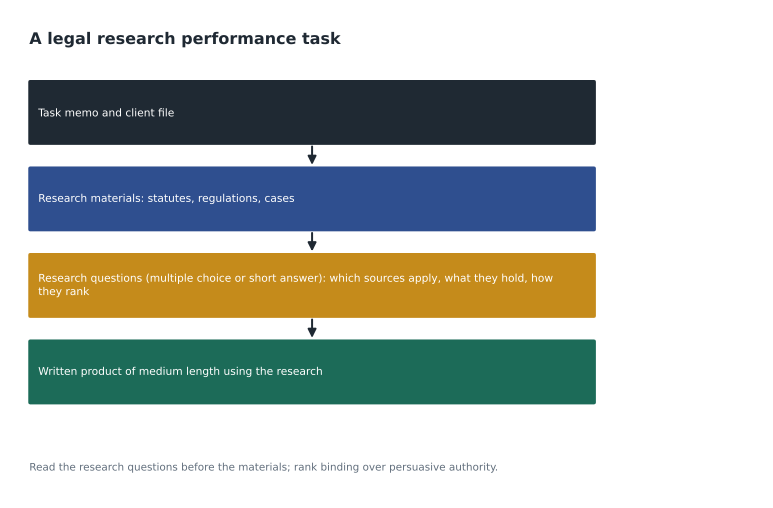
The method from Lesson 8 applies, scaled down. Read the task instructions twice, read the law closely, pair rules with facts in a quick outline, and write. On research tasks, read the research questions before reading all the materials, because the questions tell you what to look for and help you skip irrelevant sources. NextGen research materials may include sources from different levels of authority, such as a statute, a regulation and cases from different courts, and applicants must know how to rank them: a statute controls over an inconsistent regulation, a binding appellate decision controls over a trial court, and a case from another jurisdiction is only persuasive.
Resources supplied on the exam
NextGen supplies the law for topics outside the foundational subjects and for unstarred topics, and in integrated question sets and performance tasks that involve family law and trusts and estates until 2028. Applicants must be careful not to treat supplied law as a reason to skip learning the starred topics. NCBE's content scope identifies starred topics in each subject that applicants must know from memory: in civil procedure most of the core rules, in criminal procedure nearly all the constitutional protections, in evidence most of the rules on relevance, character, impeachment and hearsay, and in torts the main intentional torts, negligence, strict liability and products liability. Commercial guides list the starred topics in more detail, but the content scope itself is the authority.
Practicing NextGen formats
NCBE publishes free sample questions in each format and sells study aids, including a multiple-choice bank, banks of integrated question sets and full practice sets that mimic one session, which together can form a simulated exam. NCBE also publishes sourcebooks that summarize the foundational subjects. Applicants should take practice sets in the exam software or a close simulation, under the three-hour time limit, and review each item. Hannah's schedule includes one practice set a week from week five and a full simulated exam in week nine, plus daily stand-alone questions for subject review.
The skills in integrated sets can also be practiced without NextGen materials. Drafting a complaint paragraph for a breach of contract claim, writing a two-sentence explanation of a rule to a client or listing the facts to investigate in a negligence case all build the same skills. Vantreese gives the legacy students a weekly set of these short exercises too, because they improve MPT and MEE answers.
Pacing a NextGen session
The hardest adjustment for many applicants is managing one clock across different kinds of items. Because items within a session can be answered in any order, applicants should decide their order in advance and practice it. Vantreese suggests one common approach and asks Hannah to test it in her practice sets: begin with the performance task while fresh, giving it no more than 60 minutes; then complete the two integrated question sets in about 48 minutes; then answer the stand-alone questions, leaving a few minutes at the end for flagged items. Others prefer to start with stand-alone questions to warm up. Either works if it is practiced and if the applicant uses checkpoints, such as finishing the performance task by the one-hour mark.
Whatever the order, applicants should avoid two traps. The first is perfecting the performance task at the expense of everything else; a strong performance task does not make up for twenty unanswered multiple-choice questions. The second is leaving the integrated question sets for the end, when fatigue is greatest and short answers become careless. Since every item contributes to the score and there is no penalty for wrong multiple-choice answers, every item should receive an answer before time runs out.
Drafting under time pressure
Drafting questions reward precision more than length. When asked to revise a contract term, applicants should identify exactly what is wrong with the current language, such as ambiguity, a missing condition or an unenforceable penalty, and fix only that, keeping the rest. When asked to draft a paragraph of a complaint, they should allege facts that satisfy each element of the claim, not legal conclusions. When asked to write a sentence or two to a client, they should answer the question asked in words the client will understand. Vantreese gives the class a habit: before writing any drafting answer, write the single word or phrase that is the point of the change, then build the sentence around it.
Professional conduct inside skills questions
NextGen integrates professional responsibility into skills questions on a limited list of Model Rules, such as the duties of competence, communication, confidentiality and candor, conflicts and the rules on dealing with represented and unrepresented persons. A counseling set may ask what a lawyer may tell a client's family member, or a negotiation set may ask whether a lawyer may make a particular statement to opposing counsel. These questions test the same rules the MPRE tests, applied in context, and applicants should expect them in every session.
Common mistakes
MistakeAnswering integrated set questions without reading the whole set first.
InsteadSkim the scenario and all questions first; later questions can reveal facts or the set's direction.
MistakeWriting paragraphs where a sentence was asked for.
InsteadGive the shortest complete answer: the point and the reason.
MistakeSpending ninety minutes on the performance task because it feels like an MPT.
InsteadBudget about 60 minutes; the session clock is shared.
MistakeTreating all research materials as equally authoritative.
InsteadRank sources: statutes over inconsistent regulations, binding over persuasive authority.
MistakeSkipping starred topics because some law is supplied.
InsteadStarred topics must be known from memory; supplied law covers other topics.
Summary and key terms
- Each NextGen session has about 40 multiple-choice questions, two integrated question sets and one performance task, answered in any order.
- Suggested timing is about 1.8 minutes per multiple-choice question, 24 minutes per integrated set and 60 minutes per performance task.
- Integrated sets test skills such as drafting, counseling, investigation and negotiation on the foundational subjects, and may test core professional conduct rules.
- Short answers and drafting tasks are scored on rubrics; write the shortest complete answer.
- Performance tasks supply law and facts; legal research tasks add research questions about sources and authority.
- Starred topics must be known from memory; supplied law covers other topics.
- Practice with NCBE's sample items, study aids and practice sets in the exam software under timed conditions.
- Drafting set
- An integrated question set that asks the applicant to write or revise part of a legal document.
- Counseling set
- An integrated question set that follows a client matter and asks what to advise as circumstances change.
- Rubric
- A scoring guide listing what a written response must contain to earn each point.
- Mandatory authority
- Law that a court must follow, such as a controlling statute or a binding appellate decision.
- Persuasive authority
- Law a court may consider but need not follow, such as a decision from another jurisdiction.
- Practice set
- An NCBE study aid that mimics one NextGen session.
Practice problems
Work each problem on paper first, then reveal the answer to check.
A NextGen short-answer question asks, in two sentences, why a court should deny the defendant's motion to dismiss for lack of personal jurisdiction. Write a model answer for a defendant who sold products directly to the forum state through its website.
Show answer
For example: "The defendant purposefully availed itself of the forum by selling and shipping products directly to forum residents through its website, and the plaintiff's claim arises out of those sales. Exercising jurisdiction is reasonable because the defendant could foresee being sued where it sent its products."
A research task includes a state statute, a regulation that seems to conflict with it and a trial court opinion applying the regulation. How should you rank them?
Show answer
The statute controls over an inconsistent regulation; the trial court opinion is not binding precedent and is persuasive at most, and it is weakened if it applied a regulation that conflicts with the statute.
Why should you skim all questions in an integrated set before answering the first?
Show answer
Because later questions may reveal facts or the direction of the matter that affect earlier answers, and skimming helps budget time across the set.
About what share of the NextGen score comes from performance tasks?
Show answer
About 30 percent.
Lesson quiz · 5 questions
Score 60% or more to complete this lesson.
Create a free account to save your progress, take quizzes and earn a certificate.