
LAWU-314 · Lesson 10 of 12 · 22 min
Subject review sprints: high-yield rules across the tested subjects
▶ Video coming soon A video version of this lesson is on the way.
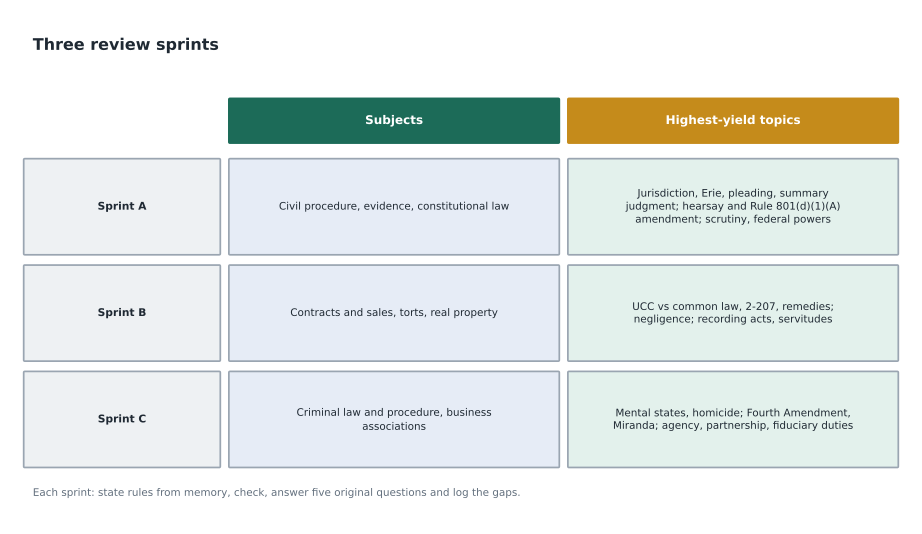
Vantreese calls this session "the sprints". Section B has studied every tested subject in law school, some of them two years ago. Rather than reteach them, she runs three timed review sprints, each covering a group of subjects, in which the students state the highest-yield rules from memory and then check them against her list. "You do not need to know everything," she says. "You need to know the rules that decide most questions, cold, and you need to know where your gaps are. The sprints find the gaps." Each sprint ends with five original questions. The rules below are the generally accepted rules the national exams test; jurisdiction-specific components need separate study.
Sprint A: civil procedure
Subject matter jurisdiction comes first. Federal question jurisdiction under 28 U.S.C. section 1331 requires that the federal issue appear on the face of a well-pleaded complaint. Diversity jurisdiction under section 1332 requires complete diversity of citizenship and an amount in controversy exceeding 75,000 dollars; a corporation is a citizen of its state of incorporation and the state of its principal place of business, its nerve center, while an unincorporated association such as an LLC takes the citizenship of each of its members. Supplemental jurisdiction under section 1367 reaches claims that share a common nucleus of operative fact with a claim within original jurisdiction, but in diversity cases it does not extend to claims by plaintiffs against parties joined under Rules 14, 19, 20 or 24 when that would destroy complete diversity. Removal under section 1441 is available to defendants for cases that could have been filed in federal court, within 30 days after service, but a diversity case cannot be removed if any properly joined and served defendant is a citizen of the forum state.
Personal jurisdiction requires a basis in state law and compliance with due process: general jurisdiction where the defendant is essentially at home, which for a corporation means its state of incorporation and principal place of business, or specific jurisdiction where the defendant purposefully availed itself of the forum and the claim arises out of or relates to those contacts, and exercising jurisdiction is fair. Venue under section 1391 lies where any defendant resides if all reside in the same state, or where a substantial part of the events occurred. Erie requires federal courts in diversity to apply state substantive law and federal procedural law; a valid Federal Rule on point governs. Pleading requires a short and plain statement showing a plausible claim under Twombly and Iqbal. Summary judgment under Rule 56 is granted when there is no genuine dispute of material fact and the movant is entitled to judgment as a matter of law. Claim preclusion bars relitigation of claims arising from the same transaction between the same parties after a final judgment on the merits; issue preclusion bars relitigation of an issue actually litigated and necessarily decided.
Sprint A: evidence
Relevance under Rules 401 to 403: evidence is relevant if it has any tendency to make a fact of consequence more or less probable, and relevant evidence may be excluded if its probative value is substantially outweighed by the danger of unfair prejudice, confusion or waste of time. Character evidence under Rule 404 is generally inadmissible to prove action in conformity, but other acts may be admitted for another purpose, such as motive, intent, plan, identity or absence of mistake; a criminal defendant may offer evidence of a pertinent trait, which opens the door to rebuttal. Impeachment includes prior convictions under Rule 609, prior inconsistent statements under Rule 613 and bias. Under the 2024 amendment to Rule 613(b), extrinsic evidence of a prior inconsistent statement is admissible only after the witness is given a chance to explain or deny it, unless the court orders otherwise.
Hearsay is an out-of-court statement offered to prove the truth of the matter asserted. Statements that are not hearsay under Rule 801(d) include certain prior statements of testifying witnesses and opposing party statements. A significant change took effect December 1, 2026: amended Rule 801(d)(1)(A) treats a testifying witness's prior inconsistent statement as not hearsay, so it may be used substantively, without the former requirement that it have been made under oath at a proceeding. Applicants sitting in 2027 should know both the old and new versions and watch NCBE's announcements about which will be tested. The key exceptions in Rule 803, which apply regardless of availability, include present sense impressions, excited utterances, then-existing state of mind, statements for medical diagnosis or treatment, recorded recollection, business records and public records. Rule 804 exceptions, which require unavailability, include former testimony, dying declarations in homicide and civil cases, statements against interest and forfeiture by wrongdoing. In criminal cases, the Confrontation Clause bars testimonial hearsay unless the declarant is unavailable and the defendant had a prior opportunity for cross-examination, under Crawford v. Washington.
Sprint A: constitutional law
Justiciability requires standing: injury in fact, causation and redressability. Federal power is enumerated: the commerce power reaches channels, instrumentalities and activities that substantially affect interstate commerce; the spending power allows conditions that are clear, related and not coercive; the Tenth Amendment bars commandeering state legislatures or officers. The dormant Commerce Clause invalidates state laws that discriminate against interstate commerce unless necessary to an important local purpose with no reasonable alternative. The Supreme Court has recently addressed the separation of powers several times. In Loper Bright Enterprises v. Raimondo (2024) it overruled Chevron deference, and in Trump v. Slaughter (2026) it overruled Humphrey's Executor and upheld the President's removal of a Federal Trade Commission member. Individual rights questions turn on the level of scrutiny: strict scrutiny for suspect classifications and fundamental rights, intermediate scrutiny for sex-based classifications, and rational basis for most economic regulation. Speech rules distinguish content-based restrictions, which receive strict scrutiny, from content-neutral time, place and manner rules, which must be narrowly tailored to a significant interest and leave open alternative channels.
Sprint B: contracts and sales
First identify the governing law: Article 2 governs sales of goods, the common law governs services and real estate, and mixed contracts follow their predominant purpose. Formation requires offer, acceptance and consideration. Under the common law mirror image rule, an acceptance that varies the offer is a counteroffer; under UCC section 2-207, a definite expression of acceptance can operate as acceptance despite different or additional terms, and between merchants additional terms become part of the contract unless they materially alter it, the offer limits acceptance to its terms or the offeror objects. The statute of frauds requires a writing for contracts for the sale of land, contracts not performable within one year, suretyship promises, marriage-related promises and sales of goods for 500 dollars or more, subject to exceptions such as part performance, merchant confirmations and specially manufactured goods.
Modification under the common law needs consideration, subject to the fair-and-equitable exception for unanticipated circumstances, while under the UCC it needs only good faith. The parol evidence rule bars prior or contemporaneous evidence that contradicts a fully integrated writing, but not evidence of fraud, mistake, conditions precedent or ambiguity. Performance questions turn on conditions, material breach and substantial performance, and under the UCC on the perfect tender rule, the seller's right to cure and installment contracts. Remedies: expectation damages, limited by foreseeability under Hadley v. Baxendale, certainty and mitigation; UCC buyer remedies of cover and market differential; seller remedies of resale, market differential and lost profits for lost volume sellers. Anticipatory repudiation allows the nonbreaching party to suspend performance and sue immediately, and under section 2-609 a party with reasonable grounds for insecurity may demand adequate assurance.
Sprint B: torts
Intentional torts require intent, meaning purpose or knowledge to a substantial certainty, and include battery, assault, false imprisonment, intentional infliction of emotional distress, trespass to land and chattels and conversion. Privileges include consent, self-defense, defense of others and property, and necessity. Negligence requires duty, breach, actual and proximate cause and damages. The standard is the reasonable person; negligence per se applies when a statute designed to protect the plaintiff's class against the harm that occurred is violated; res ipsa loquitur allows an inference of negligence when the accident ordinarily would not occur without negligence and the instrumentality was in the defendant's control. Proximate cause limits liability to foreseeable harms, though the eggshell plaintiff rule makes the defendant liable for the full extent of injury once some harm is foreseeable. Duties of landowners vary by entrant in many jurisdictions. Defenses on the MBE default to pure comparative negligence. Strict liability applies to abnormally dangerous activities and wild animals, and products liability reaches manufacturing defects, design defects under the risk-utility or consumer-expectation test, and failure to warn.
Sprint B: real property
Estates and future interests require the vocabulary: fee simple, fee tail, life estate, and the future interests of reversion, remainder and executory interest, with the rule against perpetuities. Concurrent ownership: a joint tenancy requires the four unities and carries the right of survivorship; a conveyance by one joint tenant severs it as to that share. Landlord and tenant: the implied warranty of habitability in residential leases, the covenant of quiet enjoyment and constructive eviction, assignment and sublease, and the bar on self-help eviction in most jurisdictions. Land transactions: a contract for land must satisfy the statute of frauds, carries an implied promise of marketable title and passes equitable title to the buyer; deeds must be delivered; recording statutes determine priority among successive purchasers. Under a notice statute, a subsequent bona fide purchaser for value without notice prevails; under a race-notice statute, the subsequent purchaser must also record first; under a pure race statute, the first to record wins. Mortgages follow the lien theory in most states, with priorities by time and recording, and foreclosure wipes out junior interests but not senior ones. Easements arise by express grant, implication, necessity or prescription; covenants and equitable servitudes run with the land when their requirements are met.
Sprint C: criminal law and procedure
Criminal law questions turn on the act, the mental state and the defenses. The Model Penal Code's four mental states are purpose, knowledge, recklessness and negligence. Homicide: murder requires malice, which includes intent to kill, intent to cause serious bodily harm, depraved heart recklessness and felony murder; voluntary manslaughter is an intentional killing in the heat of passion upon adequate provocation; involuntary manslaughter is a reckless or criminally negligent killing. Inchoate crimes: attempt requires specific intent and a substantial step; conspiracy requires an agreement and, in most jurisdictions, an overt act, and under the Pinkerton rule a conspirator is liable for foreseeable crimes of co-conspirators in furtherance; solicitation merges with the completed crime. Defenses include self-defense, insanity under the M'Naghten or Model Penal Code tests, duress and necessity.
Criminal procedure is mostly constitutional. The Fourth Amendment protects reasonable expectations of privacy and property; a warrant is required unless an exception applies, such as search incident to arrest, automobile, plain view, consent, exigent circumstances or a stop and frisk on reasonable suspicion under Terry v. Ohio. Under Carpenter v. United States (2018), acquiring historical cell-site location records is a search that usually requires a warrant. The exclusionary rule suppresses evidence obtained unconstitutionally, with exceptions for good faith, inevitable discovery, independent source and attenuation. Miranda warnings are required before custodial interrogation; a request for counsel bars further interrogation until counsel is present unless the suspect initiates. The Sixth Amendment right to counsel attaches at formal charging and is offense-specific. Double jeopardy, the right to a jury and the Confrontation Clause round out the list.
Sprint C: business associations
Agency: an agent acts with actual authority, express or implied, or apparent authority when the principal's manifestations lead a third party reasonably to believe the agent is authorized; a principal can ratify an unauthorized act; an employer is vicariously liable for torts of employees within the scope of employment, but generally not for independent contractors. Partnerships: a general partnership forms when two or more persons carry on as co-owners a business for profit, without formality; partners are agents of the partnership and are jointly and severally liable for its obligations, subject to the exhaustion rule; they owe duties of loyalty and care; limited liability partnerships shield partners from vicarious liability. Corporations: directors owe duties of care and loyalty; the business judgment rule protects informed, good-faith decisions; conflicting-interest transactions are protected by disinterested approval or fairness; shareholders bring derivative suits after a demand or a showing that demand would be futile; veil piercing is rare and requires abuse of the corporate form. Limited liability companies combine limited liability with flexible management, either member-managed or manager-managed, and members' personal liability is limited in the same way as shareholders'.
Worked problem
Running a sprint
Vantreese gives the class ten minutes to write the hearsay exceptions that apply regardless of the declarant's availability, then five minutes to answer an original question: A hospital nurse testifies that a patient, on arrival, told her, "My chest has hurt since I lifted the boxes this morning." The statement is offered in the patient's workers' compensation case. Is it admissible?
Show solution
- Identify the issue: the statement is offered for its truth, so it is hearsay unless an exception applies.
- State the exception: Rule 803(4) admits statements made for, and reasonably pertinent to, medical diagnosis or treatment that describe medical history, symptoms, their inception or their general cause.
- Apply: the patient described a symptom, chest pain, its inception, this morning, and its general cause, lifting boxes, to a nurse while seeking treatment.
- Conclude: admissible under Rule 803(4); the statement of cause is pertinent to treatment, and the declarant's availability does not matter.
Answer: Admissible. Hannah gets the exception right but writes "present sense impression" first; the error log entry is "confused 803(1) with 803(4)", and her next task is ten questions on the medical diagnosis exception.
Common mistakes
MistakeAssuming an LLC is a citizen of its state of organization for diversity.
InsteadAn unincorporated association takes the citizenship of each member.
MistakeTreating a prior inconsistent statement as always limited to impeachment.
InsteadKnow the Rule 801(d)(1)(A) amendment effective December 1, 2026, and the earlier version, and watch NCBE's guidance on which applies.
MistakeApplying the mirror image rule to a sale of goods between merchants.
InsteadUCC section 2-207 governs acceptances with different or additional terms.
MistakeConfusing notice and race-notice recording statutes.
InsteadUnder race-notice the subsequent purchaser must both lack notice and record first.
MistakeTreating apparent authority as based on the agent's statements.
InsteadApparent authority rests on the principal's manifestations to the third party.
Summary and key terms
- Review by sprint: state the highest-yield rules from memory, check them and log the gaps.
- Civil procedure: subject matter and personal jurisdiction, venue, Erie, pleading, summary judgment and preclusion.
- Evidence: relevance and Rule 403, character, impeachment, hearsay and its exceptions, and Confrontation; know the 2024 Rule 613(b) change and the December 1, 2026 Rule 801(d)(1)(A) amendment.
- Constitutional law: standing, federal powers, the dormant Commerce Clause, recent separation-of-powers decisions and levels of scrutiny.
- Contracts: governing law first, formation, 2-207, statute of frauds, modification, parol evidence, performance and remedies.
- Torts and property: intentional torts, negligence elements and defenses, strict and products liability; estates, concurrent ownership, leases, recording statutes, mortgages and servitudes.
- Criminal law and procedure and business associations: mental states, homicide, inchoate crimes, the Fourth, Fifth and Sixth Amendments; agency, partnership, corporate duties and LLCs.
- Complete diversity
- The requirement that no plaintiff share citizenship with any defendant in a diversity case.
- Hearsay
- An out-of-court statement offered to prove the truth of the matter asserted.
- Business judgment rule
- The presumption that directors acted on an informed basis, in good faith and in the honest belief that the action was in the company's best interests.
- Race-notice statute
- A recording statute under which a subsequent purchaser prevails only if without notice and the first to record.
- Apparent authority
- Authority arising from the principal's manifestations that lead a third party reasonably to believe the agent may act.
- Pinkerton rule
- The rule that a conspirator is liable for foreseeable crimes committed by co-conspirators in furtherance of the conspiracy.
Practice problems
Work each problem on paper first, then reveal the answer to check.
Original question. A plaintiff from Ohio sues an LLC in federal court on a state-law claim for 200,000 dollars. The LLC is organized in Delaware with its principal office in Michigan, and one of its members lives in Ohio. Is there diversity jurisdiction?
Show answer
No. An LLC takes the citizenship of each of its members, so it is a citizen of Ohio, destroying complete diversity.
Original question. O conveys Blackacre to A, who does not record. O then conveys Blackacre to B, who pays value, knows nothing of A's deed and records. In a race-notice jurisdiction, who prevails?
Show answer
B, because B is a subsequent purchaser for value without notice who recorded before A.
Original question. Police stop a car for speeding and, without consent, search the trunk, finding drugs. They had no other information. Is the evidence admissible?
Show answer
No, absent another basis. The automobile exception requires probable cause to believe the car contains evidence, and a speeding stop alone does not supply it; search incident to arrest does not reach the trunk in these circumstances.
Original question. A corporation's directors approve a merger after a two-hour meeting with financial advisers' reports. A shareholder sues, alleging the price was too low. What doctrine protects the directors?
Show answer
The business judgment rule, if they acted on an informed basis, in good faith and without conflicts; the shareholder must rebut the presumption.
Lesson quiz · 5 questions
Score 60% or more to complete this lesson.
Create a free account to save your progress, take quizzes and earn a certificate.