
LAWU-314 · Lesson 4 of 12 · 20 min
Legacy UBE or NextGen: knowing which exam you will take
▶ Video coming soon A video version of this lesson is on the way.
Hannah arrives at the fourth session with a printed copy of her board's announcement and a highlighter. She will sit for the NextGen bar exam in July 2027, in only the third administration of the new exam, and she wants to know whether that makes her life harder or easier. Vantreese says it makes it different. The four classmates taking legacy formats will spend their summer on the MBE, the MEE and the MPT, while Hannah will spend hers on a single integrated exam with new kinds of questions. Both groups need the same law and the same skills, but they need different practice materials, and the most common error during a transition is studying for the wrong exam. Today's job is to understand both formats well enough that nobody makes it.
Why NCBE built a new exam
NCBE began a study of the bar exam in 2018, and its testing task force surveyed more than 14,000 practicing lawyers about what new lawyers actually do. The resulting exam tests fewer subjects in less depth and puts more weight on lawyering skills: legal research, legal writing, issue spotting and analysis, investigation and evaluation, client counseling and advising, negotiation and dispute resolution, and client relationship and management. NCBE also designed the exam to be taken on a laptop in a proctored setting and to integrate knowledge and skills in the same questions, rather than testing knowledge in multiple choice and skills only on performance tests. The first administration was in July 2026.
The legacy format, in one paragraph
In a legacy UBE jurisdiction the exam is two days. On Tuesday applicants write two 90-minute MPTs in the morning and six 30-minute MEE essays in the afternoon. On Wednesday they take the 200-question MBE in two three-hour sessions. The MBE counts for half the score, the MEE for 30 percent and the MPT for 20 percent, and the combined score is on a 400-point scale. The MBE tests seven subjects and the MEE eight. Family law and trusts and estates are no longer tested on the MEE, but they may appear in MPT tasks, where the needed law is supplied in the library, through February 2028.
The NextGen format
The NextGen exam takes about nine hours over a day and a half: two three-hour sessions on the first day and one on the second. Each session contains the same mix of question types, and applicants may answer the questions within a session in any order.
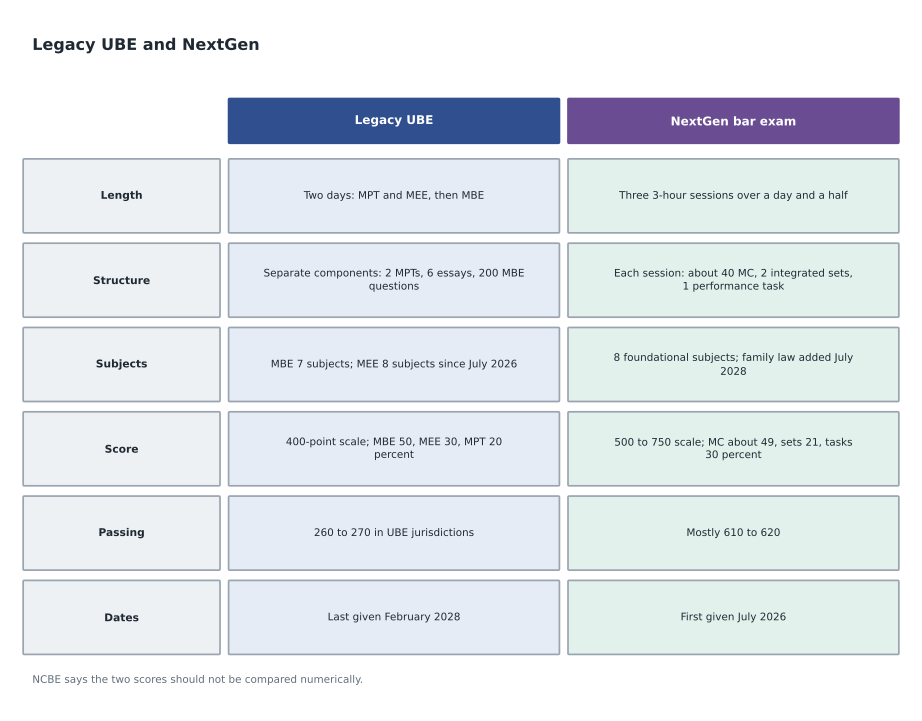
Each session has about 40 stand-alone multiple-choice questions, two integrated question sets and one performance task. Stand-alone questions resemble MBE questions at first but may have four to six answer choices, and some ask the applicant to select two answers, with partial credit possible. Integrated question sets present one scenario with several questions of different kinds: multiple choice, short answer and sometimes drafting or counseling tasks such as revising part of a complaint, a contract term or a letter to a client. Performance tasks take about an hour each and supply the law, as the MPT does; some are legal research performance tasks, which combine research steps answered in multiple-choice or short-answer form with a shorter written product. Across the exam, multiple-choice questions count for about 49 percent of the score, integrated question sets about 21 percent and performance tasks about 30 percent.
NextGen tests eight foundational concepts and principles: civil procedure, contract law (including Article 2 sales), evidence, torts, business associations, constitutional law, criminal law and constitutional protections of the accused, and real property. Family law becomes a foundational subject beginning in July 2028. Until then, family law and trusts and estates may appear in skills questions with the necessary law supplied. NCBE's content scope marks some topics with stars to show that applicants must know them from memory; for unstarred topics, the exam supplies the rule or tests the skill of using it.
How NextGen is scored
NextGen reports a single scaled score from 500 to 750. NCBE scores the multiple-choice items, and graders in each jurisdiction score the written responses using rubrics NCBE prepares. The score is scaled and equated, not curved, so an applicant is measured against a standard rather than against other applicants in the room. Jurisdictions set passing scores, and most of those set by late 2026 fall between 610 and 620: Missouri, New Mexico, North Dakota and Washington chose 610, many others chose 620, and Minnesota had not yet announced its score. NCBE has said that NextGen scores should not be compared numerically with legacy UBE scores. In November 2025 it published guidance suggesting that legacy passing standards of 260 to 270 correspond roughly to NextGen scores of 610 to 620, which is useful context but not a conversion formula.
NCBE reported results of the first administration in September 2026: 2,630 examinees in ten jurisdictions, a mean score of 640.6, and overall, first-time and repeat pass rates of 72.7, 85.2 and 41.0 percent. NCBE said those rates were within a few points of the same jurisdictions' July pass rates in the previous five years. That is the most reassuring number Vantreese can give Hannah: the new exam has not, so far, been harder to pass for a well-prepared first-time taker.
The transition calendar
Jurisdictions adopt NextGen on different dates. A first group began in July 2026, more begin in 2027, and the remainder begin in July 2028. NCBE will give the legacy MBE, MEE and MPT for the last time in February 2028. Applicants who fail the last legacy exam in their jurisdiction will retake on NextGen, which matters for anyone sitting in the final legacy administrations. Daniel and Priya, for instance, will take the legacy UBE in July 2027; if either had to retake, their jurisdictions would still give the legacy exam in February 2028, but a second retake would be on NextGen.
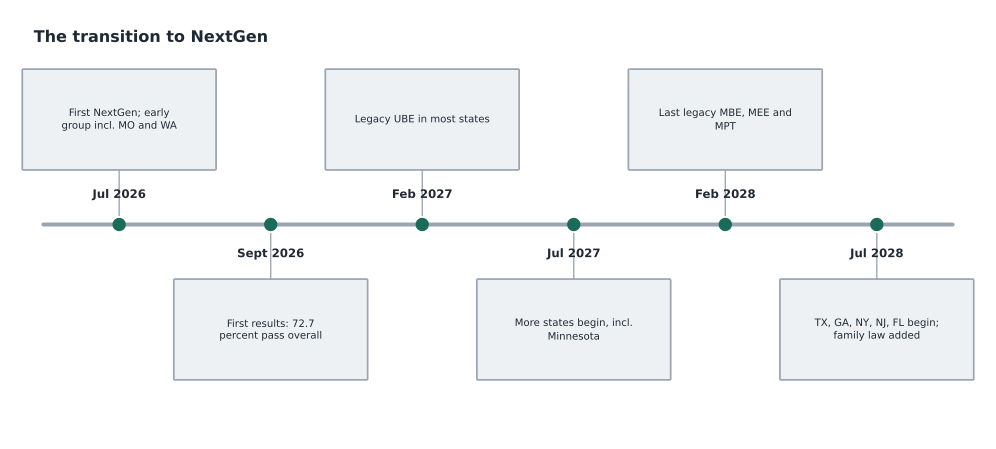
Some jurisdictions add their own components to NextGen. Texas will add a graded Texas Law Component on six subjects when it begins NextGen in July 2028. Georgia and Florida will add their own components. Others, like Minnesota, have none. A few jurisdictions, such as Louisiana, Nevada and Puerto Rico, have not adopted NextGen at all.
Choosing the right materials
The practical consequence is simple and easy to forget: study materials must match the exam. A legacy applicant should practice with MBE questions, MEE essays and MPTs. A NextGen applicant should use NCBE's NextGen sample questions, study aids and practice sets, which contain stand-alone questions, integrated question sets and performance tasks in the exam's format, and commercial courses designed for NextGen. Older MEE practice sets include subjects that left the MEE in July 2026, so a legacy applicant can skip the conflict of laws, family law, trusts and estates and secured transactions essays. A NextGen applicant can use MBE questions for subject review, especially early in preparation, but must also practice the new formats under timed conditions.
Hannah asks whether she should still learn to write an MEE-style essay. Vantreese says she does not need the MEE's format, but she needs the skill underneath it: reading a fact pattern, spotting issues and writing a clear, organized analysis quickly. That skill is tested in integrated question sets and performance tasks. Marcus asks the reverse question: should legacy applicants care about NextGen at all? Only to understand that the skills NCBE now emphasizes, such as counseling and drafting, are the same skills graders reward on a good MPT.
Software, laptops and logistics
NextGen is taken on the applicant's own laptop running secure exam software, in person and under proctoring. NCBE publishes a software tutorial so applicants can practice the interface, including how to flag questions, use the timer, navigate within a session and view the materials for performance tasks. Many legacy jurisdictions also let applicants type essays and MPTs on laptops using a separate secure program, often for an added fee. Applicants should practice with the actual software well before exam day.
Worked problem
Sorting the materials
Vantreese gives each student a shelf of materials: a book of MBE questions, a set of older MEE essays from 2019 to 2025, a book of MPTs, NCBE's NextGen sample questions and a commercial NextGen practice set. She asks Hannah and Priya to sort the shelf for their exams.
Show solution
- Priya, taking the legacy UBE in New York: keep the MBE book, keep the MPT book and keep the MEE essays except those on conflict of laws, family law, trusts and estates and secured transactions. Use the NextGen materials only for occasional skills practice.
- Priya also needs New York Law Course materials and New York Law Exam practice, which are separate from the UBE.
- Hannah, taking NextGen in Minnesota: keep the NextGen sample questions and practice set as her core materials and take them under timed conditions in the exam software.
- Hannah may use the MBE book for subject review, especially early in the summer, knowing that stand-alone NextGen questions may have more than four choices or ask for two answers.
- Hannah should use the MPT book for performance task practice only after working through NextGen performance tasks, because NextGen tasks are shorter and may include research steps.
Answer: The two shelves overlap in law but not in format. Priya's core is the three legacy components plus New York's own requirements. Hannah's core is the NextGen materials, with MBE questions as supplementary review.
Questions to ask about your exam
Vantreese gives the class a short list of questions to answer from the board's website before choosing study materials. Which format will be given on my exam date, legacy UBE, NextGen or a state exam? If NextGen, what is the jurisdiction's passing score, or when will it be announced? Does the jurisdiction add a local component, and if so, is it a course, a test or graded questions on the exam? Will I write on a laptop, and which software will I use? If I need to retake, which format will the next administration use? Does the jurisdiction accept transferred scores of the kind I will earn, and does it matter for my plans?
Each student answers aloud. Hannah's answers are the most uncertain, because Minnesota had not announced its NextGen passing score by November 2026, but Vantreese says uncertainty about the passing score should not change her preparation at all. A well-prepared first-time taker aims well above any plausible passing score, and the work is the same whether the line is 610 or 620. Daniel, Priya and Marcus confirm that their July 2027 exams use the current formats. Jordan confirms that Hawaii's combined exam uses the MBE, MEE and MPT with its own ethics exam.
What does not change
Amid the changes, much stays the same. Both formats test the core subjects of law school, civil procedure, contracts, evidence, torts, constitutional law, criminal law and procedure, real property and business associations, through multiple-choice questions and written analysis. Both reward reading carefully, knowing rules precisely, applying them to facts and managing time. Both are scaled and equated so that the difficulty of a particular administration does not decide who passes. And both are graded, in their written parts, by lawyers in the jurisdiction who are looking for the same things: the issue, the rule, the facts and a conclusion. Vantreese tells the class that the methods in the next four lessons apply to both formats, with adjustments she will point out along the way.
Common mistakes
MistakeAssuming every jurisdiction switches to NextGen at the same time.
InsteadAdoption dates run from July 2026 to July 2028, and a few jurisdictions have not adopted NextGen.
MistakeConverting a NextGen score to a legacy score by subtracting 350.
InsteadNCBE says the scores should not be compared numerically; its guidance on equivalent passing standards is not a conversion formula.
MistakeStudying family law and trusts and estates as MEE subjects in 2027.
InsteadThey left the MEE in July 2026; they may appear in performance tests with the law supplied.
MistakePreparing for NextGen only with MBE questions.
InsteadNextGen includes integrated question sets and performance tasks that must be practiced in their own format and software.
MistakeAssuming a retake will be on the same format.
InsteadApplicants who fail a jurisdiction's last legacy exam will retake on NextGen.
Summary and key terms
- NextGen was built on a study of what new lawyers do and tests fewer subjects with more emphasis on skills.
- The legacy UBE combines the MPT, MEE and MBE over two days; the last legacy administration is February 2028.
- NextGen has three three-hour sessions, each with about 40 multiple-choice questions, two integrated question sets and one performance task.
- NextGen tests eight foundational subjects, with family law added in July 2028; starred topics must be known from memory.
- NextGen scores run from 500 to 750; most passing scores are 610 to 620; scores should not be compared numerically with legacy scores.
- The first NextGen results in 2026 showed pass rates close to earlier July rates in the same jurisdictions.
- Match practice materials and software practice to the exact exam you will take.
- NextGen bar exam
- NCBE's new bar exam, first given in July 2026, which integrates legal knowledge and lawyering skills and reports one score from 500 to 750.
- Integrated question set
- A NextGen scenario followed by several questions of different types, such as multiple choice, short answer and drafting.
- Performance task
- A NextGen task of about an hour in which the law is supplied and the applicant produces analysis or a document.
- Legal research performance task
- A performance task that combines research steps answered in short form with a shorter written product.
- Foundational concepts and principles
- The eight subjects NextGen tests directly, with family law added from July 2028.
- Starred topic
- A topic in NCBE's NextGen content scope that applicants must know from memory.
- Legacy UBE
- The Uniform Bar Examination built from the MBE, MEE and MPT, given for the last time in February 2028.
Practice problems
Work each problem on paper first, then reveal the answer to check.
An applicant will sit in a jurisdiction whose last legacy UBE is February 2027 and whose first NextGen exam is July 2027. She plans to sit in July 2027. Which materials should form her core preparation?
Show answer
NextGen materials: NCBE sample questions, study aids and practice sets in the NextGen format, practiced in the exam software, with MBE questions only as supplementary review.
Why might a legacy UBE applicant in 2027 still see a trusts problem on the exam?
Show answer
Because family law and trusts and estates may appear in MPT tasks, where the needed law is provided in the library, through February 2028.
What does it mean that a NextGen score is equated rather than curved?
Show answer
It is measured against a fixed standard adjusted for the difficulty of the exam form, not ranked against the other applicants who sat at the same time.
Explain why the weights of NextGen differ from the legacy UBE in what they reward.
Show answer
On NextGen about half the score comes from multiple choice and the rest from integrated question sets and performance tasks that test skills, while on the legacy UBE half comes from the MBE, 30 percent from MEE essays and 20 percent from MPTs.
Lesson quiz · 5 questions
Score 60% or more to complete this lesson.
Create a free account to save your progress, take quizzes and earn a certificate.