
LAWU-314 · Lesson 11 of 12 · 20 min
Wellbeing, accommodations, exam day and the first year of practice
▶ Video coming soon A video version of this lesson is on the way.
Vantreese invites a guest to the eleventh session: Leontyne Arbuckle, a Larkhaven graduate who sat for the bar in July 2025 and now works as a second-year associate at a Brennan Falls litigation firm. Arbuckle tells the class three things she wishes she had known. She studied too many hours in June and burned out in early July. She waited too long to request extra rest breaks for a back condition and nearly missed the deadline. And she did not realize how much her first year of practice would depend on habits that had nothing to do with the bar exam: keeping a calendar, asking questions early and understanding exactly what she could and could not do with client money. Vantreese says that is the agenda for the day.
Wellbeing is a performance issue
Bar preparation is a long effort under pressure, and wellbeing affects the result directly. Sleep, exercise, food and connection with other people support memory, attention and reading accuracy, which are exactly what the exam tests. The profession has paid increasing attention to lawyer wellbeing since a national task force report in 2017 documented high rates of stress, depression and substance use among lawyers and law students and urged changes across the profession. Many jurisdictions now include wellbeing in continuing legal education, and every state has a lawyer assistance program that offers confidential help to lawyers, law students and bar applicants.
Vantreese gives concrete advice. Keep a regular sleep schedule and protect it; sleep is when memory consolidates. Exercise most days, even briefly. Eat regular meals. Take one day a week mostly off. Stay in contact with friends and family, and tell them the exam date so they understand the summer. Limit alcohol and avoid using substances to manage stress or sleep. Watch for warning signs, such as persistent hopelessness, inability to sleep or eat, panic or thoughts of self-harm, and seek help promptly from a doctor, counselor, the law school's counseling services or the lawyer assistance program. Seeking help is a strength, and, as Lesson 3 explained, it is not a reason for denial of admission.
Comparison is a particular hazard. Classmates post their practice scores and hours online, and some commercial courses display progress percentages that make students anxious. Hannah admits she checks a study group chat dozens of times a day. Vantreese suggests muting it during study hours and comparing her work only with her own plan and error log.
Testing accommodations
Applicants with disabilities may be entitled to testing accommodations, such as extra time, additional or longer breaks, a separate room, assistive technology, a large-print exam or permission to bring medication or food. The Americans with Disabilities Act requires that licensing exams be offered in a place and manner accessible to people with disabilities, and boards have procedures for requesting accommodations. NCBE handles accommodation requests for the MPRE, which must be approved before the applicant schedules the exam; each board handles requests for its bar exam.
The most important practical points are timing and documentation. Accommodation requests have their own deadlines, often earlier than the exam application deadline; Georgia's deadline for the February 2027 exam, for example, was November 1, 2026. Boards usually require documentation from a qualified professional describing the condition, its current functional limitations and the accommodations recommended, along with records of any accommodations received in law school or on earlier standardized tests. Applicants should begin gathering documentation months in advance. If a request is denied in whole or in part, most boards offer reconsideration or appeal, which takes time. Hannah, who received extended time in law school for a documented condition, has already asked her physician for an updated evaluation so she can file her request with her application.
The week before
The last week should be calm. Applicants should confirm the exam location, the reporting time and what they may bring; visit or map the site; arrange travel and, if needed, a hotel near the site; install and test any required exam software; check the laptop's battery, charger and updates; and prepare permitted items, such as identification, the admission ticket, pens or pencils if allowed, earplugs if allowed, and food and water if permitted. Rules on permitted items differ and are strictly enforced. Some jurisdictions require applicants to place phones in sealed pouches, and Texas, for example, uses that approach. An applicant who brings a prohibited item may be dismissed or have answers voided.
The study plan should taper. Light review of short outlines, a few practice questions to stay in rhythm and early nights are enough. The last day before the exam should include no new material.
Exam day
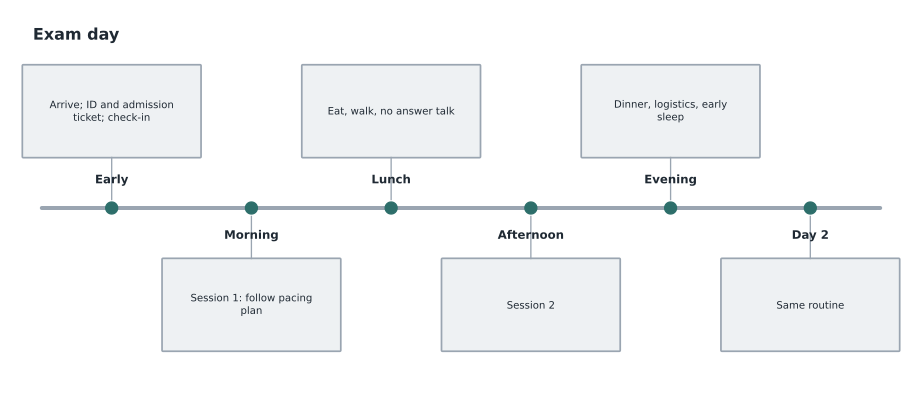
Applicants should arrive early, eat a familiar breakfast and expect a long check-in. During each session, they should follow their pacing plan and keep moving; a hard question or task is not a sign of failure, because every applicant faces the same exam and scoring adjusts for difficulty. At breaks, they should eat, drink water, stretch and avoid discussing the exam with other applicants, which only spreads anxiety and misinformation. After the first day, they should not try to reconstruct their answers. The evening should be quiet: dinner, a short look at the next day's logistics and sleep.
If something goes wrong, such as a software failure, illness or a disruption in the room, applicants should tell a proctor immediately and follow the board's procedures. Boards have policies for technical problems, and NCBE and boards have handled disruptions at individual sites; in July 2026 one jurisdiction's sitting at a single venue was canceled for many applicants, and the board offered alternatives including a make-up administration. Applicants should keep a record of any problem and report it in writing as the board instructs.
After the exam
Results usually come out in the fall for the July exam. The waiting period is difficult. Applicants who will start jobs should do so; those who are not working may want to rest, travel or work on something unrelated. Applicants should keep their contact information current with the board and respond promptly to any character and fitness inquiries, which can continue while results are pending. If results are not good, the first steps are to request any score information the jurisdiction provides, review it with an adviser and make a plan for the next administration. Some jurisdictions offer review of written answers. Repeat takers who change their preparation, especially by doing more timed practice with feedback, improve their chances substantially.
Admission and the oath
After passing and clearing character and fitness, applicants are admitted by the court, usually at a ceremony, and take an oath to support the constitutions of the United States and the state and to discharge their duties faithfully. Some jurisdictions have requirements that must be completed before admission, such as New York's 50 hours of pro bono service and skills competency requirement, and others that follow admission, such as Hawaii's professionalism course. Admission to a federal district court is a separate step, usually simple for members of the state bar.
The first year of practice
Arbuckle spends the rest of the session on the first year, and Vantreese adds the rules. New lawyers must meet continuing legal education requirements, which vary: Texas requires 15 hours a year including 3 hours of ethics; Minnesota requires 45 hours every three years; Georgia, under rules effective January 1, 2026, requires 18 hours every two years including 3 hours of ethics and 2 of professionalism, plus a transition into law practice program for new lawyers; New York requires newly admitted lawyers to complete 32 transitional credits in their first two years; Hawaii requires 3 hours a year with ethics hours over a three-year period and a professionalism course after admission. Many jurisdictions also require annual registration and fees and reporting of trust accounts.
Trust accounting is the area where new lawyers most often get into serious trouble. Client money, including unearned fees and settlement funds, must be held in a trust account separate from the lawyer's own money, under Model Rule 1.15 and its state versions. Small or short-term deposits usually go into an interest on lawyers' trust account, or IOLTA, whose interest funds legal aid. Lawyers must keep records, reconcile accounts and never use client money for any other purpose, even briefly. A new lawyer at a firm will not usually manage the trust account but must understand the rules, because every lawyer is responsible for complying with them.
Other habits matter just as much. Calendar every deadline with a backup system; missed deadlines are a leading cause of malpractice claims. Communicate with clients promptly, as Model Rule 1.4 requires. Ask a supervising lawyer when unsure; Model Rule 5.2 protects a subordinate lawyer who acts in accordance with a supervisor's reasonable resolution of an arguable question of professional duty, but not one who follows a clearly improper instruction. Understand the limits of practice in other jurisdictions under Model Rule 5.5 and the state's version. And maintain malpractice insurance where required or provided; Oregon and Idaho require it, and other states require disclosure of whether a lawyer carries it.
Worked problem
A first-year problem
Arbuckle describes, without names, a problem a friend faced in her first month. A client paid a 5,000-dollar advance fee by check, and the partner told her to "put it in the operating account for now, we'll move it later." What should she do?
Show solution
- Identify the rule: an advance fee that has not been earned is client property and must be deposited in the trust account under Rule 1.15(c), withdrawn only as earned or expenses incurred.
- Recognize the risk: depositing it in the operating account is commingling, even if moved later.
- Act: raise the issue with the partner directly and politely, citing the rule, and ask to deposit it in trust.
- If the partner insists, consult the firm's ethics counsel or another senior lawyer; Rule 5.2 does not protect following a clearly improper instruction.
- Document what was done.
Answer: The friend raised the rule; the partner, who had misspoken, agreed and the check went to the trust account. Arbuckle's point is that new lawyers are responsible for their own compliance, and that raising an issue respectfully is part of the job.
Managing anxiety
Some anxiety before and during the exam is normal and can even sharpen attention. It becomes a problem when it interferes with sleep, eating or the ability to study, or when it leads to panic during practice exams. Vantreese recommends simple techniques that many applicants find useful: slow breathing for a minute before each session; a short routine, such as writing down the session's pacing checkpoints, to start each session with a task rather than a worry; and, when a question feels overwhelming, marking it and moving on, then returning later. Practicing under realistic conditions also reduces anxiety, because the real exam then feels familiar. Applicants whose anxiety is severe should talk to a counselor or physician during preparation, not after.
Families and partners can help by understanding the summer's demands, taking on some household tasks and not asking about practice scores. Arbuckle says the best thing her partner did was cook dinner every Thursday and never mention the exam at the table.
A note on character and fitness after the exam
Character and fitness review can continue after the exam, and boards may contact applicants with new questions while results are pending. Applicants must keep their applications current: most boards require applicants to report new arrests, citations, judgments or other changes until admission. A new matter that arises in the months after the exam is far less damaging if reported promptly than if discovered later. Daniel asks whether a speeding ticket in August would count. Vantreese tells him to read his board's instructions on amendments; many ask applicants to report any charge other than minor traffic matters, and when in doubt, report.
Common mistakes
MistakeTreating sleep and rest as time lost from studying.
InsteadSleep, exercise and rest support memory and accuracy; protect them.
MistakeRequesting accommodations at the exam application deadline.
InsteadCheck the separate, often earlier, accommodation deadline and gather documentation months ahead.
MistakeBringing a phone or other prohibited item to the exam room.
InsteadRead the permitted items list and follow it exactly.
MistakeDiscussing answers with other applicants between sessions.
InsteadRest, eat and focus on the next session.
MistakeDepositing an unearned advance fee in the operating account.
InsteadUnearned fees belong in the trust account until earned.
Summary and key terms
- Wellbeing affects performance; protect sleep, exercise, meals and connection, and seek help early through counseling or a lawyer assistance program.
- Testing accommodations are available under the ADA; deadlines are often early and documentation from a qualified professional is required.
- The week before the exam is for logistics, software checks, permitted items and light review.
- On exam day, follow the pacing plan, rest at breaks and avoid discussing answers; report any problem to a proctor and in writing.
- After results, admission follows with the oath; some requirements, such as New York's pro bono hours, come before admission and others after.
- New lawyers must meet CLE requirements that vary by jurisdiction and must understand trust accounting under Rule 1.15.
- Calendar deadlines, communicate with clients, ask supervisors and know the limits of Rules 5.2 and 5.5.
- Lawyer assistance program
- A confidential state program that helps lawyers, law students and applicants with mental health, substance use and other problems.
- Testing accommodations
- Changes to exam conditions, such as extra time or breaks, provided for applicants with disabilities.
- IOLTA
- An interest on lawyers' trust account, a pooled trust account for small or short-term client funds whose interest funds legal aid.
- Commingling
- Mixing client funds with the lawyer's own funds, which the trust account rules prohibit.
- Continuing legal education
- Ongoing education that lawyers must complete to keep their licenses, with requirements that vary by jurisdiction.
- Model Rule 5.2
- The rule that a subordinate lawyer is bound by the rules but is protected when following a supervisor's reasonable resolution of an arguable question.
Practice problems
Work each problem on paper first, then reveal the answer to check.
An applicant who received extended time in law school plans to request accommodations for a July exam. She intends to file the request with her application in April. What should she check first?
Show answer
The board's accommodation deadline and documentation requirements, which may be earlier and more detailed than the application, and she should obtain current documentation well in advance.
During the first afternoon of the exam, an applicant's exam software freezes. What should she do?
Show answer
Notify a proctor immediately, follow the instructions given and the board's technical-problem procedures, and keep a written record of the problem to report as the board directs.
A new associate receives a settlement check for a client. Where should it be deposited?
Show answer
In the firm's client trust account, from which the client's share is paid promptly and the fee withdrawn only as authorized.
Why might a new lawyer not be protected by Model Rule 5.2 when following a supervisor's instruction?
Show answer
Because Rule 5.2 protects a subordinate only when the supervisor's resolution of an arguable question of professional duty is reasonable; it does not excuse following a clearly improper instruction.
Lesson quiz · 5 questions
Score 60% or more to complete this lesson.
Create a free account to save your progress, take quizzes and earn a certificate.