
LAWU-314 · Lesson 6 of 12 · 20 min
MBE strategy
▶ Video coming soon A video version of this lesson is on the way.
Vantreese hands out a single multiple-choice question and gives the class two minutes. It is about a landowner who sells a parcel to a buyer who does not record, after which the landowner sells the same parcel again to a second buyer who knows nothing of the first sale. The call asks who prevails under a recording statute that she prints at the top. Four students pick the right answer. Hannah picks a wrong one and then explains, correctly, the rule that makes it wrong: she knew the law but read the statute as a race statute when it was a notice statute. "That," says Vantreese, "is what most wrong answers on the MBE look like. Not ignorance. Misreading." The session is about a method that reduces misreading and about how to practice so that the method becomes automatic.
The anatomy of an MBE question
Every MBE question has three parts: a fact pattern, a call and four answer choices. The fact pattern, often a paragraph, describes a dispute with the details a lawyer would need. The call is the question: who is likely to prevail, what is the strongest argument, which statement is most accurate, should the motion be granted. The answer choices usually contain a result and a reason, as in "Yes, because ..." or "No, unless ...". The scored questions are spread evenly across seven subjects, 25 each, and they are mixed in random order, so applicants must identify the subject from the facts. The legacy MBE has 200 questions in two three-hour sessions, which allows about 1.8 minutes per question.
Questions are written to test whether the applicant can apply a rule to facts, not whether the applicant can recite it. That is why the wrong answers, called distractors, are so tempting: each is designed to be chosen by someone who knows the rule imperfectly, who reads the facts carelessly or who answers a different question than the one asked. The questions follow the generally accepted rule, which on the MBE means the majority rule, the Federal Rules of Civil Procedure and Evidence and the Uniform Commercial Code, unless the question states otherwise. NCBE's subject matter outline tells applicants, for example, to assume in torts that joint and several liability and pure comparative negligence apply unless the question indicates otherwise.
A five-step method
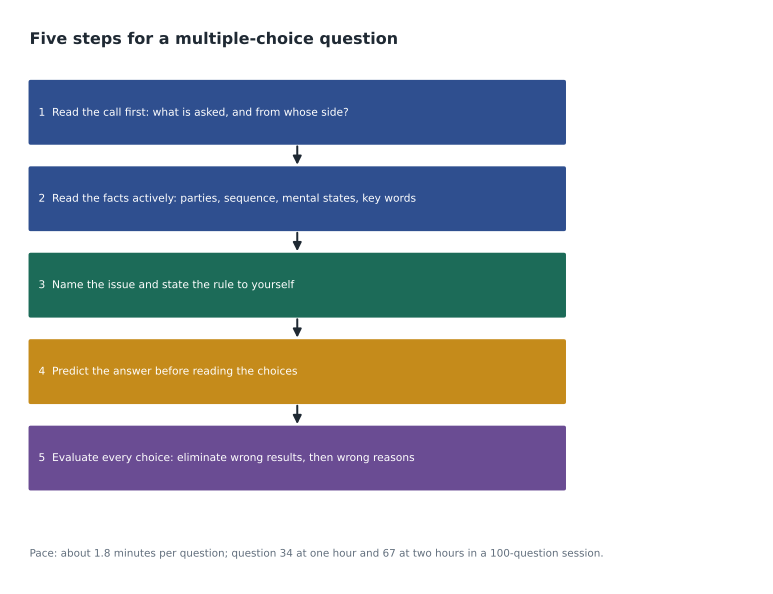
Vantreese teaches five steps and asks the students to use them on every practice question until they no longer think about them.
Step one: read the call first. The call tells you what to look for in the facts and often identifies the subject and the posture. A call that asks about a motion for summary judgment tells you to think about genuine disputes of material fact. A call that asks for the defendant's best defense tells you the plaintiff probably has a claim. A call that asks which fact would most help the plaintiff tells you to look for an element in doubt.
Step two: read the facts actively. Note who the parties are and how they are related, the sequence of events, any dates or time periods, the mental states of the actors, and words that carry legal weight: "reasonably believed", "in writing", "without permission", "for value", "recorded". In a criminal question the defendant's intent usually decides the case. In a property question the order of conveyances and recordings decides it. In an evidence question the purpose for which the evidence is offered decides it.
Step three: identify the issue and state the rule. Before looking at the answers, name the issue in a few words, such as "hearsay, excited utterance" or "consideration, preexisting duty", and state the rule to yourself. This step is the main defense against distractors, because it makes the applicant decide what the law is before seeing wrong answers that sound plausible.
Step four: predict the answer. Apply the rule to the key facts and predict the outcome. Sometimes the prediction will be exact; often it will be a direction, such as "the plaintiff should win because the statement was not offered for its truth".
Step five: evaluate the choices. Read every choice. Eliminate any that reach the wrong result. Among those that reach the right result, eliminate any that give the wrong reason, misstate the rule or rely on facts not in the question. Choose the best remaining answer. If two remain, return to the call and the facts; the difference between them is usually a fact the applicant passed over.
Patterns in wrong answers
Distractors follow recognizable patterns, and naming them helps applicants spot them.
- Right result, wrong reason. The answer says the plaintiff wins, which is correct, but because of a rule that does not apply. On "Yes, because" questions the reason must be correct and sufficient.
- The minority rule or a rule from another subject. The answer states a rule that some jurisdictions follow or that belongs to another area, such as applying the common law mailbox rule to a contract for goods where the UCC has a different provision on the point.
- A true statement that does not answer the question. The answer correctly states the law on something, but not on the issue the call asks about.
- An absolute word. Answers that say "always", "never", "only" or "must" are often, though not always, wrong because legal rules usually have exceptions.
- A fact not in the question. The answer depends on an assumption that the facts do not support, such as assuming a defendant knew something the facts do not say.
- The emotionally satisfying answer. The answer punishes the bad actor in the facts, even though the law does not.
Words in the answer choices matter. "Because" requires the reason to be sufficient to produce the result. "If" requires only that the condition, if true, produce the result. "Unless" means the result follows except when the condition is met. Applicants who misread these connectors miss questions they understand.
Pacing
With 100 questions in three hours, the applicant should be at about question 34 after one hour and question 67 after two hours, leaving a few minutes at the end. Applicants should wear a watch if allowed, or use the clock provided, and check pace at those two points rather than after every question. If a question is taking much longer than average, the applicant should choose the best answer available, mark it for review and move on. There is no penalty for wrong answers, so applicants must answer every question; an unanswered question is a guaranteed miss.
Long fact patterns tempt applicants to skim. Vantreese recommends the opposite: read long questions at normal speed and spend the time saved on short questions, which often test a single precise rule.
How to practice
Practice is useful only if it is reviewed. Vantreese gives four rules for practice sets. First, do them timed and in mixed subjects once the build phase is over, because that is how the exam works. Second, review every question, including those answered correctly, because a correct answer for the wrong reason is a future wrong answer. Third, keep an error log with three columns: the subject and rule, what went wrong and what to do next time. Fourth, use the log to drive rule study: if the log shows four misses on the hearsay exception for statements against interest, the student should reread that rule and do ten more questions on it.
The "what went wrong" column should be specific. Vantreese suggests a small set of categories: did not know the rule; knew the rule imperfectly; misread the facts; misread the call; fell for a distractor pattern; changed a correct answer; ran out of time. Over a few weeks the categories show what kind of problem the applicant has, which is more useful than the overall percentage. Students should use released NCBE questions and the questions in good commercial courses; questions written carelessly elsewhere can teach the wrong lessons.
Changing answers
Applicants often ask whether they should change answers. Research on multiple-choice tests generally finds that changes made for a reason, such as noticing a fact or recalling a rule, are more often from wrong to right than the reverse. Changes made from vague anxiety are not. Vantreese's rule: change an answer only if you can say in one sentence what fact or rule you missed the first time.
Stand-alone NextGen questions
Hannah's stand-alone questions on NextGen will look like MBE questions in many ways, and NCBE says early ones resemble the MBE. But some will have more than four choices, and some will ask her to select two answers, with partial credit possible. The method still works, with one change: on select-two questions, evaluate each choice independently against the rule and the facts, rather than looking for the single best answer. Pacing on NextGen is about 1.8 minutes per multiple-choice question as well, but the time is shared with integrated question sets and a performance task in each session, which Lesson 9 addresses.
Worked problem
Applying the method
Vantreese writes an original question on the board. A homeowner hired a contractor to build a deck for 12,000 dollars, payable on completion. Halfway through, the contractor said he would stop unless the homeowner agreed to pay 15,000 dollars because lumber prices had risen. Lumber prices had in fact risen about 10 percent. The homeowner signed a writing agreeing to pay 15,000 dollars. When the deck was finished, the homeowner paid 12,000 dollars. In the contractor's suit for the remaining 3,000 dollars, will he likely prevail? (A) Yes, because the modification was in a signed writing. (B) Yes, if the price increase was unforeseen and the modification was fair and equitable in light of it. (C) No, because a contract modification always requires new consideration. (D) No, because the homeowner signed under economic duress.
Show solution
- Call: will the contractor prevail on the modification. The subject is contracts, and the deck is a services contract governed by the common law, not the UCC.
- Facts: a midstream demand for more money, a price rise that happened but was modest, a signed writing, no new duty undertaken by the contractor.
- Issue and rule: the preexisting duty rule makes a promise to pay more for the same performance unenforceable for lack of consideration, but the modern rule in Restatement (Second) of Contracts section 89 enforces a modification that is fair and equitable in view of circumstances not anticipated when the contract was made.
- Prediction: the contractor wins only if the section 89 exception applies.
- Choices: (A) states a UCC-style approach to writings and is not the rule for services. (C) uses an absolute word and ignores the modern exception. (D) states a possible defense but the facts do not show an improper threat beyond a demand. (B) states the exception as a condition, which is the best answer.
Answer: (B). The question tests whether the applicant applies the common law rather than the UCC and knows the modern exception to the preexisting duty rule. The connector "if" makes (B) correct even though the facts leave the condition uncertain.
Subject-specific habits
Each MBE subject has habits that prevent common errors. In civil procedure, identify whether the question is about jurisdiction, pleading, discovery, trial or judgments before thinking about rules. In constitutional law, identify the government actor and the source of power or the right at stake, then the level of scrutiny. In contracts, decide first whether the UCC or the common law governs. In criminal law, identify the mental state and whether the question tests common law or the Model Penal Code. In evidence, ask for what purpose the evidence is offered. In real property, draw a quick timeline of conveyances and recordings. In torts, list the elements and check each against the facts. Daniel copies the list onto an index card and reviews it before every practice set for two weeks.
Common mistakes
MistakeReading the answer choices before forming a view of the rule.
InsteadRead the call and facts, state the rule and predict before reading the choices.
MistakeAccepting an answer with the right result and an inadequate reason.
InsteadOn "because" answers, the reason must be correct and sufficient.
MistakeSkipping difficult questions and leaving them blank.
InsteadThere is no penalty for wrong answers; answer every question and mark difficult ones for review.
MistakeReviewing only questions answered incorrectly.
InsteadReview every question; a right answer for the wrong reason is a future miss.
MistakeApplying the UCC to a services contract or the common law to a sale of goods.
InsteadIdentify the governing law first; the MBE tests the distinction often.
Summary and key terms
- Each MBE question has facts, a call and four choices; the 175 scored questions are spread evenly across seven subjects.
- The legacy MBE allows about 1.8 minutes per question; check pace at question 34 and question 67 in each session.
- Use five steps: read the call, read the facts actively, state the rule, predict, then evaluate every choice.
- Distractors follow patterns: right result with the wrong reason, minority rules, true but irrelevant statements, absolute words, unsupported facts.
- Answer every question; there is no penalty for guessing.
- Practice timed, mixed sets, review every question and keep an error log with specific categories.
- NextGen stand-alone questions resemble the MBE but may have more choices or ask for two answers.
- Call of the question
- The sentence that states what the question asks, such as which party will prevail or which argument is strongest.
- Distractor
- A wrong answer choice designed to attract applicants who know the rule imperfectly or misread the facts.
- Error log
- A record of practice mistakes by subject, rule and cause, used to direct further study.
- Generally accepted rule
- The majority or uniform rule the MBE tests unless a question states otherwise.
- Select-two question
- A NextGen multiple-choice question that asks for two correct answers and may award partial credit.
- Pretest question
- An unscored question included to test it for future use; it looks like any other question.
Practice problems
Work each problem on paper first, then reveal the answer to check.
Original question. A pedestrian sued a driver for injuries in a crash. At trial the pedestrian offers testimony from a bystander that, seconds after the crash, another bystander screamed, "That car just ran the red light!" The driver objects. Is the testimony admissible?
Show answer
Yes, likely as an excited utterance under Federal Rule of Evidence 803(2), because the statement related to a startling event and was made while the declarant was under the stress of excitement it caused. The declarant's availability is immaterial for this exception.
Original question. A state law requires all commercial trucks on state highways to use a special mudguard that only one manufacturer, located in the state, produces; neighboring states require a different design. An out-of-state trucking company challenges the law. What is its strongest argument?
Show answer
That the law violates the dormant Commerce Clause by unduly burdening interstate commerce, and possibly by discriminating in favor of an in-state manufacturer, since the burden on interstate trucks is substantial and the safety benefit unproven.
A student's error log shows ten misses in real property, eight labeled "misread the facts". What is the best response?
Show answer
Practice reading property facts more carefully, for example by noting each conveyance, its date and whether and when it was recorded before answering, rather than only rereading the property outline.
With 100 questions in three hours, where should an applicant be at the two-hour mark?
Show answer
At about question 67.
Lesson quiz · 5 questions
Score 60% or more to complete this lesson.
Create a free account to save your progress, take quizzes and earn a certificate.