
LAWU-314 · Lesson 1 of 12 · 24 min
How the bar exam works
▶ Video coming soon A video version of this lesson is on the way.
Professor Gwyneth Vantreese opens the last course Section B will take at Larkhaven by setting a kitchen timer on the lectern and starting it. It runs for ninety seconds while she says nothing. When it rings, she asks how many of them spent the silence thinking about something other than law. Every hand goes up. "That," she says, "is the problem this course solves. The bar exam is not mainly a test of how much law you know. You already know a great deal of law. It is a test of whether you can find the right rule, apply it to facts you have never seen and do it again two hundred times while a clock runs. We are going to train that." Before she came to Larkhaven she spent eight years as a litigator, six years as a volunteer essay grader for a state board of law examiners and five years running the law school's academic success program. She teaches this course in the third-year winter term, in sessions that are not dated on the syllabus, because each student in the room will sit for a different exam in a different place.
The five students who have been together since their first week of Civil Procedure are all in the room. Daniel Reyes plans to go home to El Paso and sit for the Texas exam. Hannah Lindqvist has a job offer in Minneapolis and will sit for Minnesota's first NextGen administration. Marcus Webb is headed back to Atlanta and the Georgia exam. Priya Natarajan has an appellate clerkship lined up in New York and will sit there, with an eye on New Jersey later. Jordan Kimura is going home to Honolulu and the Hawaii exam. Vantreese says the mix is deliberate: by the end of the term each of them will be able to read any jurisdiction's rules and know what they mean for a study plan.
Who licenses lawyers
There is no national law license in the United States. Each state, the District of Columbia and each territory decides who may practice law there, and in nearly every jurisdiction the decision belongs to the highest court. The court adopts admission rules and appoints a board of law examiners, sometimes called a board of bar examiners or a committee of bar examiners, to run the process. The board reviews applications, gives the exam, investigates character and fitness and recommends applicants for admission. The court then admits them, usually at a ceremony where new lawyers take an oath.
Because the authority is local, so are the details. Filing deadlines, fees, the exam format, the passing score, how long a score stays valid, whether the jurisdiction adds a local law component and whether it lets lawyers from elsewhere in without an exam are all set jurisdiction by jurisdiction. Vantreese puts it plainly: "The single most important document in your bar preparation is not an outline. It is your jurisdiction's admission rules, and the second most important is the board's current instructions for your exam."
A national organization supplies most of the tests. The National Conference of Bar Examiners, usually called NCBE, is a nonprofit that writes the Multistate Bar Examination (the MBE), the Multistate Essay Examination (the MEE), the Multistate Performance Test (the MPT), the Multistate Professional Responsibility Examination (the MPRE) and the new NextGen bar exam. NCBE does not admit anyone. Jurisdictions decide which of its tests to use, whether to add their own and what score passes. For the written parts of the legacy exam, graders in each jurisdiction read the answers, using analyses and grading materials NCBE prepares.
The five pieces of licensure
Every jurisdiction's requirements fall into a handful of categories. Vantreese draws them as five boxes and tells the class that a missing box is as fatal as a failed exam.
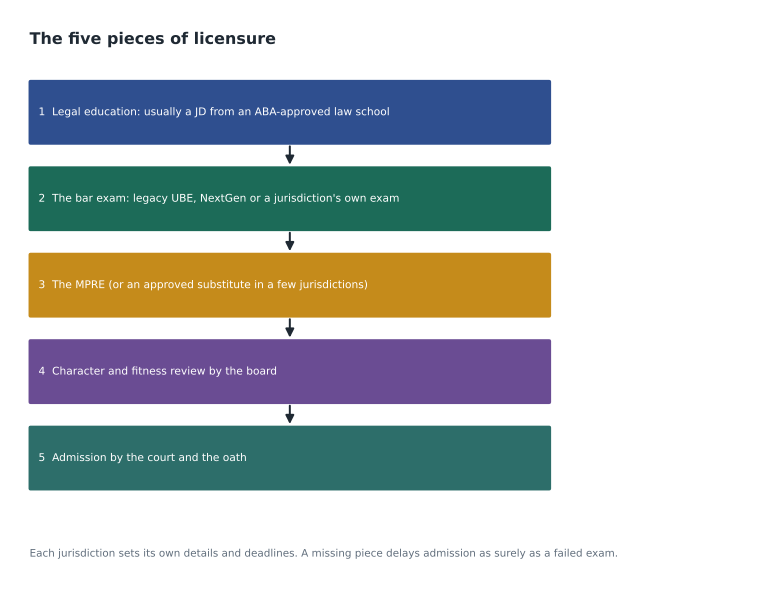
- Legal education. Most jurisdictions require a JD from a law school approved by the American Bar Association. A few accept other routes, such as study in a law office under a lawyer's supervision, and some states have begun opening the door to schools approved by other accreditors. Texas finalized the end of its ABA-only rule in January 2026, and Florida authorized other accreditors approved by its supreme court from October 1, 2026. Foreign-educated lawyers face separate rules that vary widely.
- The bar exam. In most jurisdictions this is either the legacy Uniform Bar Examination or the NextGen bar exam, sometimes with a local component. A few jurisdictions write their own exam, usually alongside the MBE.
- The MPRE. Almost every jurisdiction requires a passing score on this two-hour ethics exam, though the score required varies. Wisconsin and Puerto Rico do not require it, and Connecticut and New Jersey accept a qualifying law school professional responsibility course as an alternative.
- Character and fitness. The board investigates whether the applicant has the honesty, diligence and judgment to be trusted with clients' affairs. Lesson 3 covers it in detail.
- Admission. After all of the above, the court admits the applicant. Some jurisdictions add conditions before or soon after admission, such as New York's pro bono and skills requirements, a professionalism course or a period of mentoring.
The pieces of the legacy exam
Until the transition described below is complete, most applicants will meet the same three NCBE tests in some combination. The MBE is a multiple-choice exam of 200 questions given in two three-hour sessions of 100 questions each. Of the 200, 175 are scored and 25 are unscored pretest questions that look exactly like the others. The scored questions are divided evenly, 25 each, among seven subjects: civil procedure, constitutional law, contracts, criminal law and procedure, evidence, real property and torts. The MEE is six essay questions, each answered in 30 minutes, in a three-hour session. Since July 2026 its subjects are business associations (agency and partnership, corporations and limited liability companies), civil procedure, constitutional law, contracts including Article 2 of the Uniform Commercial Code, criminal law and procedure, evidence, real property and torts. NCBE removed conflict of laws, family law, trusts and estates and secured transactions from the MEE starting with the July 2026 exam. The MPT is a pair of 90-minute tasks, each giving the applicant a file of facts and a library of law and asking for a document a new lawyer might write.
In a jurisdiction that gives the legacy Uniform Bar Examination, these three tests are combined: the MPT on Tuesday morning, the MEE on Tuesday afternoon and the MBE on Wednesday. The MBE counts for 50 percent of the total, the MEE for 30 percent and the MPT for 20 percent. The result is a UBE score on a 400-point scale. Jurisdictions set their passing score, which ranges from 260 to 270 in UBE jurisdictions. Because the score is uniform, it can be transferred to other UBE jurisdictions within the time each allows, which is the main reason the UBE spread.
How the exam is scored
Bar scores are scaled, not raw. Vantreese spends time here because misunderstanding scoring causes more anxiety than any other single topic. The MBE is equated: NCBE uses questions that have appeared on earlier exams to adjust for differences in difficulty between administrations, so that a given scaled score means the same level of performance whether the exam was hard or easy. A student who gets 125 of 175 scored questions right on a harder form may receive the same scaled score as a student who gets 129 right on an easier form.
Written answers are graded differently. In the legacy system, graders in each jurisdiction read the MEE and MPT answers and give each a grade on a relative scale, often 1 to 6. A grade of 4 does not mean the answer was right on four points out of six; it means the answer was better than most in that pile. The jurisdiction then scales the written grades to the MBE, so that the distribution of written scores in that jurisdiction matches the distribution of MBE scores for the same group. The practical consequence is that the written portion rewards being clearly better than the typical answer, not being perfect.
The NextGen bar exam reports a single score on a 500 to 750 scale. NCBE scores the multiple-choice questions, jurisdictions grade the written responses using NCBE's rubrics, and jurisdictions set the passing score, most between 610 and 620. NCBE tells candidates not to compare NextGen scores numerically with legacy UBE scores.
Who uses what
The landscape in late 2026 is unusually varied because the profession is in the middle of a change. The large majority of jurisdictions give the legacy UBE or have begun giving the NextGen bar exam. Others write their own exams. California gives the MBE, five essays and a performance test drafted by its State Bar. Florida uses its own Part A of essays and multiple-choice questions on Florida law with the MBE as Part B. Georgia gives the MBE with two MPTs and four Georgia-drafted essays. Louisiana, the one civil-law state, gives its own series of tests and does not use the MBE at all. Hawaii combines the MBE, MEE and MPT with its own short legal ethics exam on a 200-point scale. Nevada replaced its traditional exam in 2026 with a plan that separates a foundational law exam, a lawyering performance exam and supervised practice. The point is not to memorize this list but to see that "the bar exam" means different things in different places.
The calendar
Bar exams are given twice a year, on the Tuesday and Wednesday at the end of February and the end of July. The next dates are February 23 and 24, 2027; July 27 and 28, 2027; and February 22 and 23, 2028. Section B will sit on July 27 and 28, 2027, about ten weeks after graduation. Results typically come out in the fall, at different times in different jurisdictions, and swearing-in ceremonies follow.
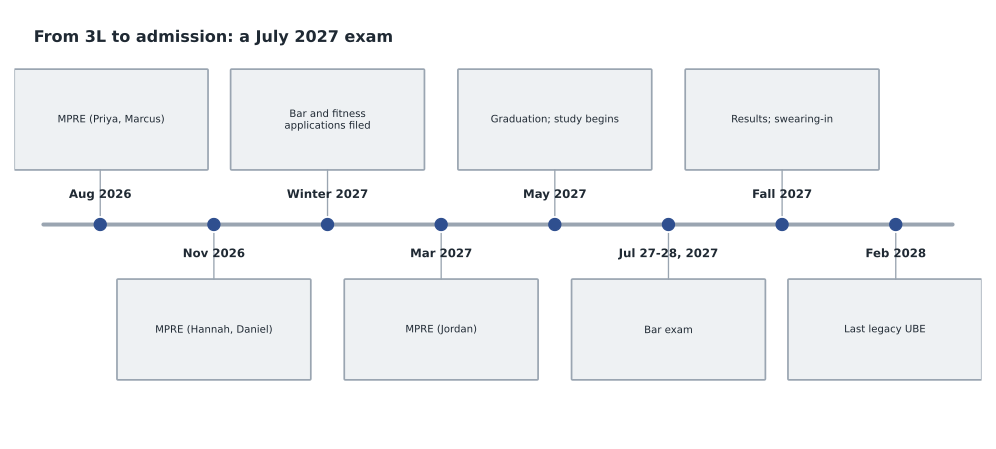
Jordan, who as an Army logistics officer planned convoys backward from the arrival date, asks the class to do the same. Working back from July 27, the steps are: the commercial or self-study course during the summer, the application filed by the jurisdiction's deadline, the MPRE taken in time for the score to count, the character and fitness application completed, and transcripts and law school certifications sent after graduation. Several of these have to be started during the term they are sitting in.
What passing rates tell you
Pass rates are a crude measure, but they tell students where the risk is. NCBE reported that 2,630 examinees received scores on the first NextGen administration in July 2026; 72.7 percent passed overall, 85.2 percent of first-time takers passed and 41.0 percent of repeat takers passed. California, which has one of the highest passing lines in the country, reported a July 2026 pass rate of 48.3 percent overall and 64.7 percent for first-time takers. Across jurisdictions the pattern is consistent: first-time takers from ABA-approved schools pass at high rates, and repeat takers pass at much lower rates. Vantreese draws one lesson from that pattern. "The cheapest bar exam you will ever take is the first one. Preparing properly once costs ten weeks. Failing costs six more months, a second fee and often a job offer."
Priya asks whether the rates mean the exam is easy for first-time takers. Vantreese says no: they mean that most first-time takers prepare seriously, because most of them have jobs waiting. The students who fail on the first try are disproportionately those who worked full time during preparation, started late, skipped practice essays or never took a full timed practice exam. Those are choices, not destiny, and the course is built to make the right choices easy.
The transition years
The NextGen bar exam was first given in July 2026 in a group of early-adopting jurisdictions. More join in each administration through July 2028. NCBE will give the legacy MBE, MEE and MPT for the last time in February 2028. For a student graduating in 2027 this produces a real question: which exam will I take? Hannah will take NextGen in Minnesota in July 2027. Daniel, Marcus, Priya and Jordan will take legacy or jurisdiction-specific formats, because Texas, Georgia and New York do not switch until July 2028 and Hawaii writes its own exam. Lesson 4 covers the two formats in detail. The rule for now is to confirm, from the board's own website, exactly which exam the jurisdiction will give on your date.
How this course is built
The course follows the order a careful applicant should follow. The first five lessons are about knowing the target: how licensure works, choosing a jurisdiction, character and fitness and the MPRE, the two exam formats and a study plan. Lessons 6 through 9 teach a method for each kind of question: the MBE, the MEE, the MPT and NextGen's integrated question sets and performance tasks. Lesson 10 runs review sprints through the most tested rules. Lesson 11 covers wellbeing, testing accommodations, exam day and the first year of practice. Lesson 12 is a full original practice set with a debrief.
Students who want a deeper treatment of any single piece can continue in the US Bar Exam Preparation program, which has full courses on bar admission, MBE review, the MEE, the MPT, the NextGen exam and the MPRE, and a course for each jurisdiction. This course is the law school's capstone: it ties those pieces to what Section B already knows from three years of classes.
Worked problem
Reading the target for one applicant
Vantreese asks Daniel to state, in one paragraph, exactly what he must do to be licensed in Texas after a July 2027 exam, using only what he has learned so far, and then to list what he still has to look up.
Show solution
- Education: Daniel will have a JD from an ABA-approved school, which satisfies Texas.
- Exam: Texas gives the legacy UBE through February 2028, with a passing score of 270, and it moves to NextGen in July 2028. Daniel will sit for the legacy UBE in July 2027.
- Local component: Texas requires its Texas Law Component, which until NextGen arrives is satisfied by completing an online Texas Law Course.
- MPRE: Texas requires a scaled score of 85.
- Character and fitness: Texas investigates through its Board of Law Examiners; Daniel filed his Declaration of Intention to Study Law in his first year, which starts the investigation early.
- Still to look up: the current application deadlines for July 2027, the fee for his category, the deadline for completing the Texas Law Course and the documents due after graduation.
Answer: Daniel's paragraph names all five boxes and identifies four specific items to check on the Board's website. Vantreese's comment is that the paragraph is correct but would be useless without dates, so his first assignment is to turn the list into a calendar.
A vocabulary for the course
Vantreese closes the first class with vocabulary the students will use all term. An administration is one sitting of the exam, such as July 2027. A component is one part of an exam, such as the MBE. A jurisdiction is any licensing authority: a state, the District of Columbia or a territory. A scaled score is a score adjusted to a common scale. Equating is the statistical process that keeps scaled MBE scores comparable across administrations. Portability is the ability to use a score in more than one jurisdiction. A cut score or passing score is the minimum total that passes in a given jurisdiction. She asks them to use these words precisely, because loose talk about "getting a 270" or "passing the MBE" causes real mistakes. In a UBE jurisdiction you do not pass the MBE; you pass the exam, by combining scores.
Common mistakes
MistakeTreating NCBE as the body that admits lawyers or sets the passing score.
InsteadNCBE writes and scores tests. Each jurisdiction's highest court and board decide which tests to use, the passing score and who is admitted.
MistakeAssuming the bar exam is the same everywhere.
InsteadFormats differ: legacy UBE, NextGen, state-drafted exams and hybrids. Confirm the exact format for your jurisdiction and date.
MistakeReading a written grade of 4 as four points out of six.
InsteadWritten grades in the legacy system are relative rankings within a jurisdiction, then scaled to the MBE.
MistakeThinking that a hard MBE form will lower your score.
InsteadEquating adjusts for the difficulty of each administration, so the scaled score reflects performance, not luck of the form.
MistakeStarting the admission paperwork after graduation.
InsteadThe MPRE, the character and fitness application and some local requirements must be started during law school.
Summary and key terms
- Each jurisdiction's highest court licenses lawyers through a board of law examiners; there is no national license.
- Licensure has five pieces: legal education, the bar exam, the MPRE, character and fitness and admission by the court.
- NCBE writes the MBE, MEE, MPT, MPRE and NextGen exam, but jurisdictions choose the tests, grade the written parts and set the passing score.
- The legacy UBE combines the MBE (50 percent), MEE (30 percent) and MPT (20 percent) into a score on a 400-point scale; passing scores range from 260 to 270.
- The NextGen exam reports one score from 500 to 750; most jurisdictions set passing scores between 610 and 620.
- MBE scores are equated across administrations; legacy written grades are relative and scaled to the MBE.
- The legacy exam ends in February 2028, and jurisdictions move to NextGen on different dates between July 2026 and July 2028.
- Board of law examiners
- The body appointed by a jurisdiction's highest court to run bar admission, including the exam and the character and fitness review.
- NCBE
- The National Conference of Bar Examiners, the nonprofit that writes the MBE, MEE, MPT, MPRE and NextGen bar exam.
- Uniform Bar Examination (UBE)
- The combination of the MBE, MEE and MPT, graded and scored uniformly so that the score can be transferred among participating jurisdictions.
- Scaled score
- A score converted to a common scale so that results from different administrations or components can be compared and combined.
- Equating
- The statistical adjustment that keeps scaled MBE scores comparable across exam forms of different difficulty.
- Portability
- The ability to use a bar exam score for admission in more than one jurisdiction.
- Administration
- One sitting of the exam, such as the July 2027 bar exam.
Practice problems
Work each problem on paper first, then reveal the answer to check.
A classmate says, "NCBE failed me." What is wrong with that statement?
Show answer
NCBE scores the multiple-choice questions and supplies tests and grading materials, but the jurisdiction grades the written answers, sets the passing score and decides who is admitted. The jurisdiction, not NCBE, determines whether the applicant passed.
An applicant in a UBE jurisdiction receives a scaled MBE score of 128 and is upset because she heard you need 135 to pass. What should she understand?
Show answer
In a UBE jurisdiction there is no separate passing score on the MBE. The MBE counts for half of a combined score on a 400-point scale, and strong written scores can carry a weaker MBE. What matters is the total against the jurisdiction's passing score.
Why might a student who plans to practice in two neighboring states care whether both use the UBE?
Show answer
A UBE score can be transferred to another UBE jurisdiction within the time it allows and if it meets that jurisdiction's passing score, which can avoid a second exam. A state that writes its own exam will usually require its own exam.
List three admission tasks that a third-year student should begin before graduation.
Show answer
Taking the MPRE in time for the score to count, filing the character and fitness or bar application by the jurisdiction's deadline and completing any local requirements that can be done before admission, such as a jurisdiction's online law course.
Lesson quiz · 5 questions
Score 60% or more to complete this lesson.
Create a free account to save your progress, take quizzes and earn a certificate.