
LAWU-314 · Lesson 3 of 12 · 20 min
Character and fitness and the MPRE
▶ Video coming soon A video version of this lesson is on the way.
Vantreese starts the third session by reading aloud, without names, a short list of things that have delayed the admission of graduates she has advised: a traffic ticket that turned into a bench warrant when the student moved and never saw the notice, a student loan in default, an undisclosed college disciplinary finding for plagiarism, an old arrest for possession that was expunged and therefore not disclosed, and a landlord's judgment for unpaid rent. "None of these people were denied admission," she says. "Most of them were delayed, and the ones who were delayed longest were the ones who did not tell the board the truth the first time." The lesson of the day is that character and fitness is mostly about candor, and the MPRE is mostly about reading rules carefully.
What character and fitness asks
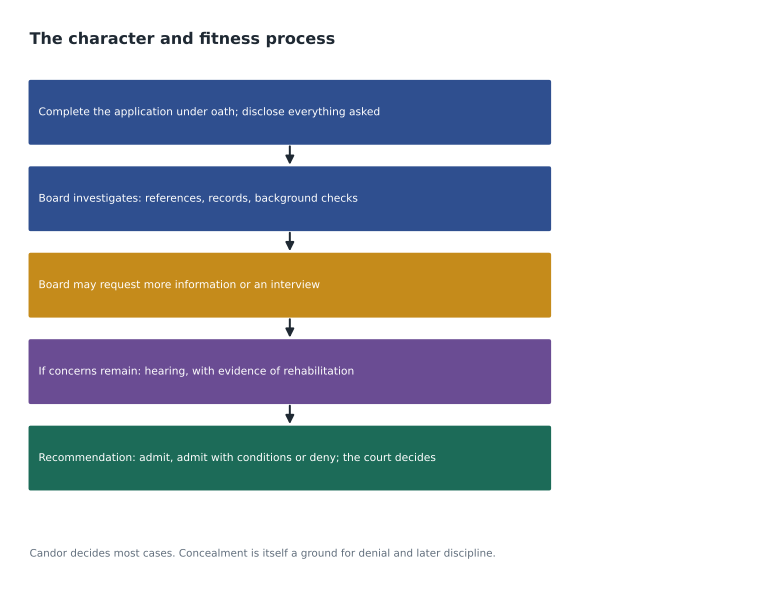
Every jurisdiction requires applicants to show that they have the character and fitness to practice law. The inquiry looks at past conduct as evidence of how the applicant will behave as a lawyer: whether clients can trust the applicant with their money and secrets, whether the applicant will be honest with courts and opponents, and whether the applicant will meet deadlines and obligations. The burden is on the applicant. Boards ask about criminal history, academic discipline, employment, finances, prior litigation, professional licenses and, in some jurisdictions, conduct-related questions about health. Applicants sign the application under oath, and false statements are themselves grounds for denial or, if discovered later, for discipline.
The Supreme Court has set constitutional limits on the inquiry. In Schware v. Board of Bar Examiners (1957), the Court held that a state may require high standards of qualification but that the standard must have a rational connection with fitness to practice, and that past membership in the Communist Party and the use of aliases decades earlier did not justify denying admission. In Konigsberg v. State Bar of California, decided the same year, the Court reversed a denial based on the applicant's refusal to answer questions about political associations, though the Court later upheld a denial for refusing to answer such questions when the refusal obstructed the investigation. The modern principle is that boards may investigate thoroughly, applicants must cooperate fully, and the decision must rest on conduct relevant to practice.
How boards evaluate conduct
Boards apply factors that are remarkably consistent across jurisdictions. Relevant conduct includes unlawful conduct, academic misconduct, false statements, acts of dishonesty or fraud, neglect of financial obligations, violation of court orders, evidence of a pattern of irresponsibility and conduct that reflects disregard for the rights of others. Boards then weigh how old the applicant was, how recent the conduct was, how serious it was, the circumstances, how reliable the information is, whether there was a pattern, whether the applicant has been candid and what evidence of rehabilitation there is. Rehabilitation evidence includes time without further problems, restitution, treatment where relevant, community service, letters from employers and supervisors, and, above all, a full and frank account of what happened.
Financial issues are a common source of delay. A student loan in default, unpaid judgments or tax problems suggest to a board that the applicant may mishandle client funds. Applicants with such issues should address them before filing if possible and explain them fully if not: a payment plan, a consolidation or a settlement agreement shows responsibility. Daniel mentions that he paid off a medical bill that went to collection two years ago; Vantreese says he should disclose it if the application asks about collections, attach proof of payment and move on.
Candor is the whole game
The single most important rule is to disclose. Applications usually ask about arrests and citations, not only convictions, and many ask about matters that were sealed or expunged; a board's question governs, not the applicant's view of what matters. Applicants should read each question literally, answer it fully and, when in doubt, disclose and explain. Model Rule 8.1, which most jurisdictions have adopted, makes it a disciplinary violation for a bar applicant to knowingly make a false statement of material fact in connection with an application or to fail to disclose a fact necessary to correct a misapprehension. A lawyer admitted on a false application can be disciplined years later, and the original conduct that was hidden is often less serious than the concealment.
Applicants should also make their law school records consistent with their bar application. Law school applications asked similar questions, and boards often obtain them. An arrest that was not disclosed to the law school should be disclosed both to the board and, through an amendment, to the school. Marcus asks what happens if the conduct is embarrassing but minor, like an underage drinking citation in college. Vantreese says it is exactly the kind of thing boards see every week and it rarely matters if disclosed, because it says little about fitness to practice; failing to disclose it says a lot.
Mental health questions
Bar applications have historically asked about mental health diagnoses and treatment. Since 2015 the American Bar Association has urged jurisdictions to limit questions to conduct and behavior rather than diagnosis or treatment, and many have done so; New York removed its mental health question in 2020. Where questions remain, they are often limited to whether a condition currently impairs the applicant's ability to practice. Vantreese tells the class that seeking help is not a reason for denial in any jurisdiction she knows of, and that students who need treatment should get it now rather than worry about a form; if a question applies, an honest answer showing that the applicant sought treatment and is managing a condition is evidence of good judgment.
Timing and conditional admission
Investigations take months, and a delayed application can delay admission even after the applicant passes. Applicants with issues should file early, gather records in advance and respond quickly to requests. Some jurisdictions offer conditional admission, under which an applicant with a history of substance use, financial problems or another concern is admitted subject to conditions such as monitoring, reporting or practice supervision for a period. If a board recommends denial, applicants usually have a right to a hearing and to review by the court, and many have successfully shown rehabilitation at that stage.
The MPRE
The Multistate Professional Responsibility Examination tests knowledge of the rules governing lawyer conduct. It is a computer-based exam given at testing centers three times a year. It has 60 multiple-choice questions, of which 50 are scored and 10 are unscored pretest questions, and applicants have two hours. Scores are reported on a scale from 50 to 150. The 2027 dates are March 23 and 24, August 18 and 19, and November 4 and 5, with registration deadlines of January 21, June 17 and September 21; NCBE does not offer late registration. The fee for 2026 and 2027 is 185 dollars.
Passing scores are set by each jurisdiction and range from 75 to 86. Georgia requires 75; Texas, Minnesota, New York and Hawaii require 85; California requires 86. Jurisdictions also set time limits on how old a score may be, so applicants should check whether a score earned in August 2026 will still be valid when they apply. New York accepts a score within four years before admission; other jurisdictions use shorter windows, such as two years before the bar exam. NCBE reported a mean MPRE score of 95.6 across administrations in 2025.
What the MPRE tests
The MPRE is based mainly on the ABA Model Rules of Professional Conduct and the ABA Model Code of Judicial Conduct, with some questions drawn from generally accepted principles in cases and the law of evidence and procedure, such as the attorney-client privilege and the work product doctrine. It does not test a jurisdiction's own variations. The most heavily tested areas are conflicts of interest, the client-lawyer relationship, client confidentiality and the regulation of the profession, followed by litigation and other forms of advocacy, communications about legal services, the lawyer's different roles, safekeeping property and judicial conduct.
Section B took Professional Responsibility in their second year, so much of this is review. Priya and Marcus took the MPRE in August 2026 and passed with scores of 112 and 92. Hannah and Daniel took it in November 2026 and are waiting for their scores. Jordan has registered for March 2027. Vantreese tells the waiting students to keep studying lightly until scores come out, because if either must retake, March 2027 is the last administration that gives them a score in time for most July application deadlines.
How to prepare for the MPRE
Most students need two to four weeks of focused preparation. The work is to learn the Model Rules' specific wording, because many questions turn on the difference between "shall" and "may", between "knows" and "reasonably should know" and between informed consent and informed consent "confirmed in writing" or "in a writing signed by the client". Students should practice with released and commercial questions and track mistakes by rule. Common traps include assuming that a lawyer must disclose a client's past crime (usually the lawyer may not), confusing the rules for former clients with the rules for current clients, and treating the attorney-client privilege as the same thing as the duty of confidentiality, which is much broader.
Vantreese gives the class her MPRE method, which mirrors the method for other multiple-choice questions taught in Lesson 6. Read the call of the question first, because it often asks whether the lawyer is "subject to discipline", which is the standard of the Model Rules, rather than whether the lawyer acted wisely. Identify which rule governs. Look for the trigger words in the facts: knowledge, consent, writing, fees. Then choose the answer that states the rule and the right reason. Many wrong answers reach the right result for the wrong reason.
Worked problem
A disclosure decision
Jordan's application for Hawaii asks whether he has ever been charged with any violation of law other than minor traffic violations. In the Army he received an administrative reprimand for a vehicle accident while on duty, and as a nineteen-year-old he was cited for disorderly conduct after an argument outside a concert; the charge was dismissed. He asks whether he must disclose either.
Show solution
- Read the question literally: it asks about charges, not convictions. A dismissed citation for disorderly conduct is a charge.
- Disclose the citation and its dismissal, with the date, the court and a short factual explanation.
- The military reprimand was not a charge of a violation of law, but many applications ask separately about military discipline. Check the application's other questions; if one asks about military service records or discipline, disclose it there.
- Attach documents where available: the dismissal order and his discharge papers.
- Keep the explanation factual and short; take responsibility without minimizing.
Answer: Jordan should disclose the dismissed citation under the charges question and disclose the reprimand if another question reaches it. Neither is likely to affect admission if disclosed; either could become a serious problem if a board found it on a background check after he left it out.
Preparing the application
Vantreese gives the class a practical routine for the character and fitness application. Gather documents before starting: every address for the period the application covers, employers and supervisors with contact details, any court or disciplinary records, credit reports and law school and college disciplinary records. Read every question to the end before answering any, because later questions sometimes clarify earlier ones. Answer in full sentences when explanation is needed and attach documents rather than paraphrasing them. Keep a complete copy of everything filed. And tell references in advance that the board may contact them, so that they respond promptly. Applications often ask for every residence and job over many years, and incomplete histories are among the most common reasons for delay.
Common mistakes
MistakeLeaving out an expunged or dismissed matter because it no longer appears on a record.
InsteadAnswer the question as written; many applications ask about arrests, charges and sealed matters expressly.
MistakeAssuming a past problem will cause denial and hiding it.
InsteadMost past problems cause no denial if disclosed and explained; concealment is itself a basis for denial and later discipline.
MistakeIgnoring the time limit on an MPRE score.
InsteadEach jurisdiction limits how old a score may be; check the window for your application date.
MistakeStudying a jurisdiction's own ethics rules for the MPRE.
InsteadThe MPRE tests the ABA Model Rules and Model Code of Judicial Conduct, not state variations.
MistakeTreating privilege and confidentiality as the same.
InsteadConfidentiality under Model Rule 1.6 covers all information relating to the representation; the evidentiary privilege is narrower.
Summary and key terms
- Character and fitness asks whether past conduct shows the honesty, diligence and judgment needed to practice; the applicant bears the burden.
- Schware and Konigsberg require a rational connection between the reason for denial and fitness to practice, while applicants must cooperate fully.
- Boards weigh age, recency, seriousness, pattern, candor and rehabilitation.
- Candor is decisive: answer each question literally and fully; Model Rule 8.1 makes false statements and material omissions a disciplinary violation.
- Many jurisdictions now ask about conduct rather than mental health diagnoses; seeking treatment is not a reason for denial.
- The MPRE has 60 questions (50 scored) in two hours, is scored from 50 to 150 and is offered three times a year with no late registration.
- Jurisdictions require MPRE scores from 75 to 86 and set their own time limits on score age.
- Character and fitness
- The board's review of an applicant's past conduct to determine whether the applicant can be trusted to practice law.
- Rehabilitation
- Evidence that an applicant has addressed past misconduct, such as time without problems, restitution and candor.
- Conditional admission
- Admission subject to conditions such as monitoring or reporting for a period, used in some jurisdictions.
- MPRE
- The Multistate Professional Responsibility Examination, a two-hour, 60-question ethics exam scored from 50 to 150.
- Model Rule 8.1
- The rule making it misconduct for a bar applicant to make a knowing false statement of material fact or to fail to correct a misapprehension.
- Subject to discipline
- The MPRE's usual standard, asking whether conduct violates the Model Rules.
Practice problems
Work each problem on paper first, then reveal the answer to check.
An applicant had a credit card debt sent to collection three years ago and has now paid it. The application asks about debts more than 90 days overdue in the past five years. What should she do?
Show answer
Disclose the debt, explain the circumstances and attach proof that it has been paid. Paid debts disclosed candidly are rarely a problem.
Why did the Court in Schware find that the denial violated due process?
Show answer
The state's reasons, decades-old party membership and use of aliases with no showing of dishonest purpose, had no rational connection with the applicant's present fitness to practice law.
A student scored 84 on the MPRE and will apply in a jurisdiction requiring 85. What are her options?
Show answer
Retake the MPRE at the next administration whose score will arrive in time, or consider a jurisdiction that requires a lower score if her plans allow. She cannot round up.
Why does Vantreese tell students to read whether a question asks if a lawyer is "subject to discipline"?
Show answer
Because the MPRE often asks whether conduct violates the Model Rules, not whether it was wise or customary, and the answer can differ.
Lesson quiz · 5 questions
Score 60% or more to complete this lesson.
Create a free account to save your progress, take quizzes and earn a certificate.