
LAWU-314 · Lesson 8 of 12 · 20 min
Performance tests (MPT)
▶ Video coming soon A video version of this lesson is on the way.
Vantreese tells the class that the performance test is the part of the bar exam most like practice and the part most students prepare for least. "For three years you have read cases someone else chose and answered questions someone else wrote," she says. "On the MPT, someone hands you a file, a stack of law and a memo from a partner who is busy, and you have ninety minutes to give her something she can use. That is a Tuesday at a law firm." Marcus, who will write two MPTs on Georgia's first day, asks whether there is a trick. Vantreese says there is a method, and that the method is mostly about following instructions.
What the MPT is
The Multistate Performance Test consists of 90-minute tasks; UBE jurisdictions use two, and others use one or two. Each task has two parts. The File contains the source documents for the problem: a task memorandum from a supervising lawyer, and documents such as interview transcripts, letters, contracts, pleadings, police reports and emails. Some of the documents are irrelevant or contain conflicting facts, as in a real file. The Library contains the law: statutes, regulations, rules and cases, which may be real, modified or written for the exam. The problems are set in fictional jurisdictions, such as the State of Franklin in the Fifteenth Circuit, so that applicants use only the law provided. NCBE's instructions say that an applicant's general knowledge of the law may provide background, but the problem must be answered on the basis of the Library.
The task might be an objective memorandum, a persuasive brief, a letter to a client or opposing counsel, a demand letter, proposed contract or will provisions, a discovery plan, a closing argument or a set of interview questions. The skills tested are the ones NCBE has long described: problem solving, legal analysis and reasoning, factual analysis, communication, organization and management of a legal task, and recognizing and resolving ethical dilemmas. In the legacy UBE the two MPTs count for 20 percent of the total score, which makes each one worth roughly as much as two MEE essays. In jurisdictions such as Georgia that weight the MPT more heavily, it matters even more.
Because the law is supplied, the MPT is also where family law and trusts and estates may appear on the legacy exam through February 2028. A task might ask for a memo on a premarital agreement or a will provision, with every rule needed in the Library.
The time budget
NCBE's instructions suggest that applicants spend about half of the 90 minutes reading and organizing and half writing. Vantreese recommends a sequence.
Read the task memo first and read it twice. It tells the applicant who the client is, what document to write, for whom, in what format, and sometimes what not to address. Many memos include a separate formatting guideline, such as a firm's memo on how to write persuasive briefs or a template for a client letter. Following those instructions is the single most important source of points: NCBE's grading materials begin with whether the answer is responsive to the task.
Then skim the File to learn the story, and read the Library closely. Vantreese tells applicants to read the Library before studying the File in detail, because the law tells them which facts matter. For each case, extract the rule, the test or factors, and how the court applied them. Cases in the Library often build on one another: one states a general rule, a second adds an exception, a third applies the exception to facts like the client's. Some statutes have definitions sections that decide the problem.
Next, reread the important File documents with the rules in mind and build an outline that pairs each element or factor with the facts that bear on it. Note conflicts in the facts, gaps that need investigation and any ethical issue, such as a client's request that would require misleading a court. Then write.
Writing the document
The document should look like what the task memo asked for. A memo should have the headings the firm's format requires and an objective analysis that addresses weaknesses. A persuasive brief should have argument headings that state the conclusion the client wants and the reasons, a statement of facts if the memo asks for one, and an argument that uses the cases, distinguishing those that hurt and relying on those that help. A client letter should be written for a lay reader, without jargon, answering the client's question and explaining options. Proposed provisions should be drafted precisely, with a brief explanation if the memo asks for one.
Applicants should use the Library's cases by name and with their reasoning, as a lawyer would: "In Harlow, the court held that a seller's oral assurance created an express warranty because the buyer relied on it; here, the seller's email is even stronger evidence because it is written." They should not invent law or rely on law outside the Library. They should use facts from the File precisely, noting where facts are disputed or missing. And they should stay within the scope of the task: if the memo says not to address damages, an answer that discusses damages wastes time and may signal that the applicant did not read the instructions.
Common problems
The most common MPT failures are running out of time, writing the wrong kind of document and ignoring the Library in favor of remembered law. Running out of time usually comes from spending too long reading. Applicants should set a firm time to start writing, about 45 to 50 minutes into each task, and stick to it. Writing the wrong document usually comes from skimming the task memo; reading it twice fixes that. Ignoring the Library usually comes from overconfidence in a familiar subject. The Library may have modified a familiar rule deliberately.
Vantreese adds a fourth: missing the ethical issue. Many MPTs include a fact that raises a professional responsibility question, such as a client's suggestion to backdate a document, a contact with a represented opposing party or a conflict with another client. A strong answer notes it briefly and handles it properly, for example by explaining in the memo that the lawyer cannot make the requested argument and why.
An original practice task
Vantreese gives the class a short task set in Westmarch, the fictional state the Larkhaven faculty have used in earlier courses. The task memo, from a supervising partner named Wilda Gaudreau, asks for an objective memorandum on whether a client, a small catering company called Saffron Ladle Catering, may terminate its kitchen lease early under a Westmarch statute. The File includes the lease, emails with the landlord about a ceiling leak and a health inspector's report. The Library includes a fictional statute, Westmarch Code section 47-210, which allows a commercial tenant to terminate a lease if the premises become "unfit for the use for which they were leased" and the landlord fails to repair within 30 days after written notice, and two fictional Westmarch cases interpreting it.
Worked problem
Outlining the task
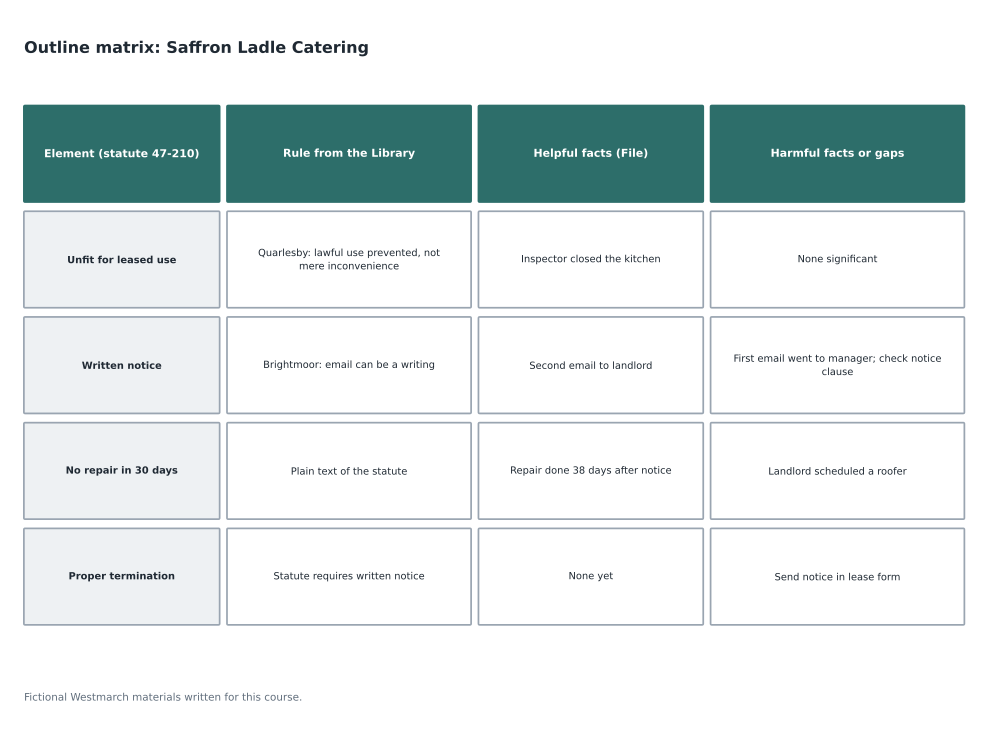
Using only the Library and File described, outline the memo's analysis in ten minutes.
Show solution
- Element one, unfitness: the first fictional case, Quarlesby v. Fenhollow Realty, holds that premises are unfit when a condition prevents lawful use for the leased purpose, not merely when it is inconvenient. The inspector's report ordered the kitchen closed until the ceiling was repaired, so the kitchen could not lawfully be used for catering. This element is likely met.
- Element two, written notice: the second fictional case, Brightmoor Bakery v. Dunscombe, holds that emails can satisfy the writing requirement if they describe the condition and ask for repair. Saffron Ladle Catering's first email went to the property manager; its second, to the landlord directly, came eleven days later. The memo should note that the 30-day period likely ran from the second email unless the manager was the landlord's agent for notices; the lease's notice clause must be checked.
- Element three, failure to repair within 30 days: the landlord's reply said a roofer was scheduled, but the File shows the repair was finished 38 days after the second email. The element is likely met, though the landlord may argue that scheduling the repair was enough.
- Element four, proper termination: the statute requires written notice of termination; the File does not show one yet. The memo should recommend sending it promptly and in the form the lease requires.
- Ethics: the client's owner asks in an email whether the firm can say the leak began earlier than it did. The memo should note that the firm cannot misrepresent facts.
Answer: The outline answers the partner's question element by element, identifies the weak point (which email started the 30 days) and recommends next steps. Vantreese notes that every part comes from the Library and File; nothing depends on real landlord and tenant law.
Practicing performance tests
Applicants should complete at least six to eight full MPTs under timed conditions during preparation, plus several outlines in 45 minutes. NCBE sells past MPTs with point sheets that explain what graders were looking for, and summaries of recent tasks are available. After each task, applicants should compare their answer with the point sheet: Did I write the right document in the right format? Did I use each Library case? Did I use the key facts? Did I address the ethical issue? Did I finish? Those who will take NextGen should practice NextGen performance tasks instead, which are shorter, about an hour, and may include research steps, as Lesson 9 explains, but the reading and organizing skills are the same.
Kinds of MPT documents
Each kind of document has its own conventions, and graders notice when they are followed. An objective memorandum to a supervising lawyer usually has a short statement of the question, a brief answer and a discussion organized by issue, and it addresses weaknesses candidly, because the supervisor needs to know them. A persuasive brief or memorandum of points and authorities uses argument headings that are full sentences stating the conclusion and the reason, such as "The lease is terminated because the landlord failed to repair within thirty days after written notice", and it acknowledges adverse authority only to distinguish it. A client letter opens with the answer to the client's question in plain language, explains the reasons without legal jargon and closes with options and next steps; it should not be condescending and should not include internal strategy the client could disclose. A letter to opposing counsel is firm and professional and avoids conceding facts. A set of contract or will provisions is drafted in precise operative language, with defined terms used consistently. A closing argument or opening statement is written to be heard: short sentences, a clear theme and the facts that support it.
Task memos often attach a firm guideline for the document type. When they do, the guideline controls even if it differs from what the applicant learned in legal writing. If the guideline says to omit a statement of facts, omit it. If it says to use headings in a particular form, use that form. The guideline is part of the test of following instructions.
Using the Library well
Strong MPT answers use the Library's cases the way a good lawyer uses precedent. They state the rule each case announces, explain the facts that mattered to the court and compare those facts with the client's. They notice when two cases point in different directions and explain which is more like the client's situation and why. They read statutes word by word, including definitions, exceptions and consequence clauses. And they notice dates: an older case may have been modified by a later case or by a statute in the Library. Weak answers summarize each case in turn, then summarize the facts, and leave the comparison to the reader.
Vantreese tells the class to treat the Library as if it were the only law in the world. Students who know a subject well are most at risk, because they reach for the rule they learned in class instead of the one on the page. The examiners sometimes modify a familiar rule precisely to see who reads carefully.
Common mistakes
MistakeSkimming the task memo and starting to write a familiar kind of memo.
InsteadRead the task memo twice and follow its format instructions exactly.
MistakeRelying on remembered law instead of the Library.
InsteadUse only the law provided; the Library may modify familiar rules.
MistakeReading for 70 minutes and writing for 20.
InsteadStart writing at about 45 to 50 minutes and finish the document.
MistakeIgnoring irrelevant or conflicting documents without saying so.
InsteadUse what matters, and note conflicts or gaps that affect the analysis.
MistakeMissing an embedded ethics issue.
InsteadLook for client requests or facts that raise professional responsibility questions, and address them briefly.
Summary and key terms
- The MPT gives a File of facts and a Library of law and asks for a lawyer's document in 90 minutes.
- Problems are set in fictional jurisdictions; answer from the Library, not from general knowledge.
- In the legacy UBE, two MPTs count for 20 percent of the score; some jurisdictions weight them more.
- Spend about half the time reading and organizing and half writing; read the task memo twice.
- Read the Library before studying the File in detail, and build an outline that pairs elements with facts.
- Write the document the memo asked for, in its format, using Library cases and File facts precisely.
- Watch for ethical issues, and complete at least six to eight timed MPTs with point-sheet review.
- MPT
- The Multistate Performance Test, a 90-minute task in which the applicant writes a legal document using a supplied file and library.
- File
- The MPT's source documents, including the task memo and factual materials.
- Library
- The MPT's legal materials: statutes, rules and cases that govern the problem.
- Task memo
- The supervising lawyer's instructions stating the assignment and its format.
- Point sheet
- NCBE's grading guide for a past MPT, describing what graders looked for.
- Responsiveness
- Whether the answer does what the task memo asked, the first thing graders consider.
Practice problems
Work each problem on paper first, then reveal the answer to check.
A task memo asks for a persuasive brief but says, "Do not include a statement of facts." An applicant writes a two-page statement of facts. What is the cost?
Show answer
Time that should have gone to the argument and a signal that the applicant did not follow instructions, which affects the responsiveness assessment.
A Library case states a rule that differs from the majority rule you learned in law school. Which rule should you apply?
Show answer
The Library's rule, because the problem is governed only by the law provided.
In the Saffron Ladle Catering task, why does it matter whether the property manager was the landlord's agent for notices?
Show answer
If notice to the manager counted, the 30-day period ran from the first email, eleven days earlier, which strengthens the client's position on the repair deadline.
Why might a legacy applicant see a trusts problem on the July 2027 exam even though trusts left the MEE?
Show answer
Because family law and trusts and estates may appear on the MPT through February 2028, with the necessary law supplied in the Library.
Lesson quiz · 5 questions
Score 60% or more to complete this lesson.
Create a free account to save your progress, take quizzes and earn a certificate.