
LAWU-314 · Lesson 2 of 12 · 20 min
Choosing a jurisdiction: admission requirements, portability and deadlines
▶ Video coming soon A video version of this lesson is on the way.
Vantreese begins the second session with a question nobody expects: "Why are you taking the bar exam where you are taking it?" Daniel says family. Hannah says the job offer. Marcus says Atlanta is where he wants to build a practice. Priya says the clerkship. Jordan says home. Vantreese nods at each answer and then says that every one of them is a good reason and none of them is a plan. A plan also asks what the jurisdiction requires, how long a score will stay useful, whether a second license will be needed later and what has to be done by which date. "You choose your first jurisdiction once," she says, "and you live with the consequences for years."
Start with where you will practice
The first question is the obvious one: where will you practice in the first years after law school? A license is needed in the jurisdiction where a lawyer maintains an office or regularly practices law, subject to narrow exceptions for temporary practice and for in-house lawyers that each state defines. A federal court admits lawyers to its own bar, but nearly every federal district requires membership in good standing of some state bar, and many require membership in the bar of the state where the court sits. A lawyer who practices only federal immigration or patent law before a federal agency may need only one state license, but most new lawyers need the license of the state where they will work.
When the answer is uncertain, the analysis changes. A student who does not yet have a job, or who might move within a few years, should weigh portability. A student whose employer is in one state but whose clients are in a neighboring one should ask the employer what licenses its lawyers hold. Large firms usually tell incoming associates where to sit and pay the fees; government offices and public interest employers often have their own rules about timing. Priya's clerkship, for example, will be with a court in New York, and her plan for afterward is a firm with offices in both New York and New Jersey.
Read the admission rules, not a summary
Every board publishes its rules and its instructions. Vantreese hands out a checklist and tells the students to answer each item from the board's own website, with the rule number or page next to the answer. Commercial guides and NCBE's comparison charts are good starting points, but when a summary and the rule disagree, the rule controls, and students who rely on a secondhand summary are the ones who discover in June that a deadline passed in March.
- Eligibility: Is a JD from an ABA-approved school required? May students sit before the degree is conferred? Are there limits on the number of attempts?
- The exam: Which format will be given on your date, legacy UBE, NextGen or a state exam? Is there a local law component, and is it a course, a test or part of the exam?
- The MPRE: What score is required, and within what time before or after the bar exam must it be earned?
- Character and fitness: Is the investigation part of the bar application or a separate filing? When must it be filed, and what documents are required?
- Deadlines and fees: What are the timely, late and final filing dates? What does each category of applicant pay? Is there a separate fee for writing the exam on a laptop?
- Accommodations: What is the deadline for requesting testing accommodations, and what documentation does the board require?
- After the exam: When are results released? What must be done before admission, and what requirements apply in the first years of practice?
Five students, five rulebooks
Vantreese has each student present their jurisdiction's answers to the class, and she projects the results as a comparison table. She does this partly to show how different the answers are and partly because the students will meet colleagues from other states for the rest of their careers.
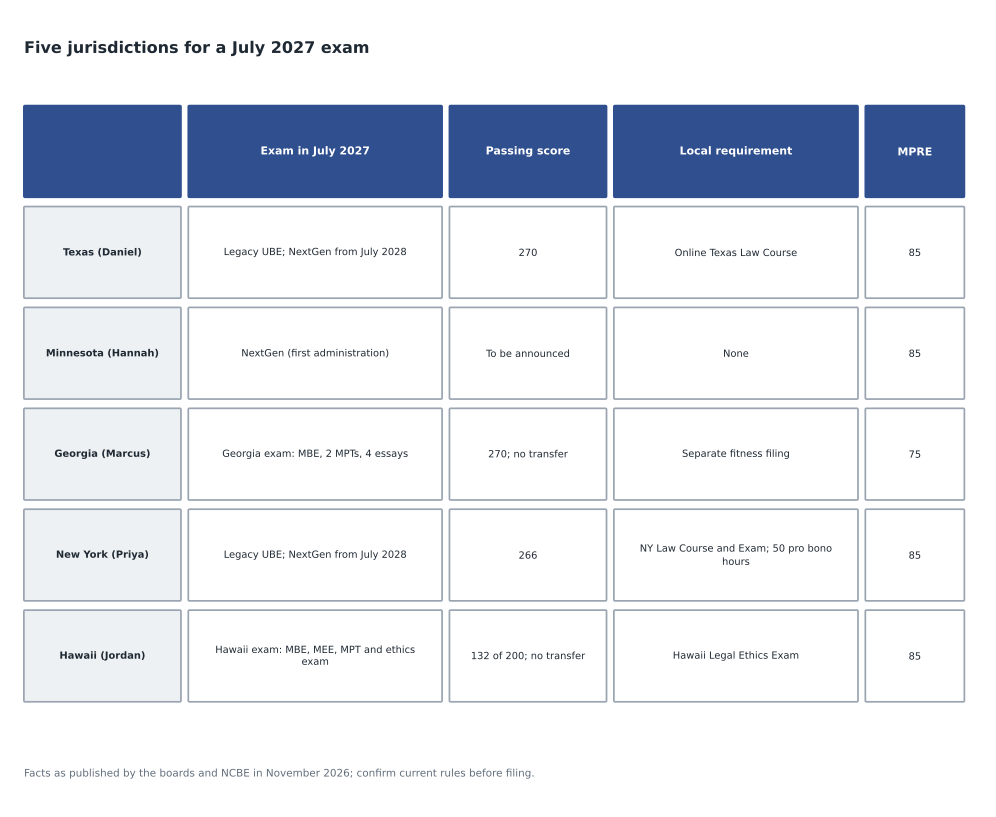
Daniel's Texas: Texas gives the legacy UBE through February 2028 with a passing score of 270 and moves to NextGen in July 2028. It requires a Texas Law Component, which until NextGen arrives is satisfied by completing an online Texas Law Course; when NextGen arrives the component becomes a graded part of the exam. Texas requires an MPRE score of 85. It accepts transferred scores that are no more than five years old and requires five of the last seven years of practice for admission without examination.
Hannah's Minnesota: Minnesota gave its last legacy UBE in February 2027 and gives its first NextGen exam in July 2027. As of November 2026 NCBE listed Minnesota's NextGen passing score as to be announced; on an interim basis the state accepts transferred NextGen scores of 620 or more from other jurisdictions, but its supreme court said that figure is not necessarily its own passing score. Minnesota has no state-specific exam component and requires an MPRE score of 85. Hannah will be one of the first applicants in her state to take NextGen, and Vantreese tells her to check the board's announcements every month until her application is filed.
Marcus's Georgia: Georgia writes its own exam. On the first day applicants write two MPTs and four Georgia-drafted essays, and on the second day they take the MBE. The passing score is 270, scores cannot be transferred in or out, and Georgia will move to NextGen with a Georgia requirement in July 2028. Georgia requires an MPRE score of 75. It also runs character and fitness as a separate application with its own earlier filing window, so Marcus must file that application well before the exam application.
Priya's New York: New York gives the legacy UBE through February 2028 with a passing score of 266, and moves to NextGen in July 2028. Applicants must also complete the New York Law Course and pass the New York Law Exam, perform 50 hours of qualifying pro bono work and satisfy a skills competency requirement before admission. New York requires an MPRE score of 85. Priya's longer-term plan, a New Jersey license, depends on portability: New Jersey accepts transferred UBE scores of 266 within 36 months, so a July 2027 score could carry her into New Jersey until mid-2030.
Jordan's Hawaii: Hawaii is not a UBE jurisdiction. It combines the MBE, MEE and MPT with its own 15-question Hawaii Legal Ethics Exam into a score on a 200-point scale, and the passing score has been 132 since February 2025. Hawaii does not accept transferred scores and has no admission on motion, so a Hawaii score will not carry Jordan into another state. Hawaii requires an MPRE score of 85.
Marcus points out that the table makes Georgia and Hawaii look risky, because a score there does not travel. Vantreese agrees that portability is lower but says risk depends on the plan. Marcus wants to practice in Atlanta for the long term; Jordan wants to practice in Honolulu. Neither needs portability now. If either later moves, admission rules for experienced lawyers, discussed below, will matter more than an old score.
Portability and the UBE
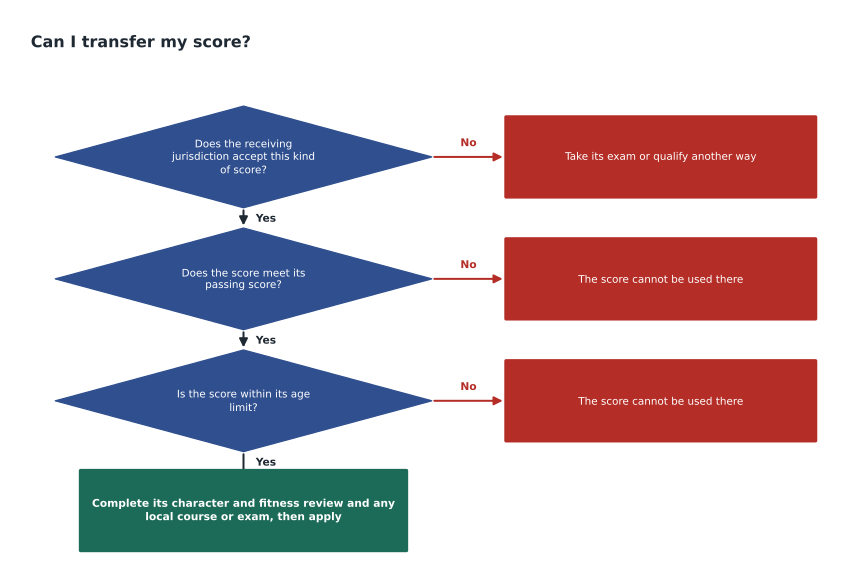
Portability is the main advantage of the UBE. A UBE score can be transferred to another UBE jurisdiction if it meets that jurisdiction's passing score and is no older than the jurisdiction allows, which ranges from two to five years. The receiving jurisdiction still runs its own character and fitness review and may require a local course or exam. A score of 266, for example, transfers to a jurisdiction whose passing score is 266 or lower, but not to one that requires 270.
During the transition, NextGen scores are portable among jurisdictions that accept them, on terms each sets. Some jurisdictions began accepting transferred NextGen scores from July 2026; others will not accept them until they adopt NextGen themselves. New York, for example, has said it will not accept transferred NextGen scores from exams before July 2028. Legacy UBE scores remain transferable on the usual terms. The practical rule is the same as before: before relying on a transfer, read the receiving jurisdiction's current rules.
Admission without examination
Many jurisdictions admit experienced lawyers from elsewhere without a new exam, usually called admission on motion. The requirements vary but usually include a period of active practice, such as three of the last five years or five of the last seven, good standing and a clean disciplinary record, and sometimes reciprocity, meaning the lawyer's home jurisdiction must offer the same courtesy. Some jurisdictions, including California, Florida, Hawaii, Nevada and Rhode Island, have no admission on motion at all; some offer an abbreviated attorneys' exam instead. A new graduate cannot use admission on motion, but the rules matter for a long-term plan: a lawyer who expects to move in five years may care more about the receiving state's motion rules than about portability of the first score.
Deadlines
Bar applications have filing windows with timely, late and final deadlines, and the late periods carry large added fees. For a July exam the windows usually fall in winter and spring. Texas, for example, lists February 1, April 1 and May 1 as its timely, late and final deadlines for a July exam. Some jurisdictions have abolished late filing altogether. A few require law students to register or file a declaration years before the exam; Texas asks students to file a Declaration of Intention to Study Law early in law school, which starts the character and fitness investigation, and Daniel filed his in his first year.
Vantreese asks each student to build a backward calendar from July 27, 2027. Hannah's includes the Minnesota filing deadline, an MPRE administration and the request for accommodations she plans to make for a documented condition. Marcus's begins with the Georgia fitness application. Priya's includes registration for the New York Law Exam after she completes the New York Law Course, and a schedule for finishing her pro bono hours. Jordan's includes the March 2027 MPRE, with registration due January 21, 2027.
Changing your mind
Students sometimes change jurisdictions after filing. Most boards allow a withdrawal, often with little or no refund, and a new application elsewhere must meet that jurisdiction's deadlines. A student who changes jurisdictions late may find the deadline has passed. A student who fails and wants to switch states faces attempt limits that some jurisdictions count across all jurisdictions, not just their own. These are good reasons to decide carefully once.
Worked problem
Choosing between two states
A classmate in another section, a hypothetical student named Ansgar Vasquell, has offers from a firm in Kansas City, Missouri, and a public defender's office in Kansas City, Kansas. He asks how to decide where to sit for the bar.
Show solution
- Identify where he will practice: the firm would need a Missouri license; the public defender would need a Kansas license.
- Check the format and portability: both states have given the UBE, so a score earned in one can transfer to the other if it meets the receiving state's passing score and age limit. Each state's transition to NextGen must be checked, because a NextGen score transfers only where the receiving state accepts it.
- Check timing: the receiving state's age limit decides how long he has to use a transfer; he should confirm it in the current rules.
- Check the other requirements: each state runs its own character and fitness review and may require a local component.
- Decide: he should sit where his first job is and plan the transfer within the receiving state's time limit if he later moves.
Answer: The answer is to sit in the state of the job he accepts and to keep the transfer rules of the other state on his calendar. Vantreese adds that the decision should rest on the job, not on which state's passing score looks lower.
Common mistakes
MistakeRelying on a commercial chart for deadlines and fees.
InsteadUse the board's current rules and instructions; charts lag behind changes.
MistakeAssuming any UBE score transfers anywhere.
InsteadA score transfers only to a jurisdiction that accepts that kind of score, at or above its passing score and within its age limit, and the receiving jurisdiction still reviews character and fitness.
MistakeAssuming a NextGen score transfers to every NextGen jurisdiction during the transition.
InsteadEach jurisdiction sets its own terms; some do not accept transferred NextGen scores until they adopt NextGen.
MistakePlanning to use admission on motion right after graduation.
InsteadMotion admission requires years of practice and is unavailable in some jurisdictions.
MistakeFiling the character and fitness application with the exam application in every state.
InsteadSome jurisdictions, such as Georgia, require a separate fitness filing with an earlier window.
Summary and key terms
- Sit first in the jurisdiction where you will practice; weigh portability if your plans are uncertain.
- Answer every planning question from the board's own rules and instructions, not from a summary.
- Formats differ widely: Texas and New York give the legacy UBE until July 2028, Minnesota gives NextGen from July 2027, and Georgia and Hawaii write their own exams.
- UBE scores transfer only to jurisdictions that accept them, meet the receiving passing score and fall within its age limit.
- NextGen transfer rules are set by each jurisdiction and change during the transition.
- Admission on motion requires years of practice and is not offered everywhere.
- Build a backward calendar from the exam date that includes filing windows, the MPRE, accommodations and local requirements.
- Admission on motion
- Admission of an experienced lawyer licensed elsewhere without a new bar exam, usually requiring years of practice and good standing.
- Reciprocity
- A requirement that the applicant's home jurisdiction offer the same admission courtesy to lawyers from the receiving jurisdiction.
- Score transfer
- Use of a UBE or NextGen score earned in one jurisdiction to seek admission in another.
- Filing window
- The period during which a bar application may be filed, often with timely, late and final deadlines and rising fees.
- Local component
- A jurisdiction's own requirement on its law, such as an online course, a short test or graded questions on the exam.
- Declaration of intention
- An early filing some jurisdictions require of law students, which begins the character and fitness investigation.
Practice problems
Work each problem on paper first, then reveal the answer to check.
An applicant earned a UBE score of 268 in New York in July 2027. Could she use it to seek admission in a UBE jurisdiction whose passing score is 270?
Show answer
No. A transferred score must meet the receiving jurisdiction's passing score. She would need to take that jurisdiction's exam or qualify another way.
Why does Jordan's choice of Hawaii make admission rules for experienced lawyers more important to him than portability?
Show answer
Hawaii does not issue UBE scores and does not accept transfers, so his score will not travel. If he later moves, he will need the other state's exam or its rules for admitting experienced lawyers.
Name three items a student should confirm directly from the board before filing.
Show answer
Any three of: the exam format on the chosen date, the filing deadlines and fees, the MPRE score and timing rule, the character and fitness filing process, the accommodations deadline and local requirements.
A student will work in a state that moves to NextGen in July 2028 but is unsure whether he will stay more than two years. What should he check about a July 2027 legacy score?
Show answer
Which neighboring jurisdictions accept transferred legacy UBE scores, their passing scores and their age limits, so he knows how long the score remains usable.
Lesson quiz · 5 questions
Score 60% or more to complete this lesson.
Create a free account to save your progress, take quizzes and earn a certificate.