
LAWU-314 · Lesson 5 of 12 · 21 min
Building a study plan for 3L and the summer
▶ Video coming soon A video version of this lesson is on the way.
Jordan arrives at the fifth session with a spreadsheet. It has a row for every day from graduation to July 27, 2027, and columns for subject, task, hours planned and hours completed. Vantreese looks at it for a long time and says it is the best plan she has seen in years and that it will fail in the third week, because it has no slack, no review days and no time for anything except studying. "A study plan is a training plan," she tells the class. "Athletes do not run their hardest every day. They build, they test, they recover and they taper. You are going to do the same thing, and you are going to start before you graduate."
The shape of bar preparation
Most successful applicants spend about ten weeks of full-time study between graduation and a July exam, usually 40 to 50 hours a week, often with a commercial bar review course or a structured self-study program. The weeks are not all alike. The first phase builds knowledge: learning or relearning the rules in each tested subject through lectures, outlines and short sets of practice questions. The second phase shifts the weight to practice: timed question sets, essays and performance tests, each reviewed carefully. The third phase simulates the exam with full-length practice exams and targeted review of weak areas, and the last days taper so that the applicant arrives rested.
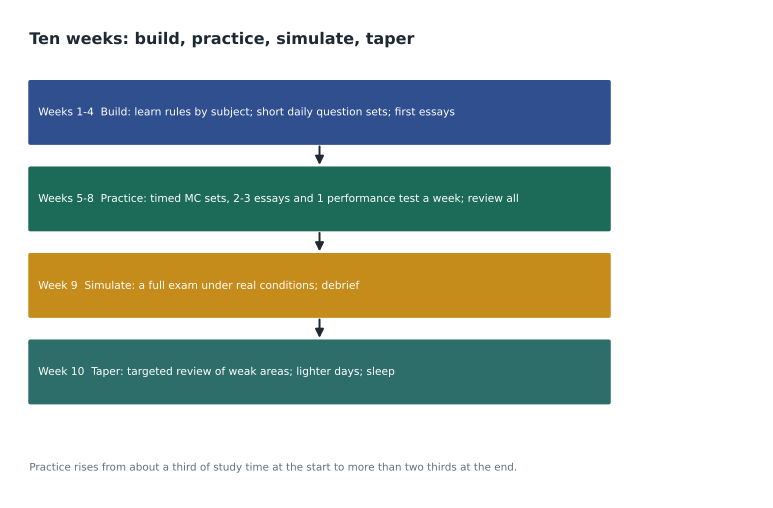
The mistake Vantreese sees most often is staying in the first phase too long. Students who feel unready keep rereading outlines and watching lectures and postpone practice until they feel they know enough. They never feel they know enough, and the exam rewards practice. A useful rule of thumb is that by the middle of the summer at least half of each day should be spent answering questions and reviewing answers, and by the end, more than two thirds.
What can be done during 3L
The third year is not too early to start, and starting does not mean beginning bar review in January. It means doing the things that make the summer work:
- Paperwork: file the bar application and character and fitness materials by the timely deadline, take the MPRE and request accommodations if needed. Lesson 2's backward calendar belongs here.
- Courses: take, if possible, courses in heavily tested subjects that the student has not studied, such as business associations, evidence or criminal procedure. Section B took most of these. Students in jurisdictions with local components should check which local subjects are tested.
- Skills: practice a handful of MEE essays or NextGen performance tasks during the term to learn the format, without trying to master the law.
- Commitments: arrange the summer. Tell employers the exam date, plan finances so that full-time study is possible and clear the calendar. Students who work more than a few hours a week during bar preparation pass at noticeably lower rates.
- Health: establish the sleep, exercise and eating habits that will carry through the summer, and get any medical, dental or mental health care that has been postponed.
Daniel asks whether he should start a commercial course early. Vantreese says that many courses offer early-start materials for subjects not covered in law school, and they can be useful for one or two subjects, but that most students get little from starting the full course before graduation. The better use of the spring is finishing law school well, which includes passing every class, since a failed class can delay graduation and the bar application.
Commercial course, self-study or a hybrid
Most applicants use a commercial bar review course, which provides lectures, outlines, a schedule, practice questions and graded essays. Others assemble their own program from NCBE study aids, released questions, outlines and books. Some use a commercial course plus a tutor or supplementary materials for weak areas. There is no single right choice. What matters is that the program includes enough timed practice in the correct format, feedback on written answers and a schedule the applicant will actually follow. Hannah must make sure her course is built for NextGen, and Marcus must make sure his covers Georgia's essays and two MPTs.
Employers often pay for a course and sometimes for a stipend. Students without that support should compare prices carefully and look at the law school's own resources: many schools, Larkhaven included, offer free bar support programs, practice essays graded by faculty and loaner materials. Vantreese runs Larkhaven's.
Building the weekly schedule
A weekly schedule should be concrete enough that each day starts with a known task. Vantreese recommends a template rather than a day-by-day spreadsheet, so that a bad day does not break the plan. A typical practice-phase week might look like this: five days with a morning of timed questions in one or two subjects and review, an afternoon of an essay or performance test and review followed by rule study in weak areas; one longer day with a half-length simulated session; and one day mostly off. Review days are built in every fourth or fifth day so that the applicant can catch up without guilt.
Jordan's revised plan replaces his daily rows with a weekly template and adds a column for scores. Vantreese tells him that the scores matter less than the trend and that the trend matters less than the error log, which Lesson 6 explains.
Scheduling subjects
Subjects should be scheduled by weight and by weakness. On the legacy MBE, each of the seven subjects counts equally; on the MEE, any of the eight subjects can appear, and civil procedure, evidence, contracts, torts and real property appear often. On NextGen, the eight foundational subjects are tested in both multiple choice and skills questions. Students should spend more time on subjects in which they are weakest, but they should not abandon their strong subjects, because skills decay without practice. Spaced repetition, returning to each subject every week or so rather than studying it once in a block, produces better retention than massed study.
Local components need their own time. Daniel's Texas Law Course is an online course to be completed within a set window; Priya's New York Law Course and New York Law Exam require separate study, and she plans to finish the course in June. Jordan's Hawaii Legal Ethics Exam is short but tests Hawaii's own rules, so he plans two evenings of review.
Measuring progress
Students should track a few numbers: the percentage correct on timed multiple-choice sets by subject, grades or self-assessments on essays and performance tests, and time per question. They should also take at least one full-length simulated exam under real conditions, starting at the real starting time, so that they know how their attention holds up over a whole day. Most commercial courses include a simulated MBE and simulated written days; NCBE sells simulated NextGen exams made of practice sets.
The numbers are diagnostic, not predictive. Early scores are low for almost everyone, because applicants are still learning the rules. What matters is improvement and the reasons for errors. A student who misses questions because she does not know the rule needs more rule study. A student who knows the rule but misreads the facts needs slower reading. A student who runs out of time needs pacing practice. Each problem has a different fix.
The case for rest
Rest is part of the plan, not a reward for finishing it. Memory consolidates during sleep, and fatigue impairs reading accuracy, which is exactly what the exam tests. Applicants should sleep a consistent seven to nine hours, take at least one day a week mostly off and stop studying at a fixed time each night. The last two or three days before the exam should be light: reviewing short outlines, packing, confirming logistics and sleeping. Students who cram the night before the exam perform worse on the first morning, which on the legacy UBE is the MPT and on NextGen is a full three-hour session.
Worked problem
Repairing a plan
Midway through the summer, a hypothetical applicant named Sorcha Brennt has been following a commercial schedule but is three days behind, scoring about 55 percent on timed MBE sets and skipping essays because they take too long. She asks Vantreese whether she should restart the schedule.
Show solution
- Do not restart. Drop the missed lectures in subjects she already knows and keep the practice assignments.
- Diagnose the 55 percent: her error log shows most misses are in evidence and real property and many are misread facts.
- Shift time: add a daily 20-question timed set in evidence or real property with full review, and read each question's call first.
- Restore essays: write one timed essay a day for a week, even if imperfect, and compare it with the model answer for issues spotted and organization.
- Protect rest: keep one day a week off and stop by a fixed time each night.
Answer: Sorcha's plan becomes a practice-heavy plan focused on two weak subjects and on written practice she had been avoiding. Two weeks later her timed sets average about 63 percent and she has written ten essays. Vantreese's point is that falling behind is normal; the response is to protect practice and cut passive review, not to start over.
Five plans for five exams
Vantreese asks each member of Section B to sketch the outline of a summer plan for their own exam, and the class compares them. The comparison shows how much the format shapes the plan even when the law overlaps.
Daniel's legacy UBE plan for Texas gives roughly equal weight to the three components in proportion to their value: MBE practice most days, two or three MEE essays a week and one MPT a week from week four, with the online Texas Law Course finished in the first two weeks so that it does not crowd the final month. He schedules two simulated MBE sessions and one simulated written day.
Hannah's NextGen plan for Minnesota is built around the practice set. From week five she takes one full three-hour practice set a week in the exam software, reviews every item the next morning and fills the rest of the week with stand-alone questions, integrated question sets on her weakest subjects and one performance task. Because she has an accommodation for extended time, she practices with her approved timing so that her pacing plan matches the real exam.
Marcus's Georgia plan gives extra weight to the performance test because Georgia weights its two MPTs more heavily than the UBE does, and it adds Georgia-specific essay practice using released Georgia questions. He schedules his MPT practice on Tuesdays, the day he will write them on the real exam, to build the habit.
Priya's New York plan adds two separate tracks to the legacy UBE: the New York Law Course, which she finishes in June, and preparation for the New York Law Exam, which she takes after completing the course. She also tracks her pro bono hours, because admission cannot happen until all 50 are certified, and she plans to finish them during her clerkship's first months if she has not done so before graduation.
Jordan's Hawaii plan uses the same NCBE components as a UBE plan but adds two evenings of review for the Hawaii Legal Ethics Exam and practice on Hawaii's combined scoring. Because Hawaii's score is a single combined number on a 200-point scale, he follows the same principle as everyone else: no component can be neglected, because each contributes to the total.
Vantreese points out what the five plans share. Each is anchored to the exam date, front-loads paperwork and local requirements, moves to timed practice by mid-summer, schedules at least one full simulation and builds in a taper. Each also includes a weekly review of the error log, which is how a plan adjusts itself.
Money and time
Bar preparation costs money even when an employer pays for the course: application fees, the MPRE fee, laptop fees, travel and living costs during ten weeks without income. Students should build a budget early. Many law schools and some bar associations offer bar loans, stipends or grants, and some public interest employers provide stipends for incoming lawyers. A student who must work during the summer should tell the law school's bar support program, which can help design a longer plan that starts in the spring and includes more total weeks at fewer hours each.
Common mistakes
MistakeSpending most of the summer rereading outlines and watching lectures.
InsteadShift to timed practice and careful review by mid-summer; practice is what the exam rewards.
MistakeWorking substantial hours during bar preparation without adjusting the plan.
InsteadPlan finances and commitments so that study can be full time, or build a longer plan.
MistakeAbandoning the plan after falling behind.
InsteadUse a weekly template with catch-up blocks and cut passive review first.
MistakeTreating early practice scores as predictions.
InsteadUse scores and the error log to diagnose why answers are wrong.
MistakeCramming in the final days.
InsteadTaper: light review, logistics and sleep before the exam.
Summary and key terms
- Most applicants study about ten weeks full time, moving from building knowledge to timed practice to simulation and a taper.
- By mid-summer at least half of study time should be practice and review; by the end, more than two thirds.
- During 3L, file paperwork, take the MPRE, request accommodations, take key courses and arrange finances and commitments.
- Choose a commercial course, self-study or hybrid that matches your exam format and includes feedback on writing.
- Use a weekly template with review days, schedule subjects by weight and weakness and leave time for local components.
- Track scores and errors to diagnose problems, and take at least one full simulated exam.
- Rest, sleep and a taper are part of the plan.
- Build phase
- The early part of bar preparation focused on learning rules, with short practice sets.
- Practice phase
- The middle of preparation, when timed questions, essays and performance tests with review take most of the time.
- Simulated exam
- A full-length practice exam taken under realistic timing and conditions.
- Spaced repetition
- Returning to material at intervals rather than studying it once in a block, which improves retention.
- Taper
- Reducing study intensity in the final days before the exam to arrive rested.
- Weekly template
- A repeating schedule of task types that replaces a rigid day-by-day plan.
Practice problems
Work each problem on paper first, then reveal the answer to check.
A student plans to work 25 hours a week at a firm during bar preparation for a July exam. What should Vantreese advise?
Show answer
That substantial work during preparation correlates with lower pass rates, so the student should reduce work if possible, ask the employer for a leave or build a longer plan that starts earlier and includes enough practice.
Why is a weekly template more robust than a day-by-day spreadsheet?
Show answer
Because a missed day does not break the schedule; the template defines task types and catch-up blocks, so the applicant can absorb setbacks without restarting.
A student's timed scores are flat at 60 percent, and her error log shows most misses come from misreading facts. What should change?
Show answer
Reading technique and pace: read the call first, read the facts slowly, note key facts and check the answer against them, rather than doing more rule study.
Why should the last days before the exam be light?
Show answer
Fatigue impairs reading accuracy and memory, and the first session of the exam is demanding, so rest improves performance more than last-minute study.
Lesson quiz · 5 questions
Score 60% or more to complete this lesson.
Create a free account to save your progress, take quizzes and earn a certificate.