
LAWU-314 · Lesson 7 of 12 · 20 min
Essay writing (MEE)
▶ Video coming soon A video version of this lesson is on the way.
For the seventh session Vantreese brings a stack of real-looking answers to an essay question she wrote herself, five answers in all, with names removed. She asks Section B to grade them on a scale of 1 to 6 in ten minutes, the way a volunteer grader would. They disagree about the details but agree on the ranking, and the best answer is not the longest. It is the one that names every issue, states each rule in a sentence and uses the facts to reach a conclusion in each paragraph. "Graders read hundreds of these," she says. "They are not looking for brilliance. They are looking for the issues, the rules and the facts, in order, quickly. Give them what they are looking for."
What the MEE is and how it is graded
The Multistate Essay Examination consists of six questions, each answered in 30 minutes, in a three-hour session. Since July 2026 it covers business associations (agency and partnership, corporations and limited liability companies), civil procedure, constitutional law, contracts and sales under Article 2 of the UCC, criminal law and procedure, evidence, real property and torts. A single question may combine subjects, for example a contracts question that raises an agency issue. NCBE writes the questions and prepares analyses, and graders in each jurisdiction grade the answers after a grading workshop, usually on a relative scale such as 1 to 6. The grades are then scaled to the MBE. NCBE states that the MEE tests the ability to identify legal issues raised by a hypothetical factual situation, separate material from immaterial facts, present a reasoned analysis of the issues in a clear, concise and well-organized composition, and demonstrate an understanding of the fundamental legal principles relevant to the problem.
Relative grading has a practical consequence: a grader compares answers within a pile, and an answer that spots more of the issues and analyzes them clearly will rank higher than most, even if it is not perfect. Graders typically spend only a few minutes per answer. An answer that hides its analysis in long paragraphs without signposts risks a lower grade than it deserves.
Some jurisdictions use their own essays. Georgia, for example, gives four Georgia-drafted essays alongside two MPTs, and other state exams have their own formats and timing. The method below applies to all of them.
Reading the question
MEE questions end with a list of numbered calls, often three or four. The calls are the outline of the answer. Vantreese tells the class to read the calls first, then read the facts with the calls in mind, marking the facts that matter for each call. Every fact in an MEE question is there for a reason: a date may trigger a statute of limitations, a description of a document may raise the statute of frauds, the fact that a partner "had always been the one who ordered supplies" may establish apparent authority. When a fact seems to have no purpose, the applicant has probably missed an issue.
Planning in five minutes
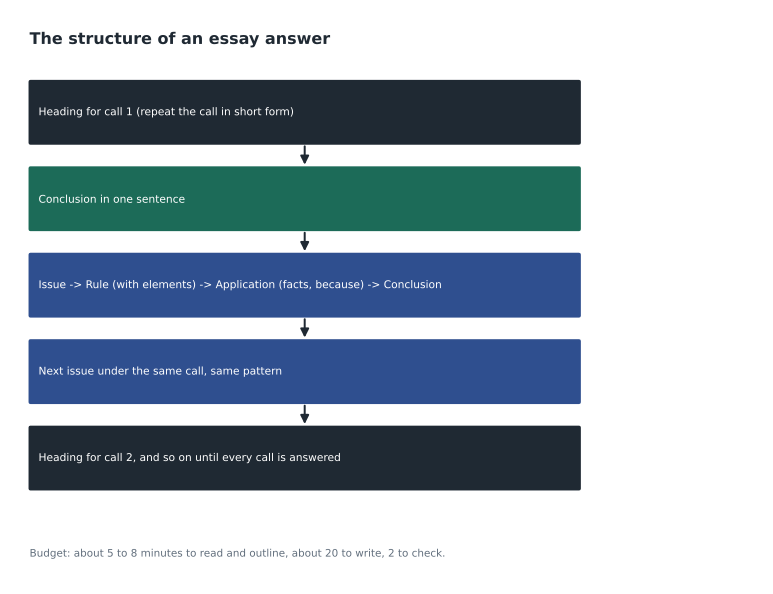
Of the 30 minutes, applicants should spend about five to eight planning and the rest writing. Planning means a short outline, not prose: for each call, the issues, the rule for each in a phrase and the key facts. The outline prevents the most common failure, which is running out of time before the last call. If time is short, applicants should answer every call briefly rather than one call fully, because each call carries points.
The structure of an answer
Each call gets a heading that repeats it in short form. Under each heading the answer gives a one-sentence conclusion, then the analysis, then, if useful, a restated conclusion. This conclusion-first structure, sometimes written as CRAC, helps graders find the answer and is accepted everywhere. Within the analysis, each issue gets its own paragraph that follows a familiar pattern: state the issue, state the rule, apply the rule to the facts and conclude.
The rule statement should be accurate and complete enough to decide the issue. "A partner is an agent of the partnership for the purpose of its business" is a rule. "Partners can bind the partnership" is a fragment that earns less credit. Where a rule has elements, the answer should list them and then address each element in the application. Where the law is divided, the answer should state the majority rule and note the alternative briefly.
The application is where most points are earned and lost. Weak answers state a rule and then a conclusion, without connecting them. Strong answers use the specific facts and explain why they satisfy or fail each element. A useful test is whether a sentence of application could be moved to a different essay; if it could, it is not using the facts. Vantreese tells the class to use the word "because" in nearly every sentence of application, which forces the connection between fact and rule.
Arguing both sides
When the facts are ambiguous, the answer should say so and analyze both possibilities, then reach the better conclusion. Graders reward recognition of the close question. They do not reward refusing to conclude. "The court will probably find" is better than "it depends". Applicants should also note alternative arguments when one theory might fail, such as promissory estoppel when consideration is doubtful.
Style
Graders read on screens or on paper, quickly. Short paragraphs, headings and plain sentences help. Applicants should avoid long introductions, restating the facts, policy discussions unless the question asks for them and citations to cases, which are not expected. Underlining or bolding rule statements is unnecessary on most typed exams. Spelling and grammar errors rarely cost points unless they obscure meaning, but clarity matters. Typed answers can be longer, which tempts applicants to write too much; a focused answer of 600 to 900 words is usually enough for one MEE question.
An original practice question
Vantreese gives the class a question she wrote for this session. Cadoc Fairley and Seline Brisbaine opened a bike repair shop in Brennan Falls three years ago. They had no written agreement; they split the profits equally and each worked in the shop. Fairley usually ordered parts. Last spring, without telling Brisbaine, Fairley signed a lease in the shop's name for a second location at 4,000 dollars a month for three years. Brisbaine learned of it a month later and told the landlord she did not agree. Fairley also borrowed 20,000 dollars from a local bank in the shop's name and used it to pay his personal credit card debt. The calls are: (1) Is the business a partnership? (2) Is the business bound by the lease? (3) Is the business liable on the loan, and what remedies does Brisbaine have against Fairley? (4) If the business cannot pay, are Fairley and Brisbaine personally liable?
Worked problem
A model answer outline
Write an outline for the bike shop question in eight minutes, then write the answer to call 2 in full.
Show solution
- Call 1, partnership: under the Revised Uniform Partnership Act, the association of two or more persons to carry on as co-owners a business for profit forms a partnership whether or not they intend to; sharing profits creates a presumption of partnership. They co-own and operate the shop and split profits equally, so it is a general partnership, without any written agreement or filing.
- Call 2, the lease: each partner is an agent of the partnership for the purpose of its business, and an act apparently for carrying on in the ordinary course the partnership business, or business of the kind it carries on, binds the partnership unless the partner lacked authority and the third party knew or had notice of that. Signing a three-year lease for a second location is arguably outside the ordinary course of a small shop's business, which would require the consent of all partners for actual authority; but the landlord likely believed the transaction ordinary and had no notice of a lack of authority. The better view is that the partnership is bound if a second location is within the kind of business the shop carries on; if not, it is bound only if Brisbaine ratifies, which she did not.
- Call 3, the loan: borrowing in the business's name for a business purpose would bind it; here Fairley used the money personally. If the bank had no notice of his purpose and borrowing is apparently in the ordinary course, the partnership is bound to the bank. Fairley breached his duty of loyalty by using partnership credit for his own benefit and must account to the partnership for the benefit; Brisbaine may seek an accounting and indemnification, and may dissociate or seek dissolution.
- Call 4, personal liability: partners in a general partnership are jointly and severally liable for partnership obligations, but under RUPA a judgment creditor generally must first exhaust partnership assets before reaching a partner's personal assets, with exceptions. Both are personally liable; Brisbaine may seek indemnification from Fairley for losses caused by his breach.
Answer: Call 2, written out: The partnership is likely bound by the lease. Under RUPA section 301, each partner is an agent of the partnership, and a partner's act apparently for carrying on in the ordinary course the partnership's business binds the partnership unless the partner had no authority and the third party knew or had notice of that. Fairley signed in the shop's name. A lease for a second location may be outside the ordinary course of a two-person repair shop, because it commits the business to 144,000 dollars over three years and changes its scale, and acts outside the ordinary course require the consent of all partners. But the landlord dealt with the partner who usually handled the shop's business, signed in the shop's name, and had no notice of any limit on Fairley's authority until a month later. If a court views opening another location as business of the kind the shop carries on, the partnership is bound. If not, the partnership is not bound, because Brisbaine did not ratify; she objected as soon as she learned of the lease. On these facts the better conclusion is that the partnership is bound, and Brisbaine's remedy is against Fairley.
Vantreese points out three features of the model call 2 answer. It states the rule with its elements and its exception. It uses specific facts, the amount and term of the lease, the shop's size and Fairley's usual role, to argue both sides. And it ends with a conclusion. It also does not discuss whether the business is a partnership, because that was call 1. Each call is answered where it is asked.
Practicing essays
Applicants should write at least 15 to 20 timed essays during preparation, spread across all MEE subjects, and should compare each with NCBE's released analysis or a model answer. The comparison should ask four questions: Did I spot every issue? Did I state each rule accurately? Did I use the specific facts? Did I conclude? Students should also practice simply outlining essays in eight to ten minutes, which builds issue-spotting speed without the time cost of writing. Older NCBE essays are available, though those before July 2026 include subjects no longer tested. Feedback from a grader, through a course or the law school's bar program, is worth more than additional unreviewed essays.
Marcus asks how his practice should differ for Georgia's four essays. Vantreese says the method is identical, but he should use Georgia's released questions, practice at the time limit Georgia uses and learn the Georgia rules that differ from the generally accepted rules the MBE tests.
What graders say they see
Vantreese, drawing on her years as a volunteer grader, describes the answers that cluster in the middle of the pile. They spot the main issue but miss the second one, state rules in general terms and use few facts. The answers at the top are not much longer; they are more complete and more precise. They name the second and third issues, state each rule with its elements, use the specific facts that decide each element and conclude. The answers at the bottom usually share one of three problems: they discuss the wrong subject, they run out of time before the last call or they restate the facts without analysis. Each problem is fixable with practice, and timed practice with feedback is the fix.
Common mistakes
MistakeRestating the facts at length before analyzing.
InsteadStart each call with a conclusion and use facts only as they apply to the rule.
MistakeWriting a rule and a conclusion with no application.
InsteadConnect specific facts to each element, using because.
MistakeSpending 25 minutes on the first call.
InsteadOutline briefly and answer every call; each carries points.
MistakeRefusing to conclude on a close issue.
InsteadAnalyze both sides and state the more likely outcome.
MistakePracticing essays on subjects removed from the MEE in July 2026.
InsteadFocus on the eight current subjects, and practice performance tests for family law and trusts and estates.
Summary and key terms
- The MEE has six 30-minute questions on eight subjects since July 2026; graders use relative scales, and grades are scaled to the MBE.
- Read the calls first, then the facts with the calls in mind; every fact has a purpose.
- Spend about five to eight minutes outlining and the rest writing, and answer every call.
- Use a heading for each call, a conclusion first, then issue, rule, application and conclusion for each issue.
- State rules accurately with their elements, and use specific facts to apply them.
- Argue both sides of close questions and conclude.
- Write at least 15 to 20 timed essays and compare each with a model answer or analysis.
- MEE
- The Multistate Essay Examination, six 30-minute essay questions written by NCBE and graded by each jurisdiction.
- Call
- One of the numbered questions at the end of an essay prompt.
- IRAC
- Issue, rule, application, conclusion: the standard structure of legal analysis.
- CRAC
- Conclusion, rule, application, conclusion: a variation that states the conclusion first.
- Relative grading
- Grading answers by comparing them with others in the same pile rather than against a fixed point total.
- Application
- The part of an answer that connects specific facts to the elements of a rule.
Practice problems
Work each problem on paper first, then reveal the answer to check.
Rewrite this weak application so that it uses the facts: "The statement is hearsay, so it is inadmissible."
Show answer
For example: "The officer's report that the witness said the car was speeding is hearsay because it repeats an out-of-court statement offered to prove that the car was speeding, and no exception applies because the witness was not under the stress of the event when she spoke an hour later."
An MEE question has four calls and you have eight minutes left with two calls unanswered. What should you do?
Show answer
Write a short answer to each remaining call: a conclusion, the rule in a sentence and one or two sentences of application, rather than finishing one call fully.
Why is a conclusion-first structure useful on the MEE?
Show answer
Graders read quickly; stating the conclusion first shows them the answer immediately and makes the analysis that follows easier to follow.
In the bike shop question, why does Brisbaine's objection to the landlord matter?
Show answer
It shows she did not ratify the lease, so if the lease was outside the ordinary course and Fairley lacked authority, the partnership would not be bound.
Lesson quiz · 5 questions
Score 60% or more to complete this lesson.
Create a free account to save your progress, take quizzes and earn a certificate.