
LAWU-314 · Lesson 12 of 12 · 25 min
Practice exams: a capstone practice set and debrief
▶ Video coming soon A video version of this lesson is on the way.
For the last session Vantreese runs a practice exam in miniature. Section B sits in a classroom set up like an exam room, phones in a box at the door, a clock on the wall and a proctor's script read aloud. The set has three parts: twelve original multiple-choice questions to be answered in 22 minutes, one original essay question in 30 minutes and one short performance task in 45 minutes. All of it is original, written for the course, and none of it reproduces released exam materials. Afterward the class debriefs together, the way a study group should after every practice exam. "The point is not the score," Vantreese says. "The point is to learn what happens to you under the clock, while there is still time to change it."
Part 1: twelve multiple-choice questions
1. A plaintiff from Texas sues a corporation incorporated in Delaware with its headquarters in Texas, in federal court, for 90,000 dollars on a state-law claim. The defendant moves to dismiss for lack of subject matter jurisdiction. Should the motion be granted? (A) No, because the defendant is incorporated in Delaware. (B) No, because the amount exceeds 75,000 dollars. (C) Yes, because the defendant is a citizen of Texas. (D) Yes, because state-law claims cannot be heard in federal court. Answer: (C). A corporation is a citizen of both its state of incorporation and its principal place of business, so complete diversity is lacking.
2. At a robbery trial, the prosecution offers a store clerk's statement to a 911 operator, made while the robber was fleeing, describing his clothing. The clerk does not testify. The defendant objects on hearsay and confrontation grounds. The statement is most likely: (A) admissible as an excited utterance and nontestimonial because it was made to meet an ongoing emergency; (B) inadmissible because the clerk is available; (C) inadmissible because all 911 calls are testimonial; (D) admissible only to impeach the clerk. Answer: (A). Excited utterances do not require unavailability, and statements to meet an ongoing emergency are generally nontestimonial.
3. A buyer ordered 1,000 widgets from a seller at 10 dollars each for delivery on June 1. On May 15 the seller told the buyer it would not deliver. The market price on May 15 was 12 dollars and on June 1 was 13 dollars. The buyer did not cover. The buyer's damages under the UCC market measure are based on the market price: (A) when the buyer learned of the breach, under section 2-713, in the commercially reasonable time after repudiation as many courts read it; (B) on the date of contracting; (C) set by the seller; (D) never, because the buyer did not cover. Answer: (A). The buyer may recover the difference between the market price and the contract price under section 2-713; courts apply the market at or a reasonable time after the buyer learned of the repudiation.
4. A homeowner leaves a ladder against her house. A ten-year-old neighbor climbs it onto the roof and falls. In a jurisdiction that applies the attractive nuisance doctrine, the homeowner is most likely liable if: (A) she knew children were likely to trespass, the condition posed an unreasonable risk that children would not appreciate, and the cost of eliminating it was slight; (B) the child had permission; (C) the ladder was defective; (D) the child was an invitee. Answer: (A).
5. O conveys land "to A for life, then to B and her heirs." B's interest is: (A) a vested remainder in fee simple; (B) a contingent remainder; (C) an executory interest; (D) a reversion. Answer: (A). B is ascertained and there is no condition precedent other than the end of A's life estate.
6. A state law prohibits anyone from displaying signs on residential lawns except signs identifying the residents. A homeowner wants to display a political sign. The law is most likely: (A) unconstitutional, because it forecloses an important and inexpensive medium of speech; (B) constitutional as a content-neutral rule; (C) constitutional because homeowners have no free speech rights on private property; (D) unconstitutional only during elections. Answer: (A). The Supreme Court struck down a similar city ordinance in City of Ladue v. Gilleo (1994).
7. A defendant, intending to kill his rival, fires a gun at him but misses and kills a bystander. The defendant is guilty of: (A) the murder of the bystander under the doctrine of transferred intent, and attempted murder of the rival; (B) only attempted murder; (C) involuntary manslaughter only; (D) no homicide, because he did not intend to kill the bystander. Answer: (A).
8. Police officers, without a warrant, use a thermal imaging device from a public street to detect heat patterns inside a home. The evidence is most likely: (A) inadmissible, because using sense-enhancing technology not in general public use to explore details of a home is a search; (B) admissible, because the officers stayed on a public street; (C) admissible, because heat is not private; (D) inadmissible only if the home was rented. Answer: (A). Kyllo v. United States (2001).
9. A partner in a general partnership, without consulting the other partners, buys office supplies from a regular vendor for the partnership. The partnership is: (A) bound, because the purchase was apparently in the ordinary course of business; (B) not bound, because the other partners did not consent; (C) bound only if the vendor got written authorization; (D) not bound, because partnerships act only through votes. Answer: (A).
10. A plaintiff wins a judgment against a driver for injuries in a crash. Later, the plaintiff sues the driver's employer on a respondeat superior theory, arising from the same crash. The employer seeks to prevent the plaintiff from relitigating damages. Which doctrine is most relevant? (A) Issue preclusion, if the damages issue was actually litigated and necessarily decided; (B) claim preclusion, because the employer was a party; (C) the Erie doctrine; (D) supplemental jurisdiction. Answer: (A). Preclusion questions on the MBE require attention to whether the parties are the same and what was decided.
11. A lawyer represents a client in a contract dispute. The client tells the lawyer he plans to lie at his deposition next week. Under the Model Rules the lawyer: (A) should remonstrate with the client and, if the client testifies falsely, take reasonable remedial measures, including disclosure to the tribunal if necessary; (B) must immediately disclose the plan to opposing counsel; (C) may say nothing because the information is privileged; (D) must withdraw without speaking to the client. Answer: (A). Model Rule 3.3 governs false evidence offered in a proceeding, which includes a deposition, and the duty of candor can override confidentiality.
12. Under the generally accepted rule, a contract for the sale of land that is not in a signed writing is unenforceable unless: (A) the buyer has partly performed by acts such as taking possession and making improvements or payment, in reliance on the contract; (B) the price is under 500 dollars; (C) the parties are merchants; (D) the seller is a corporation. Answer: (A). Part performance is the main exception for land contracts.
Part 2: an original essay
The essay question concerns a construction dispute in Westmarch. Nerys Haskett hired Hatchwell Builders to renovate her bakery for 120,000 dollars, with completion by March 1 and a clause stating that time is of the essence. Hatchwell finished on March 20 because a subcontractor failed to deliver windows. Haskett lost an estimated 18,000 dollars in profits during the delay. When she refused to pay the last 30,000 dollars, Hatchwell's site manager removed some of Haskett's display cases, saying they would be returned when she paid. The calls: (1) Did Hatchwell breach the contract, and what are Haskett's damages? (2) Is Hatchwell's nonperformance excused by the subcontractor's failure? (3) Does Haskett have a tort claim based on the removal of the display cases, and is Hatchwell liable for it?
Worked problem
A model answer outline for the essay
Outline the essay in eight minutes and compare your outline with this one.
Show solution
- Call 1: the contract is for services, governed by the common law. Late completion breached an express term; because time was of the essence, the delay was a material breach of that term, though Haskett elected to accept performance. She may recover expectation damages for the delay, including lost profits if foreseeable when the contract was made and proved with reasonable certainty; a bakery's lost profits from a renovation delay are likely foreseeable, and an established business can usually prove them from its records. She must still pay the contract price less her damages; withholding 30,000 dollars is more than the 18,000 dollars she can prove, unless other damages exist.
- Call 2: a subcontractor's failure ordinarily does not excuse the general contractor. Impracticability requires an unforeseeable event whose nonoccurrence was a basic assumption of the contract; a supplier's failure is a foreseeable business risk that the contractor bears unless the contract allocates it otherwise.
- Call 3: removing Haskett's display cases without her consent is trespass to chattels or conversion, depending on the seriousness of the interference; holding them until payment makes conversion arguable. Hatchwell is vicariously liable for its site manager's tort if it was committed within the scope of employment; using self-help to collect a debt for the employer is arguably within the scope even if unauthorized. Haskett may seek return of the cases and damages.
Answer: A strong answer reaches a conclusion on each call, applies the facts (the dates, the time-is-of-the-essence clause, the amounts and the manager's statement) and notes the close questions. Vantreese gives this outline a 5 and says a 6 would also briefly address whether Haskett's withholding of more than her damages is itself a breach.
Part 3: a short performance task
The performance task, written in the NextGen style but usable by everyone, gives the class a task memo from a supervising lawyer, a client email and a two-page library containing a fictional Westmarch statute on home improvement contracts and one fictional case. The statute requires home improvement contracts over 1,000 dollars to be in writing, to state the start and completion dates and to give the homeowner a three-day right to cancel; a contractor who fails to comply "may not recover more than the reasonable value of services actually performed". The case, the fictional Pellworth v. Ardwell Remodeling, held that the statute applies to repairs as well as additions and that an emailed estimate signed by both parties satisfies the writing requirement. The client, a contractor named Okerby, replaced a homeowner's roof for 14,000 dollars on the basis of a text exchange and was paid 6,000 dollars. The task is to write a short memo answering whether Okerby can recover the remaining 8,000 dollars, and then to answer two research questions: which authority is binding and whether a text exchange can count as a writing under the case.
Worked problem
Debriefing the performance task
What should the memo conclude, and what must it include?
Show solution
- Rule: the statute applies to contracts over 1,000 dollars for home improvement; Pellworth extends it to repairs, so a roof replacement is covered.
- Writing: Pellworth accepted a signed emailed estimate; a text exchange may qualify if it shows the essential terms and both parties' assent, but the facts show no completion date and no notice of the right to cancel, so the contract fails the statute regardless.
- Consequence: Okerby may recover only the reasonable value of services actually performed. If that value exceeds 6,000 dollars, he may recover the difference; the memo should identify what evidence of value is needed.
- Research questions: the statute is binding; Pellworth, as a Westmarch appellate decision interpreting it, is binding on Westmarch trial courts; and the text exchange question is open under Pellworth, which addressed email.
- Ethics: the client's email asks whether he can backdate a written contract. The memo must say no.
Answer: Okerby likely cannot recover the full 8,000 dollars but may recover the reasonable value of his work beyond what he has been paid. Students who missed the statute's consequence clause, the most important sentence in the library, scored low; that is the lesson of the task.
The debrief
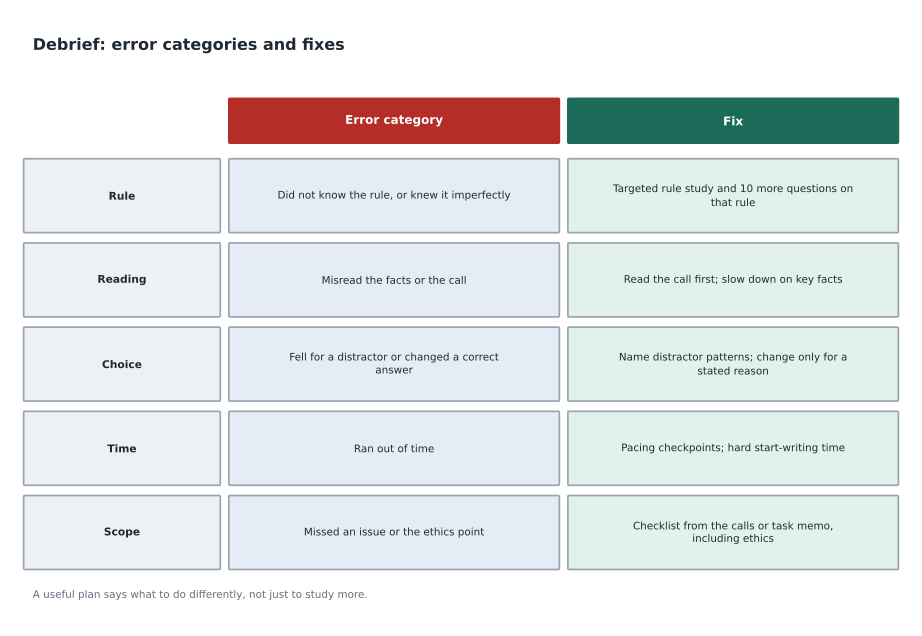
Vantreese collects the answers and returns them the next day with scores and comments, and the class debriefs. Daniel scored 10 of 12 on the multiple-choice questions, missing the UCC market price question and the preclusion question; his log says "knew 2-713 imperfectly" and "misread the call". Hannah scored 11 of 12 but ran four minutes over on the performance task; her log says "started writing too late". Marcus scored 9 of 12 and wrote the strongest essay in the room; his log points to real property and constitutional law for more question practice. Priya scored 12 of 12 and wrote a strong essay but forgot the ethics issue in the performance task. Jordan scored 10 of 12, finished everything early and wrote an essay that Vantreese said needed more use of facts.
Each student writes a two-line plan for the summer from the debrief. Daniel will drill UCC remedies and slow down on calls. Hannah will set a hard start-writing time on every performance task. Marcus will add daily property and constitutional law sets. Priya will add an ethics check to her performance task checklist. Jordan will practice using facts by rewriting one paragraph of each essay after comparing it with a model answer. Vantreese points out that none of the five plans says "study more". Each says what to do differently, which is the only kind of plan that changes a score.
Simulated exams during the summer
The capstone set is a fraction of an exam. During the summer, applicants should take at least one full simulated exam under real conditions, starting at the real times with real breaks, on the format they will face: a simulated MBE day and simulated written day for legacy applicants, or three practice sets in one and a half days for NextGen applicants. After a simulated exam, applicants should rest briefly, then debrief within a day or two: score it, categorize every error, and adjust the plan. Two simulations, one around week five or six and one around week eight or nine, give both a diagnosis and a check on progress.
Last words
Vantreese ends the course where she started it, with the kitchen timer. She sets it for ninety seconds again and asks the students to spend it, this time, thinking about the first thing they will do when they sit down on July 27. Daniel says he will read the first task memo twice. Hannah says she will look at the clock and write down her start-writing time. Marcus says he will breathe. Priya says she will remember that everyone in the room is facing the same exam. Jordan says he will start his watch. When the timer rings, Vantreese says that is all she wanted: a plan for the first ninety seconds, and then the next, and then the next. Section B's last class at Larkhaven ends there. Students who want to continue can go on to the US Bar Exam Preparation program and the course for their own jurisdiction.
Common mistakes
MistakeTreating a practice score as a verdict.
InsteadUse practice exams to find specific, fixable problems.
MistakeWriting a summer plan that only says to study more.
InsteadWrite a plan that says what to do differently, tied to error log categories.
MistakeMissing the consequence clause in a performance task statute.
InsteadRead every operative sentence in the library; consequences often decide the task.
MistakeTaking a simulated exam and never debriefing it.
InsteadScore it, categorize every error and adjust the plan within a day or two.
MistakeSkipping the ethics issue in performance tasks.
InsteadAdd an ethics check to every performance task checklist.
Summary and key terms
- Practice exams are for learning what happens under the clock while there is time to change it.
- The capstone set combined twelve multiple-choice questions, an essay and a short performance task, all original.
- Multiple-choice misses most often came from imperfect rules and misread calls, not from ignorance.
- Strong essays answered every call with rules and facts; strong performance tasks found the consequence clause and the ethics point.
- Debrief every practice exam with error log categories and a specific fix for each.
- Take at least two full simulated exams on your exam's format during the summer.
- Plan the first minutes of the exam, then the next, and trust the preparation.
- Debrief
- A structured review of a practice exam that categorizes errors and sets fixes.
- Consequence clause
- A provision stating what follows from noncompliance with a statute, often decisive in a performance task.
- Transferred intent
- The doctrine that intent to harm one person transfers to an unintended victim.
- Part performance
- Acts in reliance on an oral land contract, such as possession and improvements, that can make it enforceable despite the statute of frauds.
- Simulated exam
- A full-length practice exam taken under real timing and conditions.
- Quantum meruit
- Recovery of the reasonable value of services performed, often available when a contract cannot be enforced.
Practice problems
Work each problem on paper first, then reveal the answer to check.
On the capstone set, why was the time-is-of-the-essence clause important for the essay?
Show answer
It made timely completion an essential term, so the delay was a material breach of that term and supported Haskett's claim for delay damages, though she accepted the late performance.
In question 1, would the answer change if the corporation's headquarters were in Oklahoma?
Show answer
Yes. The corporation would be a citizen of Delaware and Oklahoma, the plaintiff of Texas, so diversity would be complete, and the amount exceeds 75,000 dollars.
What one change would most improve a summer plan for an applicant whose debrief shows repeated time problems on performance tests?
Show answer
A hard start-writing time on every performance test, practiced until it is automatic.
Why should a simulated exam use the real starting times and breaks?
Show answer
So that the applicant learns how attention, energy and pacing hold up over a real exam day and can adjust before the exam.
Lesson quiz · 5 questions
Score 60% or more to complete this lesson.
Create a free account to save your progress, take quizzes and earn a certificate.