
LAWU-313 · Lesson 9 of 12 · 25 min
Wage and hour law
▶ Video coming soon A video version of this lesson is on the way.
Pembrook returns to the wage complaint Lucan Barraza filed in August 2026, which by October had grown into a lawsuit. Lucan's lawyer filed a collective action under the Fair Labor Standards Act on behalf of Akerley's single-van delivery drivers, alleging that they were misclassified as independent contractors and owed minimum wage and overtime, and added state-law class claims. In the same month, a group of warehouse employees complained that they were not paid for the time they spent each morning waiting to pass through the security screening Akerley installed at the Fallow Mill Road entrance, or for the time spent at the end of the shift in a bag check. And a customer service team lead asked whether she was really exempt from overtime, since she was paid a salary of 52,000 dollars but spent most of her day taking orders on the phone like the representatives she led. Pembrook says that wage and hour claims are now among the most common employment cases in federal court, because they are usually brought collectively, liability does not depend on intent, and damages double automatically.
The Fair Labor Standards Act
The Fair Labor Standards Act of 1938 established a federal minimum wage, overtime pay for long hours, record-keeping requirements and limits on child labor. It covers employees of enterprises with at least 500,000 dollars in annual gross sales and two or more employees engaged in commerce, along with individual employees engaged in interstate commerce or the production of goods for commerce, and nearly all public employers. Unlike Title VII, the FLSA has no employee threshold.
The federal minimum wage has been 7.25 dollars an hour since July 2009. Thirty states and the District of Columbia set higher minimums, many above 15 dollars, and dozens of cities set their own; the employee is entitled to the highest applicable rate. For the course, Pembrook says, Westmarch's minimum wage is 14.00 dollars an hour in 2026. Employers may pay tipped employees a cash wage as low as 2.13 dollars an hour under federal law if tips bring the total to at least the minimum wage, though several states prohibit or limit the tip credit. Wages must be paid free and clear: an employer cannot require employees to bear business expenses, such as uniforms or tools, if doing so reduces their wages below the minimum.
The FLSA requires overtime pay of one and one-half times the employee's regular rate for hours worked over 40 in a workweek. A workweek is a fixed and regularly recurring period of 168 hours; each workweek stands alone, so an employer cannot average hours over two weeks. Federal law has no daily overtime requirement, although California and a few other states require overtime after eight hours in a day. The regular rate includes nearly all remuneration for employment, including nondiscretionary bonuses, shift differentials and commissions, so an employer that pays a production bonus must recalculate the overtime rate to include it. Overtime cannot be waived by agreement.
Who is covered: misclassification
Lesson 1 introduced the economic reality test for whether a worker is an employee under the FLSA. Lucan's case applies it with money at stake. Lucan was paid a fixed amount per stop and bore the cost of his van, fuel and insurance. In several weeks, after those costs, his effective hourly pay fell below the federal and Westmarch minimums, and in most weeks he worked well over 40 hours with no overtime premium. If the drivers are employees, Akerley owes the difference between what they earned and the minimum wage, net of expenses that were primarily for Akerley's benefit, and overtime for hours over 40 at one and a half times their regular rate. Piece-rate pay, such as pay per stop, is permitted, but the regular rate is computed by dividing total weekly earnings by total hours worked, and the employee is owed an additional half-time for each overtime hour.
Pembrook notes the timing of the Department of Labor's final independent contractor rule, announced November 19, 2026 and effective 60 days after publication. Akerley will cite it, because it emphasizes control and opportunity for profit or loss in a way it believes favors the multi-van operators. But the rule interprets the statute rather than amending it, and on the core factors Lucan looks like an employee under any version of the test. The Westmarch claims, under the invented ABC test, are even stronger for the drivers.
Exemptions
Section 13(a)(1) of the FLSA exempts from both the minimum wage and overtime requirements employees employed in a bona fide executive, administrative or professional capacity, and outside salespeople, as defined by Department of Labor regulations. Computer professionals have their own exemption. These white-collar exemptions generally require three things: payment on a salary basis, meaning a predetermined amount each pay period not reduced because of variations in the quality or quantity of work; payment of at least a minimum salary level; and a primary duty that meets the duties test for the exemption.
The salary level has been contested. The Department set it at 684 dollars a week (35,568 dollars a year) in a 2019 rule. In April 2024 it issued a rule raising the level to 844 dollars a week in July 2024 and to 1,128 dollars a week in January 2025, with automatic updates every three years. In November 2024, in Texas v. United States Department of Labor, a federal district court in Texas vacated the 2024 rule in its entirety, holding that the salary increases so outweighed the duties test that they exceeded the Department's authority. The 2019 level of 684 dollars a week therefore applies under federal law as of this course, although several states, including California, Washington, New York and Colorado, set higher salary thresholds for their own exemptions. Highly compensated employees earning at least 107,432 dollars a year under the 2019 rule are exempt if they customarily and regularly perform at least one exempt duty.
The duties tests are where most litigation occurs. An executive employee's primary duty is managing the enterprise or a recognized department, the employee customarily directs the work of two or more full-time employees, and the employee has authority to hire or fire or whose recommendations on those matters carry particular weight. An administrative employee's primary duty is office or non-manual work directly related to the management or general business operations of the employer or its customers, and includes the exercise of discretion and independent judgment with respect to matters of significance. A learned professional's primary duty requires advanced knowledge in a field of science or learning customarily acquired by a prolonged course of specialized intellectual instruction. Job titles do not matter; the employee's actual primary duty does.
The Supreme Court decided three exemption cases in recent years. In Encino Motorcars, LLC v. Navarro (2018), it rejected the longstanding principle that FLSA exemptions must be narrowly construed and held that they should be given a fair reading, like any other statutory provision. In Helix Energy Solutions Group, Inc. v. Hewitt (2023), it held that an oil rig manager paid a daily rate, who earned over 200,000 dollars a year, was not paid on a salary basis and therefore was entitled to overtime; a day rate is not a predetermined weekly amount, and the regulation's special provision for daily-rate workers was not satisfied. And in E.M.D. Sales, Inc. v. Carrera (2025), it held unanimously that an employer must prove that an employee falls within an exemption by a preponderance of the evidence, the default civil standard, rejecting the Fourth Circuit's rule requiring clear and convincing evidence.
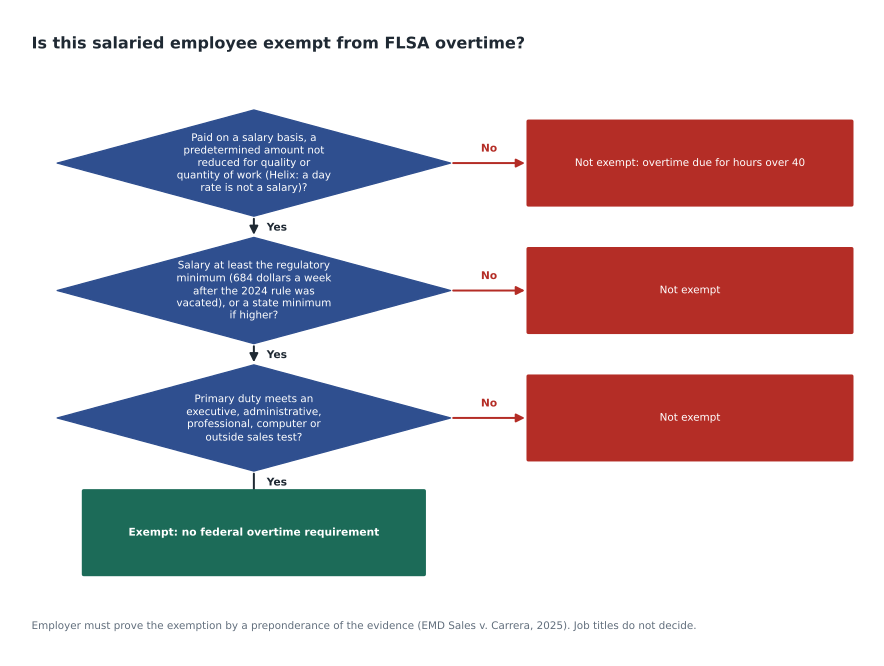
Section B applies the tests to the Akerley team lead. Her salary of 52,000 dollars satisfies the federal salary level. The question is her primary duty. If she spends most of her time taking orders like the representatives she leads, with supervision as a secondary task, her primary duty is not management, and the executive exemption fails unless the management duties are her most important ones and she has real input on hiring and firing. The administrative exemption also fails: taking orders is production work, the work the business exists to do, not work related to the management or general business operations of the company. Marcus asks whether the fact that she is called a team lead matters. Pembrook repeats that titles never decide exemption, and that misclassified "leads" and "assistant managers" are among the most common FLSA plaintiffs.
Hours worked
The FLSA does not define work. In Anderson v. Mt. Clemens Pottery Co. (1946), the Supreme Court held that time spent walking from the time clock to workstations and preparing for work was compensable. Congress responded with the Portal-to-Portal Act of 1947, which excludes from compensable time ordinary travel to and from the place of performance of the principal activities, and activities that are preliminary or postliminary to those principal activities. The courts have since drawn lines. In Steiner v. Mitchell (1956), the Court held that changing clothes and showering at a battery plant, where workers were exposed to toxic lead, were integral and indispensable to their principal activities and compensable. In IBP, Inc. v. Alvarez (2005), it adopted the continuous workday rule: once the first principal activity begins, time spent walking and waiting until the last principal activity ends is compensable. Under section 203(o), time spent changing clothes may be excluded by the terms or practice of a collective bargaining agreement, and in Sandifer v. United States Steel Corp. (2014) the Court read "changing clothes" to include donning protective gear.
In Integrity Staffing Solutions, Inc. v. Busk (2014), warehouse workers who filled online orders sought pay for the roughly 25 minutes they spent waiting for and passing through antitheft security screening at the end of each shift. The Court unanimously held that the screening was not compensable under the FLSA: an activity is integral and indispensable only if it is an intrinsic element of the principal activities and one the employee cannot dispense with if he is to perform them, and the employer could have eliminated the screenings without impairing the workers' ability to retrieve and pack products. The decision interprets only federal law. Some state courts have reached the opposite result under their own statutes: the California Supreme Court held in Frlekin v. Apple Inc. (2020) that time spent in mandatory bag checks on the employer's premises is compensable as time under the employer's control, and the Pennsylvania Supreme Court reached a similar result for security screening in Heimbach v. Amazon.com, Inc. (2021).
Akerley's warehouse employees therefore probably lose a federal claim for the end-of-shift bag check under Integrity Staffing. The morning screening is harder for Akerley: if employees must pass screening before reaching their stations, it is likely preliminary under the Portal-to-Portal Act, but if Akerley requires them to retrieve scanners or attend a mandatory huddle before screening, those principal activities start the continuous workday. Under Westmarch law, Pembrook says, inventing a rule that follows the California and Pennsylvania approach, time spent on the employer's premises in mandatory screening is compensable hours worked.
Other recurring questions involve on-call time, which is compensable if the employee is engaged to wait rather than waiting to be engaged, depending on how freely the employee can use the time; meal periods, which may be unpaid only if the employee is completely relieved of duty; short rest breaks of about 5 to 20 minutes, which must be paid; training time; travel during the workday; and off-the-clock work such as answering emails at home, which is compensable if the employer knew or should have known of it. Employers must keep accurate records of hours worked. When they do not, Mt. Clemens allows employees to prove hours by just and reasonable inference, shifting to the employer the burden of rebutting the estimate. In Tyson Foods, Inc. v. Bouaphakeo (2016), the Court allowed employees in a collective and class action to rely on representative sampling of average donning and doffing times, because each employee could have relied on the same evidence in an individual suit.
Enforcement
Employees may sue individually or in a collective action under section 216(b). Unlike a Rule 23 class action, an FLSA collective action requires each employee to opt in by filing a written consent; those who do not are not bound. Courts traditionally used a two-step process, conditionally certifying a collective and authorizing notice on a modest factual showing that employees are similarly situated, and then deciding at the end of discovery whether to decertify. The Fifth Circuit in Swales v. KLLM Transport Services (2021) rejected that approach and requires the court to decide whether employees are similarly situated before sending notice, and the Sixth Circuit in Clark v. A and L Homecare and Training Center (2023) requires a strong likelihood that others are similarly situated. State wage claims are often brought as Rule 23 opt-out class actions alongside the FLSA collective, as in Lucan's case.
Remedies are substantial. An employer that violates the minimum wage or overtime provisions owes the unpaid wages and an equal amount as liquidated damages, unless it proves that it acted in good faith and had reasonable grounds to believe its conduct was lawful, along with mandatory attorney fees for prevailing plaintiffs. The limitations period is two years, extended to three for willful violations, which McLaughlin v. Richland Shoe Co. (1988) defined as knowing or reckless disregard of whether the conduct violated the Act. Each paycheck starts a new period. Individual owners and officers with operational control can be personally liable. The Secretary of Labor may also sue and supervise settlements. Private settlements of FLSA claims generally require court or Department approval to be binding, a rule the Second Circuit applied in Cheeks v. Freeport Pancake House (2015), though some circuits have relaxed it. The anti-retaliation provision, section 15(a)(3), protects employees who file complaints; in Kasten v. Saint-Gobain Performance Plastics Corp. (2011), the Court held that oral complaints are protected if sufficiently clear and detailed for a reasonable employer to understand them as an assertion of rights.
Worked problem
Estimating Akerley's exposure to the drivers
Lucan worked an average of 55 hours a week for 100 weeks within the limitations period, earning an average of 1,100 dollars a week in stop fees and incurring about 250 dollars a week in van, fuel and insurance costs that primarily benefited Akerley. Assume he is an employee under the FLSA and the Westmarch minimum wage is 14.00 dollars an hour. Estimate the federal overtime owed and explain the other components of his claim.
Show solution
- Regular rate: for piece-rate pay, divide weekly earnings by total hours: 1,100 divided by 55 equals 20 dollars an hour.
- Overtime premium: for each of the 15 overtime hours, he is owed an additional half of the regular rate, 10 dollars, or 150 dollars a week. Over 100 weeks, 15,000 dollars.
- Minimum wage check: after deducting 250 dollars of expenses that primarily benefited Akerley, his net pay was 850 dollars for 55 hours, about 15.45 dollars an hour, above both minimums on average; but in weeks with lower earnings or higher costs, he may have fallen below 14.00 dollars, and those weeks must be computed separately.
- Liquidated damages: an equal amount unless Akerley proves good faith and reasonable grounds, so roughly 30,000 dollars on the overtime alone, plus attorney fees.
- Limitations: two years, or three if willful; Akerley's knowledge of the drivers' hours from GPS data may support willfulness.
- State claims: under the Westmarch ABC test and its own overtime and wage payment statutes, additional remedies may apply, but there can be no double recovery of the same unpaid wages.
Answer: On these assumptions Lucan's federal overtime claim alone is about 15,000 dollars, doubled to about 30,000 with liquidated damages, plus fees. Multiplied across dozens of drivers, the exposure explains why misclassification cases settle and why Akerley is reconsidering the model.
Hannah notes that the math is simple once the classification question is answered. Pembrook agrees, adding that the hardest part of most wage cases is reconstructing hours, which is why Akerley's GPS data, intended to monitor drivers, will become the plaintiffs' best evidence. That observation leads into Lesson 10, on workplace privacy and monitoring.
Common mistakes
MistakeAssuming that paying a salary makes an employee exempt.
InsteadExemption requires salary basis, the minimum salary level and a qualifying primary duty; job titles and salaries alone do not decide.
MistakeUsing the 2024 salary thresholds.
InsteadThe 2024 rule was vacated in November 2024; the federal level is 684 dollars a week, but some states set higher thresholds.
MistakeConstruing exemptions narrowly or requiring clear and convincing proof.
InsteadExemptions get a fair reading (Encino), and the employer must prove them by a preponderance (EMD Sales).
MistakeAssuming Integrity Staffing controls state-law claims.
InsteadIt interprets only the FLSA; states such as California (Frlekin) and Pennsylvania (Heimbach) treat screening time as compensable.
MistakeAveraging hours over a two-week pay period.
InsteadEach workweek stands alone for overtime purposes.
Summary and key terms
- The FLSA sets a 7.25-dollar federal minimum wage, requires overtime at one and a half times the regular rate after 40 hours a week, and requires records; states and cities often set higher minimums.
- Misclassified independent contractors can recover minimum wage and overtime; piece-rate workers are owed half-time premiums for overtime hours.
- White-collar exemptions require salary basis, a minimum salary (684 dollars a week federally after the 2024 rule was vacated) and a qualifying primary duty.
- Encino (2018) requires a fair reading of exemptions; Helix (2023) holds that a day rate is not a salary; EMD Sales (2025) sets a preponderance standard for proving exemptions.
- Hours worked include principal activities and integral and indispensable tasks; the Portal-to-Portal Act excludes commuting and preliminary or postliminary activities; Integrity Staffing (2014) held security screening noncompensable under federal law.
- Collective actions require opt-in; remedies include back wages, equal liquidated damages and fees, with a two- or three-year limitations period.
- Regular rate
- The hourly rate, including most forms of remuneration, on which overtime is computed.
- Salary basis
- Payment of a predetermined amount each pay period that is not reduced because of variations in the quality or quantity of work.
- Primary duty
- The principal, main, major or most important duty an employee performs, used in the exemption tests.
- Portal-to-Portal Act
- The 1947 statute excluding commuting and preliminary or postliminary activities from compensable time.
- Continuous workday
- The rule that time between the first and last principal activities of the day is compensable.
- Collective action
- An FLSA suit under section 216(b) in which similarly situated employees must opt in.
- Liquidated damages (FLSA)
- An additional amount equal to unpaid wages, awarded unless the employer proves good faith and reasonable grounds.
Practice problems
Work each problem on paper first, then reveal the answer to check.
An employer pays a warehouse worker 18 dollars an hour plus a 100-dollar weekly production bonus. He works 50 hours. How is his overtime computed?
Show answer
The regular rate includes the nondiscretionary bonus: (50 x 18 + 100) divided by 50 = 20 dollars. He is owed an additional half of 20, or 10 dollars, for each of the 10 overtime hours, plus the straight-time pay.
What did Helix Energy Solutions v. Hewitt hold?
Show answer
That a worker paid a daily rate was not paid on a salary basis and was therefore entitled to overtime, even though he earned more than 200,000 dollars a year.
What standard of proof applies to FLSA exemptions after EMD Sales v. Carrera?
Show answer
Preponderance of the evidence.
Is time spent in a mandatory end-of-shift security screening compensable under the FLSA?
Show answer
No, under Integrity Staffing Solutions v. Busk (2014), because the screening was not integral and indispensable to the principal activities; it may be compensable under some state laws.
How does an FLSA collective action differ from a Rule 23 class action?
Show answer
Employees must affirmatively opt in by written consent to join an FLSA collective action, whereas class members in a Rule 23 action are included unless they opt out.
Lesson quiz · 5 questions
Score 60% or more to complete this lesson.
Create a free account to save your progress, take quizzes and earn a certificate.