
LAWU-313 · Lesson 4 of 12 · 25 min
Employee mobility: noncompetes, trade secrets and duties of loyalty
▶ Video coming soon A video version of this lesson is on the way.
Devorah Lisk was Akerley's top account executive for hospital customers in eastern Westmarch. When she was promoted from inside sales to an outside sales role in April 2023, she signed a Confidentiality and Restrictive Covenant Agreement as a condition of the promotion and a 6,000-dollar raise. The agreement barred her, for 18 months after leaving Akerley for any reason, from working for a competitor in a sales role within 100 miles of Brennan Falls, and from soliciting any Akerley customer she had dealt with in the prior two years. It also required her to return all company information and chose Westmarch law. On October 2, 2026, Devorah resigned to become regional sales director at Pellmont Health Supply, Akerley's largest competitor. Two weeks later, Akerley's largest hospital customer, Merrin Valley Regional, told its Akerley representative that it was moving its surgical supply contract to Pellmont when the current term ended in January. A forensic review of Devorah's company laptop showed that in her last week she had emailed a spreadsheet of Merrin Valley's pricing and order history to her personal account.
Pembrook says the file raises the three bodies of law that govern employees who leave: the duty of loyalty an employee owes while still employed, contractual restrictive covenants, and trade secret law. Each protects a different employer interest and each is limited by a strong public policy favoring the freedom of workers to change jobs and the benefits of competition.
The duty of loyalty while employed
An employee is the employer's agent and owes a duty of loyalty during the employment. Under agency law, an employee may not compete with the employer, solicit the employer's customers for a rival, use the employer's confidential information for personal benefit, or recruit coworkers to leave in a way that harms the employer, while still on the payroll. The duty ends when employment ends, except for the continuing obligation not to use or disclose confidential information.
The law nonetheless allows employees to prepare to compete. An employee may look for a new job, accept an offer, form a new company, and make arrangements to compete, so long as he or she does not begin competing or soliciting before leaving and does not misuse confidential information. The line can be fine: telling a customer that one is leaving is usually permitted, while asking the customer to move its business before departure is not. Officers and senior managers may owe heightened fiduciary duties that limit even preparation, such as the duty not to divert a corporate opportunity. Remedies for breach include damages, disgorgement of profits, and forfeiture of compensation paid during the period of disloyalty in some states.
Devorah's email of the Merrin Valley spreadsheet during her last week, if done to use it at Pellmont, is a breach of the duty of loyalty as well as a potential trade secret misappropriation and a breach of her agreement. Whether she solicited Merrin Valley before leaving is a question of fact that Akerley will try to answer through her phone records and the hospital's purchasing staff.
Restrictive covenants: the common law framework
A covenant not to compete is a promise by an employee not to work for a competitor or start a competing business, usually for a stated period and within a stated territory, after the employment ends. Related covenants include nonsolicitation agreements, which bar soliciting customers or employees; nondisclosure agreements, which protect confidential information; and no-hire or no-poach clauses. Because noncompetes restrain trade, the common law has always treated them with suspicion, enforcing them only if they are reasonable.
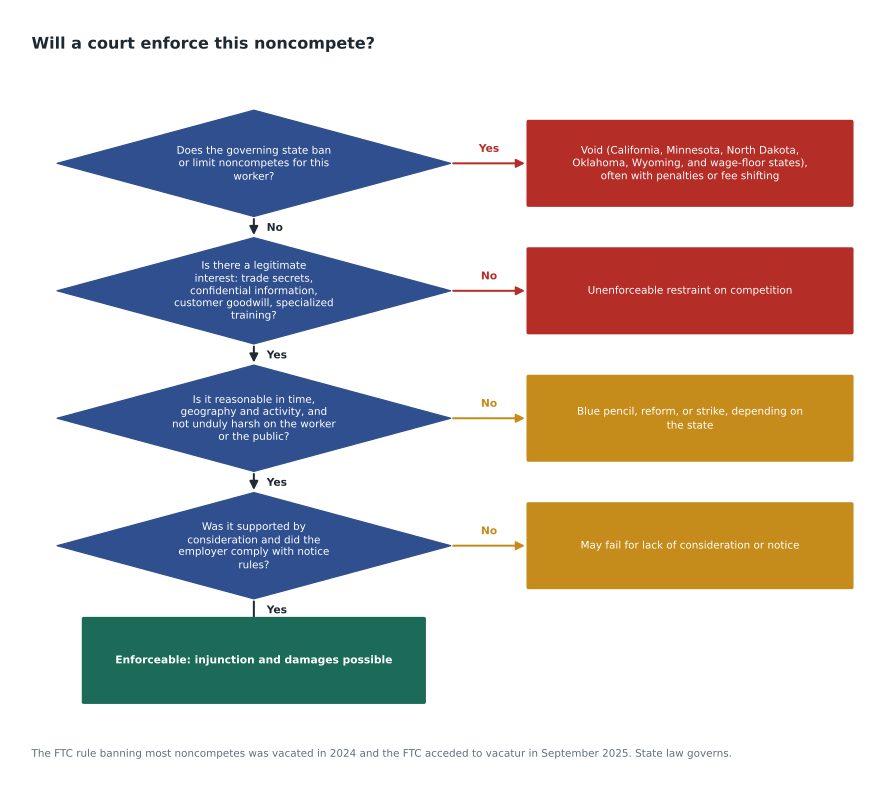
Most states apply a three-part reasonableness test, reflected in the Restatement of Employment Law (2015). First, the covenant must protect a legitimate interest of the employer beyond simply avoiding competition: trade secrets and confidential information, customer relationships and goodwill developed at the employer's expense, or in some states specialized training. Second, it must be reasonable in duration, geographic scope and the activities restricted, no broader than necessary to protect that interest. Third, it must not impose undue hardship on the employee or injure the public, for instance by depriving a community of needed medical services. Courts also require consideration: a new job satisfies the requirement in every state, but states divide on whether continued employment alone supports a covenant signed in the middle of the relationship. Pennsylvania and Minnesota, among others, require something more, such as a raise, promotion or bonus; Devorah received a promotion and raise, which satisfies even the strict rule.
When a covenant is overbroad, states take three approaches. Under the blue pencil rule, a court may strike grammatically severable unreasonable terms but may not rewrite the clause. Under the reformation or partial enforcement approach, now the majority, a court may modify the covenant to a reasonable scope and enforce it as modified, often only if the employer acted in good faith. A few states, such as Nebraska by judicial decision and Wisconsin by statute, follow a red pencil rule and refuse to enforce an overbroad covenant at all, on the theory that partial enforcement encourages employers to overreach. In BDO Seidman v. Hirshberg (1999), the New York Court of Appeals held that an accounting firm could enforce a covenant only as to clients the employee had served and with whom he had developed relationships through his work for the firm, not as to clients he brought with him or never served, and enforced the covenant as so limited.
The states that ban or limit noncompetes
State legislatures have moved aggressively in the last decade, and the law now varies more from state to state than any other area covered in this course. California has voided employee noncompetes since 1872; Business and Professions Code section 16600 provides that every contract restraining anyone from engaging in a lawful profession, trade or business is void, subject to narrow exceptions for the sale of a business or dissolution of a partnership. In Edwards v. Arthur Andersen LLP (2008), the California Supreme Court rejected a "narrow restraint" exception and held that even a limited nonsolicitation clause was void. In 2023 California added section 16600.5, effective January 1, 2024, which makes noncompetes void regardless of where and when the contract was signed, bars employers from attempting to enforce them, and gives employees a private right of action with attorney fees; the legislature also required employers to notify current and certain former employees by February 14, 2024 that their noncompete clauses were void. California courts have generally continued to permit narrowly drawn clauses that protect trade secrets.
North Dakota and Oklahoma also void most employee noncompetes. Minnesota banned them for agreements signed on or after July 1, 2023, with exceptions for the sale or dissolution of a business. Wyoming enacted a ban, effective July 1, 2025, with exceptions for executive and management personnel and their professional staff, the sale of a business, and covenants protecting trade secrets; it also voids physician noncompetes and limits repayment agreements for training and relocation costs on a sliding scale that ends after four years. Many other states ban noncompetes for workers below a compensation threshold: Illinois (under its Freedom to Work Act, for employees earning 75,000 dollars or less a year, a figure that rises in steps), Washington, Oregon, Colorado, Maine, Maryland, New Hampshire, Rhode Island, Virginia and others, each with its own threshold, notice requirement and remedies. Massachusetts, under its Noncompetition Agreement Act of 2018, limits most noncompetes to 12 months, bars them for nonexempt employees and for employees laid off or terminated without cause, and requires garden leave pay of at least half the employee's salary or other agreed consideration. Many states now forbid noncompetes for physicians and other health care workers. Florida moved in the opposite direction in 2025, enacting a statute that makes certain noncompetes for highly paid employees easier to enforce by injunction.
Federal law briefly threatened to replace this patchwork. In April 2024 the Federal Trade Commission adopted a rule that would have banned nearly all employee noncompetes as an unfair method of competition. In August 2024, in Ryan, LLC v. Federal Trade Commission, a federal district court in Texas set the rule aside nationwide, holding that the Commission lacked authority to issue substantive competition rules and that the rule was arbitrary and capricious. After a change in the Commission's membership, the FTC voted in September 2025 to dismiss its appeals and accede to the vacatur. The Commission has said it will challenge particular noncompetes that harm competition case by case under section 5 of the FTC Act, but there is no federal ban. State law controls.
Marcus asks whether a choice-of-law clause can avoid a state ban. Pembrook says that courts apply the Restatement (Second) of Conflict of Laws section 187 and often refuse to apply a chosen law that would violate a fundamental policy of the state with a materially greater interest, which is usually the state where the employee lives and works. Several ban states have also enacted statutes forbidding employers from requiring their residents to agree to out-of-state law or forum. Section B saw this problem from the conflicts side in LAWU-302, where the neighboring State of Harrowmere's Employee Mobility Act voided a Westmarch noncompete. Devorah lives and works in Westmarch, and both Akerley and Pellmont are Westmarch companies, so no conflict arises.
Applying the framework to Devorah
For the course, Pembrook defines Westmarch's rule: Westmarch enforces reasonable noncompetes for employees earning more than 80,000 dollars a year, applies the majority reformation approach, and requires independent consideration for mid-employment agreements. Devorah earned about 140,000 dollars with commissions. Akerley has legitimate interests in its hospital relationships, developed at its expense, and in its pricing information. The 18-month duration is at the long end but within the range courts routinely enforce for senior sales roles; the 100-mile radius covers most of Akerley's eastern Westmarch territory but may extend beyond the area where Devorah actually worked. The nonsolicitation clause, limited to customers she dealt with in the prior two years, is narrower and more likely to be enforced as written. A court applying reformation might enforce a shorter or geographically narrower noncompete, or enforce only the nonsolicitation clause, which is all Akerley needs to protect the Merrin Valley account.
Trade secrets
Trade secret law protects information regardless of any contract. The federal Defend Trade Secrets Act of 2016 created a civil cause of action in federal court for misappropriation of trade secrets related to products or services in interstate commerce; nearly every state has also adopted the Uniform Trade Secrets Act. Under both, a trade secret is information, including business, financial and technical information, that derives independent economic value from not being generally known or readily ascertainable, and that its owner takes reasonable measures to keep secret. Customer-specific pricing, margins and purchasing histories often qualify; the identity of hospitals that buy surgical supplies does not, because anyone can find it. Misappropriation means acquiring a trade secret by improper means or using or disclosing it in breach of a duty of confidence.
Remedies include injunctions against actual or threatened misappropriation, damages for actual loss and unjust enrichment (or a reasonable royalty), exemplary damages of up to twice the award for willful and malicious misappropriation, and attorney fees in cases of bad faith. The Defend Trade Secrets Act also authorizes ex parte civil seizure in extraordinary circumstances. It contains two employee-protective provisions. An injunction may not prevent a person from entering into an employment relationship, and any conditions on employment must be based on evidence of threatened misappropriation, not merely on the information the person knows. And employees are immune from liability for disclosing trade secrets in confidence to government officials or an attorney solely to report a suspected violation of law; employers must give notice of this immunity in agreements governing confidential information, or lose the right to exemplary damages and attorney fees against an employee who was not notified.
Some courts have accepted the doctrine of inevitable disclosure, which allows an injunction against working for a competitor when the employee's new job would inevitably require use of the former employer's trade secrets. The leading case is PepsiCo, Inc. v. Redmond (1995), in which the Seventh Circuit, applying Illinois law, barred a former PepsiCo manager from taking a similar position at Quaker Oats for several months because he knew PepsiCo's detailed strategic plans for the coming year. California and several other states reject the doctrine because it functions as a noncompete the employee never agreed to, and the Defend Trade Secrets Act's limit on employment injunctions reflects the same concern.
Akerley's case on the Merrin Valley spreadsheet is strong if it can show reasonable secrecy measures: password protection, access limited to the account team, confidentiality agreements and markings. Emailing the file to a personal account in her last week, combined with Merrin Valley's prompt switch, is classic evidence of misappropriation. Pembrook notes that Akerley's 2023 agreement omitted the Defend Trade Secrets Act immunity notice, which means Akerley could recover actual damages and an injunction under the Act but not exemplary damages or attorney fees against Devorah.
Worked problem
Akerley v. Lisk and Pellmont
Akerley's lawyers propose to sue Devorah and Pellmont in federal court and seek a temporary restraining order barring Devorah from working for Pellmont for 18 months anywhere within 100 miles, and barring Pellmont from serving Merrin Valley. Advise on the strongest claims and the scope of relief Akerley is realistically likely to obtain, under Westmarch law as Pembrook has defined it.
Show solution
- Jurisdiction: a Defend Trade Secrets Act claim supplies federal question jurisdiction; state contract and duty of loyalty claims come in under supplemental jurisdiction.
- Trade secret claim: the spreadsheet of Merrin Valley pricing and order history likely qualifies if Akerley protected it; the last-week email to a personal account supports misappropriation. Seek return and forensic deletion, and an order barring use.
- Contract claims: Westmarch enforces noncompetes for employees above 80,000 dollars, and the promotion and raise supply consideration. The nonsolicitation clause is narrow and likely enforceable; the full noncompete may be reformed to a shorter period or narrower area.
- Duty of loyalty: if Devorah solicited Merrin Valley before resigning, seek disgorgement or damages; this requires evidence.
- Pellmont: tortious interference with contract if it knew of the agreement, and misappropriation if it used the spreadsheet. The DTSA bars an injunction preventing Devorah from working at all unless based on evidence of threatened misappropriation.
- Remedy plan: request a TRO requiring return of information and barring solicitation of Devorah's former customers and use of the spreadsheet, rather than a total employment ban that a court is unlikely to grant.
Answer: Akerley's best near-term relief is an order protecting the spreadsheet and enforcing the customer nonsolicitation clause, including as to Merrin Valley if Devorah solicited it. A blanket 18-month, 100-mile employment ban is likely to be narrowed; the missing immunity notice forfeits exemplary damages and fees under the DTSA.
Other mobility restraints
Employers also restrict mobility in less obvious ways. Training repayment agreement provisions require employees who leave within a period to repay training costs; regulators and some states, including Wyoming and California, now limit them. Forfeiture-for-competition clauses in deferred compensation plans take away unvested benefits if an employee competes; New York's employee choice doctrine enforces them without a reasonableness inquiry if the employee left voluntarily. Agreements between employers not to hire or recruit each other's employees can violate the Sherman Act, and the Justice Department has brought criminal no-poach and wage-fixing prosecutions, although juries acquitted in most of the early trials. Pembrook ends by noting that the most effective protection for most employers is not a broad noncompete but sensible information security, narrow nonsolicitation clauses and treating key employees well enough that they stay.
Common mistakes
MistakeAssuming a federal ban on noncompetes exists.
InsteadThe FTC's 2024 rule was set aside in Ryan, LLC v. FTC, and the FTC acceded to vacatur in September 2025; state law governs.
MistakeTreating all states alike.
InsteadCalifornia, Minnesota, North Dakota, Oklahoma and Wyoming void most employee noncompetes; many states use wage thresholds; others apply reasonableness with blue pencil, reformation or red pencil rules.
MistakeSeeking an injunction that bars a former employee from working anywhere for a competitor based only on what she knows.
InsteadThe DTSA forbids injunctions preventing employment and requires evidence of threatened misappropriation; many states reject inevitable disclosure.
MistakeForgetting the DTSA whistleblower immunity notice.
InsteadAgreements governing confidential information must include it, or the employer loses exemplary damages and attorney fees against unnotified employees.
Summary and key terms
- Employees owe a duty of loyalty during employment; they may prepare to compete but may not solicit customers or misuse confidential information before leaving.
- Noncompetes are enforced only if they protect a legitimate interest, are reasonable in time, area and scope, avoid undue hardship, and are supported by consideration.
- States differ widely: California (section 16600 and 16600.5), North Dakota, Oklahoma, Minnesota (2023) and Wyoming (2025) ban most employee noncompetes; many states use wage thresholds; others reform or blue-pencil overbroad covenants.
- The FTC noncompete rule was vacated in 2024 and abandoned in September 2025.
- Trade secret law (DTSA and UTSA) protects information with economic value from secrecy that the owner reasonably protects; the DTSA limits employment injunctions and requires an immunity notice.
- Inevitable disclosure (PepsiCo v. Redmond) is accepted by some courts and rejected by others, including California.
- Duty of loyalty
- An employee's obligation, as the employer's agent, not to compete, solicit for a rival or misuse confidential information during employment.
- Covenant not to compete
- A promise not to work for a competitor or start a competing business for a period and area after employment ends.
- Nonsolicitation agreement
- A promise not to solicit the employer's customers or employees after leaving.
- Blue pencil rule
- The approach that lets a court strike severable unreasonable terms but not rewrite a covenant.
- Trade secret
- Information that derives economic value from not being generally known and that its owner takes reasonable measures to keep secret.
- Inevitable disclosure
- A doctrine allowing an injunction where a new job would inevitably require use of a former employer's trade secrets.
- Garden leave
- A period during which a departing employee remains paid but does not work, used as consideration for a noncompete in some states.
Practice problems
Work each problem on paper first, then reveal the answer to check.
May an employee tell a customer, on her last day, that she is joining a competitor?
Show answer
Generally yes. Announcing a departure is usually permitted; soliciting the customer's business for the competitor before leaving is not.
What did BDO Seidman v. Hirshberg hold?
Show answer
That an accounting firm's covenant was enforceable only as to clients the employee served and developed relationships with through the firm, and that the court could partially enforce the covenant on those terms.
What happened to the FTC noncompete rule?
Show answer
It was set aside nationwide in Ryan, LLC v. FTC (N.D. Tex. 2024), and in September 2025 the FTC dismissed its appeals and acceded to vacatur.
Under the DTSA, may a court enjoin a former employee from working for a competitor because she knows trade secrets?
Show answer
Not merely because of what she knows. The Act bars injunctions preventing employment and requires conditions to rest on evidence of threatened misappropriation.
Why is the identity of hospitals that buy surgical supplies usually not a trade secret?
Show answer
Because it is generally known or readily ascertainable; specific pricing, margins and order histories are more likely to qualify.
Lesson quiz · 5 questions
Score 60% or more to complete this lesson.
Create a free account to save your progress, take quizzes and earn a certificate.