
LAWU-313 · Lesson 2 of 12 · 26 min
At-will employment
▶ Video coming soon A video version of this lesson is on the way.
Pembrook begins the second class with an email. It is from Wystan Akerley to Fiona Galbraith, sent at 9:40 on a Monday night in September 2026: "Let Koenraad go tomorrow. I don't like his attitude on the dock. No need to make a production of it." Koenraad Vetter, a 34-year-old forklift operator, had worked at the Fallow Mill Road distribution center for four years with good reviews. He was fired the next morning. When he asked why, the shift manager told him that the company had decided to "go in a different direction." Pembrook asks Section B whether Akerley has done anything unlawful. Several hands go up to say that firing someone for no real reason must be illegal. Pembrook says that, as a general matter in the United States, it is not, and that this lesson is about why.
The rule
Employment for an indefinite term in every state except Montana is presumed to be at will. Either party may end the relationship at any time, with or without notice, for a good reason, a bad reason or no reason at all, so long as the reason is not one that the law specifically forbids. The Tennessee Supreme Court's formulation in Payne v. Western and Atlantic Railroad Co. (1884) is still quoted: employers may dismiss employees "for good cause, for no cause or even for cause morally wrong, without being thereby guilty of legal wrong." The employee has the same freedom to quit, and the law treats that mutuality as the rule's main justification.
The rule is younger than many students assume. English law presumed that a general hiring was for a year, and early American courts sometimes followed it. In 1877, Horace Gay Wood's treatise on master and servant asserted that in America a general or indefinite hiring was presumed to be at will, a proposition whose supporting authority later scholars have found thin. State courts nevertheless adopted Wood's rule over the following decades, and by the early twentieth century it was settled. In Adair v. United States (1908), the Supreme Court even held that Congress could not prohibit railroads from firing workers for union membership, reasoning that the employer's right to discharge and the employee's right to quit were equal liberties of contract. Adair belongs to the Lochner era and has long since been abandoned, but the common law default it reflected survives.
Hannah asks why the rule persisted after the Lochner era ended. Pembrook gives the arguments on each side. Defenders of at will say that it is efficient and flexible, that it avoids litigation over the reasons for every termination, that employees value the freedom to quit, and that employers who fire good workers arbitrarily pay the price in turnover and reputation. Critics respond that the mutuality is formal rather than real, because losing a job usually costs an employee far more than losing an employee costs an employer; that employees often believe, wrongly, that the law already requires good cause; and that every other major industrial democracy requires a justification for dismissal. Rather than abolish the rule, American law has carved exceptions into it: statutes forbidding particular reasons, contract doctrines that let employers promise more, and tort doctrines that protect public policy. The result is a rule that remains the default but now governs a shrinking set of terminations.
Montana: the exception that proves the rule
Montana is the only state that has displaced the at-will rule by statute. The Wrongful Discharge from Employment Act, enacted in 1987, provides that once an employee has completed the employer's probationary period, a discharge is wrongful if it was not for good cause, if it was in retaliation for refusing to violate public policy or reporting a violation, or if the employer violated its own written personnel policy. The Act also limits remedies: lost wages and benefits for up to four years, reduced by interim earnings, with punitive damages only for actual fraud or malice, and it preempts common law wrongful discharge claims. Montana amended the Act in 2021, among other things to give employers more room to set the length of the probationary period. Pembrook mentions Montana not because Akerley operates there but because it shows what a good-cause regime looks like in American law: it gives employees a substantive right while trading away the large tort verdicts that the common law exceptions can produce. Puerto Rico and the Virgin Islands also have statutes requiring justification for dismissal.
Contracts that displace at will
Because at will is only a presumption, the parties can contract around it. The clearest way is a contract for a definite term. A two-year employment agreement for a hospital executive, a coaching contract or a fixed-term faculty appointment limits the employer's right to fire before the term ends; an employer that does so without cause is liable for the salary for the remainder of the term, reduced by what the employee earns or could with reasonable effort earn in comparable work. Executive contracts typically define cause in detail and specify severance if the executive is terminated without cause or resigns for good reason.
Collective bargaining agreements almost always provide that employees may be disciplined or discharged only for just cause, and they send disputes to arbitration. Arbitrators have developed a substantial common law of just cause: whether the employee had notice of the rule, whether the rule was reasonable, whether the employer investigated fairly, whether the evidence supported the charge, whether the rule was applied evenly, and whether the penalty was proportionate to the offense and the employee's record. Unionized workers are therefore the largest group of American employees who are not at will, although union density in the private sector has fallen to about six percent.
Oral promises can also displace at will, but they face two obstacles. The statute of frauds bars enforcement of oral agreements that by their terms cannot be performed within a year, so an oral promise of a three-year job is unenforceable in most states, while an oral promise of lifetime employment or employment until retirement is often held to be capable of performance within a year because the employee might die. And courts require clear and specific evidence that the employer intended to give up its right to fire at will. Vague assurances ("you'll always have a job here as long as you do good work") are often treated as optimism rather than contract, although some courts have enforced them. Lesson 3 takes up the implied contract cases built on handbooks and assurances of this kind.
Marcus asks what happens when an offer letter says employment is at will and the employee later receives oral assurances of job security. Pembrook answers that most courts give effect to an express written at-will provision and refuse to let later vague statements override it, especially when the document also says that only a specified officer may change the at-will relationship and only in writing. That is why careful employers include both an at-will statement and an integration clause, and why careful employees should ask for job security terms in writing.
Promissory estoppel and fraud
An employee who relies on a promise of employment can sometimes recover even when no enforceable contract exists. In Grouse v. Group Health Plan, Inc. (1981), the Minnesota Supreme Court allowed a pharmacist to recover under promissory estoppel after he resigned from his job and turned down another offer in reliance on a promised position that the defendant withdrew before he started. The employer argued that, because the job would have been at will, the pharmacist could have been fired on his first day and so suffered no damage. The court rejected the argument: the promise implied at least a good-faith opportunity to perform, and reliance damages measured by what he gave up were appropriate. Other courts have reached the opposite result, reasoning that reliance on an at-will job is unreasonable. The split is a good reminder that the at-will rule interacts with general contract doctrine.
Fraudulent inducement is a separate claim. An employer that lies about a material fact to induce a candidate to accept a job, such as the company's financial health, the existence of the position or the compensation structure, may be liable in tort for the employee's losses, including the job he or she gave up. The at-will nature of the new job does not immunize the lie, although it may limit damages.
Statutory limits on the reasons for firing
Most of what restrains employers in practice is statutory. Federal and state statutes forbid firing an employee because of race, color, religion, sex, national origin, age, disability, genetic information, pregnancy or military service; because the employee complained of discrimination, unpaid wages or unsafe conditions; because the employee took protected leave; because the employee engaged in protected concerted activity; or because the employee testified, served on a jury or reported fraud. State laws add more: many protect off-duty lawful conduct, political activity, use of lawful products or cannabis, status as a victim of domestic violence, or credit history. Whistleblower statutes, including the Sarbanes-Oxley Act and the Dodd-Frank Act for securities violations, the False Claims Act for fraud on the government, and dozens of industry-specific federal provisions administered by OSHA, protect employees who report specified wrongdoing. In Murray v. UBS Securities, LLC (2024), the Supreme Court held that a Sarbanes-Oxley whistleblower need not prove that the employer acted with retaliatory intent; the employee must show that the protected activity was a contributing factor in the adverse action, and the employer then bears the burden of proving by clear and convincing evidence that it would have taken the same action anyway.
Pembrook asks Section B to apply the statutes to Koenraad. He is not in a protected category that played any apparent role, he made no complaints, took no leave and engaged in no group activity. If "attitude on the dock" is really about something else, such as a complaint he made about forklift maintenance (protected by OSHA's section 11(c) and possibly the NLRA if made with coworkers), an injury report or his national origin, the analysis changes. Otherwise Akerley's decision, however unfair it seems, is lawful.
Constructive discharge
An employer cannot avoid the rules on discharge by making working conditions so intolerable that the employee quits. Under the doctrine of constructive discharge, a resignation is treated as a firing when the employer deliberately created or knowingly permitted conditions so intolerable that a reasonable person would have felt compelled to resign. The doctrine matters because many statutory and contract remedies require a discharge. In Pennsylvania State Police v. Suders (2004), the Supreme Court held that a Title VII constructive discharge claim based on supervisor harassment requires conduct even more severe than a hostile environment, and that the Faragher/Ellerth affirmative defense is available unless an official act precipitated the resignation. In Green v. Brennan (2016), the Court held that the limitations period for a constructive discharge claim runs from the date the employee gives notice of resignation, not from the employer's last discriminatory act.
The mechanics of termination
Even a lawful at-will firing triggers obligations. The federal Worker Adjustment and Retraining Notification Act requires employers with 100 or more employees to give 60 days' written notice before a plant closing that causes 50 or more employees at a single site to lose their jobs, or a mass layoff of at least 50 employees making up a third of the site's workforce, or 500 employees regardless of percentage. An employer that fails to give notice owes back pay and benefits for each day of violation up to 60 days. Several states, including New York, New Jersey and California, have their own WARN statutes with lower thresholds or longer notice periods.
State wage payment laws govern final pay. Some states require payment of all wages on the day of termination; others allow until the next regular payday. Many states require payment of accrued, unused vacation if the employer's policy or state law treats it as earned wages. The Consolidated Omnibus Budget Reconciliation Act requires employers with 20 or more employees to offer departing employees continuation of group health coverage, generally for 18 months at the employee's expense. Some states require written notice of the termination date or reason, or a separation notice for unemployment purposes. Unemployment insurance is available to employees who lose their jobs through no fault of their own; an employee fired for misconduct, as defined by state law, may be disqualified.
References raise their own risks. A former employer that makes false statements of fact to a prospective employer may be liable for defamation, although communications to someone with a legitimate interest in the information enjoy a qualified privilege that is lost only by knowing falsity, reckless disregard or excessive publication. Fear of defamation suits leads many employers to confirm only dates of employment and title. A few states have statutes protecting good-faith references, and some courts have held that an employer who gives a misleadingly positive reference about a dangerous former employee can be liable to a third party injured by that employee.
Worked problem
Firing for a bad reason
Akerley fires Koenraad Vetter because Wystan Akerley dislikes his "attitude." Two weeks later Koenraad learns from a coworker that the real reason was that he had told other forklift drivers, during a break, that the company's failure to replace worn brake pads was going to get someone killed, and that several drivers had agreed to raise it together with the shift manager. Akerley's handbook (which it distributes to all employees) says employment is at will and can be changed only by a writing signed by the CEO. Advise Koenraad.
Show solution
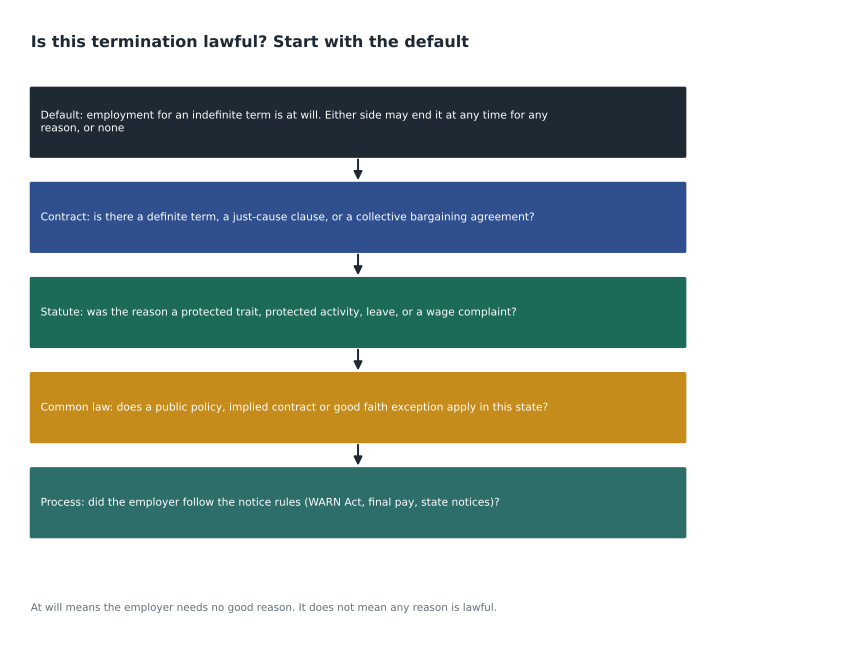
- Start with the default: Koenraad was employed for an indefinite term, and the handbook confirms at-will status, so a firing for 'attitude' alone would be lawful.
- Look for a contract: none. The handbook disclaimer and signature requirement defeat any argument that informal assurances changed his status.
- Look for a statute: speaking with coworkers about a safety hazard and agreeing to raise it as a group is concerted activity for mutual aid or protection under section 7 of the NLRA, which protects nonunion employees. Firing him for it would violate section 8(a)(1).
- Safety complaints may also be protected under OSHA section 11(c), but that requires a complaint filed with OSHA within 30 days of the retaliation.
- Consider state law: Westmarch might recognize a public policy tort for complaining about safety violations (Lesson 3), though some states hold that statutory remedies are exclusive.
- Gather proof: the coworker's account, the timing, Wystan's email, and any maintenance records. Calendar the six-month NLRB deadline and the 30-day OSHA deadline.
Answer: If the coworker's account is true, the firing was not a lawful at-will termination but retaliation for protected concerted activity. Koenraad should file an unfair labor practice charge with the NLRB within six months and consider an OSHA complaint within 30 days; reinstatement and back pay are the main remedies.
What at will means in practice
Pembrook ends with a practical observation from her years on both sides. Employers win many employment cases not because at will lets them fire for any reason but because an employee who claims a forbidden reason must prove it, and at will means the employer does not have to prove a good one. Plaintiffs win when the evidence suggests that the employer's stated reason was not its real reason. For that reason, the most important practical rule for employers is the one that at will does not require: give a true reason, document it, and apply it consistently. The most important rule for employees' lawyers is to ask what else was happening in the weeks before the termination. Priya observes that this means the at-will rule shapes evidence and burden more than it shapes outcomes. Pembrook says that is exactly the point, and that Lesson 3 will show how the common law has narrowed even the rule itself.
Common mistakes
MistakeTelling a client that firing for no reason or an unfair reason is illegal.
InsteadOutside Montana and contract settings, at-will employment lets an employer fire for any reason that is not specifically forbidden by statute, contract or a recognized common law exception.
MistakeAssuming oral assurances of job security create an enforceable contract.
InsteadCourts require clear and specific promises, the statute of frauds may bar multi-year oral contracts, and written at-will clauses with integration language usually control.
MistakeTreating a resignation as ending the case.
InsteadA resignation can be a constructive discharge if the employer created intolerable conditions; the limitations period runs from notice of resignation (Green v. Brennan).
MistakeForgetting the mechanics of termination.
InsteadWARN notice, final pay timing, accrued vacation, COBRA notices and state separation notices apply even to lawful at-will terminations.
Summary and key terms
- Employment for an indefinite term is presumed at will in every state except Montana; either party may end it at any time for any reason not specifically forbidden.
- The rule became settled in the late nineteenth century after Wood's 1877 treatise; it rests on formal mutuality and efficiency arguments.
- Montana's Wrongful Discharge from Employment Act requires good cause after probation and limits remedies.
- Contracts for a definite term, just-cause clauses in collective bargaining agreements, and clear promises can displace at will; written at-will clauses with integration language usually defeat vague assurances.
- Statutes forbid firing for protected traits, protected activity, leave and whistleblowing; Murray v. UBS (2024) requires no retaliatory intent under Sarbanes-Oxley.
- Constructive discharge treats intolerable conditions as a firing; WARN, final pay, COBRA and reference rules govern the mechanics of termination.
- At-will employment
- Employment for an indefinite term that either party may end at any time for any reason not specifically forbidden by law.
- Wood's rule
- The presumption, stated in Horace Wood's 1877 treatise, that an indefinite hiring is at will.
- Just cause
- A contractual standard, common in collective bargaining agreements, requiring a fair and proportionate reason for discipline or discharge.
- Constructive discharge
- A resignation treated as a discharge because the employer created or permitted conditions so intolerable that a reasonable person would quit.
- WARN Act
- The federal statute requiring 60 days' notice of plant closings and mass layoffs by employers with 100 or more employees.
- Qualified privilege
- A defense to defamation for good-faith communications to someone with a legitimate interest, such as a reference to a prospective employer.
Practice problems
Work each problem on paper first, then reveal the answer to check.
An employer fires a salesperson because the CEO dislikes his taste in music. He has no contract, belongs to no protected class implicated by the decision and made no complaints. Is the firing lawful?
Show answer
Yes, in an at-will state. The reason is arbitrary but not forbidden by statute, contract or a recognized public policy.
An executive with a three-year written contract is fired without cause after one year. What is the usual measure of recovery?
Show answer
The salary and benefits for the remaining two years, reduced by what the executive earns or could reasonably earn in comparable employment (mitigation).
What did Murray v. UBS Securities (2024) hold?
Show answer
A Sarbanes-Oxley whistleblower must show that protected activity was a contributing factor in the adverse action but need not prove retaliatory intent; the employer can then avoid liability only by clear and convincing evidence that it would have acted the same way.
A company with 300 employees closes a warehouse and lays off 80 workers there with one week's notice. What federal statute is implicated?
Show answer
The WARN Act, which requires 60 days' notice of a plant closing affecting 50 or more employees at a single site; the employer may owe up to 60 days of back pay and benefits.
Why did the Minnesota court in Grouse allow recovery even though the promised job would have been at will?
Show answer
Because the promise implied a good-faith opportunity to perform, and the pharmacist reasonably relied on it by resigning and turning down another offer; promissory estoppel allowed reliance damages.
Lesson quiz · 5 questions
Score 60% or more to complete this lesson.
Create a free account to save your progress, take quizzes and earn a certificate.