
LAWU-313 · Lesson 6 of 12 · 25 min
Harassment, religious accommodation and retaliation
▶ Video coming soon A video version of this lesson is on the way.
Pembrook opens with two files that reached Fiona Galbraith's desk in the same week of October 2026. The first concerns Ximena Paredes, a picker on the second shift. Ximena reported to HR that Royce Gunderson, the operations manager who had chosen Cyrus Kettridge over Nkechi Arinze for the supervisor job, had for months made comments about her body, sent her late-night texts asking her to meet him for drinks, and twice cornered her in the inventory cage. She had not reported earlier, she said, because Gunderson controlled shift assignments and overtime, and because a coworker who complained about him the year before had been moved to the weekend shift. Two weeks after her report, Ximena was moved to the weekend shift. The second file concerns Josiah Teale, a warehouse inventory specialist and a Seventh-day Adventist who observes the Sabbath from sundown Friday to sundown Saturday. Akerley announced in September that all warehouse staff would rotate onto Saturday shifts beginning in November. Josiah asked to be excused and offered to work Sundays or extra weekday hours. His supervisor said exceptions would be unfair to everyone else.
Pembrook says the two files cover three doctrines that sit on top of Title VII's basic prohibition: harassment, religious accommodation and retaliation. Retaliation, she adds, is now the most frequently alleged basis in charges filed with the EEOC, and many employers that would defeat the underlying discrimination claim lose the retaliation claim.
Harassment as discrimination
Title VII does not mention harassment. The Supreme Court recognized it as a form of discrimination in Meritor Savings Bank, FSB v. Vinson (1986), holding that a plaintiff may establish a violation by proving that discrimination based on sex created a hostile or abusive working environment, even without economic loss. Harassment claims fall into two categories. Quid pro quo harassment occurs when a supervisor conditions a job benefit on submission to sexual demands or takes a tangible action because the employee refused. Hostile environment harassment occurs when unwelcome conduct because of a protected characteristic is severe or pervasive enough to alter the conditions of employment and create an abusive working environment.
In Harris v. Forklift Systems, Inc. (1993), the Court held that the environment must be both objectively hostile, as a reasonable person would find it, and subjectively perceived as hostile by the victim, but that the plaintiff need not show psychological injury. Courts look at all the circumstances: the frequency and severity of the conduct, whether it is physically threatening or humiliating or merely an offensive utterance, and whether it unreasonably interferes with work. Title VII is not, the Court has said, a general civility code; isolated incidents, unless extremely serious, do not amount to a change in the terms of employment. Oncale v. Sundowner Offshore Services (1998) held that same-sex harassment is actionable when it is because of sex. Harassment because of race, religion, national origin, age or disability is analyzed under the same framework.
The conduct must be because of a protected characteristic. A supervisor who is abusive to everyone is an equal-opportunity bully, not a Title VII violator, although the plaintiff may show that sex-specific or race-specific abuse was directed at her group. Gunderson's comments about Ximena's body, his propositions and his physical cornering are sex-based on their face. Several states have relaxed the federal standard by statute; New York, for example, amended its Human Rights Law in 2019 so that harassment need not be severe or pervasive and is actionable if it subjects the employee to inferior terms, conditions or privileges of employment, subject to a defense for petty slights.
When is the employer liable?
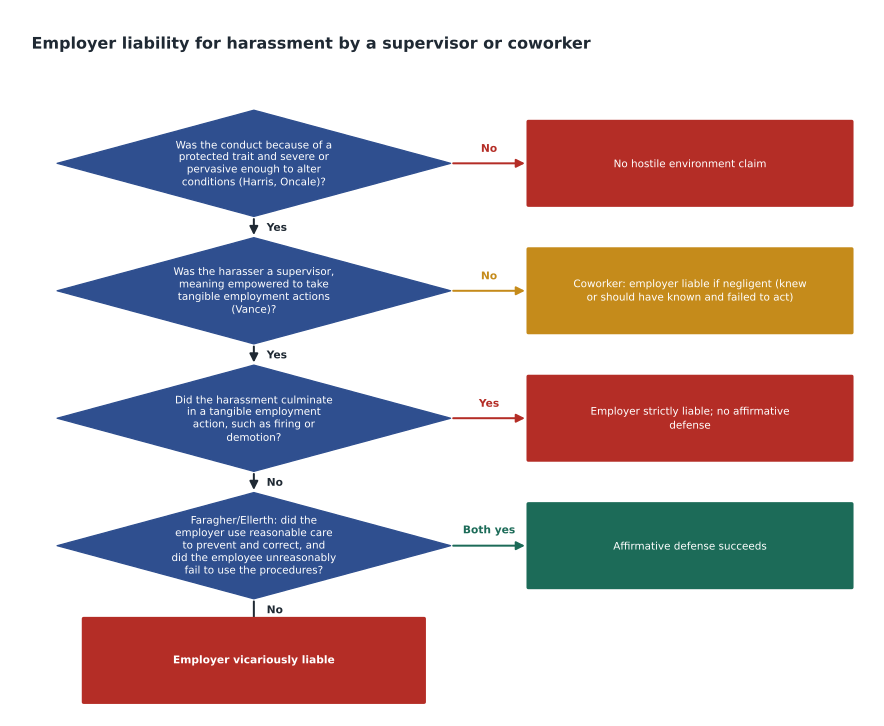
Because Title VII makes employers, not individual harassers, liable, the key question is when the employer answers for a harasser's conduct. In Burlington Industries, Inc. v. Ellerth and Faragher v. City of Boca Raton, both decided in 1998, the Court adopted a framework based on agency principles. When a supervisor's harassment culminates in a tangible employment action, such as discharge, demotion or an undesirable reassignment with significantly different responsibilities, the employer is strictly liable. When no tangible action is taken, the employer is vicariously liable for a supervisor's hostile environment harassment but may raise an affirmative defense by proving two elements: that it exercised reasonable care to prevent and promptly correct harassing behavior, usually by maintaining and enforcing an effective anti-harassment policy with a complaint procedure; and that the employee unreasonably failed to take advantage of preventive or corrective opportunities. The employer bears the burden on both elements.
Who counts as a supervisor matters. In Vance v. Ball State University (2013), the Court held that a supervisor, for purposes of vicarious liability, is someone the employer has empowered to take tangible employment actions against the victim, such as hiring, firing, demoting, promoting, transferring or disciplining, not merely someone who directs daily work. For harassment by coworkers, the employer is liable only if it was negligent: if it knew or should have known of the harassment and failed to take prompt and appropriate corrective action. The same negligence standard generally applies to harassment by customers, vendors and other non-employees whom the employer can control.
Applying the framework to Ximena
Section B takes the steps in turn. The conduct was because of sex and, with months of comments, propositions and two incidents of physical cornering, likely severe or pervasive. Gunderson is a supervisor under Vance: he controls shift assignments and overtime and had the authority to move employees to the weekend shift. Before her report, there was no tangible action, so Akerley may try the affirmative defense. Akerley has a written anti-harassment policy with a hotline and several reporting channels, and it trains managers annually. Ximena waited months to report. But a delay is not unreasonable per se, and courts consider whether the employee had a reasonable fear of retaliation; the reassignment of the coworker who complained the year before, if proved, makes her fear concrete. An employer whose policy exists on paper but is ignored in practice cannot show reasonable care. The move to the weekend shift two weeks after her report raises a separate question: if Gunderson ordered it, it may be a tangible employment action that eliminates the defense for the period after it, and it is almost certainly retaliation.
Pembrook adds the regulatory context. In April 2024 the EEOC issued comprehensive enforcement guidance on harassment. In May 2025 a federal district court in Texas, in Texas v. EEOC, vacated the portions addressing gender identity, and on January 22, 2026 the Commission voted to rescind the entire guidance. Enforcement guidance never had the force of law; the governing law remains the statute and the Supreme Court's decisions from Meritor through Vance, along with Bostock. Employers still need effective policies, training and complaint procedures, because those are what make the Faragher/Ellerth defense available. Federal law also now limits a common settlement practice: the Speak Out Act of 2022 makes predispute nondisclosure and nondisparagement clauses unenforceable with respect to sexual harassment and sexual assault disputes, though it does not affect agreements made after a dispute arises.
Religious discrimination and accommodation
Title VII's definition of religion in section 701(j) includes all aspects of religious observance and practice as well as belief, and requires an employer to reasonably accommodate an employee's religious practice unless doing so would impose an undue hardship on the conduct of its business. Religion is defined broadly and includes sincerely held moral or ethical beliefs that function as religion in the employee's life, but not political, social or economic views or personal preferences. Employers may question sincerity only when they have an objective basis for doing so.
For decades, the meaning of undue hardship was governed by a line in Trans World Airlines, Inc. v. Hardison (1977) suggesting that requiring an employer to bear more than a de minimis cost was an undue hardship. Lower courts read the phrase to excuse almost any accommodation. In Groff v. DeJoy (2023), the Court unanimously clarified the standard. Gerald Groff, an evangelical Christian postal carrier, refused to work Sundays after the Postal Service began Sunday deliveries for Amazon; he was disciplined and resigned. The Court, in an opinion by Justice Alito, held that an employer must show that the burden of granting an accommodation would result in substantial increased costs in relation to the conduct of its particular business. Courts must consider all relevant factors, including the accommodation at issue and the practical impact in light of the nature, size and operating cost of the employer. Impacts on coworkers matter only if they affect the conduct of the business; coworkers' dislike of religious practice or of the accommodation itself cannot be the basis of undue hardship. And an employer must do more than conclude that a requested accommodation is too burdensome; it must consider other options, such as voluntary shift swaps.
In EEOC v. Abercrombie and Fitch Stores, Inc. (2015), the Court held that an employer violates Title VII if the need for a religious accommodation is a motivating factor in an adverse decision, even if the employer has no actual knowledge of the need. The retailer declined to hire a young woman who wore a headscarf to her interview because the scarf would violate its "look policy"; it was liable even though she never asked for an accommodation, because the manager suspected she wore it for religious reasons and that suspicion motivated the decision.
Religious employers have special protection. Section 702 exempts religious corporations, associations and educational institutions with respect to employing individuals of a particular religion. The First Amendment's ministerial exception, recognized in Hosanna-Tabor Evangelical Lutheran Church and School v. EEOC (2012) and extended in Our Lady of Guadalupe School v. Morrissey-Berru (2020), bars employment discrimination claims by employees who perform important religious functions, such as teachers at religious schools who instruct students in the faith.
Josiah's request is the core case for accommodation. Akerley is a 420-employee company with several hundred warehouse staff. Pembrook asks what Akerley must show after Groff. It cannot rely on the general unfairness of exceptions or on coworkers' resentment. It would need to show substantial increased costs: for example, that it cannot staff the Saturday shift without paying premium overtime it otherwise would not incur, or that Josiah's particular skills are essential on Saturdays. It must also consider alternatives, including Josiah's offer to work Sundays or extra weekday hours, voluntary swaps with coworkers, and adjusting the rotation. Collective bargaining agreements' seniority systems can limit accommodation (Hardison involved one), but Akerley's warehouse is not unionized. On these facts, Akerley is unlikely to establish undue hardship.
Retaliation
Section 704(a) prohibits discrimination against an employee because the employee has opposed any practice made unlawful by Title VII (the opposition clause) or has made a charge, testified, assisted or participated in any manner in an investigation, proceeding or hearing under the statute (the participation clause). The ADA, the ADEA, the FLSA, the FMLA, the NLRA and nearly every other employment statute contain similar provisions. Opposition must be based on a reasonable, good-faith belief that the practice is unlawful; the underlying practice need not actually violate the law. In Crawford v. Metropolitan Government of Nashville (2009), the Court held that an employee who reports harassment in response to questions in an employer's internal investigation has engaged in opposition, even if she did not initiate the complaint.
In Burlington Northern and Santa Fe Railway Co. v. White (2006), the Court held that the anti-retaliation provision is broader than the discrimination provision. It covers actions that are not related to employment or that occur outside the workplace, and it reaches any action that is materially adverse, meaning one that might well have dissuaded a reasonable worker from making or supporting a charge of discrimination. Reassigning a forklift operator to dirtier and harder track laborer duties, and a 37-day suspension later reversed with back pay, both qualified. Muldrow (2024) explained that its own "some harm" standard for discrimination claims and Burlington Northern's standard for retaliation differ, because the retaliation provision aims to prevent harm to the enforcement process. In Thompson v. North American Stainless, LP (2011), the Court held that firing an employee's fiancé in retaliation for her charge was actionable by the fiancé, who was within the zone of interests the statute protects.
Causation is the usual battleground. In University of Texas Southwestern Medical Center v. Nassar (2013), the Court held that Title VII retaliation claims require proof that the protected activity was a but-for cause of the adverse action; the motivating-factor standard of section 703(m) does not apply. Temporal proximity supports an inference of causation when it is very close; in Clark County School District v. Breeden (2001), the Court said that an action taken 20 months after protected activity suggests by itself no causality at all. Evidence that the decision-maker knew of the protected activity is essential, and departures from normal procedures, shifting explanations and comparator evidence work as they do in discrimination cases.
Ximena's transfer to the weekend shift two weeks after her complaint is a textbook retaliation claim. A move to weekend work is materially adverse; it would dissuade a reasonable worker from complaining. The timing is close, and if Gunderson, whom she accused, made the decision, his knowledge is obvious. Akerley may say the move was part of the Saturday rotation, but the rotation began in November and applied to everyone, while Ximena's transfer was a permanent change made in October to her alone.
Worked problem
Galbraith's response plan
Fiona Galbraith asks what Akerley should do now about Ximena and Josiah to reduce liability and comply with the law. Gunderson denies everything. Ximena has texts on her phone. The coworker moved to weekends last year, Bianca Yslas, has since quit.
Show solution
- Ximena: immediately reverse the weekend transfer and restore any lost pay or premium; a prompt reversal limits retaliation damages and supports reasonable care.
- Investigate promptly and impartially: use someone outside Gunderson's chain of command, preserve the texts and cage access logs, interview witnesses including Bianca Yslas, and document findings.
- Interim measures: separate Ximena from Gunderson's supervision without burdening her; Gunderson, not the complainant, should be moved if anyone is.
- Corrective action: if the investigation substantiates the conduct, discipline proportionate to its seriousness, up to termination; review why the earlier complaint was handled by moving the complainant.
- Josiah: engage with him about accommodations, consider his offer to work Sundays or extra weekday hours and voluntary swaps, and grant an accommodation unless Akerley can document substantial increased costs under Groff.
- Train supervisors on retaliation, and audit how prior complaints were handled; a policy that exists only on paper will not support a Faragher/Ellerth defense.
Answer: Prompt reversal of the transfer, a genuine investigation, corrective action and an accommodation for Josiah will not erase past liability, but they can preserve affirmative defenses, reduce damages and prevent new claims.
Priya asks whether Akerley could have avoided all of this by firing Gunderson the day Ximena complained. Pembrook says that acting before investigating creates its own risks, including claims by the accused, and that what the law rewards is not speed alone but prompt, fair and effective response. Hannah observes that in both files the employer's real problem was a manager making decisions the company's own policies did not support. Pembrook says that is true of most of the cases she has tried.
Common mistakes
MistakeTreating any offensive comment as actionable harassment.
InsteadFederal law requires conduct because of a protected trait that is severe or pervasive enough to alter conditions, judged objectively and subjectively (Harris).
MistakeCalling anyone who directs work a supervisor.
InsteadUnder Vance, a supervisor is someone empowered to take tangible employment actions; for coworkers, liability requires negligence.
MistakeApplying the de minimis cost standard to religious accommodation.
InsteadGroff (2023) requires substantial increased costs in relation to the employer's business; coworker hostility to the accommodation does not count.
MistakeUsing the motivating-factor standard for retaliation.
InsteadNassar requires but-for causation for Title VII retaliation, and Burlington Northern defines adverse action broadly as anything that might dissuade a reasonable worker.
MistakeTreating rescinded EEOC guidance as having changed the governing law.
InsteadThe 2024 guidance was rescinded in January 2026, but the statute and Supreme Court precedent, including Bostock and Faragher/Ellerth, continue to govern.
Summary and key terms
- Harassment because of a protected trait is discrimination when it is quid pro quo or creates a hostile environment that is severe or pervasive (Meritor, Harris, Oncale).
- Employers are strictly liable for supervisor harassment culminating in a tangible action; otherwise the Faragher/Ellerth affirmative defense may apply; coworker harassment requires negligence; supervisors are defined by Vance.
- The EEOC's 2024 harassment guidance was partly vacated in 2025 and rescinded in January 2026; the Speak Out Act limits predispute nondisclosure clauses.
- Employers must accommodate religious practice unless it causes substantial increased costs (Groff, 2023); suspicion of a religious need can motivate liability (Abercrombie).
- Retaliation protects opposition and participation; adverse action is anything that might dissuade a reasonable worker (Burlington Northern); causation is but-for (Nassar).
- Hostile environment
- Unwelcome conduct because of a protected trait that is severe or pervasive enough to alter the conditions of employment.
- Quid pro quo harassment
- Conditioning a job benefit on submission to sexual demands, or taking tangible action because the employee refused.
- Tangible employment action
- A significant change in employment status such as firing, demotion, failure to promote or reassignment with significantly different responsibilities.
- Faragher/Ellerth defense
- An employer's affirmative defense to supervisor harassment without a tangible action: reasonable care to prevent and correct, plus the employee's unreasonable failure to use procedures.
- Undue hardship (religion)
- After Groff, a burden that results in substantial increased costs in relation to the conduct of the employer's particular business.
- Materially adverse action
- In retaliation law, any action that might well dissuade a reasonable worker from making or supporting a charge of discrimination.
- Ministerial exception
- A First Amendment doctrine barring discrimination claims by employees who perform important religious functions for religious organizations.
Practice problems
Work each problem on paper first, then reveal the answer to check.
An employee who suffered months of supervisor harassment without any tangible action never used the employer's well-publicized complaint procedure, for no reason. What defense does the employer have?
Show answer
The Faragher/Ellerth affirmative defense, if it proves it exercised reasonable care to prevent and correct harassment and that the employee unreasonably failed to use the procedure.
Under Vance, is a lead worker who assigns daily tasks but cannot hire, fire or discipline a supervisor?
Show answer
No. For vicarious liability purposes, a supervisor must be empowered to take tangible employment actions; harassment by the lead is analyzed under the negligence standard.
After Groff, may an employer deny a Sabbath accommodation because coworkers resent covering the shift?
Show answer
No. Coworker impacts count only if they affect the conduct of the business, and animus toward religion or toward the accommodation cannot establish undue hardship.
What did Thompson v. North American Stainless hold?
Show answer
That an employee fired because his fiancée filed an EEOC charge could sue for retaliation, because he was within the zone of interests Title VII protects.
What causation standard governs Title VII retaliation claims?
Show answer
But-for causation, under University of Texas Southwestern Medical Center v. Nassar (2013).
Lesson quiz · 5 questions
Score 60% or more to complete this lesson.
Create a free account to save your progress, take quizzes and earn a certificate.