
LAWU-313 · Lesson 10 of 12 · 24 min
Workplace privacy
▶ Video coming soon A video version of this lesson is on the way.
In February 2026 Akerley installed new software in its customer service center that records every call, logs keystrokes and idle time, takes a screenshot of each representative's screen every five minutes and produces a daily "productivity score." The delivery drivers' RouteLink app tracks location continuously while the app is open, which most drivers leave on all day, including during lunch and personal errands. The warehouse replaced its badge time clocks with fingerprint scanners in 2025. After a forklift struck a rack in September, Akerley required the operator to take a drug test, which detected marijuana metabolites; Westmarch has legalized adult recreational use. And when a picker posted on Facebook, on a weekend, that "management at Akerley doesn't care if we cook in that warehouse, maybe we should all call in sick on the next 95-degree day," a manager printed the post and placed it in her file. Pembrook says each item raises a different body of privacy law, and that the first question is always whether the employer is public or private.
Public employers and the Constitution
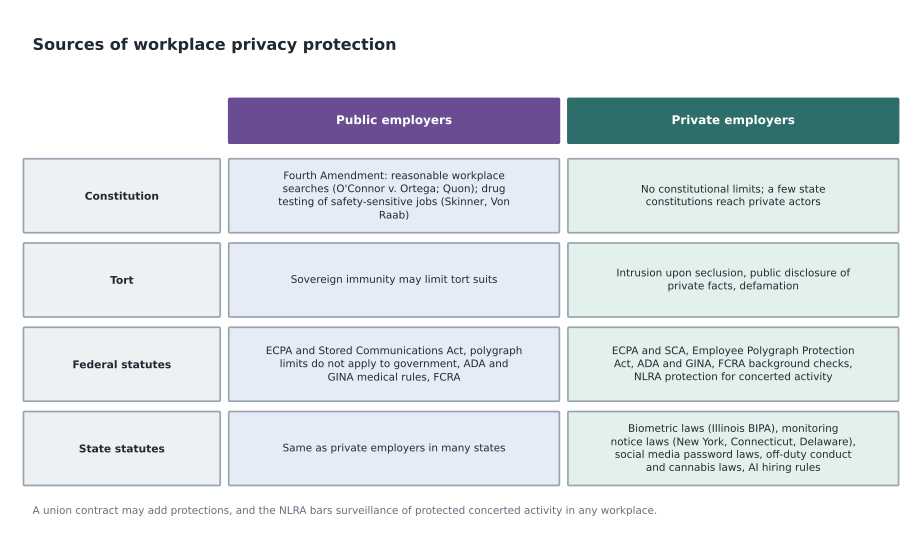
The Fourth Amendment protects government employees against unreasonable searches by their employer. In O'Connor v. Ortega (1987), a plurality held that public employees may have a reasonable expectation of privacy in their offices, desks and files, depending on the operational realities of the workplace, and that work-related searches, both noninvestigatory searches for work purposes and investigations of work-related misconduct, are judged by a standard of reasonableness under all the circumstances rather than by probable cause and a warrant. In City of Ontario v. Quon (2010), the Court assumed that a police officer had a reasonable expectation of privacy in text messages sent on a department-issued pager, and held that the city's review of transcripts to determine whether the character limit was adequate was reasonable because it had a legitimate work-related purpose and was not excessively intrusive.
Drug testing of public employees is a search. In Skinner v. Railway Labor Executives' Association (1989) and National Treasury Employees Union v. Von Raab (1989), the Court upheld suspicionless testing of railroad employees after accidents and of customs employees seeking positions involving drug interdiction or firearms, because of special needs beyond ordinary law enforcement and the safety-sensitive nature of the jobs. Suspicionless testing of employees in ordinary jobs is generally unconstitutional. Public employees also have First Amendment protection for speech on matters of public concern, under the balancing test of Pickering v. Board of Education (1968), but not for speech made pursuant to their official duties, under Garcetti v. Ceballos (2006); Lane v. Franks (2014) held that truthful sworn testimony outside the scope of ordinary job duties is protected. None of these constitutional rules applies to Akerley, a private company, although some state constitutions, such as California's privacy clause, reach private employers.
Common law privacy torts
Private employees rely mainly on tort law and statutes. The tort of intrusion upon seclusion, described in Restatement (Second) of Torts section 652B, makes a person liable for intentionally intruding, physically or otherwise, on another's solitude or private affairs in a manner that would be highly offensive to a reasonable person. Courts have recognized intrusion claims for hidden cameras in locker rooms and restrooms, searches of an employee's person or purse, and surveillance of an employee's home, but have generally rejected claims based on monitoring of company email or computer use, reasoning that employees have no reasonable expectation of privacy in employer systems, especially after notice. The tort of public disclosure of private facts requires publicity given to private matters that would be highly offensive and are not of legitimate public concern, such as broadcasting an employee's medical condition to coworkers. Defamation and false light claims arise when employers communicate inaccurate reasons for discipline.
Electronic monitoring statutes
The Electronic Communications Privacy Act of 1986 includes the federal Wiretap Act, which prohibits intentional interception of wire, oral or electronic communications, and the Stored Communications Act, which prohibits unauthorized access to stored communications. Both have exceptions that cover most employer monitoring. The Wiretap Act permits interception where one party consents, and courts have found consent from clear notice in handbooks or login banners; it also excludes interception by equipment used in the ordinary course of business, the so-called business extension exception, which allows employers to monitor business calls but not to keep listening once a call is clearly personal. The Stored Communications Act permits the provider of the communication service, which may be the employer for its own email system, to access stored communications. Employers who access an employee's personal accounts without authorization, however, may violate the Act; in Konop v. Hawaiian Airlines, Inc. (2002), the Ninth Circuit held that an airline officer who used another pilot's login to view a pilot's password-protected website criticizing management could violate the Act, and in Pietrylo v. Hillstone Restaurant Group (2009) a jury found that managers who coerced an employee into providing her password to a private chat group violated it.
States add protections. About half the states prohibit employers from requiring or requesting employees' or applicants' passwords to personal social media accounts. New York's Civil Rights Law section 52-c, effective May 2022, requires private employers that monitor employees' telephone, email or internet use to give written notice at hiring, obtain acknowledgment and post the notice; Connecticut and Delaware have similar notice laws. Some states require two-party consent for recording calls, which matters for call centers that record customers and employees. Westmarch, Pembrook says for the course, follows the federal one-party consent rule and requires written notice of electronic monitoring, modeled on New York.
Applying these rules, Akerley's call center monitoring is probably lawful under federal law if the representatives were given clear written notice and the monitoring is limited to business systems and business calls. The productivity score raises other issues: it may screen out workers with disabilities who need more breaks, so it must be applied consistently with the ADA's accommodation duty and the PWFA, and it may chill concerted activity if used to identify workers who talk to each other about working conditions. Continuous location tracking of drivers during lunch and personal time is more troubling. If the drivers are employees, monitoring their location during off-duty time could support an intrusion claim in some states, and a few states, including New Jersey, require notice before using tracking devices on vehicles. A narrow policy would track location only during working hours and for routing and safety purposes.
Biometrics
Fingerprint and facial recognition time clocks have produced some of the largest privacy verdicts in American law, almost all under the Illinois Biometric Information Privacy Act of 2008. BIPA requires private entities to inform individuals in writing and obtain a written release before collecting biometric identifiers, to publish a retention and destruction policy, and not to sell or profit from biometric data. It gives a private right of action with liquidated damages of 1,000 dollars for each negligent violation and 5,000 dollars for each intentional or reckless one. In Rosenbach v. Six Flags Entertainment Corp. (2019), the Illinois Supreme Court held that a plaintiff need not show actual harm beyond the statutory violation. In Cothron v. White Castle System, Inc. (2023), it held that a separate claim accrues with each scan, exposing employers to potentially enormous damages; the legislature responded in August 2024 by amending the statute so that repeated collection of the same biometric information from the same person by the same method counts as a single violation. Texas and Washington have biometric statutes enforceable only by their attorneys general, and several cities regulate biometric technology. Westmarch has no biometric statute, so Akerley's fingerprint scanners raise no claim there, but an employer with a warehouse in Illinois would need BIPA-compliant notices and releases before installing them.
Drug testing, polygraphs and medical information
Federal law does not generally regulate drug testing by private employers, except that the Department of Transportation requires testing of commercial drivers and other safety-sensitive transportation workers, and federal contractors must maintain drug-free workplaces. State laws vary widely: some restrict random testing or require reasonable suspicion, some protect employees who test positive for lawful off-duty cannabis use, and others expressly allow employers to test and discipline. California, effective January 1, 2024, prohibits most employers from discriminating against employees for off-duty cannabis use or for tests that detect only nonpsychoactive metabolites, and New York's 2021 cannabis law protects lawful off-duty use unless the employee is impaired at work or a federal requirement applies. Testing current impairment, rather than past use, is the trend. The ADA does not treat a test for illegal drug use as a medical examination, and current illegal drug users are not protected individuals, but people in recovery are.
For the forklift operator, Pembrook supplies an invented Westmarch rule: Westmarch protects lawful off-duty use of products that are legal under state law but allows employers to discipline employees who are impaired at work or who hold safety-sensitive positions. A forklift operator after an accident is in a safety-sensitive position, and post-accident testing is common. But a metabolite test does not show impairment at the time of the accident, so Akerley should base any discipline on evidence of impairment, such as observed behavior, or on a clear, consistently applied policy for safety-sensitive positions.
The Employee Polygraph Protection Act of 1988 prohibits most private employers from requiring or requesting lie detector tests and from disciplining employees for refusing, with exceptions for ongoing investigations of economic loss such as theft, where the employee had access to the property and the employer has reasonable suspicion, and for security firms and drug manufacturers. The ADA requires employers to keep medical information confidential and in separate files, and GINA prohibits requesting or using genetic information, including family medical history, with limited exceptions such as voluntary wellness programs.
Background checks
Employers that obtain background reports from consumer reporting agencies must comply with the Fair Credit Reporting Act. Before obtaining a report, the employer must give the applicant or employee a clear and conspicuous written disclosure, in a document consisting solely of the disclosure, and obtain written authorization. Before taking adverse action based on the report, the employer must give the individual a copy of the report and a summary of rights, so the individual can dispute errors; after taking action, it must give a further notice. Willful violations allow statutory damages of 100 to 1,000 dollars per person and punitive damages, which has produced many class actions over disclosure forms that include extraneous language. In Safeco Insurance Co. v. Burr (2007), the Court held that willfulness includes reckless disregard. State and local ban-the-box laws in many jurisdictions prohibit asking about criminal history until after a conditional offer, and the EEOC has long warned that blanket exclusions based on arrest or conviction records can have a disparate impact on Black and Hispanic applicants under Title VII.
Speech and off-duty conduct
Private employers may generally discipline employees for what they say, on or off duty, but two sources of law limit that power. Several states protect lawful off-duty conduct or political activity: New York Labor Law section 201-d protects lawful recreational activities, political activities and use of legal products outside work hours, Colorado protects any lawful off-duty activity, and Connecticut extends free speech protection to private employees in some circumstances. More broadly, section 7 of the National Labor Relations Act protects employees' concerted activity for mutual aid or protection, including social media posts that discuss working conditions with or on behalf of coworkers, in union and nonunion workplaces alike. The NLRA also prohibits employer surveillance, or creating the impression of surveillance, of protected concerted activity.
The Facebook post fits the NLRA closely. It complains about heat in the warehouse, a working condition, and proposes group action, calling in sick together on hot days. Placing it in the picker's file signals that Akerley is watching protected activity and may discourage it. Whether a call to engage in a sick-out is protected depends on whether it is a lawful concerted refusal to work under unsafe conditions or an unprotected partial strike, a question Lesson 11 takes up; but monitoring and recording the post, without more, already risks an unfair labor practice charge. Akerley's handbook rules on social media and on confidentiality will also be judged under the NLRB's standard for work rules, which in Stericycle, Inc. (2023) asked whether a rule has a reasonable tendency to chill employees in exercising section 7 rights, viewed from the perspective of an economically dependent employee. The current Board majority, in place since early 2026, has signaled that it may revisit Stericycle, so Pembrook tells the class to check the current standard before advising.
Worked problem
Auditing Akerley's privacy practices
Galbraith asks for a short list of changes to reduce Akerley's privacy risk across the five practices in the file: call center monitoring, driver location tracking, fingerprint time clocks, the forklift drug test and the Facebook post.
Show solution
- Call center: give and document written notice of monitoring and recording; confirm consent practices for recording customers; limit monitoring to business systems; review the productivity score for disability and pregnancy accommodation and for any use against concerted activity.
- Drivers: limit location tracking to working hours and business purposes; give notice; if drivers are reclassified as employees, treat off-duty tracking as off-limits.
- Fingerprint clocks: no Westmarch statute applies, but adopt a written retention and destruction policy and obtain written consent, which would be required under BIPA if Akerley expands into Illinois.
- Drug testing: adopt a written policy distinguishing safety-sensitive positions and impairment evidence from mere metabolite results, consistent with Westmarch's off-duty conduct rule.
- Facebook post: remove it from the file, instruct managers not to monitor or record employees' protected discussions of working conditions, and review the social media policy for section 7 compliance.
- Background checks: confirm FCRA standalone disclosures and pre-adverse action notices; check ban-the-box rules in each location.
Answer: Most of Akerley's risk comes not from monitoring as such but from monitoring without notice, beyond business needs, or in ways that touch protected activity or protected conditions. Clear notice, narrow purposes and consistent policies address most of it.
Common mistakes
MistakeTelling a private-sector employee that the Fourth or First Amendment protects her at work.
InsteadConstitutional protections apply only to public employers; private employees rely on torts and statutes.
MistakeAssuming all employer monitoring of email and calls is unlawful.
InsteadConsent and the business extension and provider exceptions permit most monitoring of employer systems with notice; accessing personal accounts without authorization is different.
MistakeIgnoring biometric statutes.
InsteadIllinois BIPA requires notice and written release before collecting biometrics, with liquidated damages; after 2024, repeated scans of the same person count as one violation.
MistakeTreating any positive cannabis test as proof of impairment.
InsteadMetabolite tests show past use; several states protect lawful off-duty use, and impairment evidence is the safer basis for discipline.
MistakeDisciplining employees for social media posts about working conditions.
InsteadSection 7 of the NLRA protects concerted activity, including online, in nonunion workplaces; surveillance of it is an unfair labor practice.
Summary and key terms
- Public employees have Fourth Amendment protection judged by reasonableness (O'Connor, Quon), drug testing limits (Skinner, Von Raab) and speech protection (Pickering, Garcetti); private employees do not.
- Private employees rely on torts such as intrusion upon seclusion and on statutes; courts rarely find a reasonable expectation of privacy in employer systems after notice.
- ECPA's consent, business extension and provider exceptions permit most monitoring; unauthorized access to personal accounts can violate the Stored Communications Act (Konop, Pietrylo); states add password and notice laws.
- Illinois BIPA requires notice and release for biometrics; Cothron (2023) prompted a 2024 amendment limiting per-scan liability.
- Drug testing is largely governed by state law; California and New York protect lawful off-duty cannabis use; the Polygraph Protection Act limits lie detectors; the FCRA governs background reports.
- State off-duty conduct laws and the NLRA protect some speech; surveillance of concerted activity violates the NLRA.
- Intrusion upon seclusion
- A tort for intentional intrusion into another's private affairs that would be highly offensive to a reasonable person.
- Business extension exception
- The Wiretap Act exclusion for interception by equipment used in the ordinary course of business.
- Stored Communications Act
- The part of ECPA prohibiting unauthorized access to stored electronic communications.
- Biometric identifier
- A physical characteristic such as a fingerprint, retina scan, voiceprint or face geometry used to identify a person.
- Ban-the-box law
- A law prohibiting employers from asking about criminal history until later in the hiring process.
- Adverse action notice
- Under the FCRA, the notices required before and after an employer acts on a background report.
Practice problems
Work each problem on paper first, then reveal the answer to check.
May a private employer read an employee's email on the company system after giving notice that the system is monitored?
Show answer
Generally yes. The employee has little expectation of privacy in employer systems after notice, and ECPA's consent and provider exceptions apply.
What did City of Ontario v. Quon hold?
Show answer
That a police department's review of an officer's text messages on a department pager was a reasonable work-related search, assuming he had some expectation of privacy.
Under Illinois BIPA as amended in 2024, how many violations occur when an employer scans the same employee's fingerprint 500 times without consent?
Show answer
One violation for that person, method and data, rather than 500 separate violations as Cothron had held.
What must an employer do before rejecting an applicant based on a background report from a consumer reporting agency?
Show answer
Give the applicant a pre-adverse action notice with a copy of the report and a summary of FCRA rights, then a final adverse action notice.
May a nonunion employer fire an employee for a Facebook post urging coworkers to protest unsafe heat?
Show answer
Generally no. The post is concerted activity for mutual aid or protection under section 7 of the NLRA, unless it loses protection through misconduct.
Lesson quiz · 5 questions
Score 60% or more to complete this lesson.
Create a free account to save your progress, take quizzes and earn a certificate.