
LAWU-313 · Lesson 12 of 12 · 25 min
Capstone: an employment law problem
▶ Video coming soon A video version of this lesson is on the way.
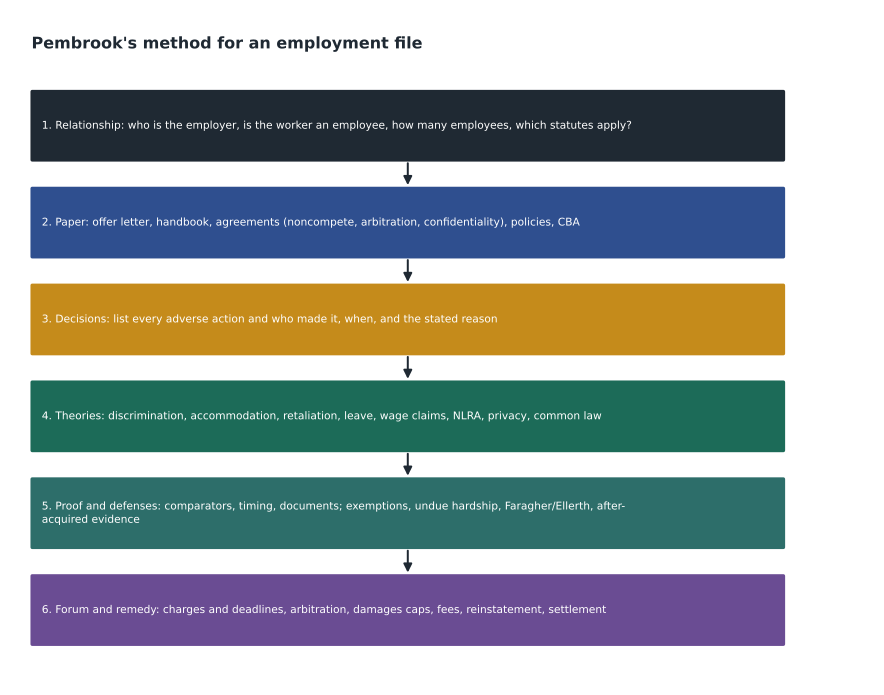
For the last class, Pembrook sets the Akerley file aside and hands out a new one. She tells Section B that the problem is entirely fictional, that it is set in Westmarch under the rules of Westmarch law she has defined during the course, and that it is designed the way real employment files arrive: as one client's story that contains half a dozen legal claims, several deadlines and at least one argument the client has not thought of. The assignment is to write an intake memo to a supervising partner, organized by her six-step method, identifying every claim and defense, estimating strength, and recommending a forum and a first step.
The Sunfield file
Sunfield Hotel Group, LLC owns and operates three hotels in and around Brennan Falls and employs about 260 people. Chiamaka Nwankwo, who is 47, Black and was born in Nigeria, was hired in 2019 as a front desk agent and promoted in 2022 to front office manager at the Sunfield Riverside, the largest of the three hotels. As front office manager she was paid a salary of 46,000 dollars a year and classified as exempt from overtime. She regularly worked 52 to 58 hours a week. Her job description says she "manages the front office," but because the hotel cut its front desk staff in 2024, she spent most of every shift checking guests in and out, answering phones and handling complaints herself. She nominally supervised four part-time agents, but the general manager, Roland Quade, made all hiring, firing and scheduling decisions, and twice rejected her recommendations to hire.
In 2023 Sunfield distributed a revised handbook that included a Mutual Arbitration Agreement requiring arbitration of "all claims arising out of employment," waiving class and collective actions, providing that Sunfield would pay the arbitrator's fees, and stating that continued employment after 30 days would constitute acceptance. Chiamaka signed an acknowledgment of the handbook. The handbook's first page states that employment is at will. When she was promoted in 2022, she signed a Non-Competition Agreement barring her for 12 months from working "in any capacity" at any hotel within 25 miles of any Sunfield property.
In March 2026 an assistant general manager position opened at the Riverside. Chiamaka applied. Quade selected Haskel Thwaite, a 29-year-old white man who had worked in Sunfield's sales office for one year and had no front office or management experience. Chiamaka had heard Quade refer to Black housekeepers as "you people" and once tell her that guests "respond better to someone without an accent." In June 2026 her mother, who lives with her, was diagnosed with dementia, and Chiamaka asked for intermittent leave of one or two days a month to take her mother to specialists. HR approved the request in writing as FMLA leave. On August 4, 2026 Chiamaka emailed HR a written complaint that she believed she had been denied the promotion because of her race and national origin and that Quade made derogatory remarks about Black employees.
On August 18 Quade gave Chiamaka a final written warning for "chronic tardiness and unreliability," listing five dates; three were days of approved FMLA leave. On September 12 a guest slipped on a wet lobby floor that had no warning sign and broke her wrist. Quade told Chiamaka to write the incident report saying that a wet-floor sign had been in place. Chiamaka refused, telling him that the report would go to Sunfield's insurer and possibly to court, and wrote that no sign was present. On September 30, 2026, Quade fired her for "insubordination and continued performance issues." The next day Chiamaka discovered that, on a day she had left her personal Gmail account open on the front desk computer, someone had forwarded to Quade three messages she had exchanged with a lawyer about her August complaint.
Chiamaka now has an offer from the Brennan Falls Grand, an independent hotel 4 miles from the Riverside, to be its front office manager at 54,000 dollars. Sunfield's lawyer has written to the Grand warning that the noncompete bars her employment. She asks what she can do, and how quickly.
Step 1: the relationship
Sunfield, with about 260 employees, is covered by every statute in the course: Title VII and the ADA (15 employees), the ADEA (20), the FMLA (50, and Chiamaka worked at a site with well over 50 employees for more than 12 months and 1,250 hours), and the FLSA. Chiamaka is unquestionably an employee. The damages cap under section 1981a for an employer with 201 to 500 employees is 200,000 dollars. Section 1981 also applies to her race claims, without a cap. Westmarch's antidiscrimination statute, as Pembrook has defined it, covers employers with six or more employees.
Step 2: the paper
Three documents matter. The handbook's at-will statement means Chiamaka has no contract claim for job security. The Mutual Arbitration Agreement must be evaluated for formation and enforceability: courts in many states accept continued employment after notice as acceptance of an arbitration agreement, though some require clearer assent, and the agreement's mutual obligation and employer-paid fees make unconscionability arguments weak. Under Epic Systems the class waiver is enforceable under the FAA; Chiamaka is not a transportation worker, so section 1 does not help her. No sexual harassment or assault claim is involved, so the Ending Forced Arbitration Act does not apply. The Non-Competition Agreement is governed by Westmarch law, which, as Pembrook defined it in Lesson 4, enforces reasonable noncompetes only for employees earning more than 80,000 dollars a year.
Step 3: the decisions
Section B lists each adverse action, its decision-maker, date and stated reason: the failure to promote (Quade, March 2026, unstated, presumably better qualifications); the misclassification as exempt and failure to pay overtime (Sunfield, continuously since 2022); the final warning (Quade, August 18, 2026, tardiness, citing FMLA days); the termination (Quade, September 30, 2026, insubordination and performance); the access to her personal email (unknown actor, before October 1); and the threat to her new employer (Sunfield's lawyer, October 2026). Each has its own theory and its own clock.
Step 4: the theories
Failure to promote. Chiamaka has a prima facie case of race and national origin discrimination under Title VII and of race discrimination under section 1981: she is Black and Nigerian-born, she was qualified and far more experienced, and the job went to a white man with no relevant experience. Quade's remarks about "you people" and accents are evidence of bias by the decision-maker; the accent remark ties directly to national origin, and Title VII protects against discrimination based on accent unless it materially interferes with job performance. She may also have an ADEA claim, since she is 47 and Thwaite is 29, substantially younger, but she would have to prove age was the but-for cause, and nothing in the file points to age, so that claim is weak. The March 2026 decision is a discrete act; under Morgan, her EEOC charge must be filed within 300 days of the decision, which falls in January 2027.
Retaliation. Her August 4 written complaint to HR is protected opposition activity: it alleged race and national origin discrimination and she had a reasonable, good-faith basis. The final warning two weeks later and the termination eight weeks later are materially adverse under Burlington Northern. The timing is close, Quade knew of the complaint, and the warning relied on dates that were approved leave, which strongly suggests pretext. She must prove but-for causation under Nassar. She also has a section 1981 retaliation claim, which the Supreme Court recognized in CBOCS West, Inc. v. Humphries (2008).
FMLA. Counting three days of approved FMLA leave against her in a final warning is classic interference and retaliation. The interference claim requires no proof of intent; the retaliation claim does, but the warning's reliance on protected absences is direct evidence. The termination, which relied in part on "continued performance issues" building on the warning, is tainted as well. She may recover lost wages and an equal amount as liquidated damages unless Sunfield proves good faith, plus fees, within two years, or three if willful.
Wage and hour. Chiamaka's exemption fails on the duties test even though her salary exceeds 684 dollars a week. Her primary duty was front desk work, not management: Quade made all hiring, firing and scheduling decisions and rejected her recommendations, so her suggestions did not carry particular weight, and much of her time was spent doing the same work as nonexempt agents. Nor was she an administrative employee; checking in guests is the hotel's production work. Sunfield must prove the exemption by a preponderance of the evidence (EMD Sales). She is owed overtime for hours over 40, computed for a salaried nonexempt employee by dividing her weekly salary by the hours the salary was intended to cover, plus liquidated damages and fees, for two years, or three if willful. Other front office managers in Sunfield's three hotels may have the same claim, but the class and collective waiver in the arbitration agreement will likely force individual proceedings.
Public policy discharge. Chiamaka refused Quade's instruction to falsify an incident report that would go to Sunfield's insurer and could be used in litigation. Falsifying such a report could constitute insurance fraud and evidence tampering under Westmarch law. Her refusal falls squarely within the first category of the public policy exception (refusal to commit an unlawful act), and under Pembrook's Westmarch rule the tort is available unless a statute provides an expressly exclusive remedy. Causation is supported by timing: she refused on September 12 and was fired on September 30 for "insubordination," which on these facts may be the refusal itself. This tort claim allows uncapped compensatory and punitive damages under Westmarch law.
Privacy. If a Sunfield manager accessed Chiamaka's open personal Gmail account and forwarded her messages with her lawyer, that may violate the Stored Communications Act, which prohibits intentionally accessing without authorization a facility through which an electronic communication service is provided and obtaining stored communications; courts have divided on whether reading emails on a device left logged in is access without authorization, but forwarding them is strong evidence of intent. It may also support an intrusion upon seclusion claim, because reading a person's confidential communications with her lawyer would be highly offensive to a reasonable person. And it raises a litigation issue: Sunfield may not use privileged communications it obtained improperly, and its lawyers have ethical duties if they receive them.
The noncompete. Under Westmarch's invented rule, Chiamaka, earning 46,000 dollars, cannot be bound by a noncompete at all. Even under a general reasonableness analysis, a 12-month ban on working "in any capacity" at any hotel within 25 miles of any Sunfield property is overbroad: it protects no trade secret, bars even jobs unrelated to her former role, and covers the entire region. Sunfield's letter to the Grand threatening enforcement of a void covenant may itself support a tortious interference claim against Sunfield if it causes the Grand to withdraw the offer, and she may seek a declaratory judgment that the covenant is unenforceable.
Step 5: proof and defenses
Sunfield's likely defenses are predictable. On the promotion, it will say Thwaite had better leadership and sales skills; Chiamaka's experience, Quade's remarks and the absence of any documented selection criteria will be the response. On retaliation and the FMLA, it will point to tardiness, but its own warning listed approved leave days, and it will need other evidence of performance problems that predate her complaint. On the termination, it will say she was insubordinate; Chiamaka's response is that the instruction was unlawful, and that a refusal to falsify a report cannot be legitimate insubordination. On overtime, it will invoke the executive exemption and her title. On the arbitration agreement, it will move to compel all claims. It may also try to discover after-acquired evidence, such as a policy violation, to limit back pay under McKennon. Chiamaka should preserve her own evidence immediately: her copy of the incident report, the leave approval, the final warning, her August complaint, schedules and timekeeping records, and the names of witnesses to Quade's remarks.
Worked problem
The intake memo's recommendations
Write the final section of the memo: which claims to pursue, in which forums, with which deadlines, and what to do first, assuming the arbitration agreement is likely enforceable for most claims.
Show solution
- Immediate step (this week): respond to Sunfield's letter to the Grand, explaining that the noncompete is void under Westmarch law for employees earning under 80,000 dollars and overbroad in any event; demand that Sunfield withdraw its threat; prepare a declaratory judgment action if the Grand hesitates. A court action for declaratory or injunctive relief may be available even under the arbitration agreement if it carves out provisional relief, or the issue may be submitted to the arbitrator on an expedited basis.
- Preserve evidence: send Sunfield a litigation hold letter covering emails, timekeeping, the incident report and computer access logs, and demand the return and non-use of her privileged messages.
- EEOC charge: file a charge of race and national origin discrimination and retaliation, cross-filed with the Westmarch agency, well before the 300-day deadline for the March promotion decision (in January 2027); filing a charge preserves the claims even if they are later arbitrated, and the EEOC may pursue its own enforcement action.
- Claims for arbitration: Title VII and section 1981 promotion and retaliation claims, FMLA interference and retaliation, FLSA and Westmarch overtime, the public policy tort, and privacy claims, all on an individual basis.
- Calendar: FLSA and FMLA claims (two or three years, running from each paycheck and each violation); section 1981 (four years); the public policy tort (Westmarch limitations period); the Stored Communications Act (two years from discovery).
- Value: the strongest claims are FMLA retaliation and interference (documented use of approved leave), the public policy tort (uncapped damages), section 1981 retaliation and discrimination (uncapped), and overtime (roughly 12 to 18 overtime hours a week over two to three years, doubled).
Answer: Chiamaka's case is strongest where documents speak for themselves: the final warning citing FMLA days, the incident report she refused to falsify, the overtime records and the void noncompete. Lead with the noncompete letter to protect her new job, preserve evidence, file an EEOC charge, and then press individual arbitration of a combined claim with substantial settlement value.
Step 6: forum and remedy, and a last word
Pembrook asks Section B to compare remedies across claims. Title VII damages are capped at 200,000 dollars for Sunfield's size, but section 1981 damages are not. FMLA and FLSA claims carry liquidated double damages and mandatory fees. The public policy tort allows punitive damages under state law. Reinstatement is unrealistic, since Chiamaka has a new job, so front pay may be limited, but her back pay is modest because her new salary is higher; the value of her case lies largely in liquidated damages, emotional distress, punitive exposure and fees. Arbitration will be private and individual, which reduces Sunfield's exposure to a class of front office managers but does not reduce the strength of her own claims.
Marcus asks which claim Pembrook would lead with if she represented Sunfield and had to choose one to settle first. She says the FMLA claim, because the warning letter is the kind of document that juries and arbitrators do not forgive, and because it taints everything that follows. Priya asks which she would lead with for Chiamaka. The noncompete, Pembrook says, because the client's most urgent need is to keep her new job, and a lawyer who wins the big case but lets the client lose her livelihood in the meantime has not served her.
She closes the course where she began, with the one-paragraph offer letter. Every decision in the Akerley and Sunfield files, she says, began with something an employer wrote down or failed to write down, and every claim turned on whether the stated reason was the real one. Employment law changes with every administration, as the course's 2026 developments show: a new independent contractor rule, rescinded harassment guidance, a reconstituted Labor Board and noncompete laws that differ from state to state. The method does not change. Find the relationship, read the paper, list the decisions, identify the theories, test the proof and choose the forum. Then, she adds, calculate the deadline before the client leaves the room.
Common mistakes
MistakeStopping at the first obvious claim.
InsteadEmployment files usually contain overlapping claims (discrimination, retaliation, leave, wages, common law and privacy) with different standards, deadlines and remedies.
MistakeAssuming an arbitration agreement eliminates the EEOC charge.
InsteadAn employee may still file a charge, which preserves claims and allows the EEOC to act; arbitration governs the private claims.
MistakeIgnoring the client's immediate practical need.
InsteadA threatened noncompete that endangers a new job often requires action before anything else.
MistakeTreating a title such as manager as settling exemption.
InsteadThe duties test controls; an employee whose primary duty is production work and whose recommendations carry no weight is not an exempt executive.
MistakeOverlooking section 1981.
InsteadIt reaches race discrimination and retaliation with no charge requirement, a four-year limitations period and no damages cap.
Summary and key terms
- Pembrook's six-step method organizes any employment file: relationship, paper, decisions, theories, proof and defenses, forum and remedy.
- Coverage and caps follow from employer size; section 1981 adds uncapped race claims.
- Documents such as handbooks, arbitration agreements and noncompetes shape both the claims and the forum.
- Listing each decision with its decision-maker, date and stated reason reveals the theories and the deadlines.
- Overlapping claims (Title VII and section 1981, retaliation, FMLA, FLSA misclassification, the public policy tort, privacy) carry different standards and remedies.
- The client's practical needs, preservation of evidence and deadlines come first.
- Intake memo
- A memo analyzing a prospective client's facts, claims, defenses, deadlines and recommended next steps.
- Litigation hold
- A demand or instruction to preserve documents and data relevant to anticipated litigation.
- Declaratory judgment
- A court judgment stating the parties' rights, used here to declare a noncompete unenforceable.
- After-acquired evidence
- Evidence of employee misconduct discovered after an adverse action, which may limit remedies but not liability (McKennon).
- Tortious interference
- A tort for intentionally and improperly interfering with another's contract or prospective business relationship.
Practice problems
Work each problem on paper first, then reveal the answer to check.
Why is Chiamaka's ADEA claim weak even though Thwaite is 18 years younger?
Show answer
Because the ADEA requires proof that age was the but-for cause, and nothing in the file suggests that age, rather than race, national origin or other factors, drove the decision.
What is the significance of the final warning listing approved FMLA days?
Show answer
It shows that protected leave was counted against her, establishing FMLA interference without proof of intent and strong evidence of retaliation.
Why does the FAA's section 1 exemption not help Chiamaka?
Show answer
Because she is not a transportation worker engaged in interstate commerce; the exemption covers transportation workers only.
Which of Chiamaka's claims allow uncapped compensatory and punitive damages?
Show answer
The section 1981 claims and the Westmarch public policy tort; Title VII damages are capped at 200,000 dollars for Sunfield's size.
Why should the EEOC charge be filed promptly even if the claims will be arbitrated?
Show answer
To preserve the Title VII claims within the 300-day deadline for the March promotion decision and to allow the EEOC to investigate or act on its own.
Lesson quiz · 5 questions
Score 60% or more to complete this lesson.
Create a free account to save your progress, take quizzes and earn a certificate.