
LAWU-313 · Lesson 7 of 12 · 25 min
Disability and age discrimination
▶ Video coming soon A video version of this lesson is on the way.
Glenda Moffat had worked at Akerley for 22 years, the last eleven as inventory lead on the first shift at Fallow Mill Road. She was 58. In March 2026 she herniated a disc in her lower back while lifting a case of irrigation solution. Her doctor restricted her to lifting no more than 20 pounds for three months and recommended that she alternate sitting and standing. Her written job description listed "occasionally lift up to 50 pounds" among a dozen duties; most of her day was spent running cycle counts on a handheld scanner, reconciling discrepancies at a computer and directing four pickers. Akerley put her on leave in April and told her she could return when she had "no restrictions." In late June her doctor extended the restriction for another six weeks. Royce Gunderson told her on the phone that "at some point you have to think about slowing down, Glenda," and on July 8, 2026 Akerley terminated her employment, saying it needed a full-time lead who could do the whole job. Her replacement, Emrys Brisbane, was 31.
Pembrook says Glenda's file is typical in one respect: disability and age claims frequently travel together, because older workers are more likely to develop impairments and because stereotypes about age and capacity overlap. The two statutes differ, though, in coverage, causation, defenses and remedies, and a careful lawyer keeps them separate.
The Americans with Disabilities Act
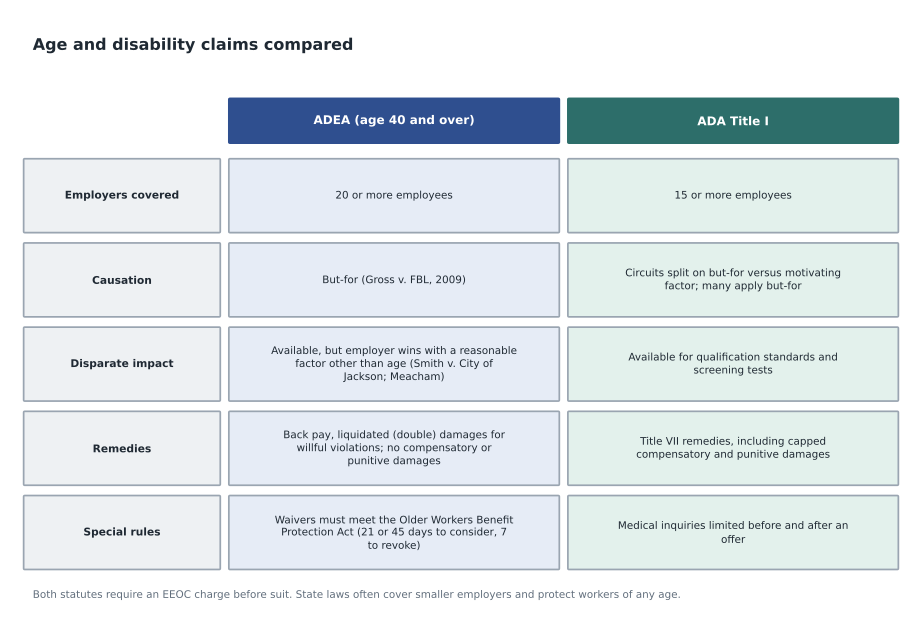
Title I of the Americans with Disabilities Act of 1990 prohibits covered employers, those with 15 or more employees, from discriminating against a qualified individual on the basis of disability in hiring, advancement, discharge, compensation, training and other terms of employment. The ADA borrows Title VII's procedures and remedies. Federal employees and employees of federal contractors and grant recipients are covered by the Rehabilitation Act of 1973, which applies the same substantive standards. The ADA differs from Title VII in one fundamental way: it requires employers not only to refrain from discrimination but to make reasonable accommodations for the known physical or mental limitations of qualified individuals with disabilities, unless the accommodation would impose an undue hardship.
Who has a disability
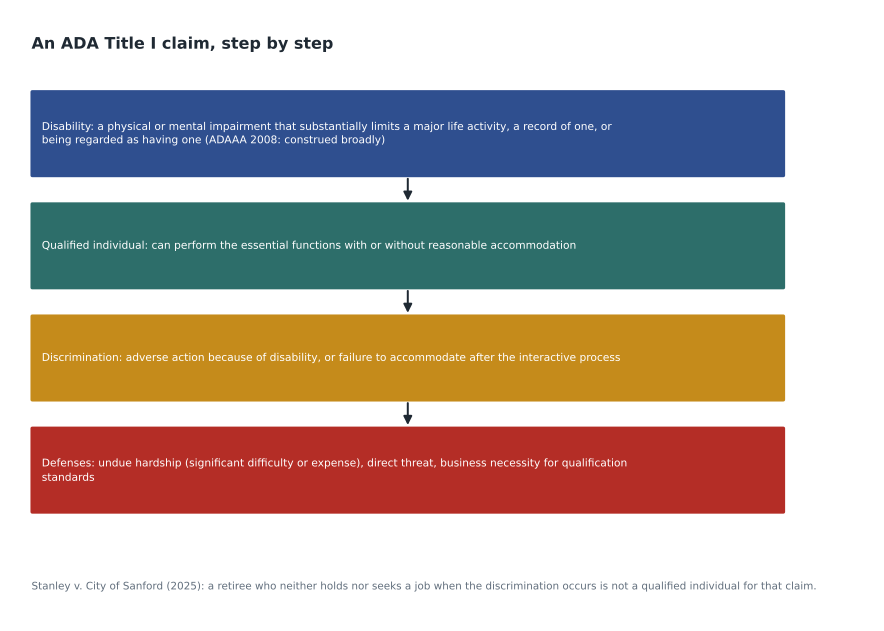
The statute defines disability in three ways: a physical or mental impairment that substantially limits one or more major life activities of the individual (actual disability); a record of such an impairment; or being regarded as having such an impairment. In its early years the ADA was read narrowly. In Sutton v. United Air Lines, Inc. (1999), the Court held that mitigating measures such as eyeglasses and medication must be considered in deciding whether a person is substantially limited, and in Toyota Motor Manufacturing v. Williams (2002) it held that the terms must be interpreted strictly to create a demanding standard. Many plaintiffs with diabetes, epilepsy, cancer in remission and other serious conditions were found not disabled at all.
Congress responded with the ADA Amendments Act of 2008, which expressly rejected Sutton and Toyota and directed that the definition be construed in favor of broad coverage. Under the amended statute, mitigating measures other than ordinary eyeglasses and contact lenses are ignored; an impairment that is episodic or in remission is a disability if it would substantially limit a major life activity when active; major life activities include lifting, bending, standing, working and the operation of major bodily functions such as neurological, digestive and reproductive functions; and "substantially limits" is not meant to be a demanding standard. The "regarded as" prong now covers anyone subjected to a prohibited action because of an actual or perceived impairment, whether or not it is believed to limit a major life activity, except impairments that are transitory and minor, meaning an actual or expected duration of six months or less. An employee who is only regarded as disabled is not entitled to accommodation.
After the 2008 amendments, most litigation has moved from whether the plaintiff is disabled to whether the plaintiff is qualified and whether the employer discriminated or failed to accommodate. Glenda's herniated disc substantially limits lifting and bending while her restriction lasts; EEOC regulations recognize that an impairment lasting fewer than six months can be substantially limiting if severe enough. She almost certainly has a disability under the first prong and also under the regarded-as prong, since Akerley terminated her because of her impairment.
Qualified individual and essential functions
A qualified individual is one who, with or without reasonable accommodation, can perform the essential functions of the position. The statute directs that consideration be given to the employer's judgment as to what functions are essential and to any written job description prepared before advertising or interviewing. EEOC regulations add other factors: the time spent performing the function, the consequences of not requiring it, the work experience of past and current incumbents, the terms of a collective bargaining agreement, and whether the position exists to perform that function. An employer cannot convert a marginal duty into an essential one simply by listing it.
Here the fight is whether lifting up to 50 pounds was an essential function of the inventory lead job. The job description lists it, which helps Akerley. But Glenda spent little time lifting, her pickers did the heavy work, Akerley's own safety rules required two-person lifts for heavy cases, and incumbents in the lead role rarely lifted anything heavy. A jury could find that lifting was marginal and that Glenda was qualified with or without accommodation.
In Stanley v. City of Sanford (2025), the Supreme Court addressed timing. A firefighter who retired on disability sued over a change that reduced health insurance subsidies for disability retirees. The Court held that, to prevail under the provision of Title I at issue, a plaintiff must have held or desired the job, and so been a qualified individual, at the time of the alleged discrimination; a retiree who neither holds nor seeks a position does not qualify. The decision limits ADA claims about post-employment benefits, although it left open other routes to challenge such changes.
Reasonable accommodation and the interactive process
The statute lists examples of reasonable accommodation: making facilities accessible; job restructuring; part-time or modified work schedules; reassignment to a vacant position; acquiring or modifying equipment; adjusting exams, training materials or policies; and providing qualified readers or interpreters. EEOC regulations and most courts recognize that leave can be a reasonable accommodation, and several circuits have held that a definite, time-limited leave that would enable the employee to return to work may be required, while indefinite leave is not. The Seventh Circuit, in Severson v. Heartland Woodcraft, Inc. (2017), took a narrower view, holding that a multi-month leave is not a reasonable accommodation because it does not help the employee perform the job's functions; it is a matter for the FMLA. An employer need not eliminate essential functions, create a new position, lower production standards applied to everyone, or provide personal items such as eyeglasses used both on and off the job.
Reassignment to a vacant position is the accommodation of last resort. In US Airways, Inc. v. Barnett (2002), the Court held that a request for reassignment that would violate the rules of a seniority system is ordinarily not reasonable, though the employee may show special circumstances, such as an employer that frequently changes its own seniority rules. Courts divide on whether an employer must reassign a disabled employee to a vacant position for which she is qualified even if a better-qualified candidate applies; the EEOC and several circuits say yes, others treat reassignment as an obligation to consider the employee without preference.
Once the employer knows of the employee's limitation and need for accommodation, it should engage in an interactive process: a good-faith exchange to identify the precise limitations and possible accommodations. Failure to engage is not a freestanding violation in most circuits, but an employer that refuses to engage risks liability if a reasonable accommodation would have been available. A demand that an employee return with "no restrictions" is a classic failure, because it refuses to consider whether the employee can work with restrictions.
Undue hardship, direct threat and medical inquiries
Undue hardship under the ADA means an action requiring significant difficulty or expense, considering the nature and cost of the accommodation, the employer's overall financial resources and size, and the impact on operations. The standard is considerably more demanding than the religious accommodation standard was before Groff, and courts have not merged the two. Most accommodations cost little or nothing, and employers rarely prevail on undue hardship for modest requests.
An employer may also require that an individual not pose a direct threat to the health or safety of others in the workplace, meaning a significant risk of substantial harm that cannot be eliminated or reduced by reasonable accommodation. The assessment must be individualized and based on the best available objective medical evidence, not on generalizations. In Chevron U.S.A. Inc. v. Echazabal (2002), the Court upheld an EEOC regulation that extends the defense to threats to the employee's own health, allowing a refinery to refuse a job to a worker whose liver condition would be aggravated by chemical exposure.
The ADA regulates medical inquiries in three stages. Before an offer, an employer may not ask whether an applicant has a disability or about its nature or severity, though it may ask whether the applicant can perform job functions. After a conditional offer and before work begins, the employer may require a medical examination of all entering employees in the same job category, keep the results confidential, and withdraw the offer only for job-related reasons consistent with business necessity. During employment, examinations and inquiries must be job-related and consistent with business necessity. The Genetic Information Nondiscrimination Act of 2008 separately prohibits employers from requesting or using genetic information, including family medical history.
Causation under the ADA
The ADA prohibits discrimination "on the basis of" disability. After Gross v. FBL Financial Services (2009) and Nassar, most circuits have held that ADA discrimination claims require but-for causation, though some continue to apply a motivating-factor standard. Glenda's termination presents no causation puzzle on Akerley's own account: it fired her because her restriction meant she could not do "the whole job." The real issues are whether lifting was essential and whether Akerley should have accommodated her by temporarily reassigning lifting to her pickers, allowing a short extension of leave, or both.
The Age Discrimination in Employment Act
The Age Discrimination in Employment Act of 1967 protects individuals who are at least 40 years old from discrimination because of age by employers with 20 or more employees. It has no upper age limit; mandatory retirement is generally prohibited, with exceptions for bona fide executives and high policymakers aged 65 and over with substantial pensions, and for certain public safety jobs. The Act protects only older workers. In General Dynamics Land Systems, Inc. v. Cline (2004), the Court held that it does not prohibit favoring older workers over younger ones, even within the protected class.
The ADEA differs from Title VII in several important respects. In Gross v. FBL Financial Services (2009), the Court held that a plaintiff must prove that age was the but-for cause of the challenged action; the mixed-motive framework of the 1991 Act does not apply because Congress amended only Title VII. Under O'Connor v. Consolidated Coin Caterers Corp. (1996), a plaintiff need not be replaced by someone under 40; the question is whether the replacement was substantially younger, which supports an inference of age discrimination. In Hazen Paper Co. v. Biggins (1993), the Court held that firing an employee to prevent his pension from vesting does not by itself violate the ADEA, because pension status, though correlated with age, is analytically distinct; such a firing violates ERISA instead. In Babb v. Wilkie (2020), the Court held that the federal-sector provision, which requires that personnel actions be "made free from any discrimination based on age," is violated if age plays any part in the process, though but-for causation still governs remedies such as reinstatement and back pay.
Disparate impact claims are available under the ADEA, as the Court held in Smith v. City of Jackson (2005), but they are narrower than under Title VII. An employer defends by showing that the practice is based on a reasonable factor other than age, a standard easier to meet than business necessity; under Meacham v. Knolls Atomic Power Laboratory (2008), the employer bears the burden of persuasion on that defense. Several circuits, including the Seventh in Kleber v. CareFusion Corp. (2019) (en banc) and the Eleventh in Villarreal v. R.J. Reynolds (2016) (en banc), have held that the ADEA's disparate impact provision protects employees but not outside job applicants, so a hiring preference for recent graduates or a cap on years of experience is not reachable on that theory.
Remedies under the ADEA are back pay, front pay or reinstatement, and an equal amount as liquidated damages for willful violations, meaning that the employer knew or showed reckless disregard for whether its conduct violated the Act. Compensatory damages for emotional distress and punitive damages are not available. Claims are tried to a jury. Because older workers often have higher salaries, back pay awards can be large.
The Older Workers Benefit Protection Act of 1990 regulates waivers of ADEA claims, which are common in severance agreements. A waiver must be knowing and voluntary: written in understandable language, specifically referring to ADEA rights, not waiving future claims, given in exchange for consideration beyond what the employee is already owed, and advising the employee in writing to consult a lawyer. The employee must have 21 days to consider the agreement, or 45 days in a group termination program, along with information about the ages of those selected and not selected, and 7 days after signing to revoke. A waiver that fails these requirements is unenforceable as to ADEA claims, and under Oubre v. Entergy Operations (1998) the employee need not return the severance pay before suing.
Worked problem
Glenda Moffat's claims
Advise Glenda on her ADA and ADEA claims against Akerley, and identify Akerley's best defenses. Akerley's records show that the inventory lead lifted something over 20 pounds about once a week, that pickers routinely did the lifting, and that Akerley had let two younger warehouse employees return on light duty after knee surgery in 2025. Gunderson's 'slowing down' remark was made in the June call. Glenda had used about 13 weeks of leave by July 8.
Show solution
- Disability: the herniated disc substantially limits lifting and bending while it lasts; the ADAAA's broad construction and the regarded-as prong both support coverage.
- Qualified individual: the dispute is whether lifting up to 50 pounds was essential. The description says so, but the weekly frequency, pickers doing the lifting and two-person lift rules suggest it was marginal. If marginal, she was qualified without accommodation.
- Failure to accommodate: Akerley required 'no restrictions' instead of engaging. Reasonable accommodations included reassigning occasional lifting to pickers or allowing a definite six-week extension. Light duty given to two younger employees undercuts any claim of hardship.
- Undue hardship and direct threat: neither is plausible for a 420-employee company and a lifting restriction that could be worked around.
- ADEA: Glenda must prove age was the but-for cause. The 'slowing down' remark by the decision-maker, replacement by a 31-year-old, and the more favorable treatment of younger injured workers support pretext, but Akerley will argue the reason was her restriction, not her age.
- Remedies: ADA back pay, front pay or reinstatement, compensatory and punitive damages capped at 200,000 dollars for a company of Akerley's size; ADEA back pay plus liquidated damages if willful. Glenda must file an EEOC charge within 300 days of July 8, 2026 (Westmarch has a state agency). Her FMLA claim is considered in Lesson 8.
Answer: Glenda has a strong ADA failure-to-accommodate and discriminatory discharge claim and a plausible ADEA claim. The ADA claim is stronger because it does not depend on proving that age, rather than her restriction, was the but-for cause.
Common mistakes
MistakeApplying the pre-2008 narrow definition of disability.
InsteadThe ADA Amendments Act requires broad construction, ignores most mitigating measures and covers episodic conditions; litigation now focuses on qualification and accommodation.
MistakeAccepting a job description as conclusive on essential functions.
InsteadIt is evidence, weighed with time spent, consequences, incumbents' experience and other factors.
MistakeRequiring an employee to return with 'no restrictions.'
InsteadThe employer must consider whether the employee can perform essential functions with reasonable accommodation and should engage in the interactive process.
MistakeUsing Title VII's motivating-factor standard for age claims.
InsteadGross requires but-for causation under the ADEA, and only liquidated damages, not compensatory or punitive damages, are available.
MistakeDrafting a severance release of age claims without OWBPA terms.
InsteadThe waiver must specifically mention the ADEA, advise consulting a lawyer, give 21 or 45 days to consider and 7 to revoke, and in group programs disclose ages.
Summary and key terms
- The ADA prohibits disability discrimination by employers with 15 or more employees and requires reasonable accommodation unless it would impose undue hardship (significant difficulty or expense).
- The 2008 amendments reversed Sutton and Toyota and require broad coverage; 'regarded as' covers non-transitory impairments but carries no accommodation right.
- A qualified individual can perform essential functions with or without accommodation; Stanley (2025) limits claims by retirees who neither hold nor seek a job.
- Accommodations include restructuring, schedules, equipment, definite leave and reassignment (limited by seniority systems under Barnett); employers should engage in an interactive process.
- Direct threat requires individualized medical evidence (Echazabal); medical inquiries are regulated before offer, after offer and during employment.
- The ADEA protects workers 40 and over at employers with 20 or more employees; it requires but-for causation (Gross), allows narrow disparate impact claims (Smith, Meacham) and gives liquidated damages for willful violations; OWBPA governs waivers.
- Disability
- A physical or mental impairment that substantially limits a major life activity, a record of one, or being regarded as having one.
- Essential functions
- The fundamental duties of a position, as distinct from marginal duties.
- Reasonable accommodation
- A modification or adjustment that enables a qualified individual with a disability to perform essential functions or enjoy equal benefits of employment.
- Interactive process
- A good-faith exchange between employer and employee to identify limitations and possible accommodations.
- Direct threat
- A significant risk of substantial harm to the health or safety of the individual or others that cannot be eliminated by reasonable accommodation.
- Reasonable factor other than age
- The ADEA defense to disparate impact claims, on which the employer bears the burden of persuasion.
- Liquidated damages
- Under the ADEA, an additional amount equal to back pay awarded for willful violations.
Practice problems
Work each problem on paper first, then reveal the answer to check.
An employee with epilepsy controlled by medication is fired after disclosing her condition. Is she disabled under the ADA?
Show answer
Yes. After the 2008 amendments, the effect of medication is ignored, and epilepsy substantially limits neurological function when active; she is also regarded as disabled.
May an employer ask an applicant during an interview whether she has ever been treated for depression?
Show answer
No. Before a conditional offer, an employer may not ask about the existence, nature or severity of a disability; it may ask whether the applicant can perform job functions.
What did US Airways v. Barnett hold about reassignment and seniority?
Show answer
That reassignment in violation of a seniority system's rules is ordinarily not a reasonable accommodation, unless the employee shows special circumstances.
A 62-year-old is replaced by a 45-year-old. Can she establish an inference of age discrimination?
Show answer
Yes. Under O'Connor v. Consolidated Coin Caterers, the question is whether the replacement was substantially younger, not whether the replacement was under 40.
An employer fires an employee to prevent his pension from vesting. Does that violate the ADEA?
Show answer
Not by itself (Hazen Paper), because pension status is distinct from age, but it violates ERISA section 510.
Lesson quiz · 5 questions
Score 60% or more to complete this lesson.
Create a free account to save your progress, take quizzes and earn a certificate.