
LAWU-313 · Lesson 11 of 12 · 26 min
Collective voice and enforcement: the NLRA, agencies and arbitration
▶ Video coming soon A video version of this lesson is on the way.
On July 8, 2026, the same heat wave that spoiled cheese at Juniper Hill Creamery pushed the temperature inside Akerley's Fallow Mill Road warehouse to 96 degrees by early afternoon. Fourteen pickers and packers on the first shift, among them Josiah Teale and Ximena Paredes, stopped work, walked out to the shaded side of the parking lot and told the shift manager that they would come back when the big fans that had been broken since June were fixed or they were given extra water breaks. Forty minutes later, after maintenance turned on two portable fans, they returned. Akerley suspended Josiah and another picker for three days as "ringleaders" of an unauthorized work stoppage. In October, after the Facebook post discussed in Lesson 10, several warehouse employees contacted a union about organizing. Meanwhile Akerley moved to compel arbitration of Lucan Barraza's wage lawsuit, pointing to the arbitration clause and class action waiver in the drivers' Independent Delivery Agreement. Pembrook says this lesson covers how employment rights are asserted collectively and how all of them are enforced: through the National Labor Relations Board, the EEOC and courts, and private arbitration.
The National Labor Relations Act
The National Labor Relations Act of 1935, often called the Wagner Act, protects the right of private-sector employees to organize, to bargain collectively through representatives of their choosing, and to engage in other concerted activities for collective bargaining or other mutual aid or protection. Section 7 states those rights. Section 8(a) defines employer unfair labor practices: interfering with, restraining or coercing employees in the exercise of section 7 rights (8(a)(1)); dominating or supporting a labor organization (8(a)(2)); discriminating to encourage or discourage union membership (8(a)(3)); retaliating for filing charges or testifying (8(a)(4)); and refusing to bargain in good faith with a certified or recognized union (8(a)(5)). The Taft-Hartley Act of 1947 added union unfair labor practices in section 8(b), excluded supervisors and independent contractors, and allowed states to enact right-to-work laws. The Act does not cover public employees, agricultural workers, domestic workers or workers covered by the Railway Labor Act.
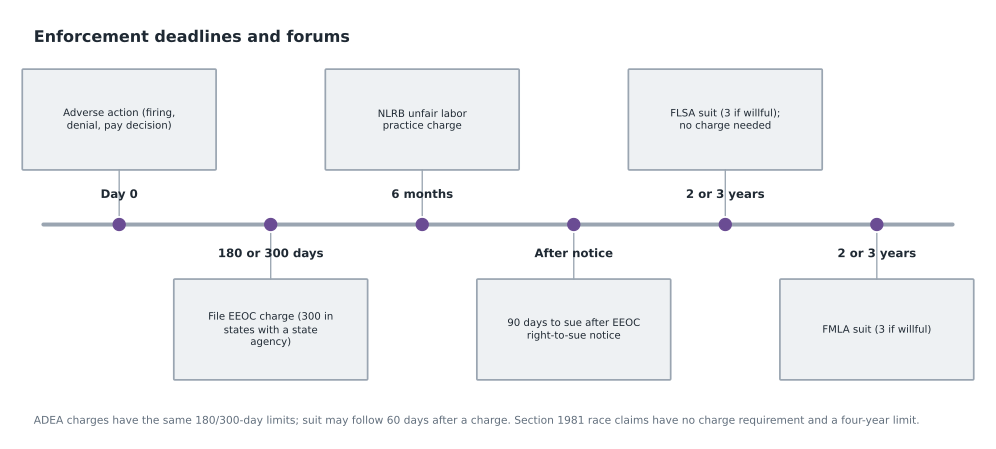
The Act is administered by the National Labor Relations Board, a five-member body that decides cases, and an independent General Counsel who investigates and prosecutes unfair labor practice charges through regional offices. Charges must be filed within six months of the conduct. The Board's remedies are remedial, not punitive: reinstatement, back pay, notice postings, and orders to bargain or to cease and desist. Its decisions are enforced, and reviewed, by the federal courts of appeals.
The Board itself has been in flux. It lacked a quorum for much of 2025, after the President removed Member Gwynne Wilcox; her challenge to the removal remains pending, and in Trump v. Slaughter (2026) the Supreme Court overruled Humphrey's Executor and upheld the President's power to remove members of the Federal Trade Commission, a holding that strongly suggests NLRB members are removable at will as well. The Board regained a quorum when new members confirmed in December 2025 were sworn in in January 2026, and since August 2026 it has had a three-to-one majority appointed by the current administration. Because the Board traditionally requires three votes to overrule precedent, many labor lawyers expect it to revisit several recent decisions in late 2026 and 2027. Pembrook tells Section B to treat Board doctrine as unusually unstable and to check the current standard before relying on any recent decision.
Concerted activity in nonunion workplaces
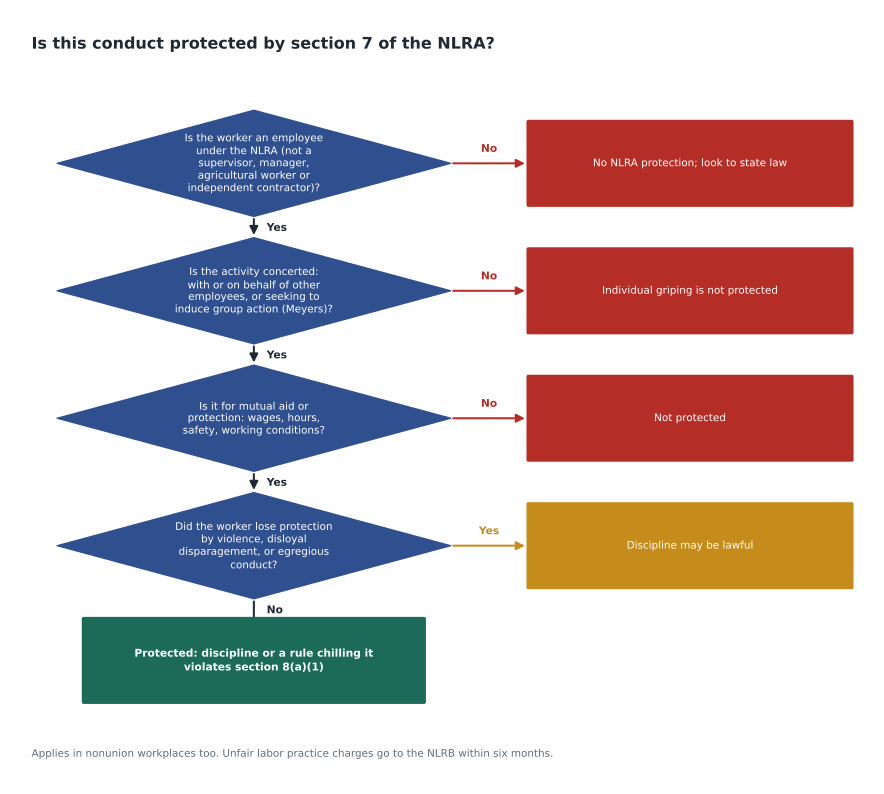
The NLRA's most important practical reach is in nonunion workplaces like Akerley's. Section 7 protects concerted activity for mutual aid or protection whether or not a union is involved. Activity is concerted, under the Board's Meyers Industries decisions of the 1980s, when it is engaged in with or on the authority of other employees, or when an individual seeks to initiate, induce or prepare for group action, or brings group complaints to management. One employee's personal griping, not linked to any group purpose, is not concerted. Mutual aid or protection covers wages, hours, safety, scheduling and other terms and conditions of employment, and extends to efforts to improve conditions through channels outside the employment relationship, such as petitions to legislators or appeals to the public, as the Supreme Court held in Eastex, Inc. v. NLRB (1978).
The heat walkout has a close precedent. In NLRB v. Washington Aluminum Co. (1962), seven machinists in an unorganized shop walked out on a bitterly cold January morning because the shop's furnace had broken, and the company fired them for leaving without permission. The Supreme Court held that the walkout was protected concerted activity, even though the workers made no specific demand before leaving and had no union; the fact that the company had a rule against leaving without permission did not strip the protection, and it did not matter whether the workers' action was a wise or reasonable way to address the problem. Akerley's warehouse walkout over heat and broken fans is materially similar. Suspending the two "ringleaders" for it violates section 8(a)(1), and the remedy would be back pay for the suspensions, removal of the discipline from their files and a notice posting.
Protection has limits. Violence, sabotage, threats and egregious misconduct are unprotected. Partial or intermittent strikes, in which employees repeatedly stop and start work on their own terms, have been held unprotected, as have sit-down strikes that seize the employer's property. Disloyal disparagement of the employer's product unconnected to a labor dispute lost protection in NLRB v. Local Union No. 1229 (Jefferson Standard) (1953). Employees who strike over economic issues may be permanently replaced, though not fired, under NLRB v. Mackay Radio and Telegraph Co. (1938); employees striking over the employer's unfair labor practices may not be permanently replaced. In Glacier Northwest, Inc. v. International Brotherhood of Teamsters (2023), the Supreme Court held that the NLRA did not preempt a state tort suit against a union that allegedly timed a strike to destroy wet concrete in the employer's trucks, because the union failed to take reasonable precautions against foreseeable and imminent danger to property. Whether the Facebook post's proposed sick-out on a hot day would be protected depends on whether it is a single concerted refusal to work in unsafe conditions, likely protected, or a pattern of intermittent stoppages, likely not.
Organizing and bargaining
Employees typically organize by signing authorization cards. A union with cards from at least 30 percent of a bargaining unit may petition the Board for a secret-ballot election, and if a majority of those voting choose the union, the Board certifies it as the exclusive bargaining representative. An employer may also voluntarily recognize a union that shows majority support. During a campaign, employers may express their views about unionization so long as they make no threat of reprisal or force or promise of benefit, under section 8(c), but they may not threaten, interrogate, promise benefits or engage in surveillance, a combination of prohibitions often summarized by the acronym TIPS.
Two recent Board decisions changed the campaign landscape, and both may be revisited. In Cemex Construction Materials Pacific, LLC (2023), the Board held that when a union demands recognition based on majority support, the employer must either recognize it or promptly file its own petition for an election, and that if the employer commits unfair labor practices that would set aside the election, the Board will order it to bargain with the union instead; the decision expanded the remedy recognized in NLRB v. Gissel Packing Co. (1969). In Amazon.com Services LLC (2024), the Board held that requiring employees to attend meetings at which the employer urges them to reject a union, the so-called captive-audience meeting, violates section 8(a)(1), applying the rule prospectively. Several states have enacted their own bans on captive-audience meetings, which are being litigated on preemption and First Amendment grounds. Once a union is certified, the employer and union must bargain in good faith over wages, hours and other terms and conditions of employment, the mandatory subjects of bargaining, and the employer may not change them unilaterally. Unionized employees have the right, under NLRB v. J. Weingarten, Inc. (1975), to have a union representative present at an investigatory interview they reasonably believe may lead to discipline.
Federal courts can intervene during Board proceedings. Under section 10(j), the Board may ask a district court for a temporary injunction pending its own decision. In Starbucks Corp. v. McKinney (2024), the Supreme Court held that courts must apply the traditional four-factor test for preliminary injunctions from Winter v. Natural Resources Defense Council, including likelihood of success, rather than the more deferential tests some circuits had used. State regulation of conduct that the NLRA arguably protects or prohibits is generally preempted under San Diego Building Trades Council v. Garmon (1959), which is why Glacier Northwest's tort exception mattered.
Enforcing discrimination claims: the administrative process
Title VII, the ADA, the ADEA and the PWFA require an employee to file a charge of discrimination with the EEOC before suing. The charge must be filed within 180 days of the discriminatory act, extended to 300 days in states, like Westmarch, that have a state or local agency with authority over the practice. The EEOC notifies the employer, may investigate, and may attempt conciliation if it finds reasonable cause; courts review the adequacy of conciliation only narrowly, under Mach Mining, LLC v. EEOC (2015). The EEOC itself may sue, but in most cases it issues a notice of right to sue, and the employee then has 90 days to file in court. An employee may request a right-to-sue notice after 180 days. Under the ADEA, an employee may sue 60 days after filing a charge without waiting for a notice. In Fort Bend County v. Davis (2019), the Court held that the charge-filing requirement is a mandatory claim-processing rule, not a jurisdictional requirement, so an employer that does not timely raise a failure to file forfeits the objection. The EEOC itself lacked a quorum from early 2025 until October 2025 and, with a quorum restored, voted in January 2026 to rescind its harassment guidance, as Lesson 6 explained.
Timing rules depend on the type of violation. In National Railroad Passenger Corp. v. Morgan (2002), the Court held that each discrete act, such as a termination, failure to promote or denial of transfer, starts its own filing period, while a hostile environment claim is timely if any act contributing to it falls within the period. In Ledbetter v. Goodyear Tire and Rubber Co. (2007), the Court held that a pay discrimination claim accrued when the discriminatory pay decision was made, not with each later paycheck; Congress overruled it in the Lilly Ledbetter Fair Pay Act of 2009, which provides that each paycheck reflecting a discriminatory compensation decision restarts the period. Section 1981 race claims, FLSA and FMLA claims, and claims under the Equal Pay Act require no charge at all.
Arbitration of employment disputes
Many employers require employees to agree to arbitrate employment disputes, often with waivers of class and collective actions. The Federal Arbitration Act of 1925 makes written arbitration agreements in contracts involving commerce valid, irrevocable and enforceable, save upon grounds that exist for the revocation of any contract. In Gilmer v. Interstate/Johnson Lane Corp. (1991), the Supreme Court held that statutory age discrimination claims can be subject to compulsory arbitration, and in Circuit City Stores, Inc. v. Adams (2001) it held that the Act applies to most employment contracts. In Epic Systems Corp. v. Lewis (2018), the Court held, 5 to 4, that arbitration agreements requiring individual proceedings and waiving class and collective actions are enforceable, rejecting the argument that section 7 of the NLRA protects the right to pursue joint litigation. Employers may not, however, use arbitration agreements to waive substantive statutory rights, and state courts police unconscionable terms; in Armendariz v. Foundation Health Psychcare Services (2000), the California Supreme Court required that mandatory employment arbitration of statutory claims provide a neutral arbitrator, adequate discovery, a written decision, all types of relief otherwise available, and no requirement that the employee pay costs unique to arbitration.
Section 1 of the FAA excludes "contracts of employment of seamen, railroad employees, or any other class of workers engaged in foreign or interstate commerce." Circuit City read the residual clause to cover only transportation workers. The Court has since applied it repeatedly. New Prime Inc. v. Oliveira (2019) held that "contracts of employment" includes agreements with independent contractors, so a trucking company could not compel arbitration of a driver's claims under the FAA by calling him a contractor. Southwest Airlines Co. v. Saxon (2022) held that a ramp supervisor who loaded cargo on airplanes belonged to a class of workers engaged in interstate commerce. And Bissonnette v. LePage Bakeries Park St., LLC (2024) held that a transportation worker need not work for a company in the transportation industry; distributors who delivered baked goods could be exempt. The courts of appeals have divided over last-mile drivers who carry goods on the final, local leg of an interstate journey, with several circuits holding such drivers exempt when the goods remain in the stream of interstate commerce.
Two further developments limit arbitration. The Ending Forced Arbitration of Sexual Assault and Sexual Harassment Act of 2021, signed in March 2022, allows a person alleging sexual harassment or sexual assault to elect to proceed in court notwithstanding a predispute arbitration agreement or joint-action waiver, and courts have applied it to entire cases that include such a claim. In Smith v. Spizzirri (2024), the Court held that when a court compels arbitration of a suit under the FAA and a party requests a stay, the court must stay the proceeding rather than dismiss it. In Jules v. Andre Balazs Properties (2026), the Court held that a federal court that stays a case with federal claims while they are arbitrated retains jurisdiction to confirm the resulting award. In California, claims under the Private Attorneys General Act raise special issues: Viking River Cruises, Inc. v. Moriana (2022) held that the individual portion of a PAGA claim can be compelled to arbitration, and Adolph v. Uber Technologies, Inc. (2023) held, as a matter of California law, that the employee retains standing to pursue the representative portion in court.
Worked problem
Akerley's motion to compel arbitration of Lucan's claims
The Independent Delivery Agreement requires individual arbitration of "all disputes arising from the relationship," waives class and collective actions, and selects the FAA. Lucan's drivers pick up at the Fallow Mill Road dock products that Akerley imports from manufacturers in other states and abroad, and deliver them within Westmarch, usually within a day of arrival. Evaluate Akerley's motion under federal law and identify the backup argument under state law.
Show solution
- FAA coverage: the agreement involves commerce, and Epic Systems would enforce the class waiver if the FAA applies.
- Section 1 exemption: New Prime holds that independent contractor agreements are 'contracts of employment,' so the label does not help Akerley. Bissonnette holds that Akerley need not be in the transportation industry.
- Class of workers engaged in interstate commerce: Lucan's drivers carry goods on the last leg of interstate journeys, with no meaningful break after arrival. Several circuits hold such last-mile drivers exempt; Akerley will argue that purely intrastate delivery after warehousing ends the interstate journey.
- If exempt, the FAA does not apply, but Akerley may seek enforcement under the Westmarch arbitration statute; many state arbitration acts have no transportation worker exclusion, though some courts refuse to enforce class waivers under state law.
- Unconscionability: review cost-shifting, discovery limits and remedy limits; a clause requiring the drivers to pay arbitration fees could be unenforceable.
- Procedure: if the court compels arbitration, Spizzirri requires a stay rather than dismissal if a party requests one, and the court retains jurisdiction to confirm the award (Jules).
Answer: Akerley faces a serious section 1 problem: under New Prime and Bissonnette, last-mile delivery drivers may be exempt from the FAA regardless of contractor labels. Its fallback is state arbitration law, which turns on Westmarch's statute and its treatment of class waivers.
Pembrook closes by pointing out that the same Akerley file now runs through three forums at once: an NLRB charge over the heat walkout suspensions, EEOC charges by Nkechi, Ximena and Glenda, and a federal court fight over whether Lucan's wage claims belong in arbitration. Choosing among forums, and keeping track of their different deadlines, is often what decides an employment case. Jordan says the lesson made him appreciate why so much of employment practice is calendar management. Pembrook says that in her first year at the plaintiffs' firm, the most valuable thing she learned was to calculate the 300-day deadline the day a client walked in.
Common mistakes
MistakeAssuming the NLRA matters only in union workplaces.
InsteadSection 7 protects concerted activity for mutual aid or protection in nonunion workplaces, such as the walkout in Washington Aluminum.
MistakeRelying on recent Board decisions as settled law.
InsteadThe Board's majority changed in 2026, and decisions such as Cemex, Amazon (captive audience) and Stericycle may be revisited; check the current standard.
MistakeMissing the EEOC charge deadline.
InsteadCharges must be filed within 180 or 300 days of each discrete act (Morgan); suit must follow within 90 days of a right-to-sue notice.
MistakeAssuming that calling drivers independent contractors lets an employer compel FAA arbitration.
InsteadNew Prime holds that section 1's exemption covers contractor agreements, and Bissonnette rejects any transportation-industry requirement.
MistakeMoving to dismiss after compelling arbitration.
InsteadUnder Spizzirri, a court must stay the case if a party requests a stay.
Summary and key terms
- The NLRA protects private-sector employees' rights to organize, bargain and engage in concerted activity; the Board, which regained a quorum in 2026 with a new majority, enforces it through unfair labor practice charges filed within six months.
- Concerted activity for mutual aid or protection is protected in nonunion workplaces (Meyers, Washington Aluminum), subject to limits for violence, intermittent strikes and disloyalty.
- Recent decisions on bargaining orders (Cemex), captive-audience meetings (Amazon, 2024) and 10(j) injunctions (Starbucks v. McKinney, 2024) shape organizing; some may change.
- Title VII, ADA, ADEA and PWFA claims require an EEOC charge within 180 or 300 days and suit within 90 days of a right-to-sue notice; each discrete act starts its own period (Morgan), and each discriminatory paycheck restarts the period (Ledbetter Act).
- The FAA generally enforces employment arbitration and class waivers (Gilmer, Circuit City, Epic Systems), but section 1 exempts transportation workers, including contractors (New Prime, Saxon, Bissonnette), and the EFAA exempts sexual harassment and assault claims.
- Section 7
- The NLRA provision protecting employees' rights to organize, bargain collectively and engage in concerted activity for mutual aid or protection.
- Unfair labor practice
- Conduct by an employer or union prohibited by section 8 of the NLRA.
- Concerted activity
- Activity engaged in with or on behalf of other employees, or to initiate or induce group action.
- Charge of discrimination
- The administrative complaint that must be filed with the EEOC before suing under Title VII, the ADA, the ADEA or the PWFA.
- Right-to-sue notice
- The EEOC notice that starts the 90-day period for filing suit.
- Transportation worker exemption
- The FAA section 1 exclusion of contracts of employment of workers engaged in foreign or interstate commerce, read to cover transportation workers.
- Class action waiver
- A contract term requiring individual proceedings; enforceable under the FAA after Epic Systems.
Practice problems
Work each problem on paper first, then reveal the answer to check.
Five nonunion employees jointly complain to their manager about unpaid overtime and are fired. Is their activity protected?
Show answer
Yes. It is concerted activity for mutual aid or protection under section 7, and firing them violates section 8(a)(1).
What test did Starbucks v. McKinney require courts to apply to section 10(j) injunction requests?
Show answer
The traditional four-factor Winter test for preliminary injunctions, including likelihood of success on the merits.
An employee was fired 250 days ago in Westmarch, which has a state agency. Is it too late to file an EEOC charge?
Show answer
No. In states with a state or local agency, the deadline is 300 days.
What did New Prime v. Oliveira hold?
Show answer
That the FAA's section 1 exemption for contracts of employment of transportation workers includes independent contractor agreements.
Can an employee alleging sexual harassment be forced into arbitration under a predispute agreement?
Show answer
Not if she elects to proceed in court; the Ending Forced Arbitration of Sexual Assault and Sexual Harassment Act makes such agreements unenforceable at her election.
Lesson quiz · 5 questions
Score 60% or more to complete this lesson.
Create a free account to save your progress, take quizzes and earn a certificate.