
LAWU-313 · Lesson 3 of 12 · 26 min
Wrongful discharge: public policy, implied contract and good faith
▶ Video coming soon A video version of this lesson is on the way.
Agatha Imrie had been a quality assurance specialist in Akerley's sterile products group for six years when, in May 2026, a manufacturer notified Akerley that two lots of surgical drape kits it had distributed might have compromised packaging. Agatha's supervisor told her to relabel the remaining boxes in the warehouse with a later lot number so that they could be shipped to a clinic that had an urgent order, and to leave the change out of the distribution records. Agatha refused, told the supervisor that what he was asking was illegal, and emailed the regulatory affairs manager to ask how the recall was supposed to be documented. Nine days later she was fired for "poor teamwork." Pembrook asks Section B whether the at-will rule from Lesson 2 settles the matter. Jordan says it cannot possibly. Pembrook agrees that in most states it does not, and that this lesson explains the three common law doctrines that have narrowed the rule: the public policy exception, implied contract, and the implied covenant of good faith and fair dealing.
The public policy exception
Beginning in the late 1950s, state courts recognized that an employer's power to fire for any reason could be used to coerce employees into breaking the law. The first widely cited case, Petermann v. International Brotherhood of Teamsters (1959), came from a California appellate court: a union business agent alleged that he was fired for refusing to commit perjury before a legislative committee. The court held that, despite the at-will rule, an employer could not fire an employee for refusing to commit a crime at its request, because allowing such a firing would encourage criminal conduct and undermine the administration of justice.
The doctrine spread through the 1970s and 1980s, and today most states recognize some form of a tort claim for discharge in violation of public policy. The California Supreme Court confirmed in Tameny v. Atlantic Richfield Co. (1980) that the claim sounds in tort, so that compensatory damages for emotional distress and punitive damages are available; the plaintiff there alleged he was fired for refusing to participate in an illegal scheme to fix retail gasoline prices. Courts have grouped the protected conduct into four categories.
- Refusing to commit an unlawful act: perjury in Petermann, price-fixing in Tameny, falsifying records, or violating safety or environmental laws. Texas, which otherwise adheres strictly to at will, recognizes only this category, under Sabine Pilot Service, Inc. v. Hauck (1985), in which a deckhand was fired for refusing to pump a boat's bilges into the water illegally.
- Performing a public duty: serving on a jury, as in Nees v. Hocks (1975), where the Oregon Supreme Court allowed a claim by an employee fired for serving despite her employer's request that she seek to be excused; responding to a subpoena; or serving in the military. Many states now protect these duties by statute.
- Exercising a statutory right: filing a workers' compensation claim, as in Frampton v. Central Indiana Gas Co. (1973), the first case recognizing that firing in retaliation for a compensation claim is actionable; or voting, or refusing to take a polygraph where the law forbids it.
- Reporting wrongdoing, or whistleblowing: in Palmateer v. International Harvester Co. (1981), the Illinois Supreme Court allowed a claim by an employee fired for providing information to the police about a coworker's suspected theft and agreeing to help with the investigation.
What counts as public policy
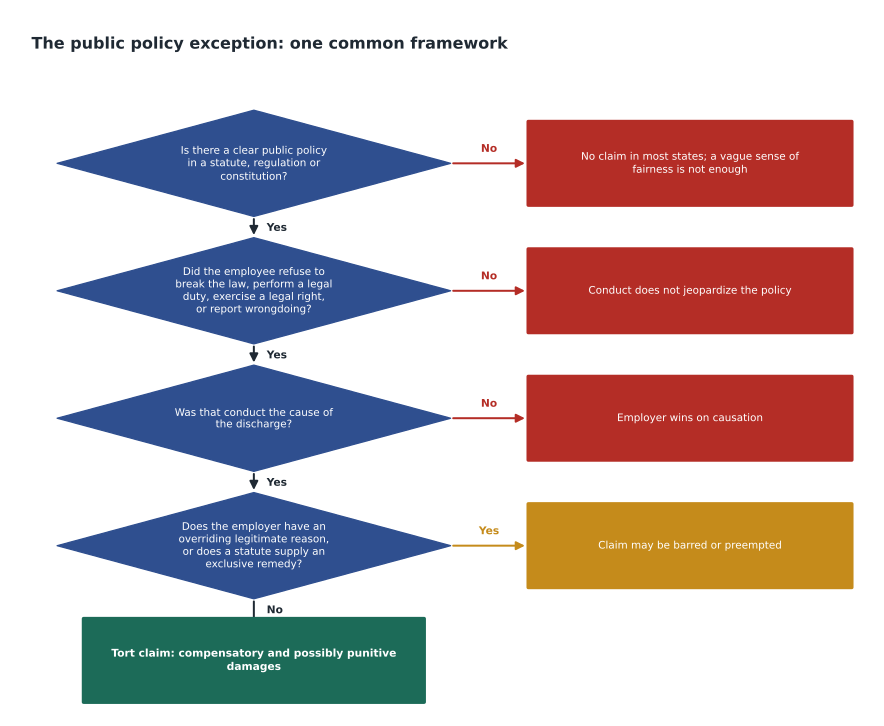
The central difficulty is identifying the public policy. If the source can be anything a judge considers fair, the exception would swallow the rule. Most courts therefore require a clear mandate of public policy found in a constitution, statute or administrative regulation. In Gantt v. Sentry Insurance (1992), the California Supreme Court held that the policy must be "tethered" to a constitutional or statutory provision, must benefit the public rather than serve only the employee's private interest, and must be well established and substantial at the time of discharge. Some states also accept professional codes of ethics adopted by regulation, and a few accept judicial decisions. A minority, led by New York in Murphy v. American Home Products Corp. (1983), decline to recognize the tort at all, reasoning that changing the at-will rule is a matter for the legislature; New York relies on statutes such as its whistleblower law, which was broadened considerably in 2022.
The private-interest limit produces some of the most-taught cases. In Wagenseller v. Scottsdale Memorial Hospital (1985), an emergency room nurse alleged that she was fired after refusing to join coworkers in a parody skit on a rafting trip that included "mooning" the audience. The Arizona Supreme Court held that her refusal implicated the state's indecent exposure statute, which embodied a public policy, and allowed the claim to proceed. In Geary v. United States Steel Corp. (1974), by contrast, the Pennsylvania Supreme Court rejected a claim by a salesman fired after repeatedly pressing concerns about the safety of a new product over his supervisors' heads, partly because he had no special expertise and because the company had acted on the concern. In Gardner v. Loomis Armored, Inc. (1996), the Washington Supreme Court allowed a claim by an armored truck driver who had been fired for leaving his truck, in violation of a company rule, to help a woman being chased by a man with a knife; the court found a public policy in encouraging citizens to rescue people in danger of serious harm.
Pembrook asks Section B to compare Agatha. Her refusal falls in the first category, and arguably the fourth. The public policy is clearly stated in law: the federal Food, Drug, and Cosmetic Act prohibits introducing adulterated or misbranded medical devices into interstate commerce, and the FDA's recall and record-keeping regulations require accurate distribution records. Falsifying a lot number to ship possibly compromised sterile kits threatens patients, not merely Agatha's private interest. Many states would recognize her claim.
Causation, defenses and statutory preemption
Like a statutory retaliation claim, a public policy claim requires proof that the protected conduct caused the discharge. Courts use the familiar tools: timing, the decision-maker's knowledge, inconsistent explanations, departures from ordinary practice and the treatment of similarly situated employees. The nine days between Agatha's refusal and her termination, combined with a vague reason ("poor teamwork") that appears in no prior review, would support an inference of causation. Akerley will argue that it fired her for documented problems; if it has no such documentation, the argument will look like a pretext.
A recurring defense is that a statute provides an adequate or exclusive remedy, so the common law claim is unnecessary or preempted. Courts divide. Some hold that when the legislature has created a specific remedy for the conduct, such as a whistleblower statute with its own procedures and deadlines, the employee must use it. Others allow both, reasoning that the tort protects the public and the statute merely adds a remedy. In Westmarch, Pembrook says, inventing a rule for the course, the public policy tort is available unless the statute expressly states that its remedy is exclusive. Federal law can also preempt: section 301 of the Labor Management Relations Act preempts state-law claims that require interpreting a collective bargaining agreement, although Lingle v. Norge Division of Magic Chef (1988) held that a retaliatory discharge claim for filing a workers' compensation claim was independent of the agreement and not preempted.
Federal whistleblower statutes may give Agatha another route. Some federal statutes protect employees who report violations in specific industries, but the Food, Drug, and Cosmetic Act itself has a whistleblower provision only for food safety, added by the Food Safety Modernization Act in 2011, not for medical devices. Her best claims are therefore the state public policy tort, any state whistleblower statute, and, if Akerley sells to federal health programs and the scheme involved false claims for payment, the anti-retaliation provision of the False Claims Act.
Implied contract: handbooks and assurances
The second limit on at will comes from contract law. In Toussaint v. Blue Cross and Blue Shield of Michigan (1980), the Michigan Supreme Court held that an employer's oral assurances that an employee would not be fired as long as he did his job, combined with a personnel manual stating that employees would be discharged only for just cause, could create an enforceable promise of job security. Even without bargaining over the manual, the court reasoned, an employer that issues policies to secure an orderly, cooperative and loyal workforce benefits from them and cannot treat them as illusory.
In Woolley v. Hoffmann-La Roche, Inc. (1985), the New Jersey Supreme Court went further and held that a widely distributed employment manual promising that employees would be fired only for cause, and setting out a detailed termination procedure, is enforceable as a unilateral contract even if no individual employee read it or relied on it. The court also gave employers a way out: an employer may avoid contractual liability by including in the manual a clear and prominent disclaimer stating that the manual does not create a contract and that employment remains at will. Minnesota's Pine River State Bank v. Mettille (1983) similarly treated a handbook's disciplinary procedures as an offer for a unilateral contract accepted by the employee's continued work.
Disclaimers became standard after these cases, and courts usually enforce them if they are clear and conspicuous. In Guz v. Bechtel National, Inc. (2000), the California Supreme Court held that an employer's written policies, which expressly reserved its right to terminate at will, defeated a claim that a long-time employee had an implied contract requiring good cause, though it left room for implied contract claims based on the totality of the circumstances in other settings, as recognized earlier in Foley v. Interactive Data Corp. (1988). Courts also look at whether the disclaimer is buried in fine print, contradicted by mandatory language elsewhere in the handbook ("employees will be terminated only after three written warnings"), or undermined by managers' oral assurances.
A second question is whether an employer may unilaterally withdraw a handbook promise. In Asmus v. Pacific Bell (2000), the California Supreme Court held that an employer may terminate a unilateral contract policy of indefinite duration after a reasonable time, with reasonable notice, so long as it does not interfere with vested benefits. The Arizona Supreme Court, in Demasse v. ITT Corp. (1999), held that once a handbook's job security promise became part of the employment contract, the employer needed new consideration and the employee's assent to remove it; continued employment alone was not enough. The split is significant for long-tenured employees whose rights predate a revised handbook.
Akerley's handbook history makes the issue concrete. Its 2019 handbook contained a Corrective Action Policy stating that "employees who have completed the 90-day introductory period are permanent employees" and that "discipline will proceed through a verbal warning, a written warning and a final warning before termination, except for gross misconduct." The 2023 revision added, on the first page in bold type, a statement that the handbook is not a contract, that employment is at will, and that the company may change its policies at any time; it changed "will" to "may" in the corrective action section. Agatha signed an acknowledgment of the 2023 revision. Under Asmus, Akerley's change was probably effective after reasonable notice. Under Demasse, an employee hired in 2020 could argue that the 2019 promise had become part of her contract and that a signed acknowledgment, without new consideration, could not remove it.
The implied covenant of good faith and fair dealing
Every contract carries an implied covenant of good faith and fair dealing, which prevents either party from acting to deprive the other of the benefits of the agreement. Applied to at-will employment, the covenant raises an obvious tension: if the employer may fire for any reason, how can firing ever breach a duty of good faith? Most states therefore refuse to use the covenant to require good cause. A minority use it narrowly. In Fortune v. National Cash Register Co. (1977), the Massachusetts Supreme Judicial Court allowed a salesman to recover commissions after the company fired him, after 25 years, shortly after he closed a large sale, in order to avoid paying the full commission; the covenant prevents an employer from firing an at-will employee to deprive him of compensation he has already substantially earned. New Hampshire's Monge v. Beebe Rubber Co. (1974) went further, holding that a termination motivated by bad faith, malice or retaliation breaches the employment contract, although later New Hampshire cases narrowed the holding toward the public policy model.
California recognizes the covenant in employment but, in Foley v. Interactive Data Corp. (1988), held that its breach gives rise only to contract damages, not tort damages; the court declined to extend to employment the tort remedy available against insurers that deny claims in bad faith. Guz later added that the covenant cannot impose substantive duties beyond those in the express or implied contract, so it cannot create a good-cause requirement where the contract is at will. The practical effect in most states is that the covenant protects earned compensation, such as commissions and bonuses that are timed to avoid payment, rather than job security.
Other torts at the end of employment
Terminated employees often plead additional torts. Intentional infliction of emotional distress requires extreme and outrageous conduct, and courts rarely find that the ordinary manner of a firing qualifies, though public humiliation, threats or sustained abuse may. Defamation claims arise from statements about the reasons for termination, subject to the qualified privilege discussed in Lesson 2 and to the doctrine, recognized in a few states, of compelled self-publication when the employee must repeat the false reason to prospective employers. Tortious interference claims are generally unavailable against the employer itself but can be asserted against a third party who induced the firing without justification. Invasion of privacy claims, covered in Lesson 10, may arise from the investigation that preceded a termination.
Worked problem
Agatha Imrie's claims
Agatha was hired in March 2020 under the 2019 handbook. She refused her supervisor's instruction to relabel possibly compromised sterile kits and omit the change from records, reported the instruction to regulatory affairs, and was fired nine days later for "poor teamwork" without any warning. Her reviews were good. She signed an acknowledgment of the 2023 handbook revision. Identify her common law claims and Akerley's defenses under Westmarch law as Pembrook has defined it (public policy tort available unless a statute's remedy is expressly exclusive; Westmarch has not decided between Asmus and Demasse).
Show solution
- Public policy tort: the policy is clearly stated in the Food, Drug, and Cosmetic Act and FDA recall and record-keeping regulations; refusing to falsify lot records and reporting internally protect patients, a public interest. Category: refusal to commit an unlawful act, plus internal whistleblowing.
- Causation: nine days, a vague reason with no documented history, good reviews and no warning support an inference that the refusal caused the firing.
- Defenses: Akerley may claim a legitimate reason (teamwork problems) and argue that a statutory remedy displaces the tort; under the Westmarch rule as defined, no statute makes its remedy exclusive here.
- Implied contract: the 2019 handbook promised progressive discipline to 'permanent employees.' Akerley skipped every step. The issue is whether the 2023 disclaimer and acknowledgment removed that promise: effective under Asmus after reasonable notice, but not without new consideration under Demasse.
- Covenant of good faith: no earned compensation was withheld, so in most states the covenant adds nothing.
- Remedies: the tort allows compensatory damages, including emotional distress, and possibly punitive damages; the contract claim allows lost wages for the period the promised procedure would have protected her.
Answer: Agatha has a strong public policy tort claim and a contested implied contract claim that turns on whether Westmarch follows Asmus or Demasse. The tort offers broader damages; the contract claim is a useful alternative if a court finds the policy insufficiently clear.
Daniel says the exercise shows why plaintiffs' lawyers plead every theory. Pembrook agrees but adds a caution from her management years: a complaint with six weak theories can make a jury doubt the strong one. Hannah asks why legislatures have not simply codified the public policy exception. Pembrook answers that many have done so piecemeal, through dozens of whistleblower statutes with different coverage, deadlines and remedies, which is why the first step in any wrongful discharge case is a careful search of the state code before anyone drafts a common law count.
Common mistakes
MistakeRelying on a general sense of fairness as the public policy.
InsteadMost courts require a clear mandate in a constitution, statute or regulation that protects the public, not only the employee (Gantt).
MistakeAssuming every state recognizes the public policy tort.
InsteadA minority, including New York (Murphy), do not; Texas recognizes only refusal to commit an illegal act (Sabine Pilot).
MistakeTreating any handbook as a contract, or treating any disclaimer as decisive.
InsteadHandbook promises can bind (Toussaint, Woolley), but clear and conspicuous disclaimers usually defeat them; mandatory language elsewhere and oral assurances can undermine a disclaimer.
MistakeUsing the implied covenant of good faith to create a good-cause requirement.
InsteadMost states refuse; the covenant mainly protects earned compensation (Fortune), and California limits recovery to contract damages (Foley, Guz).
Summary and key terms
- The public policy exception, beginning with Petermann (1959), makes discharge actionable in tort when it punishes refusing to break the law, performing a public duty, exercising a statutory right or reporting wrongdoing.
- Most courts require a clear public policy tethered to a constitution, statute or regulation that benefits the public (Gantt); New York declines to recognize the tort (Murphy).
- Causation is proved with timing, knowledge and pretext evidence; statutes may supply exclusive remedies, and section 301 may preempt claims that require interpreting a collective bargaining agreement.
- Handbooks and assurances can create implied contracts (Toussaint, Woolley, Pine River); clear disclaimers usually prevent this (Guz), and states split on unilateral modification (Asmus versus Demasse).
- The implied covenant of good faith rarely limits at-will firing; it mainly protects earned compensation (Fortune), with contract damages only in California (Foley).
- Public policy exception
- A tort claim for discharge that violates a clear public policy, such as firing an employee for refusing to commit a crime.
- Clear mandate
- The requirement that the public policy be found in a constitution, statute or regulation rather than a judge's general sense of fairness.
- Implied contract
- An enforceable promise of job security or procedure inferred from handbooks, policies or assurances.
- Disclaimer
- A clear statement in a handbook that it is not a contract and that employment remains at will.
- Implied covenant of good faith and fair dealing
- A contract term that prevents a party from depriving the other of the agreement's benefits; in employment it mainly protects earned compensation.
- Unilateral contract
- A contract formed when one party makes a promise and the other accepts by performance, such as continuing to work under a handbook.
Practice problems
Work each problem on paper first, then reveal the answer to check.
An employee is fired for serving on a jury after the employer asked her to seek an excuse. What category of public policy claim is this?
Show answer
Performing a public duty, as in Nees v. Hocks; many states also protect jury service by statute.
Why did the Pennsylvania court reject Geary's claim?
Show answer
Because his internal safety complaints, made without special expertise and bypassing supervisors, did not implicate a clear public policy strong enough to override the employer's legitimate interest in running its business.
What did Woolley v. Hoffmann-La Roche permit employers to do to avoid handbook liability?
Show answer
Include a clear and prominent disclaimer stating that the manual is not a contract and that employment remains at will.
Under Fortune v. National Cash Register, what did the covenant of good faith protect?
Show answer
Commissions the salesman had substantially earned; the employer could not fire him to avoid paying them.
Which state recognizes only the refusal-to-commit-an-illegal-act category?
Show answer
Texas, under Sabine Pilot Service v. Hauck (1985).
Lesson quiz · 5 questions
Score 60% or more to complete this lesson.
Create a free account to save your progress, take quizzes and earn a certificate.