
LAWU-313 · Lesson 1 of 12 · 32 min
Sources of employment law and who is an employee
▶ Video coming soon A video version of this lesson is on the way.
Professor Corisande Pembrook opens the first Employment Law class of the winter by putting a single sheet of paper on the document camera. It is a one-paragraph offer letter, the kind most of Section B will sign within a year: a title, a start date, a salary, a line about benefits and a sentence saying that employment is "at will." Pembrook spent nine years at a small plaintiffs' employment firm, taking cases on contingency for warehouse workers, nurses and middle managers, and then six years as in-house employment counsel for a regional hospital system, where she advised the managers her former clients used to sue. She now also mediates employment disputes. "Every employment case," she tells the class, "is a story about a decision. Somebody decided to hire, to pay, to promote, to discipline, to fire. Your job is to find out who made the decision, why, and what the paper says."
She explains that the course will follow one employer through a year of decisions. Akerley Medical Supply, Inc. is a fictional distributor of medical and surgical supplies headquartered in Brennan Falls, in the fictional State of Westmarch that Section B knows from earlier courses. Akerley employs about 420 people: warehouse pickers, packers and inventory staff at its distribution center on Fallow Mill Road, a customer service center, a sales force that calls on hospitals and clinics, and an office staff. It also uses about sixty delivery drivers whom it treats as independent contractors. The company was founded in 1987 by Ambrosine Akerley and is now run by her son, Wystan Akerley. Its human resources director is Fiona Galbraith. Every person and event in the file is invented, and where Pembrook needs a rule of Westmarch law she says so and labels it as her own invention.
Jordan Kimura, the Army veteran who has led Section B's study group since the first semester, asks why the course does not simply start with discrimination law, since that is what most employment lawyers seem to litigate. Pembrook answers that every employment statute begins with the same two threshold questions: is this person an employee, and is this entity an employer covered by the statute? A brilliant discrimination theory is worthless if the plaintiff is an independent contractor or the defendant has twelve employees and the statute requires fifteen. So the course begins at the threshold.
The sources of employment law
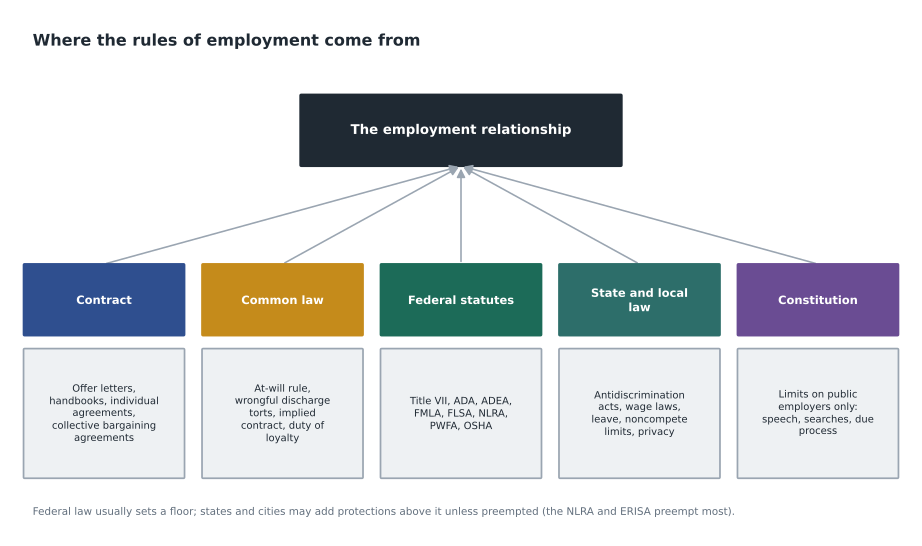
Employment law is not one body of law but several layered on top of one another, and an employment lawyer must keep all of them in view at once. The oldest layer is contract. The relationship between employer and employee is, at bottom, an agreement: work in exchange for pay. Most American employees have no written contract beyond an offer letter, but the offer letter, the employee handbook, a commission plan, a confidentiality agreement or a collective bargaining agreement can all supply enforceable terms. The second layer is the common law of torts and agency, which supplies the at-will rule, the wrongful discharge torts that limit it, the employee's duty of loyalty, and the employer's liability for its employees' acts.
The third and largest layer is statutory. Congress has enacted a long series of statutes that regulate particular aspects of employment: the National Labor Relations Act of 1935 protects organizing and collective bargaining; the Fair Labor Standards Act of 1938 sets the minimum wage and overtime rules; Title VII of the Civil Rights Act of 1964 prohibits discrimination because of race, color, religion, sex and national origin; the Age Discrimination in Employment Act of 1967 protects workers aged 40 and over; the Occupational Safety and Health Act of 1970 regulates workplace safety; the Employee Retirement Income Security Act of 1974 governs benefit plans; the Americans with Disabilities Act of 1990 prohibits disability discrimination; the Family and Medical Leave Act of 1993 guarantees unpaid leave; and the Pregnant Workers Fairness Act, effective in June 2023, requires accommodations for pregnancy-related limitations. Each has its own definitions, coverage thresholds, enforcement agency, procedures and remedies.
States add a fourth layer. Every state has an antidiscrimination statute, and many cover smaller employers, protect more characteristics and allow uncapped damages. States set higher minimum wages, require paid sick leave or paid family leave, limit noncompete agreements, regulate background checks and drug testing, and protect off-duty conduct. Cities add their own ordinances. Federal law usually sets a floor rather than a ceiling, so a state may give employees more protection unless Congress has preempted the field. Two federal statutes preempt broadly: the NLRA displaces most state regulation of union activity, and ERISA displaces most state laws that relate to employee benefit plans.
The fifth layer applies only to government employers. The Constitution limits what the state can do to its employees: the First Amendment protects some employee speech, the Fourth Amendment limits workplace searches, and the Due Process Clause protects employees who have a property interest in continued employment. A private employer is not bound by the Constitution at all, a point that surprises many clients who believe they have a constitutional right to free speech at work.
Hannah Lindqvist, the former history teacher who always wants to know why, asks how the field came to be built this way, statute by statute rather than through a general code. Pembrook gives the short answer. The common law of master and servant gave employers wide freedom, and the at-will rule that hardened in the late nineteenth century let them fire for any reason. Workers sought protection first through unions, which the NLRA legalized in 1935, and through legislation on wages and hours. When the civil rights movement turned to employment, Congress again responded to a specific problem with a specific statute. Each later statute was layered on top. The result is a field in which the same firing may be lawful under the common law, unlawful under one statute and irrelevant to another.
Coverage thresholds
Most federal employment statutes apply only to employers above a certain size, and the thresholds differ. Title VII and the ADA apply to employers with 15 or more employees for each working day in 20 or more calendar weeks in the current or preceding year. The ADEA requires 20 employees. The FMLA requires 50 employees, and an individual employee is eligible only after 12 months of service and 1,250 hours worked in the preceding year at a worksite with at least 50 employees within 75 miles. The FLSA, by contrast, has no employee threshold; it covers enterprises with annual gross sales of at least 500,000 dollars and also covers individual employees engaged in interstate commerce. The NLRA reaches most private employers whose business affects commerce, subject to the Board's jurisdictional standards. Section 1981, a Reconstruction-era statute that guarantees the equal right to make and enforce contracts, prohibits race discrimination by employers of any size.
In Arbaugh v. Y and H Corp. (2006), the Supreme Court held that Title VII's 15-employee threshold is an element of the claim, not a limit on the court's subject-matter jurisdiction. The difference matters: an employer that fails to raise the issue in time can forfeit it, and a court may not dismiss a case years into litigation on that ground of its own motion. Counting employees uses the payroll method approved in Walters v. Metropolitan Educational Enterprises (1997): an employee counts for every working day of any week in which he or she is on the payroll, whether or not the person actually worked that day.
Marcus Webb, who worked at a battery-storage startup before law school, points out that small employers are excluded from much of federal law. Pembrook agrees and adds that this is why state law matters so much in practice: Westmarch's antidiscrimination statute, she says, inventing a rule for the course, covers employers with six or more employees, so a nine-person dental office that is beyond the reach of Title VII is still bound. Many real states go further; some cover employers with a single employee.
Who is an employee: why the label matters
Employment statutes protect employees, not independent contractors. An independent contractor is a person in business for himself or herself who sells services to clients. Contractors are not entitled to the minimum wage or overtime, are not covered by Title VII or the ADA in their relationship with the client, cannot claim FMLA leave, have no right under the NLRA to organize, and receive no unemployment or workers' compensation coverage. The hiring business does not withhold income taxes or pay the employer's share of Social Security and Medicare taxes. A business that classifies workers as contractors can save a large share of its labor costs, and that saving is exactly why misclassification is one of the most litigated questions in the field.
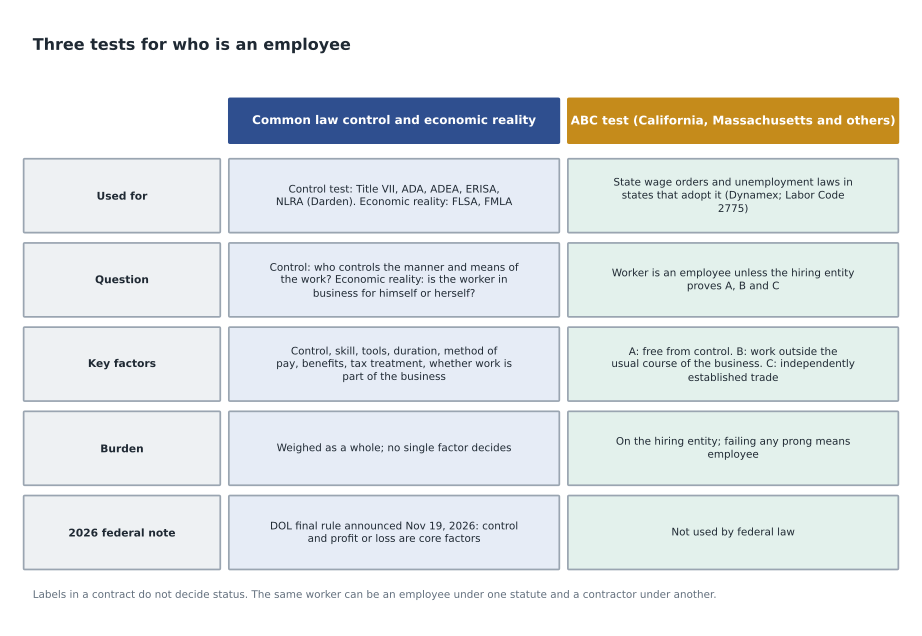
The label the parties choose does not decide the question. A contract that calls the worker an independent contractor, a 1099 tax form instead of a W-2, or a requirement that the worker form a limited liability company will all be considered, but courts look at the substance of the relationship. The difficulty is that different statutes use different tests, so the same worker can be an employee under one law and a contractor under another.
The common law control test
Most federal statutes define an employee circularly as "an individual employed by an employer." In Nationwide Mutual Insurance Co. v. Darden (1992), the Supreme Court held that when Congress uses the word employee without a more helpful definition, it means the common law agency concept. The common law test, drawn from the Restatement of Agency and from Community for Creative Non-Violence v. Reid (1989), asks whether the hiring party has the right to control the manner and means by which the work is done. The relevant factors include the skill required; the source of the tools; the location of the work; the duration of the relationship; whether the hiring party can assign additional projects; the worker's discretion over when and how long to work; the method of payment; who hires and pays assistants; whether the work is part of the hiring party's regular business; whether the hiring party is in business; the provision of benefits; and the tax treatment of the worker. No single factor decides. The control test governs Title VII, the ADA, the ADEA and ERISA.
The NLRA uses a version of the common law test because Congress, after the Supreme Court read the Act broadly in NLRB v. Hearst Publications (1944), amended the statute in 1947 to exclude independent contractors expressly. The Board's standard has changed several times. In 2023, in Atlanta Opera, it returned to a standard that considers whether a worker is rendering services as part of an independent business; whether the Board under its current majority will revisit that decision is one of the questions labor lawyers are watching in late 2026.
The economic reality test
The FLSA defines employ more broadly, as "to suffer or permit to work," language borrowed from state child labor laws that were designed to reach businesses that allowed children to work even without formally hiring them. In Rutherford Food Corp. v. McComb (1947) and later cases, the Supreme Court read the definition to require a broader inquiry than the common law test, and the courts of appeals developed the economic reality test: whether, as a matter of economic reality, the worker is economically dependent on the business or is in business for himself or herself. The FMLA adopts the FLSA's definition, so the same test governs leave rights.
The Department of Labor has repeatedly tried to codify the test, and its rules have swung with each administration. A 2021 rule made two core factors, control and the worker's opportunity for profit or loss, the most probative. A 2024 rule rescinded it and returned to a six-factor totality-of-the-circumstances analysis with no factor weighted more than another. In early 2026 the Department proposed to rescind the 2024 rule and largely restore the 2021 approach, and on November 19, 2026 it announced a final rule that does so. Under the final rule, the worker's control over the work and the opportunity for profit or loss are the core considerations, and skill, permanence and whether the work is part of an integrated unit of production are less probative factors. The final rule takes effect 60 days after publication in the Federal Register, so as of this class it has been announced but is not yet in force. Pembrook stresses two limits: a Department of Labor interpretive rule guides enforcement and may persuade courts, but after Loper Bright Enterprises v. Raimondo (2024) courts decide for themselves what the statute means; and the rule does not govern Title VII, the NLRA or the tax code.
The ABC test
Several states use a stricter test for some or all of their employment laws. Under the ABC test, a worker is presumed to be an employee unless the hiring entity proves three things: (A) the worker is free from the hiring entity's control and direction in performing the work, both under the contract and in fact; (B) the work is outside the usual course of the hiring entity's business; and (C) the worker is customarily engaged in an independently established trade, occupation or business of the same nature as the work performed. Failing any prong makes the worker an employee. Prong B does most of the work: a delivery company cannot easily show that delivery drivers perform work outside the usual course of its business.
The California Supreme Court adopted the ABC test for the state's wage orders in Dynamex Operations West, Inc. v. Superior Court (2018), and the legislature codified and extended it in Assembly Bill 5 in 2019, now found in Labor Code section 2775 and the sections that follow, with many occupational exceptions. California voters then approved Proposition 22 in November 2020, which treats app-based rideshare and delivery drivers as independent contractors entitled to certain minimum earnings and benefits. In Castellanos v. State of California (2024), the California Supreme Court upheld Proposition 22 against a constitutional challenge. Massachusetts uses an ABC test for its wage laws, and many states use one for unemployment insurance.
The Akerley drivers
Pembrook brings the course's first file into focus. Lucan Barraza has driven for Akerley since 2024. He signed an Independent Delivery Agreement that calls him a contractor, requires him to provide his own cargo van and insurance, and pays him a fixed amount per delivery stop. He receives a Form 1099. In practice, Akerley assigns routes each morning through its RouteLink dispatch app, requires drivers to wear Akerley shirts and to load at the Fallow Mill Road dock between 5:30 and 6:15 a.m., sets the order of stops, tracks the vans by GPS and deactivates drivers who decline more than two routes a month. Lucan works five or six days a week, often 52 to 60 hours, for no one but Akerley. A few drivers own two vans and hire helpers; most, like Lucan, do not. In August 2026 Lucan filed a wage complaint alleging that, after deducting fuel and van costs, his pay fell below the Westmarch minimum wage in several weeks and that he never received overtime.
Daniel Reyes, who spent three years as a paralegal at a plaintiffs' firm, says the answer is obvious: Lucan is an employee. Priya Natarajan, quick and competitive, takes the other side to test it. Lucan owns his van, pays his own expenses, and the agreement lets him hire a helper and work for others. Pembrook lets the debate run and then asks the class to separate the tests.
Under the economic reality test for the FLSA, Akerley's control is substantial: it sets routes, times, order of stops and appearance, and it can deactivate drivers who decline work. Lucan's opportunity for profit or loss is narrow; he cannot set prices, and the only way to earn more is to work more hours, which courts treat as the opposite of entrepreneurial profit. His investment in a van is real but modest compared with Akerley's investment in the warehouse, software and customers. The relationship is continuing rather than project-based, the work requires a driver's license and care rather than specialized skill, and delivery is an integral part of a distribution business. Under the 2026 final rule's core factors, control and profit or loss point in the same direction, toward employee status. The drivers who own several vans and hire helpers present a closer case, and an employer may find that some workers are employees and others are not.
Under the common law control test that would govern a Title VII or ADA claim, the result is probably the same, although that test weighs tax treatment and the parties' understanding more heavily. And under an ABC test, if Westmarch had one, Akerley could not satisfy prong B, because delivering its own products is within the usual course of its business. Pembrook tells the class that, for the course, Westmarch's wage statute uses the ABC test, an invented rule that mirrors several real states.
Worked problem
Classifying the Akerley drivers
Lucan Barraza and another driver, Marit Sandquist, both drive for Akerley under the Independent Delivery Agreement. Lucan drives one van, takes every route Akerley assigns and works only for Akerley. Marit owns three vans, employs two drivers she pays herself, bids for routes, delivers for two other distributors and a florist, and has her own business license and liability policy. Advise Akerley on the risk that each is an employee under the FLSA, under Title VII and under the Westmarch wage statute (which, for this course, uses the ABC test).
Show solution
- Identify the tests: economic reality for the FLSA (with the 2026 final rule's core factors as persuasive guidance once effective), common law control for Title VII, and the ABC test for the Westmarch wage statute.
- Lucan under the FLSA: Akerley controls routes, hours, sequence and appearance; his profit can rise only by working more; investment is limited to one van; the relationship is permanent and exclusive; delivery is integral to Akerley's business. Strong case for employee status.
- Marit under the FLSA: she controls her own staff and schedule, bids for work, serves several clients and can increase profit by managerial skill and investment in vans. Strong case for independent contractor status, though Akerley's control over routes still counts.
- Title VII: the control test reaches similar results; the agreement and 1099 treatment add weight for Akerley but cannot override actual control over Lucan.
- Westmarch ABC test: both fail prong B because delivery is within Akerley's usual course of business; Marit may satisfy prongs A and C, but failing B makes her an employee for the state wage statute.
- Advice: reclassify single-van drivers as employees or restructure the relationship to remove control; expect a back-pay exposure under both federal and state law; consider whether multi-van operators should contract through their own businesses.
Answer: Lucan is very likely an employee under every test. Marit is probably an independent contractor under the FLSA and Title VII but an employee under the ABC test, illustrating that classification is statute-specific and that a state ABC test can turn a federal contractor into a state-law employee.
Joint employment and the fissured workplace
A worker may have more than one employer. A staffing agency that places a temporary worker in a client's warehouse may be one employer and the client another, if both exercise enough control. Joint employment matters because it determines who is liable for unpaid wages, discrimination and unfair labor practices. The tests again differ by statute. Under the FLSA, courts ask whether the putative joint employer had the power to hire and fire, supervised and controlled work schedules or conditions, determined the rate and method of pay, and maintained employment records, among other factors. Under the NLRA, the Board's joint-employer standard has changed with each administration; a 2023 rule that would have broadened it was vacated by a federal court in 2024 before it took effect, and the 2020 standard, which requires the putative joint employer to possess and exercise substantial direct and immediate control over essential terms, remains in place.
Akerley uses a staffing agency, Lowenthal Workforce Solutions, to supply seasonal packers in the fall. Pembrook asks who is liable if a Lowenthal packer is not paid for time spent waiting in Akerley's security line. The answer depends on Akerley's control. If Akerley's supervisors schedule the packers, direct their work and keep their time records, Akerley is likely a joint employer under the FLSA and liable along with Lowenthal.
Who is an employer, and who is a supervisor
The employer side of the relationship raises its own questions. Title VII defines an employer to include any agent of the employer, but the courts of appeals have overwhelmingly held that individual supervisors are not personally liable under Title VII, the ADA or the ADEA; the employer entity is the defendant. The FLSA and the FMLA are different: their definitions of employer include any person acting directly or indirectly in the interest of an employer, and courts have held that individual officers and managers with operational control can be personally liable for unpaid wages. Some state statutes impose individual liability for aiding and abetting discrimination. Integrated-enterprise doctrine can treat a parent and subsidiary as a single employer when they share management, operations, labor relations and ownership.
Status within the workforce also matters. Supervisors and managers are excluded from the NLRA's protection. In harassment law, whether a harasser is a supervisor determines the employer's standard of liability, a question Lesson 6 takes up. Under the FLSA, executive and administrative employees may be exempt from overtime, which Lesson 9 covers.
A map of the course
Pembrook closes by laying out the year of decisions the class will follow. Lessons 2 through 4 cover the common law: the at-will rule, the exceptions that limit it, and the rules on noncompetes and trade secrets that govern employees who leave. Lessons 5 through 8 cover discrimination and accommodation law: Title VII, harassment, religion and retaliation, disability and age, and pregnancy and family leave. Lesson 9 covers wage and hour law. Lesson 10 covers privacy. Lesson 11 covers collective rights under the NLRA and how employment claims are enforced through agencies, courts and arbitration. Lesson 12 is a capstone problem from a different employer.
Jordan asks whether the course will take sides. Pembrook says no: having represented both workers and management, she thinks the best employment lawyers can argue either side of almost any case, and that the law in this field changes with every administration, so knowing how to find the current rule matters more than memorizing any one rule. She hands out the offer letter again and asks the class to mark every term that a statute, rather than the letter, actually controls. Most of Section B finds that the letter says very little about what the law will require.
Common mistakes
MistakeAssuming that a contract calling a worker an independent contractor settles the question.
InsteadCourts look at the substance of the relationship; labels, 1099 forms and LLC structures are factors, not answers.
MistakeUsing one test for every statute.
InsteadTitle VII, the ADA, the ADEA and ERISA use the common law control test (Darden); the FLSA and FMLA use economic reality; some states use the ABC test. The same worker can be classified differently under each.
MistakeTreating the Department of Labor's independent contractor rule as binding on courts or on every statute.
InsteadThe rule guides FLSA enforcement and may persuade courts, but courts interpret the statute independently after Loper Bright, and the rule does not govern Title VII, the NLRA or tax law.
MistakeForgetting coverage thresholds.
InsteadTitle VII and the ADA require 15 employees, the ADEA 20, the FMLA 50 plus individual eligibility; section 1981 and many state laws reach smaller employers.
MistakeTelling a private-sector client that the First Amendment protects speech at work.
InsteadThe Constitution limits only government employers; private employees must look to statutes, such as the NLRA or state off-duty conduct laws.
Summary and key terms
- Employment law layers contract, common law, federal statutes, state and local law, and, for public employers, the Constitution.
- Federal statutes have different coverage thresholds: 15 employees for Title VII and the ADA, 20 for the ADEA, 50 for the FMLA, an enterprise test for the FLSA, and none for section 1981.
- Employment statutes protect employees, not independent contractors, and misclassification is heavily litigated because of the cost savings involved.
- The common law control test (Darden) governs Title VII, the ADA, the ADEA and ERISA; the economic reality test governs the FLSA and FMLA; the ABC test governs some state laws.
- The Department of Labor announced a final independent contractor rule on November 19, 2026 that makes control and opportunity for profit or loss the core factors; it takes effect 60 days after publication.
- Joint employment can make a staffing agency and its client both liable; individual managers can be personally liable under the FLSA and FMLA but generally not under Title VII.
- Independent contractor
- A worker in business for himself or herself who sells services to clients and is outside the protection of most employment statutes.
- Common law control test
- The agency test, adopted in Darden, that asks whether the hiring party controls the manner and means of the work, weighing many factors.
- Economic reality test
- The FLSA and FMLA test asking whether the worker is economically dependent on the business or is in business for himself or herself.
- ABC test
- A state-law test presuming employee status unless the hiring entity proves freedom from control, work outside its usual course of business, and an independently established trade.
- Joint employment
- A relationship in which two entities, such as a staffing agency and its client, each exercise enough control to be liable as employers.
- Coverage threshold
- The minimum number of employees, or other measure, that brings an employer within a statute.
- Preemption
- Displacement of state law by federal law; the NLRA and ERISA preempt broadly.
Practice problems
Work each problem on paper first, then reveal the answer to check.
A nine-employee bakery fires a cook because of her religion. Can she sue under Title VII?
Show answer
No. Title VII applies to employers with 15 or more employees. She should look to state law, which may cover smaller employers, and section 1981 would apply only to race discrimination.
Why might a worker be an employee for state wage law but an independent contractor under Title VII?
Show answer
Because the tests differ. A state ABC test presumes employee status and is failed if the work is within the usual course of the business, while Title VII uses the common law control test, which weighs many factors.
What did the Supreme Court hold in Arbaugh v. Y and H Corp. (2006)?
Show answer
That Title VII's 15-employee threshold is an element of the claim, not a limit on subject-matter jurisdiction, so it can be forfeited if not timely raised.
As of November 2026, what is the status of the Department of Labor's independent contractor rule?
Show answer
The Department announced a final rule on November 19, 2026 that rescinds the 2024 rule and makes control and opportunity for profit or loss the core factors. It takes effect 60 days after Federal Register publication; until then the 2024 rule remains on the books.
Can the owner of a small company be personally liable for unpaid overtime?
Show answer
Yes. The FLSA defines employer to include any person acting in the interest of an employer, and owners or officers with operational control over pay and hours can be held individually liable.
Lesson quiz · 5 questions
Score 60% or more to complete this lesson.
Create a free account to save your progress, take quizzes and earn a certificate.