
LAWU-313 · Lesson 5 of 12 · 27 min
Title VII
▶ Video coming soon A video version of this lesson is on the way.
In June 2026 Akerley posted an opening for second-shift operations supervisor at the Fallow Mill Road distribution center. Nkechi Arinze, a Black woman who had worked at Akerley for nine years, the last four as a lead picker who trained new hires and ran the shift when the supervisor was out, applied. So did Cyrus Kettridge, a white man who had transferred from Akerley's customer service center eighteen months earlier and had never supervised anyone. The operations manager, Royce Gunderson, chose Cyrus. When Nkechi asked why, Gunderson told her that Cyrus "had more of a leadership presence" and that the shift needed "someone the guys will listen to." Nkechi has come to Pembrook's fictional former firm, and Pembrook asks Section B to evaluate her claim under Title VII of the Civil Rights Act of 1964, the statute that, more than any other, defines modern employment law.
The statute
Title VII was enacted as part of the Civil Rights Act of 1964 after more than a year of debate and the longest filibuster in Senate history to that point. Section 703(a) makes it unlawful for a covered employer to fail or refuse to hire, to discharge, or otherwise to discriminate against any individual with respect to compensation, terms, conditions or privileges of employment because of the individual's race, color, religion, sex or national origin, and to limit, segregate or classify employees in ways that deprive them of opportunities or adversely affect their status because of those characteristics. The Act created the Equal Employment Opportunity Commission. It covers employers with 15 or more employees, employment agencies and labor unions, and, since 1972, state and local governments and the federal government.
Sex was added to the bill by an amendment offered on the House floor by Representative Howard Smith of Virginia, an opponent of the bill, in circumstances historians still debate. The scope of "because of sex" has been litigated ever since. Congress amended the statute in 1978 by the Pregnancy Discrimination Act to provide that discrimination because of pregnancy, childbirth or related medical conditions is sex discrimination. The Supreme Court held in Price Waterhouse v. Hopkins (1989) that discrimination based on sex stereotypes, such as denying partnership to a woman because she was insufficiently feminine, is discrimination because of sex, and in Oncale v. Sundowner Offshore Services (1998) that same-sex harassment is actionable. In Bostock v. Clayton County (2020), the Court held, 6 to 3 in an opinion by Justice Gorsuch, that an employer who fires an employee for being gay or transgender violates Title VII, because it is impossible to discriminate on those grounds without taking the employee's sex into account. The EEOC's rescission in January 2026 of its 2024 harassment guidance, discussed in Lesson 6, did not change Bostock, which remains binding.
Race and color are separate grounds: color discrimination concerns skin tone and can occur among members of the same race. National origin covers a person's or ancestors' place of origin and characteristics associated with it, such as accent or language; English-only rules must generally be justified by business necessity. Religion is covered, subject to the accommodation duty discussed in Lesson 6. Race discrimination in employment is also prohibited by 42 U.S.C. section 1981, which has no employee threshold, no administrative charge requirement and no damages cap, and a four-year limitations period for most employment claims. In Comcast Corp. v. National Association of African American-Owned Media (2020), the Court held that a section 1981 plaintiff must prove that race was a but-for cause of the injury.
Two theories of discrimination
Title VII recognizes two principal theories. Disparate treatment is intentional discrimination: the employer treated the plaintiff differently because of a protected characteristic. Disparate impact is the use of a facially neutral practice that falls more harshly on a protected group and cannot be justified by business necessity. The theories differ in what the plaintiff must prove, what defenses are available and what remedies follow.
Disparate treatment: direct evidence
Sometimes an employer announces its reason. A policy excluding women from certain jobs, or a manager's statement that he will not promote an employee because of her religion, is direct evidence of intent. When a policy is facially discriminatory, the only defense is that the characteristic is a bona fide occupational qualification reasonably necessary to the normal operation of the business, a defense available for sex, religion and national origin but never for race or color. The defense is extremely narrow. In International Union, UAW v. Johnson Controls, Inc. (1991), the Court struck down a battery manufacturer's policy barring fertile women from jobs involving lead exposure, holding that concern for the welfare of potential offspring was not a qualification for the job and that decisions about such risks belong to the women themselves. Customer preference is not a defense unless it relates to authenticity or privacy in a narrow sense.
Disparate treatment: the McDonnell Douglas framework
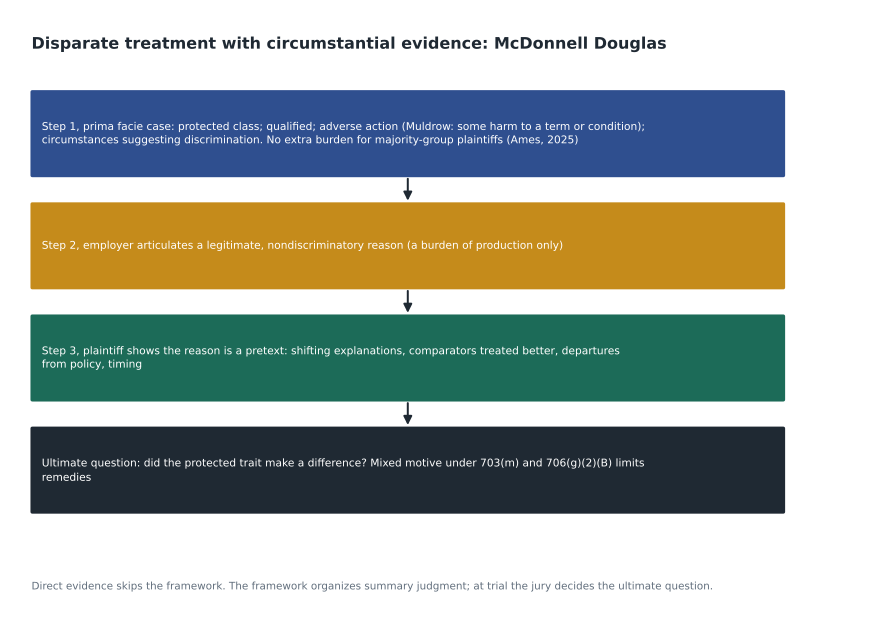
Most plaintiffs have no direct evidence and must prove intent circumstantially. In McDonnell Douglas Corp. v. Green (1973), the Supreme Court established a three-step burden-shifting framework that still organizes most discrimination litigation. First, the plaintiff establishes a prima facie case, typically by showing membership in a protected class, qualification for the position, an adverse employment action, and circumstances suggesting discrimination, such as the job going to someone outside the class. The prima facie case creates a presumption of discrimination. Second, the employer must articulate a legitimate, nondiscriminatory reason for its action; under Texas Department of Community Affairs v. Burdine (1981), this is a burden of production only, and the employer need not persuade the factfinder. Third, the plaintiff must prove that the stated reason is a pretext for discrimination. The burden of persuasion stays with the plaintiff throughout.
The Court clarified the third step in two cases. In St. Mary's Honor Center v. Hicks (1993), it held that disproving the employer's reason does not compel judgment for the plaintiff; the factfinder must still find intentional discrimination. In Reeves v. Sanderson Plumbing Products, Inc. (2000), it held that a prima facie case plus sufficient evidence that the employer's explanation is false may permit, though not require, a finding of discrimination, because a factfinder may infer that the employer is hiding a discriminatory reason. Pretext evidence includes shifting or inconsistent explanations, departures from ordinary procedures, comparators outside the protected class who were treated better despite similar conduct or qualifications, statistical patterns, and remarks by decision-makers.
Two recent decisions removed judicially created barriers at the prima facie stage. In Muldrow v. City of St. Louis (2024), a police sergeant alleged that she was transferred to a less desirable job because of her sex, without any loss of pay or rank. Several circuits had required a "significant" or "material" harm. The Court, in an opinion by Justice Kagan, held that a plaintiff challenging a transfer under section 703(a)(1) must show only some harm respecting an identifiable term or condition of employment; the harm need not be significant, serious or substantial. Muldrow reopened claims based on transfers, shift assignments and job duties that many courts had dismissed. In Ames v. Ohio Department of Youth Services (2025), the Court unanimously rejected the Sixth Circuit's rule that a plaintiff who belongs to a majority group, in that case a heterosexual woman alleging she was passed over in favor of gay colleagues, must show "background circumstances" suggesting that the employer is the unusual one that discriminates against the majority. Justice Jackson's opinion held that Title VII protects every individual and imposes the same standard on every plaintiff.
Mixed motives
Many decisions have more than one reason. In Price Waterhouse v. Hopkins, a plurality held that once a plaintiff shows that sex played a motivating part in a decision, the employer can avoid liability by proving it would have made the same decision anyway. Congress modified that rule in the Civil Rights Act of 1991. Under section 703(m), an employment practice is unlawful when a protected characteristic was a motivating factor, even though other factors also motivated the decision. Under section 706(g)(2)(B), if the employer proves it would have taken the same action in the absence of the impermissible factor, the court may award declaratory relief, limited injunctive relief and attorney fees, but not damages, back pay, reinstatement or hiring. In Desert Palace, Inc. v. Costa (2003), the Court held that a plaintiff may obtain a mixed-motive instruction with circumstantial evidence; direct evidence is not required. The motivating-factor standard applies to Title VII status discrimination claims but not to Title VII retaliation claims or to the ADEA, which require but-for causation, as Lessons 6 and 7 explain.
Applying the framework to Nkechi
Section B works through Nkechi's case. Her prima facie case is straightforward: she is Black and a woman, she was qualified (indeed more experienced than the selectee), she was denied a promotion, and the job went to a white man. Akerley's articulated reason is that Cyrus had more leadership presence. Pembrook asks how Nkechi shows pretext. Hannah points out that "leadership presence" is subjective, and courts look closely at subjective criteria because they can mask bias, although subjective judgments are not unlawful in themselves. Daniel points to Gunderson's statement that the shift needed "someone the guys will listen to," which a jury could read as reflecting a sex stereotype. Marcus notes the objective comparison: nine years against eighteen months, actual experience running the shift against none. Priya asks whether Akerley had a written selection process and whether Gunderson followed it. If Akerley's posting listed supervisory experience as a requirement and Cyrus lacked it, the departure from stated criteria is powerful evidence.
Pembrook adds that Nkechi may proceed on an intersectional theory, as a Black woman, rather than having to prove race discrimination and sex discrimination separately; most courts that have addressed the question allow it. She should also bring a section 1981 race claim, which avoids Title VII's damages caps and charge requirement but requires but-for causation.
Disparate impact
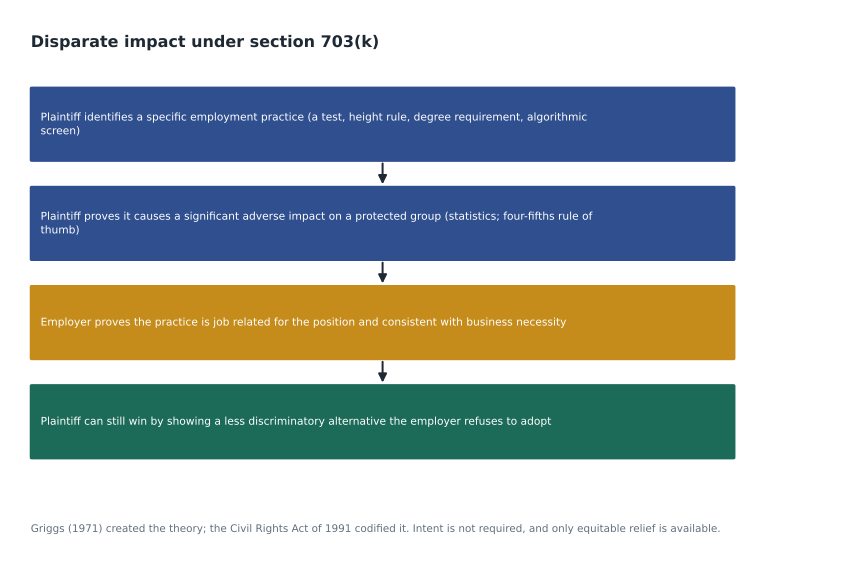
In Griggs v. Duke Power Co. (1971), the Supreme Court held that Title VII prohibits not only overt discrimination but practices that are fair in form and discriminatory in operation. Duke Power required a high school diploma and passing scores on two general aptitude tests for jobs in its better departments; the requirements disqualified Black applicants at far higher rates and had never been shown to predict job performance. Chief Justice Burger's unanimous opinion held that good intent does not redeem procedures that operate as built-in headwinds for minority groups and are unrelated to measuring job capability. After the Court made the theory harder to prove in Wards Cove Packing Co. v. Atonio (1989), Congress codified it in section 703(k) of the 1991 Act.
Under section 703(k), the plaintiff must identify a specific employment practice and prove that it causes a disparate impact on a protected group, usually through statistical evidence. The EEOC's Uniform Guidelines on Employee Selection Procedures use a four-fifths rule of thumb: a selection rate for any group that is less than 80 percent of the rate for the group with the highest rate is generally regarded as evidence of adverse impact, though courts also use tests of statistical significance. The employer must then prove that the practice is job related for the position in question and consistent with business necessity, which usually requires validation evidence. Even if the employer succeeds, the plaintiff prevails by showing that an alternative practice with less impact would serve the employer's needs and that the employer refused to adopt it. Disparate impact claims allow only equitable relief, such as back pay and injunctions, not compensatory or punitive damages, and are tried to the judge.
In Ricci v. DeStefano (2009), the Court addressed the tension between the two theories. New Haven threw out the results of a firefighter promotion exam because no Black candidates and few Hispanic candidates scored high enough for promotion, fearing a disparate impact suit. The Court held that the city's action was intentional discrimination against the candidates who passed, and that an employer may engage in race-conscious action to avoid disparate impact liability only if it has a strong basis in evidence that it would otherwise be liable.
Disparate impact has drawn renewed attention as employers adopt automated and algorithmic screening tools. A resume screen trained on past hires, a personality assessment or a video interview scoring system can produce adverse impact even if no one intends it, and the employer that uses the tool remains responsible for its effects. Several jurisdictions now regulate these tools directly. New York City's Local Law 144, enforced since July 2023, requires an annual independent bias audit and notice to candidates before an automated employment decision tool is used; Illinois amended its Human Rights Act, effective January 1, 2026, to prohibit employers from using artificial intelligence in ways that have a discriminatory effect and to require notice; and Colorado's broader artificial intelligence statute, delayed in 2025 until June 30, 2026, has been the subject of further legislative debate, so its current status must be checked before advising a client. At the federal level, an April 2025 executive order directed agencies to deprioritize disparate impact enforcement, but it did not and could not amend section 703(k), which private plaintiffs may still enforce.
Worked problem
Akerley's lifting test
In 2025 Akerley began requiring all warehouse applicants to pass a timed test: carry a 70-pound box 50 feet six times in three minutes. In 2026, 88 percent of male applicants passed and 41 percent of female applicants passed. Akerley says the test reflects the job. Its own data show that the heaviest item routinely handled weighs 45 pounds, that boxes over 50 pounds must be moved with a two-person lift or a hand truck under company safety rules, and that pickers rarely carry any item more than 15 feet. A rejected applicant, Fenella Anscombe, asks whether she has a claim.
Show solution
- Specific practice: the timed carry test is a discrete, identifiable selection requirement.
- Adverse impact: the female pass rate (41 percent) is less than half the male rate (88 percent), far below the four-fifths threshold of about 70 percent; with enough applicants it is also statistically significant.
- Business necessity: Akerley must prove the test is job related and consistent with business necessity. Its own data undercut it: the test uses a heavier weight, longer distance and faster pace than the job requires, and safety rules forbid one-person carries over 50 pounds.
- Less discriminatory alternative: a test using a 45-pound box over 15 feet, validated against actual job performance, would measure the real requirement with less impact.
- Remedies: back pay and instatement for rejected applicants who would otherwise have been hired, an injunction against the test and attorney fees; no compensatory or punitive damages on a disparate impact theory.
Answer: Fenella Anscombe has a strong disparate impact claim. Akerley should suspend the test and validate a job-related replacement; if evidence showed the test was adopted to exclude women, disparate treatment and damages would also be available.
Systemic claims and remedies
When an employer's discrimination is widespread, the EEOC or a class of plaintiffs may bring a pattern-or-practice case. Under International Brotherhood of Teamsters v. United States (1977), proof that discrimination was the employer's standard operating procedure creates a presumption that each class member was a victim, shifting to the employer the burden of proving that individual decisions were made for lawful reasons. Wal-Mart Stores, Inc. v. Dukes (2011) made such class actions harder by requiring proof of a common question, which a policy of delegating discretion to local managers did not supply.
Remedies under Title VII include back pay, limited to two years before the charge; reinstatement or instatement, or front pay when reinstatement is impractical; and, under 42 U.S.C. section 1981a, compensatory damages for emotional distress and punitive damages for intentional discrimination. Compensatory and punitive damages combined are capped according to employer size: 50,000 dollars for employers with 15 to 100 employees, 100,000 dollars for 101 to 200, 200,000 dollars for 201 to 500, and 300,000 dollars for more than 500. Back pay and front pay are not subject to the caps (Pollard v. E.I. du Pont de Nemours and Co., 2001). Punitive damages require malice or reckless indifference to federally protected rights, and under Kolstad v. American Dental Association (1999) an employer that makes good-faith efforts to comply with Title VII is not vicariously liable for punitive damages based on managers' decisions contrary to those efforts. Prevailing plaintiffs recover reasonable attorney fees. Under McKennon v. Nashville Banner Publishing Co. (1995), evidence of employee misconduct discovered after the discriminatory act does not bar liability but generally cuts off reinstatement and front pay and limits back pay to the date of discovery.
Akerley, with about 420 employees, faces a cap of 200,000 dollars on Nkechi's combined Title VII compensatory and punitive damages. Her section 1981 claim has no cap, which is one reason plaintiffs' lawyers plead both whenever race is involved.
Affirmative action and diversity programs
Title VII permits voluntary affirmative action plans only within narrow limits set by United Steelworkers v. Weber (1979) and Johnson v. Transportation Agency (1987): the plan must address a manifest imbalance in traditionally segregated job categories, must not unnecessarily trammel the interests of other employees, and must be temporary. After Students for Fair Admissions v. Harvard (2023), which held race-conscious college admissions unconstitutional, and after a January 2025 executive order revoking the federal contractor affirmative action order that had been in place since 1965, employers have reexamined diversity, equity and inclusion programs. Pembrook's advice, from both sides of the bar, is that Title VII has always forbidden making employment decisions because of race or sex, and that the safest programs broaden outreach and remove barriers rather than allocate positions, promotions or benefits by group membership. Ames reinforces that every employee can bring the same claim.
Common mistakes
MistakeTreating the employer's burden at step two of McDonnell Douglas as a burden of persuasion.
InsteadThe employer need only articulate a legitimate reason (Burdine); the plaintiff bears the burden of proving discrimination throughout.
MistakeRequiring a significant or material harm for a discriminatory transfer claim.
InsteadMuldrow (2024) requires only some harm respecting an identifiable term or condition of employment.
MistakeImposing a 'background circumstances' requirement on majority-group plaintiffs.
InsteadAmes (2025) held unanimously that all plaintiffs face the same standard.
MistakeSeeking compensatory and punitive damages on a disparate impact theory.
InsteadDisparate impact allows only equitable relief; damages under section 1981a require intentional discrimination and are capped by employer size.
MistakeAssuming that the January 2026 rescission of EEOC harassment guidance changed the law on sexual orientation and gender identity.
InsteadBostock remains binding Supreme Court precedent under Title VII.
Summary and key terms
- Title VII prohibits discrimination because of race, color, religion, sex and national origin by employers with 15 or more employees; Bostock (2020) holds that sexual orientation and transgender status discrimination is sex discrimination.
- Disparate treatment is proved by direct evidence or through McDonnell Douglas burden shifting: prima facie case, legitimate reason, pretext (Burdine, Hicks, Reeves).
- Muldrow (2024) requires only some harm to a term or condition of employment; Ames (2025) imposes no extra burden on majority-group plaintiffs.
- Under the 1991 Act, a motivating factor establishes liability, but a same-decision defense limits remedies (sections 703(m) and 706(g)(2)(B)).
- Disparate impact (Griggs; section 703(k)) requires a specific practice, adverse impact, and then business necessity and less discriminatory alternatives; only equitable relief is available.
- Damages under section 1981a are capped by employer size; section 1981 race claims have no cap and require but-for causation (Comcast).
- Disparate treatment
- Intentional discrimination because of a protected characteristic.
- Disparate impact
- A facially neutral practice that disproportionately excludes a protected group and is not justified by business necessity.
- Prima facie case
- The initial showing that creates a presumption of discrimination under McDonnell Douglas.
- Pretext
- An employer's stated reason that is false or not the real reason for the decision.
- Bona fide occupational qualification
- A narrow defense permitting sex, religion or national origin requirements reasonably necessary to the normal operation of a business; never available for race.
- Four-fifths rule
- A rule of thumb treating a group's selection rate below 80 percent of the highest group's rate as evidence of adverse impact.
- Mixed motive
- A decision motivated by both lawful and unlawful factors; under the 1991 Act it establishes liability, with remedies limited if the employer proves the same decision.
Practice problems
Work each problem on paper first, then reveal the answer to check.
A store refuses to hire men as clerks in its women's clothing department because customers prefer women. Is this a BFOQ?
Show answer
Generally no. Customer preference is not a BFOQ except in narrow privacy or authenticity contexts; selling clothing does not require being a woman.
Under Reeves, can a jury find discrimination from a prima facie case plus evidence that the employer's reason is false?
Show answer
Yes, it may, though it is not required to; the falsity of the explanation can support an inference of discrimination.
What harm must a plaintiff show to challenge a discriminatory transfer after Muldrow?
Show answer
Some harm respecting an identifiable term or condition of employment; it need not be significant or material.
An employer with 150 employees is found liable for intentional sex discrimination. What is the cap on combined compensatory and punitive damages?
Show answer
100,000 dollars; back pay and front pay are not subject to the cap.
What did Ricci v. DeStefano require before an employer may take race-conscious action to avoid disparate impact liability?
Show answer
A strong basis in evidence that it would otherwise face disparate impact liability.
Lesson quiz · 5 questions
Score 60% or more to complete this lesson.
Create a free account to save your progress, take quizzes and earn a certificate.