
LAWU-313 · Lesson 8 of 12 · 24 min
Pregnancy, family leave and the FMLA
▶ Video coming soon A video version of this lesson is on the way.
Matilde Ruelas leads a team of eleven representatives in Akerley's customer service center, which takes orders from clinics and hospitals by phone and through an online portal. In August 2026 she told her manager that she was pregnant and due in late winter, and asked for three things: a stool at the stand-up order desk where she spends part of each day, permission to keep a water bottle at her workstation despite the center's no-drinks rule, and permission to work from home two days a week during the first trimester while she was dealing with severe nausea. Her manager, Sorley Faulkes, approved the water bottle, said a stool "would look bad on the floor," and told her that remote work was not allowed for team leads. He suggested that she take FMLA leave until the nausea passed. Pembrook says this lesson covers the three federal statutes that govern Matilde's requests, and then returns to Glenda Moffat's leave from Lesson 7.
Pregnancy discrimination under Title VII
In General Electric Co. v. Gilbert (1976), the Supreme Court held that excluding pregnancy from an employer's disability benefits plan was not sex discrimination under Title VII. Congress overruled Gilbert two years later in the Pregnancy Discrimination Act of 1978, which added a definition to Title VII: discrimination because of sex includes discrimination because of or on the basis of pregnancy, childbirth or related medical conditions, and women affected by pregnancy must be treated the same for all employment-related purposes as other persons not so affected but similar in their ability or inability to work. The first clause makes pregnancy discrimination sex discrimination. The second clause raised a question that took decades to resolve: must an employer that accommodates some workers with limitations, such as those injured on the job, accommodate pregnant workers similarly?
In Young v. United Parcel Service, Inc. (2015), a driver was told she could not work while under a 20-pound lifting restriction during pregnancy, although UPS provided light duty to drivers injured on the job, drivers who lost their federal commercial driving certification and drivers with ADA disabilities. The Court adopted a modified McDonnell Douglas test. A pregnant plaintiff makes a prima facie case by showing that she sought accommodation, the employer refused, and the employer accommodated others similar in their ability or inability to work. The employer may offer a legitimate, nondiscriminatory reason, but ordinarily not simply that accommodating pregnant women would be more expensive or less convenient. The plaintiff may show pretext by producing evidence that the employer's policies impose a significant burden on pregnant workers and that the employer's reasons are not sufficiently strong to justify that burden, for example because it accommodates a large percentage of nonpregnant workers while failing to accommodate a large percentage of pregnant ones.
Title VII also prohibits overt pregnancy discrimination, such as refusing to hire a visibly pregnant applicant, forcing a pregnant employee onto leave because of assumptions about her capacity, or firing an employee who announces a pregnancy. Under Newport News Shipbuilding and Dry Dock Co. v. EEOC (1983), a health plan that covers employees' spouses must cover pregnancy for male employees' wives on the same terms as other spousal conditions. And under Johnson Controls, discussed in Lesson 5, an employer may not exclude fertile or pregnant women from jobs to protect a fetus.
The Pregnant Workers Fairness Act
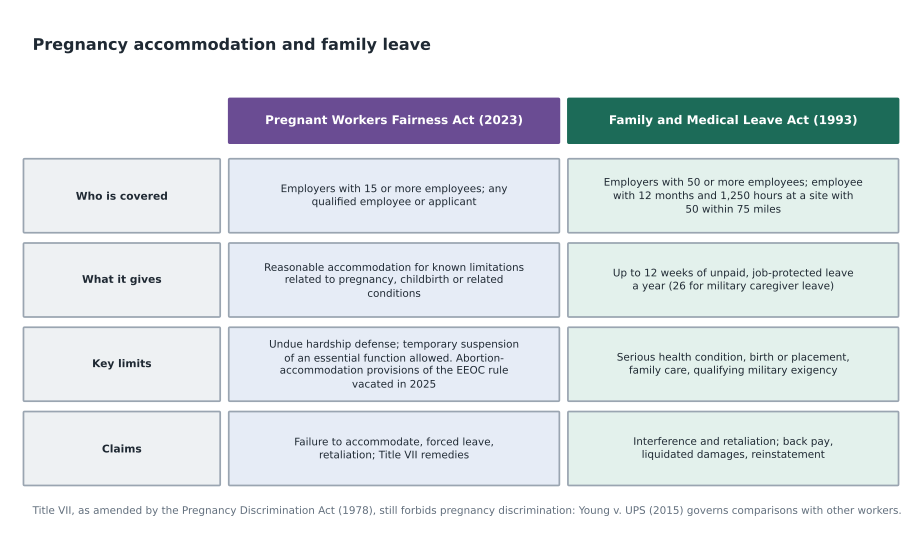
Because Young required comparators, many pregnant workers whose employers accommodated no one still had no remedy. The Pregnant Workers Fairness Act, enacted in December 2022 and effective June 27, 2023, closed that gap. It applies to employers with 15 or more employees and requires them to make reasonable accommodations to the known limitations related to the pregnancy, childbirth or related medical conditions of a qualified employee, unless the accommodation would impose an undue hardship. It borrows the ADA's definitions of reasonable accommodation and undue hardship and Title VII's procedures and remedies.
The Act goes beyond the ADA in several ways. A limitation need not rise to the level of a disability; it is enough that it is a physical or mental condition related to pregnancy, childbirth or related medical conditions, which may be modest or temporary. An employee is qualified even if she cannot perform an essential function, so long as the inability is temporary, she could perform the function in the near future, and the function can reasonably be suspended or accommodated. The Act also makes it unlawful to require a qualified employee to accept an accommodation other than one arrived at through the interactive process, to deny employment opportunities because of the need to accommodate, to take adverse action for requesting or using an accommodation, and, notably, to require an employee to take leave, paid or unpaid, if another reasonable accommodation can be provided that would let her keep working.
The EEOC's implementing regulations, issued in April 2024, identify four modifications that will virtually always be reasonable and not an undue hardship: allowing an employee to carry or keep water near her work area and drink as needed, allowing additional restroom breaks, allowing sitting for those whose work requires standing and standing for those whose work requires sitting, and allowing breaks as needed to eat and drink. The regulations limit an employer's ability to require medical documentation for these and for other obvious or previously documented needs. They also interpreted related medical conditions to include, among other things, lactation, miscarriage and abortion. In May 2025 a federal district court in Louisiana vacated the parts of the rule that required accommodation of elective abortions, holding that the EEOC had exceeded the statute; the rest of the rule remains in place, and the statute itself is unaffected.
Matilde's requests fit the Act closely. Nausea is a known limitation related to pregnancy. A stool is one of the four predictable modifications; Faulkes's concern about appearance is not an undue hardship. Remote work two days a week requires a closer look: Akerley must engage with her, consider whether a team lead's in-person duties can be performed or temporarily suspended on those days, and cannot simply invoke a general no-remote-work policy if the accommodation is otherwise reasonable. Above all, suggesting FMLA leave in place of an accommodation that would let her keep working is exactly what the Act forbids, and an employee who is forced onto leave also loses FMLA time she may need after the birth.
Lactation
The Providing Urgent Maternal Protections for Nursing Mothers Act of 2022, known as the PUMP Act, amended the FLSA to extend to nearly all employees, including exempt salaried employees, the right to reasonable break time to express breast milk for one year after a child's birth, in a place other than a bathroom that is shielded from view and free from intrusion. Break time need not be paid unless the employee is not completely relieved from duty or the employer pays for other breaks of the same length. Employees generally must notify the employer and allow ten days to comply before suing, except in specified circumstances. Many states have broader lactation laws, and the PWFA may require additional accommodations related to lactation.
The Family and Medical Leave Act
The Family and Medical Leave Act of 1993 guarantees eligible employees up to 12 workweeks of unpaid, job-protected leave in a 12-month period for: the birth of a child and bonding within one year; placement of a child for adoption or foster care; caring for a spouse, child or parent with a serious health condition; the employee's own serious health condition that makes the employee unable to perform the job; and qualifying exigencies arising from a family member's military deployment. It also provides up to 26 weeks in a single 12-month period to care for a covered servicemember with a serious injury or illness. The Act applies to private employers with 50 or more employees in 20 or more workweeks, and to all public agencies and schools. An employee is eligible after working for the employer for 12 months, which need not be consecutive, and 1,250 hours in the preceding 12 months, at a worksite where the employer has 50 or more employees within 75 miles.
A serious health condition is an illness, injury, impairment or condition that involves inpatient care or continuing treatment by a health care provider. Continuing treatment includes a period of incapacity of more than three consecutive full days with treatment, any period of incapacity due to pregnancy or prenatal care, chronic conditions such as asthma or diabetes that require periodic treatment, and permanent or long-term conditions. Pregnancy-related incapacity, including severe morning sickness, qualifies without the three-day requirement. Leave may be taken intermittently or on a reduced schedule when medically necessary, and for bonding by agreement with the employer.
Employees must give 30 days' notice of foreseeable leave, or notice as soon as practicable, and need not mention the FMLA by name; it is the employer's responsibility to recognize that leave may qualify and to give the required eligibility, rights and designation notices. Employers may require medical certification. During leave the employer must maintain group health coverage on the same terms. At the end of leave the employee is entitled to restoration to the same or an equivalent position with equivalent pay, benefits and other terms, although an employee who would have been laid off anyway has no greater right than if she had worked, and a narrow exception allows an employer to deny restoration to a salaried key employee among the highest-paid ten percent if necessary to prevent substantial and grievous economic injury. Leave is unpaid, but employees may elect, or employers may require, substitution of accrued paid leave.
The FMLA makes it unlawful to interfere with, restrain or deny the exercise of rights, and to discriminate or retaliate against an employee for exercising them. Interference claims require no proof of intent: an employer that denies leave to which an employee is entitled, discourages an employee from taking leave, or fails to restore an employee violates the Act regardless of motive, though the employee must show prejudice. Retaliation claims, such as counting FMLA absences against an employee under an attendance policy, require proof of intent. Remedies include lost wages and benefits with interest, an equal amount as liquidated damages unless the employer proves good faith and reasonable grounds for believing it complied, equitable relief such as reinstatement, and attorney fees. The limitations period is two years, or three for willful violations; no administrative charge is required.
In Ragsdale v. Wolverine World Wide, Inc. (2002), the Court invalidated a regulation that penalized an employer that failed to designate leave as FMLA leave by denying it credit for the leave already taken, holding that the employee must show actual prejudice. In Nevada Department of Human Resources v. Hibbs (2003), the Court held that Congress validly abrogated state sovereign immunity for the family-care provision, because it addressed sex stereotypes about caregiving; in Coleman v. Court of Appeals of Maryland (2012), it held that the self-care provision did not validly abrogate immunity, so state employees cannot sue their states for damages under that provision.
State paid leave
The FMLA guarantees only unpaid leave, and only to about half the workforce. States have filled the gap. More than a dozen states and the District of Columbia have paid family and medical leave insurance programs funded by payroll contributions, beginning with California in 2004; Minnesota and Delaware began paying benefits in January 2026 and Maine in May 2026. Many states and cities also require paid sick leave. Westmarch, Pembrook says, has no paid family leave program but requires employers with 25 or more employees to provide up to 40 hours of paid sick leave a year, an invented rule that resembles several real ones.
Glenda Moffat's leave
Pembrook returns to Glenda. She was eligible: 22 years of service, well over 1,250 hours, and a distribution center with hundreds of employees. Her herniated disc, with incapacity and continuing treatment, was a serious health condition. Akerley put her on leave in April but never sent an FMLA designation notice. By the time it fired her on July 8 she had been out about 13 weeks. Akerley will argue that the FMLA guaranteed her only 12 weeks, so she had no right to restoration when she could not return. Glenda will argue that Akerley's failure to give notice prejudiced her: had she known her protected leave was running out, she could have returned with restrictions before the 12 weeks expired or arranged surgery differently. Under Ragsdale she must prove that prejudice. Her stronger argument may be that, at the point her FMLA leave ended, the ADA still required Akerley to consider a short additional leave or a return with accommodation, as Lesson 7 explained. The statutes overlap rather than displace one another: FMLA leave is an entitlement with a cap; ADA leave is an accommodation without a fixed cap but limited by reasonableness and undue hardship.
Worked problem
Advising Akerley on Matilde
Galbraith asks how Akerley should respond to Matilde's three requests and to Faulkes's suggestion that she take FMLA leave. She also asks whether Akerley may require a doctor's note for the stool, and what happens after the baby is born.
Show solution
- Water bottle and stool: both are among the four predictable modifications under the PWFA regulations; grant them without requiring medical documentation.
- Remote work: engage in the interactive process. Identify which team lead duties require presence, whether they can be shifted to the three in-office days or temporarily suspended, and whether another accommodation (later start, private break space) would address the nausea. Deny only if undue hardship can be shown.
- Do not require leave: the PWFA forbids requiring leave when another reasonable accommodation would allow her to work, and forced leave would consume FMLA time.
- Title VII: if Akerley accommodates other employees with temporary limitations (for example, light duty after injuries), refusing Matilde similar treatment invites a Young claim.
- After the birth: she is entitled to up to 12 weeks of FMLA leave for her own recovery and bonding; Akerley must maintain health coverage and restore her to the same or an equivalent position. Under the PUMP Act she is entitled to break time and a private space to express milk for a year.
- Train Faulkes: his comments create retaliation and discrimination risk; document the accommodations and the reasons for any denial.
Answer: Akerley should grant the stool and water immediately, seriously evaluate partial remote work, never substitute forced leave for an available accommodation, and prepare for FMLA leave and lactation breaks after the birth.
Jordan asks whether employers resent the overlapping statutes. Pembrook says that when she was in-house, the hospital's managers found the overlap confusing, but that the solution was a single process: whenever an employee mentions a medical issue, pregnancy or family need, HR asks what the employee needs and then checks each statute, rather than letting a manager pick one. Daniel notes that Faulkes did the opposite, choosing the one answer, leave, that the PWFA specifically forbids.
Common mistakes
MistakeRequiring a pregnant employee to show a disability before accommodating her.
InsteadThe PWFA requires accommodation of known pregnancy-related limitations that need not be disabilities.
MistakeSending a pregnant employee on leave instead of accommodating her.
InsteadThe PWFA forbids requiring leave if another reasonable accommodation would allow her to keep working.
MistakeWaiting for an employee to invoke the FMLA by name.
InsteadEmployees need only give notice of a potentially qualifying reason; the employer must determine eligibility and give the required notices.
MistakeTreating the FMLA's 12 weeks as the end of all leave obligations.
InsteadThe ADA may require additional leave or other accommodation as a reasonable accommodation, and state law may give more.
MistakeCounting FMLA-protected absences under an attendance policy.
InsteadThat is FMLA interference or retaliation.
Summary and key terms
- The Pregnancy Discrimination Act makes pregnancy discrimination sex discrimination; Young v. UPS (2015) lets plaintiffs compare their treatment with other workers similar in ability to work.
- The PWFA (effective June 2023) requires employers with 15 or more employees to accommodate known pregnancy-related limitations, even temporary inability to perform essential functions, and forbids forced leave; parts of the EEOC rule on abortion were vacated in 2025.
- The PUMP Act (2022) gives nearly all employees break time and a private space to express milk for a year.
- The FMLA gives eligible employees 12 weeks of unpaid, job-protected leave for birth, bonding, family care, the employee's serious health condition and military needs, with restoration and health coverage.
- FMLA claims are interference (no intent required, prejudice needed) or retaliation; remedies include liquidated damages; Ragsdale requires prejudice for notice failures.
- State paid family leave programs now exist in more than a dozen states and DC; the FMLA and ADA overlap rather than displace each other.
- Pregnancy Discrimination Act
- The 1978 amendment to Title VII defining sex discrimination to include discrimination based on pregnancy, childbirth or related medical conditions.
- Known limitation
- Under the PWFA, a physical or mental condition related to pregnancy, childbirth or related conditions that the employee has communicated to the employer.
- Serious health condition
- Under the FMLA, an illness, injury, impairment or condition involving inpatient care or continuing treatment by a health care provider.
- Intermittent leave
- FMLA leave taken in separate blocks or on a reduced schedule for a single qualifying reason.
- Interference
- An FMLA violation consisting of denying, restraining or discouraging the exercise of FMLA rights, regardless of intent.
- Key employee
- A salaried FMLA-eligible employee among the highest-paid ten percent whom an employer may decline to restore if necessary to prevent substantial and grievous economic injury.
Practice problems
Work each problem on paper first, then reveal the answer to check.
A cashier asks for a stool because of pregnancy-related back pain. The store has never let anyone sit. Must it provide the stool?
Show answer
Under the PWFA, almost certainly yes; sitting for those whose work requires standing is one of the predictable accommodations that will virtually always be reasonable.
Under Young v. UPS, what kind of evidence can show pretext?
Show answer
Evidence that the employer accommodates a large percentage of nonpregnant workers with similar limitations while failing to accommodate a large percentage of pregnant workers, and that its reasons do not justify the burden.
An employee with 10 months of service needs leave after surgery. Is she eligible for FMLA leave?
Show answer
No; she needs 12 months of service and 1,250 hours. She may have rights under the ADA, state law or the employer's policies.
Which FMLA provision did the Court hold validly abrogated state sovereign immunity in Hibbs?
Show answer
The family-care provision, because it addressed sex-based stereotypes about caregiving; Coleman later held the self-care provision did not.
What are the remedies for an FMLA violation?
Show answer
Lost wages and benefits with interest, an equal amount as liquidated damages unless the employer shows good faith, equitable relief such as reinstatement, and attorney fees.
Lesson quiz · 5 questions
Score 60% or more to complete this lesson.
Create a free account to save your progress, take quizzes and earn a certificate.