
LAWU-312 · Lesson 9 of 12 · 24 min
Trade secrets
▶ Video coming soon A video version of this lesson is on the way.
Mattheus Ardley joined Breckwood in 2020 as its fourth engineer and became head of firmware. He knew everything: the code, the tuning parameters and, above all, the tuning library, a database of about 40,000 ear-canal measurements Breckwood had collected from volunteers, clinics and returned devices since 2020, each paired with filter settings refined by hand. The library is what makes HUSHWREN's adaptive hush work out of the box for nearly anyone. It has never been released; the earbuds carry only a compressed set of twelve profiles derived from it. In June 2026, Breckwood's security logs later showed, Ardley forwarded three large files from the library to his personal email account over two evenings. He resigned on July 10, 2026, saying he wanted a change, and on July 20 started as director of firmware at Keswick in Harrowmere. HUSHRUN launched in September with twelve fit profiles. Ivensen tells Section B that this is the most common kind of intellectual property case in American courts, and often the most valuable.
Sources of trade secret law
Trade secret law began as common law, summarized in section 757 of the Restatement of Torts (1939) and later in sections 39 to 45 of the Restatement (Third) of Unfair Competition (1995). The Uniform Trade Secrets Act, promulgated in 1979 and amended in 1985, has been adopted in some form by nearly every state; New York is the principal holdout and still applies the common law. In 2016 Congress enacted the Defend Trade Secrets Act, which amended the Economic Espionage Act of 1996 to add a federal civil cause of action, now at 18 U.S.C. section 1836, for misappropriation of a trade secret related to a product or service used in or intended for use in interstate or foreign commerce. Unlike the copyright and patent statutes, the DTSA does not preempt state law, so plaintiffs usually plead both, and the federal claim gives access to federal court without diversity. The Economic Espionage Act makes theft of trade secrets a federal crime, with heavier penalties under section 1831 when the theft is intended to benefit a foreign government.
What is a trade secret
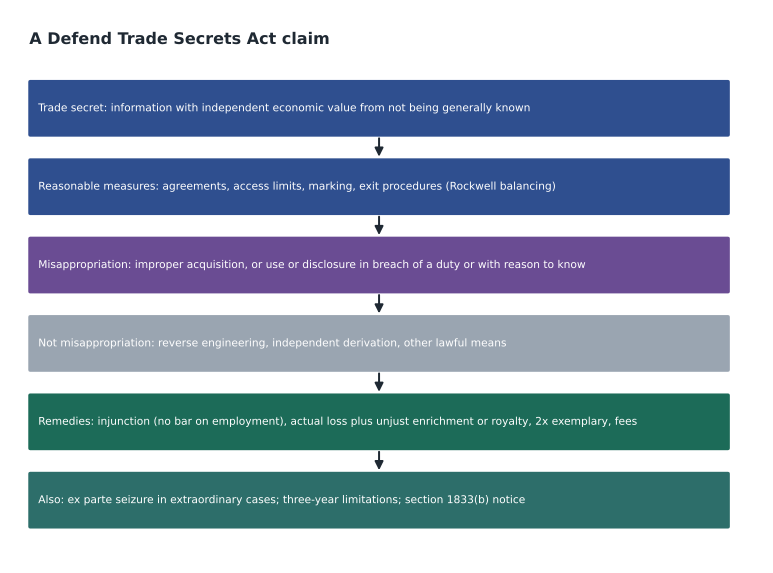
The DTSA's definition in section 1839(3), which tracks the UTSA, covers all forms and types of financial, business, scientific, technical, economic or engineering information, including patterns, plans, compilations, program devices, formulas, designs, prototypes, methods, techniques, processes, procedures, programs or codes, whether tangible or intangible and however stored, if two conditions are met. First, the owner has taken reasonable measures to keep the information secret. Second, the information derives independent economic value, actual or potential, from not being generally known to, and not being readily ascertainable through proper means by, another person who can obtain economic value from its disclosure or use.
Many things qualify: customer lists with buying histories, pricing formulas, source code, manufacturing processes, recipes, the results of failed experiments, and compilations of individually public information whose assembly took effort. Information that is generally known in the industry does not qualify, nor does information anyone could find in published sources or by inspecting a product on the market. Breckwood's library qualifies easily on value: competitors would need years and thousands of measurements to assemble anything comparable, and HUSHRUN's need for fit profiles shows the value of having them. The harder question, as in many cases, is whether Breckwood's secrecy measures were reasonable.
Reasonable measures
The law does not require perfect security, only measures reasonable under the circumstances. Courts look at nondisclosure agreements with employees, contractors and business partners; confidentiality policies and training; marking of confidential documents; restricting access to those who need to know; physical and electronic security such as passwords, encryption and logging; and exit procedures that recover materials and remind departing employees of their obligations. In Rockwell Graphic Systems v. DEV Industries (7th Cir. 1991) Judge Posner explained that the question is one of balancing the costs and benefits of precautions, usually for the jury, and that a company need not take every conceivable step. In E. I. du Pont de Nemours and Co. v. Christopher (5th Cir. 1970) the court held that photographing a partially built chemical plant from an airplane was improper means, because the law does not require a company to build a roof over an unfinished plant to guard against unusual and unforeseeable espionage.
Breckwood's record is mixed. Every employee signed a confidentiality agreement, and the source repository required two-factor authentication. But the tuning library sat on a shared company drive that all sixty employees could open, the files were not marked confidential, and Breckwood did not hold an exit interview when Ardley left; it simply collected his laptop. Keswick will argue that a company that treats its crown jewels like the office lunch schedule has not taken reasonable measures. Breckwood will respond that only engineers had reason to open the drive, that all employees were bound by confidentiality agreements, that the security logs that caught Ardley are themselves a protective measure, and that reasonableness is judged by the standards of a sixty-person startup, not a multinational.
Misappropriation
Misappropriation, defined in section 1839(5), takes two forms. One is acquisition of a trade secret by a person who knows or has reason to know that it was acquired by improper means. The other is disclosure or use of a trade secret without consent by a person who used improper means to acquire it, or who knew or had reason to know that their knowledge of it was derived through a person who used improper means, was acquired under circumstances giving rise to a duty to maintain its secrecy or limit its use, or was derived from someone who owed such a duty. Improper means include theft, bribery, misrepresentation, breach or inducement of a breach of a duty to maintain secrecy, and espionage through electronic or other means. Section 1839(6)(B) expressly provides that reverse engineering, independent derivation and any other lawful means of acquisition are not improper.
Ardley acquired the library lawfully as an employee, but his employment agreement and the nature of his position imposed a duty to keep it secret and use it only for Breckwood. Forwarding files to his personal email was itself a breach of that duty; using them at Keswick, if he did, is misappropriation by use. Keswick is liable if it used the library knowing or having reason to know that Ardley acquired it in breach of a duty. A company that hires a competitor's engineer and receives files from him is often deemed to have reason to know. Careful employers require new hires to certify that they have brought nothing from their former employer, wall them off from projects where the risk is greatest, and investigate promptly when a complaint arrives.
Proof is usually circumstantial. Plaintiffs rely on forensic evidence of downloads and transfers, the timing of the departure and the competitor's product launch, similarities in the products and a speed of development that would be implausible without the secret. HUSHRUN's fit profiles reached the market eight weeks after Ardley arrived. Breckwood's experts will compare them with the twelve profiles in HUSHWREN and with the full library, and look for the idiosyncrasies of Breckwood's hand-tuning. Keswick will say it developed its own profiles from its own measurements over two years, and show its engineering records. Independent development is a complete defense if Keswick can prove it.
Employees, general knowledge and noncompetes
Trade secret law must reconcile two interests: protecting employers' secrets and preserving employees' freedom to change jobs and use their general skill, knowledge and experience. An engineer who leaves Breckwood takes with him everything he learned about signal processing, acoustics and how to run a firmware team, and he may use all of it. What he may not take is Breckwood's specific confidential information. The line is not always clear, and courts sometimes describe the residue an employee carries away in memory as general knowledge even when it originated with the employer.
Some courts have recognized an inevitable disclosure doctrine, under which an employer may enjoin a former employee from working for a competitor in a role where the employee would inevitably use the former employer's trade secrets. The leading case is PepsiCo v. Redmond (7th Cir. 1995), which enjoined a Pepsi manager with detailed knowledge of Pepsi's strategic plans for sports drinks from working on the competing Gatorade and Snapple lines at Quaker Oats for several months. Many states reject the doctrine, and California rejects it outright. The DTSA limits it too: under section 1836(b)(3)(A)(i), a court may not grant an injunction that prevents a person from entering into an employment relationship, any conditions placed on employment must be based on evidence of threatened misappropriation and not merely on the information the person knows, and an injunction may not conflict with an applicable state law prohibiting restraints on a lawful profession, trade or business.
Employers often protect secrets with contracts: nondisclosure agreements, which are generally enforceable; nonsolicitation clauses; and noncompetition agreements, which are governed by state law and increasingly restricted. California has long voided most employee noncompetes under Business and Professions Code section 16600, and amendments effective in 2024 extended that rule to contracts signed elsewhere; Minnesota banned most new employee noncompetes in 2023; many other states limit them by income, duration or occupation. In April 2024 the Federal Trade Commission adopted a rule banning most noncompetes nationwide, but a federal district court in Texas set the rule aside in Ryan LLC v. FTC in August 2024 before it took effect, and in September 2025 the Commission voted to dismiss its appeals and accede to the vacatur, while announcing that it would pursue case-by-case enforcement against particularly harmful noncompetes. Ardley's agreement contains a twelve-month noncompete choosing Westmarch law, but he now works in Harrowmere, whose Employee Mobility Act voids employee noncompetes and out-of-state choice-of-law clauses for employees who live and work there. Ivensen reminds the class of the Conflict of Laws problem and tells Breckwood's lawyers to build their case on trade secrets, not the noncompete.
Remedies
Under the DTSA a court may grant an injunction to prevent actual or threatened misappropriation, subject to the employment limits, and may require affirmative actions to protect the secret, such as return and destruction of materials and forensic inspection of devices. In exceptional circumstances an injunction may condition future use on payment of a reasonable royalty. Damages may include the owner's actual loss and any unjust enrichment caused by the misappropriation not counted in the actual loss, or, alternatively, a reasonable royalty for the unauthorized disclosure or use. For willful and malicious misappropriation the court may award exemplary damages of up to twice the compensatory award and attorney fees. Fees may also be awarded against a plaintiff who brings a claim in bad faith. The limitations period is three years from when the misappropriation was or should have been discovered.
The DTSA added an extraordinary remedy: on an ex parte application, in extraordinary circumstances, a court may order the seizure of property necessary to prevent the propagation or dissemination of the trade secret, under section 1836(b)(2). The applicant must show, among other things, that an ordinary injunction would be inadequate because the defendant would evade or ignore it, that immediate and irreparable injury will occur, and that the defendant would destroy, move or hide the material if given notice. Federal law enforcement carries out the seizure, and the court must hold a hearing within seven days. Courts grant seizure orders rarely; most plaintiffs seek a temporary restraining order requiring preservation and return of materials instead.
Whistleblower immunity
Section 1833(b) immunizes an individual from criminal and civil liability under any federal or state trade secret law for disclosing a trade secret in confidence to a government official or to an attorney solely for the purpose of reporting or investigating a suspected violation of law, or in a complaint or other document filed under seal in a lawsuit. Employers must give notice of the immunity in any contract or agreement with an employee that governs the use of trade secrets or confidential information, or cross-reference a policy describing it. An employer that fails to give the notice may not recover exemplary damages or attorney fees against an employee to whom notice was not provided. Breckwood's standard confidentiality agreement, drafted from a template in 2019, does not mention the immunity, so Breckwood cannot recover exemplary damages or fees from Ardley under the DTSA, though it may recover them from Keswick.
Trade secrets, patents and the choice between them
Kewanee Oil v. Bicron (1974) held that trade secret protection coexists with patent law. Companies choose between them, and often use both: patenting what can be reverse engineered from the product, such as Breckwood's claimed method, while keeping secret what cannot, such as the library and the manufacturing tolerances. The choice has consequences. Filing a patent application that is later published discloses its contents and ends any secrecy. A company that keeps a process secret and uses it commercially for more than a year before someone else patents it may claim the prior commercial use defense of section 273. And a trade secret lasts only as long as the secret; one public disclosure, even by a thief, can destroy it, which is why speed matters in trade secret litigation.
Worked problem
Breckwood v. Ardley and Keswick
Breckwood's security logs show that Ardley forwarded three files totaling 2.1 gigabytes from the tuning library to his personal email on June 11 and 12, 2026. Breckwood learned of Keswick's HUSHRUN profiles in September and of the emails in October. Advise Breckwood on (a) whether the library is a trade secret, (b) misappropriation by Ardley and by Keswick, (c) what injunction it can obtain, (d) damages, and (e) the effect of its 2019 agreement template.
Show solution
- Trade secret: the library has obvious independent economic value from secrecy. Reasonable measures are contested because of the open shared drive and lack of marking; Breckwood will rely on confidentiality agreements, logging and the scale of a startup under Rockwell's balancing.
- Ardley: acquired lawfully but under a duty of confidentiality; forwarding the files to personal email breached the duty, and any use at Keswick is misappropriation by use. The timing and the volume of data are strong circumstantial evidence.
- Keswick: liable if it used the library knowing or having reason to know of Ardley's breach. HUSHRUN's speed to market supports an inference of use; Keswick's defense is independent development, documented by its engineering records.
- Injunction: a TRO and preliminary injunction requiring return and destruction of the files, forensic inspection of Ardley's accounts and Keswick's systems, and a bar on using profiles derived from the library. Under section 1836(b)(3)(A)(i) the court may not bar Ardley from working at Keswick, and Harrowmere law voids his noncompete; any conditions on his work must rest on evidence of threatened misappropriation.
- Damages: Breckwood's lost sales caused by HUSHRUN, plus Keswick's unjust enrichment such as avoided development costs, or a reasonable royalty. Exemplary damages and fees are available against Keswick if willful and malicious, but not against Ardley, because Breckwood's agreement omitted the section 1833(b) notice. The claim is timely: discovery came in 2026.
Answer: Breckwood's strongest case is trade secret misappropriation, supported by forensic evidence and timing; its weakest point is its own security practice. It should move immediately for preservation and return orders and update its agreements to include the whistleblower notice.
Common mistakes
MistakeAssuming confidential information is a trade secret just because the company says so.
InsteadThe owner must show reasonable secrecy measures and independent economic value from secrecy.
MistakeTreating reverse engineering of a purchased product as misappropriation.
InsteadSection 1839(6)(B) makes reverse engineering and independent derivation proper means.
MistakeSeeking a DTSA injunction barring a former employee from working for a competitor.
InsteadSection 1836(b)(3)(A)(i) forbids injunctions that prevent employment and requires evidence of threatened misappropriation for conditions.
MistakeRelying on a nationwide FTC noncompete ban.
InsteadThe 2024 FTC rule was set aside in Ryan LLC v. FTC and the Commission acceded to vacatur in 2025; noncompetes depend on state law.
MistakeForgetting the whistleblower immunity notice in employee agreements.
InsteadWithout the section 1833(b) notice, the employer cannot recover exemplary damages or fees against that employee.
Summary and key terms
- Trade secret law comes from common law, the UTSA (adopted by nearly every state) and the federal DTSA (2016), which does not preempt state law; the Economic Espionage Act adds criminal liability.
- A trade secret is information with independent economic value from secrecy that its owner protects with reasonable measures (section 1839(3)).
- Reasonable measures are judged by cost-benefit balancing (Rockwell); unusual espionage need not be anticipated (du Pont v. Christopher).
- Misappropriation is acquisition by improper means or use or disclosure in breach of a duty; reverse engineering and independent derivation are proper.
- Employees keep their general skill and knowledge; inevitable disclosure (PepsiCo v. Redmond) is limited and the DTSA bars injunctions that prevent employment.
- Noncompetes are governed by state law; the FTC's 2024 rule was vacated and the Commission acceded in 2025.
- Remedies: injunctions, actual loss plus unjust enrichment or a reasonable royalty, exemplary damages up to twice for willful and malicious misappropriation, fees, and rare ex parte seizures; three-year limitations period.
- Section 1833(b) immunizes whistleblowers and requires notice in employee agreements.
- Trade secrets and patents coexist (Kewanee); companies choose based on reverse engineering risk.
- Trade secret
- Information that derives independent economic value from not being generally known and is subject to reasonable secrecy measures.
- Improper means
- Theft, bribery, misrepresentation, breach of a duty of secrecy or espionage; not reverse engineering or independent derivation.
- Misappropriation
- Acquisition by improper means, or use or disclosure without consent in breach of a duty or with reason to know of improper acquisition.
- Inevitable disclosure
- A doctrine allowing an injunction against employment where use of secrets would be inevitable, limited by many states and the DTSA.
- Ex parte seizure
- A DTSA order, issued without notice in extraordinary circumstances, for seizure of property to prevent dissemination of a secret.
- Whistleblower immunity
- Protection under section 1833(b) for confidential disclosures to officials or attorneys to report suspected violations of law.
- Unjust enrichment
- The defendant's gain from misappropriation, such as avoided development costs.
Practice problems
Work each problem on paper first, then reveal the answer to check.
A competitor buys a company's product, analyzes it in a lab and deduces the formula. Is that misappropriation?
Show answer
No. Reverse engineering of a lawfully acquired product is a proper means under section 1839(6)(B).
A sales manager leaves for a competitor and, from memory, contacts customers she served for years. Has she misappropriated a trade secret?
Show answer
It depends. Using general relationships and knowledge is lawful, but using a confidential compilation of customer data, even memorized, may be misappropriation; a nonsolicitation clause may separately apply.
An employer seeks a DTSA injunction barring a former engineer from working for a rival for a year, offering no evidence that he took anything. What result?
Show answer
The court should refuse; the DTSA forbids injunctions preventing employment and requires evidence of threatened misappropriation, not merely what the employee knows.
An employee reports suspected fraud to a government agency and provides confidential documents in confidence. Can the employer sue her for trade secret misappropriation?
Show answer
Section 1833(b) immunizes her from liability for disclosures made in confidence to government officials solely to report a suspected violation of law.
Lesson quiz · 5 questions
Score 60% or more to complete this lesson.
Create a free account to save your progress, take quizzes and earn a certificate.