
LAWU-312 · Lesson 1 of 12 · 26 min
The intellectual property system: the IP Clause, policy and preemption
▶ Video coming soon A video version of this lesson is on the way.
Professor Ingeborg Ivensen begins Intellectual Property by holding up a pair of small white earbuds and asking Section B how many kinds of property they are looking at. Before joining the Larkhaven faculty she spent nine years litigating patent and trade secret cases at a Chicago firm and then six years as an administrative patent judge on the Patent Trial and Appeal Board, where, she says, she learned that most patents are neither as strong as their owners think nor as weak as their competitors hope. Marcus Webb, who worked at a battery-storage startup before law school, guesses two: a patent on the electronics and a trademark on the name. Ivensen writes nine words on the board, one under another: patent, design patent, copyright, trademark, trade dress, trade secret, right of publicity, false advertising, contract. "All of them," she says, "and the lawyer's job is to know which one matters for which problem."
The earbuds, for the purposes of the course, belong to the Breckwood file. Breckwood Acoustics, Inc. is a fictional company in Brennan Falls, in the fictional State of Westmarch, founded in 2019 by Kaveh Farrokhzad, an audiologist who taught himself signal processing. Its HUSHWREN earbuds use an algorithm Breckwood calls adaptive hush, which listens to the wearer's surroundings and the shape of the ear canal and adjusts noise cancellation many times a second. Ivensen will reopen the file in every class: the patent Breckwood obtained in September 2026, the firmware code and the app's illustrations, the HUSHWREN trademark, the tuning library a departing engineer took to a competitor, a competitor's advertisement featuring a voice that sounds like a famous singer, and counterfeits sold through an online marketplace. Everything in the file is invented. The law is real.
She tells the class that every intellectual property question can be broken into four smaller ones, and she writes them across the top of the board. What is protected? Who owns it? What counts as taking it? What can the owner get? The answers differ sharply from one regime to the next, and the differences are not accidents. They follow from what each body of law is trying to accomplish and from the constitutional and statutory sources that create it.
The IP Clause
Patent and copyright law in the United States rest on a single sentence in Article I, section 8, clause 8 of the Constitution, which gives Congress power "To promote the Progress of Science and useful Arts, by securing for limited Times to Authors and Inventors the exclusive Right to their respective Writings and Discoveries." In eighteenth-century usage, science meant knowledge in general and was the province of copyright; the useful arts were the practical crafts and the province of patents. The clause contains a purpose (promoting progress), a means (exclusive rights), a limit (limited times) and two classes of beneficiaries (authors and inventors). Congress acted quickly. The first Patent Act and the first Copyright Act were both passed in 1790, the copyright statute modeled on England's Statute of Anne of 1710 and the patent statute drawing on the Statute of Monopolies of 1624, which had abolished most royal monopolies but preserved patents for new inventions.
The Supreme Court has read the clause as both a grant and a limit. In Graham v. John Deere Co. (1966) the Court said that Congress may not authorize patents whose effect is to remove existing knowledge from the public domain or to restrict free access to materials already available, and that innovation, advancement and things that add to the sum of useful knowledge are the clause's conditions. In Feist Publications v. Rural Telephone Service (1991) the Court held that originality is a constitutional requirement for copyright, so that the facts in a telephone directory could not be protected however much effort went into compiling them. But the Court has given Congress wide latitude on the length of protection. Eldred v. Ashcroft (2003) upheld the Copyright Term Extension Act of 1998, which added twenty years to existing as well as future copyrights, because a limited time remains limited even when it is extended. Golan v. Holder (2012) upheld a statute restoring copyright to some foreign works that had fallen into the American public domain, rejecting the argument that the public domain is constitutionally untouchable.
Trademark law has a different constitutional home. In the Trade-Mark Cases (1879) the Court struck down the first federal trademark statute because trademarks are not writings or discoveries and the statute was not limited to interstate commerce. Modern federal trademark law, the Lanham Act of 1946, rests on the Commerce Clause. That difference explains a good deal: trademarks are not granted for limited times, are not rewards for creativity, and exist to prevent confusion in the marketplace rather than to encourage the production of anything.
Why protect intellectual property at all?
Ivensen asks Priya Natarajan, the section's economist, why the law should give anyone exclusive rights in an idea, a melody or a word. Natarajan gives the standard answer. Information is what economists call a public good: one person's use of it does not diminish anyone else's, and once it is released it is hard to stop others from using it. If competitors could copy Breckwood's algorithm the moment the earbuds went on sale, they would not have to recover the years of research Breckwood paid for, they could undersell Breckwood, and Breckwood, anticipating that, might never have done the research. Exclusive rights let the creator charge more than the cost of copying for a period of time and so recover the investment. That is the incentive theory, and it is the theory the Constitution itself expresses.
The incentive theory also explains the limits. Exclusive rights have costs. While a patent or copyright lasts, some people who would pay the cost of a copy, but not the price the owner charges, go without; economists call that a deadweight loss. Exclusive rights can also slow later innovation, because new inventors and authors build on earlier work. The law tries to balance the incentive against these costs with limited terms, with requirements that keep trivial contributions out of the system, with disclosure obligations, and with doctrines like fair use and experimental use that leave room for others. Hannah Lindqvist, the former history teacher, points out that much of the doctrine the class will study is really a set of choices about where the balance should lie.
Other justifications compete with the incentive theory. A natural-rights or labor theory, drawn from John Locke, says that people are entitled to the fruits of their labor. A personality theory, more influential in continental Europe, treats a work as an extension of its author and supports moral rights such as the right to be credited and to object to mutilation of the work; American law recognizes moral rights only narrowly, chiefly for works of visual art under the Visual Artists Rights Act of 1990. Trademark law rests on a consumer-protection rationale: marks lower the cost of searching for goods, because a buyer who liked one HUSHWREN earbud can find the same product again, and they give sellers a reason to maintain quality. Trade secret law rests on commercial ethics and on the practical point that, without legal protection, businesses would spend wastefully on fences and locks.
The regimes compared
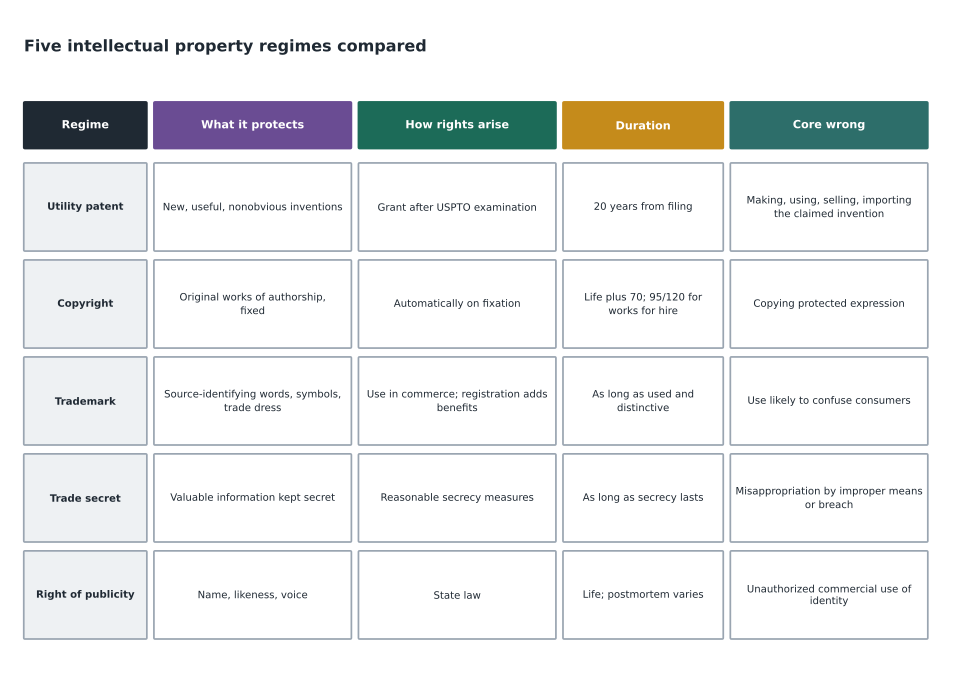
Ivensen walks the class through the chart. A utility patent protects an invention: a process, machine, manufacture or composition of matter, or an improvement of one, that is new, useful and nonobvious and is described so that a skilled person could make and use it. Rights arise only when the Patent and Trademark Office grants a patent after examination, and they last twenty years from the filing date. Patent rights are the strongest in the system. A patent owner can stop anyone from making, using, selling, offering to sell or importing the invention, even someone who developed it independently and never heard of the patent. Design patents protect new, original and ornamental designs for articles of manufacture and last fifteen years from grant. Plant patents and the separate Plant Variety Protection Act cover new plant varieties.
Copyright protects original works of authorship fixed in a tangible medium of expression: literary works, including software, musical works and sound recordings, pictorial, graphic and sculptural works, motion pictures, architectural works and others. Protection arises automatically at the moment of fixation, with no registration or notice required, though registration matters for enforcement. For works created since 1978 copyright lasts for the author's life plus seventy years, or, for works made for hire and anonymous works, ninety-five years from publication or one hundred twenty years from creation, whichever ends first. Copyright protects only expression, not ideas, and it protects only against copying. An author who independently creates an identical work infringes nothing.
Trademark law protects words, names, symbols, sounds, colors and product packaging and design that identify the source of goods or services. Rights arise from use in commerce, though federal registration adds important benefits. Trademark rights can last indefinitely, as long as the mark is used and continues to identify source. The core wrong is confusing consumers about who makes or sponsors a product. Trade secret law protects information, such as formulas, methods, customer lists and source code, that derives economic value from not being generally known and that its owner takes reasonable measures to keep secret. Protection lasts as long as secrecy does, and it is lost if the secret is independently discovered or reverse engineered from a lawfully obtained product. The right of publicity, a creature of state law, protects a person against unauthorized commercial use of name, likeness, voice or other indicia of identity.
Daniel Reyes asks why a company would ever choose a patent over a trade secret if the secret can last forever. Ivensen answers with the bargain at the center of patent law. A patent requires full public disclosure of the invention, and in exchange the inventor receives a strong but temporary right good even against independent inventors. A trade secret requires no disclosure and no examination and may last indefinitely, but it offers no protection against anyone who discovers the secret honestly. Breckwood's adaptive hush algorithm could be studied by anyone who buys an earbud and analyzes its behavior, and its firmware could eventually be extracted; a patent may be the better choice for the method. Its library of ear-canal measurements, collected over five years and never shipped to customers, is a classic trade secret.
Overlap, channeling and preemption
The regimes overlap. Breckwood's firmware is protected by copyright as a literary work, may embody patented methods, and, to the extent it is never published in readable form, may contain trade secrets. The shape of the charging case may be protected by a design patent and, once consumers associate it with Breckwood, as trade dress. Courts police the boundaries with channeling doctrines, which keep each regime from swallowing another. Copyright excludes ideas, procedures, processes, systems and methods of operation, which belong to patent law if they belong anywhere. Trademark law refuses protection for functional product features, so that a company cannot obtain through a perpetual trademark what patent law gives only for twenty years. The Court made the point in TrafFix Devices v. Marketing Displays (2001), holding that a dual-spring design claimed in an expired utility patent was functional and could not be protected as trade dress.
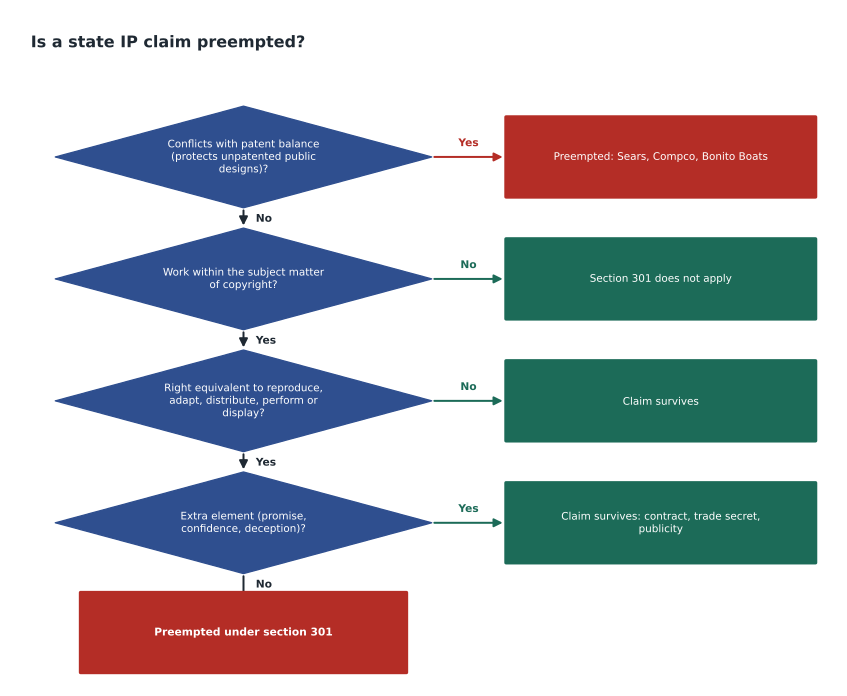
States can also protect intellectual products, but only within limits set by federal law. In Sears, Roebuck and Co. v. Stiffel Co. and Compco Corp. v. Day-Brite Lighting (both 1964) the Court held that a state could not use its unfair competition law to forbid copying of an unpatented lamp design, because federal patent law had decided that unpatented designs are free for all to copy. In Kewanee Oil Co. v. Bicron Corp. (1974) the Court held that state trade secret law is not preempted, because it protects against improper means of acquisition and leaves the public free to discover the secret honestly. In Bonito Boats v. Thunder Craft Boats (1989) the Court struck down a Florida statute that forbade copying boat hulls by a direct molding process, because it gave patent-like protection to unpatented designs.
Copyright has an express preemption provision. Section 301 of the Copyright Act preempts state-law rights that are equivalent to any of the exclusive rights of copyright in works within the subject matter of copyright. Courts apply an extra element test: a state claim survives if it requires an element, such as breach of a promise, breach of confidence or deception of consumers, that makes it qualitatively different from a copyright claim. A state law forbidding the reproduction of a song is preempted; a contract claim for unpaid royalties generally is not. The right of publicity usually survives because a person's identity is not a work of authorship, though courts have divided over claims that are really about the use of a copyrighted recording or photograph.
Institutions and courts
The Patent and Trademark Office, part of the Department of Commerce, examines and grants patents and registers trademarks. Within it, the Patent Trial and Appeal Board hears appeals from examiners and conducts the post-grant trials Congress created in the America Invents Act of 2011, and the Trademark Trial and Appeal Board hears oppositions and cancellation proceedings. The Copyright Office, part of the Library of Congress, registers copyrights, records transfers and, since the CASE Act of 2020, houses the Copyright Claims Board, a voluntary small-claims tribunal for claims of up to 30,000 dollars. The International Trade Commission can exclude infringing imports under section 337 of the Tariff Act.
Federal district courts have exclusive jurisdiction over cases arising under the patent and copyright statutes under 28 U.S.C. section 1338, and concurrent jurisdiction with state courts over trademark claims. Since 1982 appeals in patent cases go to the Court of Appeals for the Federal Circuit, created to bring uniformity to patent law; copyright and trademark appeals go to the regional circuits, which is why circuit splits in those fields are common. State courts still decide some cases that involve patents. In Gunn v. Minton (2013) the Court held that a legal malpractice claim arising from a lost patent case belonged in state court, because the patent question, though necessary, was not substantial to the federal system as a whole.
Intellectual property is also territorial. A United States patent gives no rights in Malaysia, and a Malaysian patent gives none in Westmarch. Treaties ease the burden of seeking protection country by country: the Paris Convention of 1883 gives applicants a priority period to file abroad, the Patent Cooperation Treaty provides a single international application, the Berne Convention, which the United States joined in 1989, requires member states to protect foreign works without formalities, the Madrid Protocol eases international trademark registration, and the TRIPS Agreement of 1994 sets minimum standards for members of the World Trade Organization. Jordan Kimura, who organizes the study group, asks the obvious practical question: how much of this will be on the exam? Ivensen says the treaties will appear mainly as the reason Breckwood's lawyers have deadlines they cannot miss.
Worked problem
Sorting the Breckwood file
Kaveh Farrokhzad brings the following list to Breckwood's outside counsel, Ottavio Pescatore. For each item, identify which regimes may protect it and the one most likely to matter: (a) the adaptive hush method of adjusting noise cancellation; (b) the firmware that runs on the earbuds; (c) the name HUSHWREN; (d) the distinctive pebble-shaped charging case; (e) a library of about 40,000 ear-canal measurements collected since 2020 and never released; (f) Wynona Marquand's voice, imitated in a competitor's advertisement.
Show solution
- Adaptive hush method: a process, so potentially a utility patent if it is new, nonobvious and eligible subject matter. Copyright cannot protect the method itself (section 102(b)). If it can be reverse engineered from the product, trade secret protection is fragile.
- Firmware: copyright protects the code as a literary work from the moment it is written; registration is needed before suing. Unpublished source code may also be a trade secret, and the methods it performs may be patented.
- HUSHWREN: a trademark, protected by use and, since Breckwood registered it, by a federal registration with nationwide priority. It is a coined word and inherently distinctive.
- Charging case: a design patent if one was filed in time; trade dress only if the shape is nonfunctional and, as product design, has acquired secondary meaning (Wal-Mart v. Samara, covered later).
- Measurement library: a trade secret if Breckwood took reasonable measures to keep it secret. A compilation of facts gets at most thin copyright protection for selection and arrangement under Feist, which would not stop someone from using the data.
- Marquand's voice: not Breckwood's property at all. It is Marquand's right of publicity under state law and possibly her false endorsement claim under the Lanham Act; Breckwood's interest is that the competitor's ad may also mislead consumers.
Answer: Different regimes matter for different assets: patent for the method, copyright and trade secret for the code, trademark for the name, design patent or trade dress for the case, trade secret for the library, and publicity rights for the singer. Overlap is normal, but channeling doctrines prevent copyright and trademark from protecting functional ideas that only patent law can protect.
Common mistakes
MistakeTreating intellectual property as a single kind of property with uniform rules.
InsteadEach regime has its own subject matter, requirements, duration, ownership rules, infringement test and remedies; start every problem by identifying which regimes apply.
MistakeSaying that copyright protects an idea or a method if it is described in a book or program.
InsteadSection 102(b) excludes ideas, procedures, processes, systems and methods of operation; copyright protects only the expression.
MistakeAssuming independent creation is a defense to patent infringement.
InsteadIndependent creation defeats copyright and trade secret claims but not patent claims; a patent is good against everyone who practices the claimed invention.
MistakeGrounding federal trademark law in the IP Clause.
InsteadThe Trade-Mark Cases (1879) held that the IP Clause does not support trademark legislation; the Lanham Act rests on the Commerce Clause.
MistakeAssuming every state-law claim touching a copyrighted work is preempted.
InsteadSection 301 preempts only rights equivalent to copyright; claims with an extra element, such as breach of contract or confidence, generally survive.
Summary and key terms
- The IP Clause authorizes patents and copyrights for limited times to promote progress; trademark law rests on the Commerce Clause (Trade-Mark Cases, 1879).
- The clause limits as well as grants: Graham requires real innovation for patents and Feist makes originality a constitutional requirement, but Eldred and Golan give Congress latitude over terms and the public domain.
- The incentive theory treats information as a public good; limits such as finite terms, disclosure, fair use and channeling doctrines manage the costs of exclusivity.
- Utility patents last 20 years from filing, copyright life plus 70 years, trademarks as long as they are used and distinctive, trade secrets as long as secrecy lasts.
- Channeling doctrines keep functional ideas in patent law (section 102(b); TrafFix functionality).
- Federal law preempts state protection of unpatented, public designs (Sears, Compco, Bonito Boats) but not trade secret law (Kewanee); section 301 preempts state rights equivalent to copyright unless an extra element is present.
- Patent appeals go to the Federal Circuit; copyright and trademark appeals go to the regional circuits; IP rights are territorial, and treaties ease international filing.
- IP Clause
- Article I, section 8, clause 8 of the Constitution, authorizing Congress to secure exclusive rights to authors and inventors for limited times.
- Public good
- A good that is nonrival and hard to exclude others from using, so that markets may underproduce it without legal protection.
- Deadweight loss
- The value lost when users who would pay the cost of a copy, but not the owner's price, go without.
- Channeling doctrine
- A rule that keeps one IP regime from protecting subject matter assigned to another, such as functionality in trademark law.
- Preemption
- Displacement of state law by federal law, expressly (section 301 of the Copyright Act) or because the state law conflicts with federal policy.
- Extra element test
- The test asking whether a state claim requires an element that makes it qualitatively different from a copyright claim.
- Territoriality
- The principle that IP rights exist country by country under each nation's law.
Practice problems
Work each problem on paper first, then reveal the answer to check.
A state enacts a statute forbidding anyone to copy the shape of an unpatented kitchen tool by casting a mold from it. Is the statute valid?
Show answer
Likely not. Under Bonito Boats (1989), a state may not give patent-like protection to unpatented designs that federal law leaves free to copy.
A software company sues a former licensee in state court for breach of a license agreement that forbade copying the licensed code. The licensee argues preemption under section 301. What result?
Show answer
The contract claim generally survives because the promise is an extra element; it binds only the parties and is qualitatively different from a copyright claim.
Why might a company keep a manufacturing process secret instead of patenting it?
Show answer
A trade secret requires no disclosure, no examination and has no fixed term, and a process used inside a factory may be hard to discover; but it gives no protection against independent discovery or reverse engineering, unlike a patent.
Congress extends the term of existing copyrights by twenty years. Is that within the IP Clause?
Show answer
Yes, under Eldred v. Ashcroft (2003): an extended term remains a limited time, and the Court defers to Congress's judgment about how to promote progress.
Lesson quiz · 5 questions
Score 60% or more to complete this lesson.
Create a free account to save your progress, take quizzes and earn a certificate.