
LAWU-312 · Lesson 7 of 12 · 23 min
Trademarks
▶ Video coming soon A video version of this lesson is on the way.
Ivensen starts the trademark unit by asking Section B to imagine buying earbuds in a store where every box is plain white, with no names or logos. Hannah Lindqvist says she would have to read every specification and would never know whether the pair she bought matched the pair her friend recommended. Jordan Kimura says he would buy the cheapest, which is exactly what a manufacturer of good earbuds would fear. Ivensen says they have just explained trademark law. A trademark is information: it tells the buyer who stands behind the product, lets the buyer find it again, and gives the seller a reason to keep its quality up because buyers can punish it by going elsewhere. Unlike patents and copyrights, trademarks are not rewards for creating something; they protect the link between a symbol and a source.
Breckwood's trademark portfolio is modest. It owns a federal registration on the Principal Register for HUSHWREN for earbuds and headphones, issued in May 2023 after an intent-to-use application filed in 2021. It uses the phrase ADAPTIVE HUSH to describe its noise-cancellation feature and has applied to register it. It uses a three-note chime that plays when the earbuds connect. And it considers the pebble-shaped charging case, introduced in 2022, to be part of its brand. Keswick's HUSHRUN running earbuds, launched in September 2026, are the reason Breckwood is suddenly interested in how strong these assets are.
What can be a trademark
Section 45 of the Lanham Act, codified at 15 U.S.C. section 1127, defines a trademark as any word, name, symbol or device, or any combination of them, used by a person, or which a person has a bona fide intention to use in commerce and applies to register, to identify and distinguish its goods from those of others and to indicate their source, even if that source is unknown. A service mark does the same for services. Courts and the Patent and Trademark Office read the definition broadly. In Qualitex Co. v. Jacobson Products (1995) the Court held that a color, the green-gold of dry cleaning press pads, can be a trademark if it has acquired secondary meaning and is not functional, and the Office has registered sounds such as the NBC chimes, scents and motions. Trade dress, the overall appearance of a product's packaging or of the product itself, is protected under the same principles.
Acquiring rights: use and registration
Trademark rights in the United States arise from use, not registration. At common law the first to use a mark in connection with goods in a particular market acquires rights in that market, and a good-faith remote user who adopts the same mark in a distant market without knowledge of the first user may acquire rights there, under the Tea Rose-Rectanus doctrine of Hanover Star Milling v. Metcalf (1916) and United Drug v. Theodore Rectanus (1918). Federal registration changes the picture. Since the Trademark Law Revision Act of 1988, an applicant may file based on a bona fide intent to use the mark in commerce, and once the mark is registered, the filing date becomes a date of nationwide constructive use, giving the registrant priority across the country against anyone who did not use the mark earlier. Breckwood's 2021 intent-to-use filing gives HUSHWREN nationwide priority from that date.
Registration on the Principal Register also provides constructive notice of the registrant's claim of ownership, which eliminates any good-faith defense for later adopters; prima facie evidence of validity, ownership and the exclusive right to use the mark for the listed goods; the right to use the circled R symbol; the ability to record the registration with Customs and Border Protection to block infringing and counterfeit imports; access to statutory damages in counterfeiting cases; and, after five years of continuous use following registration and the filing of a declaration, incontestable status under section 1065. In Park 'N Fly v. Dollar Park and Fly (1985) the Court held that the holder of an incontestable registration may rely on it offensively and that an incontestable mark cannot be challenged as merely descriptive, though it can still be challenged as generic, functional, abandoned or obtained by fraud.
Registration must be maintained. The registrant must file a declaration of use between the fifth and sixth years after registration and renew every ten years. A mark is abandoned when its use has been discontinued with intent not to resume, and three consecutive years of nonuse is prima facie evidence of abandonment under section 1127. A mark can also be lost if the owner licenses it without controlling the quality of the licensee's goods, sometimes called naked licensing, because the mark then no longer tells consumers anything reliable about source. The Trademark Modernization Act of 2020 added expungement and reexamination proceedings so that registrations for marks never used, or not used as of a relevant date, can be cleared from the register more quickly.
Distinctiveness
A mark must be distinctive, capable of identifying source. In Abercrombie and Fitch Co. v. Hunting World (2d Cir. 1976) Judge Friendly arranged terms along a spectrum of increasing distinctiveness: generic, descriptive, suggestive, arbitrary and fanciful. Generic terms name the class of goods ("earbuds" for earbuds) and can never be trademarks, because competitors need them to describe their own products. Descriptive terms describe a quality, characteristic, function or ingredient ("Clear Sound" for earbuds) and are protected only on proof of secondary meaning, meaning that consumers have come to associate the term primarily with a single source. Suggestive terms require imagination, thought and perception to reach a conclusion about the goods ("Coppertone" for suntan lotion), arbitrary terms are ordinary words used in an unrelated context ("Apple" for computers), and fanciful terms are invented for the purpose ("Kodak"); all three are inherently distinctive and protected without proof of secondary meaning.
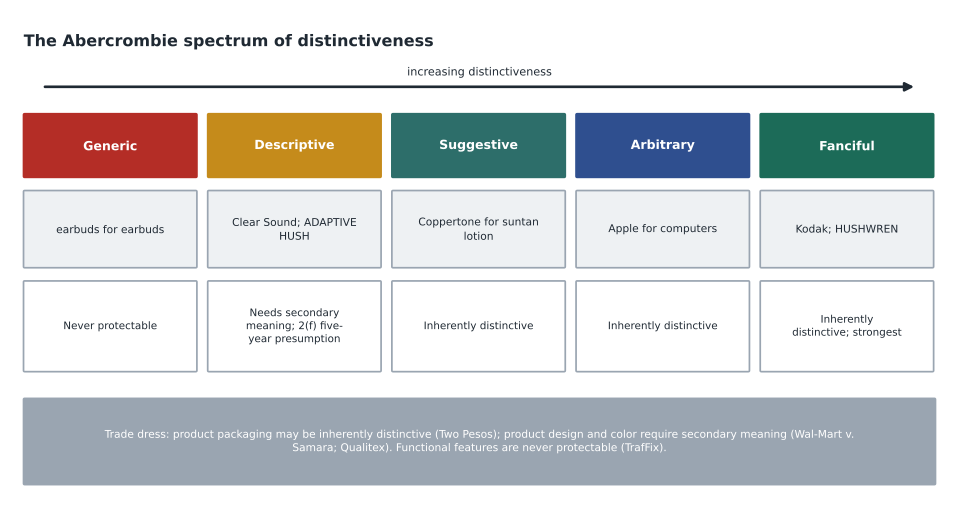
Courts use several tests to place a term on the spectrum, including how much imagination is required to connect it with the goods, whether competitors need the term to describe their products, and how dictionaries and the trade use it. HUSHWREN combines an ordinary word (hush) with the name of a small bird, and the combination describes nothing about earbuds; it is at least suggestive and probably fanciful as a whole. ADAPTIVE HUSH describes exactly what the feature does, so it is descriptive and registrable on the Principal Register only on proof of acquired distinctiveness. Under section 2(f) the Office may accept five years of substantially exclusive and continuous use as prima facie evidence, and otherwise looks at advertising expenditures, sales, unsolicited media coverage, consumer surveys and evidence of copying. A descriptive term that cannot yet show secondary meaning may be registered on the Supplemental Register, which gives fewer benefits but provides notice and supports registration abroad.
Secondary meaning is not required for every kind of trade dress. In Two Pesos v. Taco Cabana (1992) the Court held that a restaurant's distinctive decor could be inherently distinctive, so its owner did not have to prove secondary meaning. But in Wal-Mart Stores v. Samara Brothers (2000) the Court held that product design, unlike product packaging, can never be inherently distinctive, because consumers do not usually think of the shape of a product as identifying its source, and because competition would suffer if every new design could be claimed instantly. In close cases courts should classify trade dress as product design. Breckwood's pebble-shaped charging case is product design, so Breckwood must prove that consumers associate the shape primarily with Breckwood, which may be difficult four years after launch and with other companies selling rounded cases. It should pursue its pending design patent application, and advertising that calls attention to the shape ("look for the pebble") will help build secondary meaning.
Marks can also die. A mark becomes generic if the primary significance of the term to the relevant public is the name of the type of product rather than its producer. Aspirin, thermos and escalator all began as trademarks. In Elliott v. Google (9th Cir. 2017) the court held that the word google, though often used as a verb meaning to search the internet, had not become generic for search engines, because the question is whether the public understands it primarily as the name of a type of search engine, not whether it is used as a verb. In United States Patent and Trademark Office v. Booking.com (2020) the Court rejected a rule that a generic term combined with .com is necessarily generic, holding that whether BOOKING.COM was generic depended on how consumers perceived it, and consumer surveys showed they perceived it as a brand.
Functionality
Trademark law will not protect a functional feature, however distinctive, because protecting it would let a company use a perpetual trademark to obtain what only a limited-term patent can give. Under Inwood Laboratories and TrafFix Devices, a feature is functional if it is essential to the use or purpose of the article or if it affects the cost or quality of the article; an expired utility patent claiming the feature is strong evidence of functionality. Courts also recognize aesthetic functionality for features whose exclusive use would put competitors at a significant non-reputation-related disadvantage, though they apply it sparingly. In Christian Louboutin v. Yves Saint Laurent (2d Cir. 2012) the court held that Louboutin's red-lacquered outsole was a valid mark when it contrasted with the upper of the shoe, but not on an all-red shoe, where the red sole was part of a monochrome design competitors could use. If the pebble shape of Breckwood's case makes it easier to hold, pocket or manufacture, Keswick will argue functionality.
Bars to registration
Section 2 of the Lanham Act lists grounds for refusing registration. Section 2(a) bars deceptive marks and, formerly, immoral, scandalous and disparaging marks; the Court held the disparagement bar unconstitutional viewpoint discrimination in Matal v. Tam (2017), involving the band name THE SLANTS, and the immoral or scandalous bar unconstitutional in Iancu v. Brunetti (2019), involving the clothing brand FUCT. Section 2(b) bars flags and insignia of governments. Section 2(c) bars marks that consist of or comprise a name identifying a particular living individual without written consent; in Vidal v. Elster (2024) the Court unanimously upheld it as applied to an application to register TRUMP TOO SMALL for shirts, reasoning that the names clause is viewpoint neutral and that restrictions on trademarking names have a long history. Section 2(d) bars marks likely to cause confusion with a registered mark or a mark previously used and not abandoned. Section 2(e) bars marks that are merely descriptive or deceptively misdescriptive, primarily geographically descriptive or deceptively misdescriptive, primarily merely a surname, or functional, though most of these can be overcome by acquired distinctiveness under section 2(f), except functionality.
When the Office refuses registration on likelihood of confusion, it applies the same factors courts use in infringement cases, adapted for registration, from In re E. I. du Pont de Nemours and Co. (C.C.P.A. 1973). Applications are published in the Official Gazette, and anyone who believes it would be damaged may oppose registration before the Trademark Trial and Appeal Board within thirty days, extendable; registrations can later be challenged in cancellation proceedings. In B and B Hardware v. Hargis Industries (2015) the Court held that a Board decision on likelihood of confusion can have issue-preclusive effect in later infringement litigation when the usages adjudicated by the Board are materially the same as those before the court.
Ivensen tells the class to watch one pending case. In RiseandShine Corp. v. PepsiCo the Supreme Court granted certiorari on June 29, 2026 to decide whether the strength of a mark is a question of fact in the likelihood-of-confusion analysis, in a dispute between a canned coffee maker selling RISE and PepsiCo, which marketed an energy drink called MTN DEW RISE. The answer will affect how much deference appellate courts give to findings about where a mark falls on the spectrum and how commercially strong it is.
Ownership, assignment and licensing
A trademark is owned by the person who controls the nature and quality of the goods sold under it, not necessarily the person who physically affixes it. Marks may be assigned, but only with the goodwill of the business they symbolize; an assignment in gross, a transfer of the mark alone to someone who will use it on different goods, is invalid because it would deceive consumers. Licenses are common and lawful so long as the licensor exercises adequate quality control. Breckwood's agreement with Lumenreach, its contract manufacturer, should therefore include quality standards, inspection rights and a provision that all goodwill from the licensee's use inures to Breckwood, and it should define which units Lumenreach may sell and where, a point that will matter when the class studies overrun goods.
Worked problem
Auditing Breckwood's marks
Ottavio Pescatore asks Section B to assess the strength and registrability of (a) HUSHWREN, (b) ADAPTIVE HUSH, (c) the three-note connection chime and (d) the pebble-shaped charging case, and to recommend filings.
Show solution
- HUSHWREN: fanciful or at least suggestive, inherently distinctive, registered since May 2023 with priority from the 2021 intent-to-use filing. Breckwood should file its section 8 declaration between May 2028 and May 2029 and its section 15 declaration of incontestability after five years of continuous use.
- ADAPTIVE HUSH: descriptive of the feature. Registration on the Principal Register requires secondary meaning under section 2(f); Breckwood has used it only since 2024, so it cannot rely on the five-year presumption and needs evidence such as advertising, sales and surveys. The Supplemental Register is a fallback.
- Chime: a sound can be a mark if it is distinctive and not functional. A short, unusual sequence played on connection could be inherently distinctive, like the NBC chimes; if the Office treats it as a common notification sound, Breckwood needs evidence of acquired distinctiveness.
- Charging case: product design under Wal-Mart v. Samara, so secondary meaning is required, and functionality is a risk if the shape aids handling or manufacture. Breckwood should rely primarily on its design patent application and use look-for advertising to build secondary meaning.
Answer: HUSHWREN is a strong registered mark and the centerpiece of any case against HUSHRUN. The other assets are weaker and need evidence of acquired distinctiveness. Breckwood should also tighten quality-control terms in its manufacturing license.
Common mistakes
MistakeAssuming trademark rights come from registration.
InsteadRights arise from use; registration adds nationwide priority, notice, presumptions and remedies.
MistakeTreating product design trade dress as inherently distinctive.
InsteadWal-Mart v. Samara requires secondary meaning for product design; packaging may be inherently distinctive under Two Pesos.
MistakeThinking an incontestable mark can never be challenged.
InsteadIncontestability bars descriptiveness challenges (Park 'N Fly) but not genericness, functionality, abandonment or fraud.
MistakeConcluding a term is generic because people use it as a verb.
InsteadThe test is the primary significance to the relevant public (Elliott v. Google; Booking.com).
MistakeLicensing a mark without controlling quality.
InsteadNaked licensing can forfeit the mark; licenses should include quality standards and inspection rights.
Summary and key terms
- Trademarks identify source and lower consumers' search costs; they protect a symbol-source link, not creativity.
- Words, symbols, colors (Qualitex), sounds and trade dress can be marks; rights arise from use, subject to Tea Rose-Rectanus for remote good-faith users.
- Federal registration gives nationwide constructive use from the filing date, notice, presumptions, Customs recordation and, after five years, incontestability (Park 'N Fly).
- Abercrombie spectrum: generic, descriptive (needs secondary meaning), suggestive, arbitrary, fanciful.
- Packaging may be inherently distinctive (Two Pesos); product design never is (Wal-Mart v. Samara).
- Genericness turns on primary significance (Elliott v. Google; Booking.com).
- Functional features cannot be marks (Inwood; TrafFix; Louboutin on aesthetic functionality).
- Section 2 bars; the disparagement and scandalous bars fell (Tam; Brunetti) but the names clause stands (Vidal v. Elster, 2024).
- TTAB decisions can preclude later litigation (B and B Hardware); RiseandShine v. PepsiCo (cert granted June 29, 2026) concerns mark strength as a question of fact.
- Assignments require goodwill; licenses require quality control; nonuse for three years is prima facie abandonment.
- Secondary meaning
- Consumers' association of a term or design primarily with a single source; also called acquired distinctiveness.
- Inherently distinctive
- Capable of identifying source from first use, as suggestive, arbitrary and fanciful marks are.
- Constructive use
- The nationwide priority a registrant receives as of its application filing date.
- Incontestability
- Status a registration attains after five years of continuous use, limiting challenges to it.
- Genericide
- Loss of trademark rights when a mark becomes the public's name for the product type.
- Trade dress
- The overall appearance of a product's packaging or design that identifies its source.
- Naked licensing
- Licensing a mark without quality control, which may result in abandonment.
Practice problems
Work each problem on paper first, then reveal the answer to check.
A bakery uses BEST BAGELS for bagels. Can it stop a competitor using BEST BAGELS IN TOWN?
Show answer
Only if it proves secondary meaning; the term is descriptive (or laudatory), and without secondary meaning it is not protected.
A company sells a lamp in an unusual spiral shape and sues a copier six months after launch, claiming trade dress. What is the obstacle?
Show answer
Wal-Mart v. Samara: product design requires secondary meaning, which is unlikely after six months; the company should have sought a design patent.
An applicant seeks to register a mark that includes the name of a living senator without consent, as political commentary. What result after Vidal v. Elster?
Show answer
Refusal under section 2(c); the Court upheld the names clause as viewpoint neutral, though the applicant may still use the phrase without registering it.
A trademark owner licenses its mark to a franchisee and never inspects the franchisee's products for ten years. What risk does it run?
Show answer
Abandonment through naked licensing, because the mark may no longer signify consistent quality from a single source.
Lesson quiz · 5 questions
Score 60% or more to complete this lesson.
Create a free account to save your progress, take quizzes and earn a certificate.