
LAWU-312 · Lesson 8 of 12 · 24 min
Trademark infringement, dilution and expressive uses
▶ Video coming soon A video version of this lesson is on the way.
Within a month of HUSHRUN's launch, Breckwood's customer service team had logged forty-one messages from people who had bought HUSHRUN earbuds and contacted Breckwood for help, several asking why their "HUSHWREN running edition" would not pair with the HUSHWREN app. A product reviewer wrote that HUSHRUN was "apparently Breckwood's new sports line." Keswick's position, set out in a letter from its general counsel, was that hush is a common word for noise cancellation, that its earbuds are sold with KESWICK prominently on the box, and that runners are careful buyers who read reviews. Breckwood added trademark infringement and unfair competition claims to its suit in the District of Westmarch. Ivensen uses the dispute to teach the core of trademark law: likelihood of confusion, and then the doctrines that reach beyond it.
The causes of action
Section 32 of the Lanham Act, 15 U.S.C. section 1114, gives the owner of a registered mark a claim against anyone who, without consent, uses in commerce a reproduction, counterfeit, copy or colorable imitation of the mark in connection with the sale, offering for sale, distribution or advertising of goods or services, where the use is likely to cause confusion, mistake or deception. Section 43(a)(1)(A), 15 U.S.C. section 1125(a)(1)(A), gives a similar claim for unregistered marks and trade dress, and more broadly for any false designation of origin likely to cause confusion as to the affiliation, connection or association of the defendant with another person, or as to the origin, sponsorship or approval of goods. The elements are a protectable mark owned by the plaintiff, use by the defendant in commerce in connection with goods or services, and likelihood of confusion.
Likelihood of confusion
Every circuit uses a multifactor test, under different names and with slightly different lists. The Second Circuit's factors come from Polaroid Corp. v. Polarad Electronics (1961), and the Ninth Circuit's from AMF Inc. v. Sleekcraft Boats (1979). The Sleekcraft factors are representative: the strength of the mark; the proximity or relatedness of the goods; the similarity of the marks in sight, sound and meaning; evidence of actual confusion; the marketing channels used; the type of goods and the degree of care likely to be exercised by the purchaser; the defendant's intent in selecting the mark; and the likelihood of expansion of the product lines. No factor is dispositive, and courts emphasize that the factors are tools for answering a single question: whether an appreciable number of ordinarily prudent purchasers are likely to be confused about source, sponsorship or affiliation.
Strength has two dimensions: conceptual strength, where the mark falls on the Abercrombie spectrum, and commercial strength, its recognition in the marketplace. A fanciful mark like HUSHWREN is conceptually strong, but its commercial strength in a crowded field of earbuds depends on Breckwood's sales and advertising, and Keswick will point to third-party registrations and uses of HUSH-formative marks for audio products to argue that consumers distinguish them by their other elements. Whether strength is a question of fact, reviewed deferentially, or partly a question of law is the issue the Supreme Court agreed in June 2026 to decide in RiseandShine Corp. v. PepsiCo.
Similarity of the marks is judged by their overall impression as consumers encounter them, not by dissecting them side by side, though courts may give more weight to dominant portions. HUSHWREN and HUSHRUN share the first syllable and differ in a second syllable that sounds alike when spoken quickly. The goods are nearly identical, they are sold through the same online stores and electronics retailers, and they cost about the same. Evidence of actual confusion is not required, but it is powerful when it exists; courts discount isolated instances and misdirected inquiries that show inattention rather than confusion about source, but forty-one misdirected support requests and a reviewer's misstatement in a month are significant. Surveys are common in trademark litigation, and courts scrutinize their design, including the universe of respondents, the stimulus and the controls. The two leading formats are named for the cases in which they were used: the Eveready format, which shows respondents the defendant's product and asks who makes it, and suits strong marks; the Squirt format, which shows both marks, suits marks that are encountered together in the market.
Intent is often inferred from the defendant's knowledge of the plaintiff's mark and its choice to adopt a similar one; Breckwood's discovery will look for Keswick's internal naming documents. The degree of care varies with price and type of goods. A buyer of a 30,000-dollar boat is more careful than a buyer of a candy bar; earbuds at about 180 dollars fall in the middle. Ivensen tells the class that, on these facts, Breckwood has a strong likelihood-of-confusion case, and that Keswick's best argument is that its house mark KESWICK on the box dispels confusion at the point of sale. Courts treat house marks as a factor but often reject the argument when the confusion is about affiliation, because a buyer may think HUSHRUN is a product line Breckwood licensed to Keswick or made with it.
Varieties of confusion
Confusion is not limited to a buyer's mistake at the moment of purchase. Courts recognize affiliation and sponsorship confusion, which section 43(a) expressly covers. Post-sale confusion occurs when observers who see a product after purchase are misled, a theory used against knockoff luxury goods whose buyers are not confused but whose friends may be. Initial interest confusion occurs when a defendant uses a mark to capture a consumer's attention, even if the confusion is dispelled before purchase; the Ninth Circuit once applied it broadly to website metatags in Brookfield Communications v. West Coast Entertainment (1999) but later narrowed it, holding in Network Automation v. Advanced Systems Concepts (2011) that buying a competitor's mark as a search keyword was not likely to confuse sophisticated users when the resulting ads were clearly labeled. Reverse confusion occurs when a larger junior user saturates the market so that consumers come to believe the smaller senior user's goods come from the junior user, the risk Breckwood faces if Keswick's advertising budget makes HUSHRUN the better-known brand.
Defenses
Under the statutory descriptive fair use defense of section 33(b)(4), a defendant may use a term, otherwise than as a mark, fairly and in good faith only to describe its own goods. In KP Permanent Make-Up v. Lasting Impression I (2004) the Court held that a defendant asserting the defense need not negate likelihood of confusion, and that some confusion is compatible with fair use, though the degree of confusion may bear on fairness. Keswick may describe its earbuds as hushing outside noise, but it cannot claim descriptive fair use for HUSHRUN, which it uses as a mark. Courts also recognize nominative fair use, where a defendant uses the plaintiff's mark to refer to the plaintiff's own product, as a repair shop advertising that it services HUSHWREN earbuds would. The Ninth Circuit's test from New Kids on the Block v. News America Publishing (1992) asks whether the product is not readily identifiable without the mark, whether only so much of the mark is used as reasonably necessary, and whether the user does nothing to suggest sponsorship or endorsement.
The resale of genuine goods bearing a true mark is generally not infringement under the first sale principle, even without the trademark owner's consent. But goods are not genuine if they differ materially from those the trademark owner authorizes for sale in the market, or if they were not authorized for sale at all. Courts have treated a manufacturer's unauthorized overruns, made under contract but never approved or paid for by the trademark owner, as nongenuine goods whose sale infringes, as the Second Circuit did with shoes in El Greco Leather Products v. Shoe World (1986). The HUSHWREN units Lumenreach diverted are such overruns.
Expressive works after Jack Daniel's
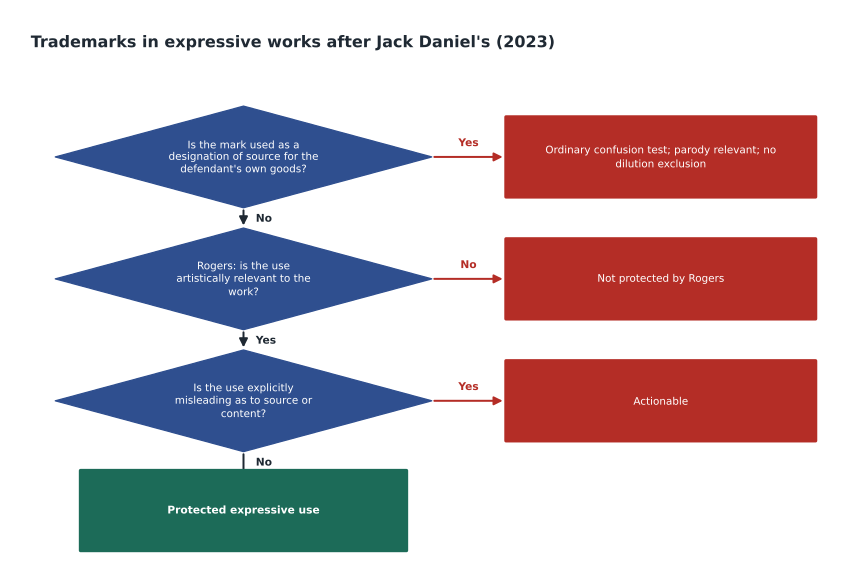
Trademark law can collide with free expression when a mark appears in a book title, a song, a film or a parody. For decades many courts applied the test from Rogers v. Grimaldi (2d Cir. 1989), in which the dancer Ginger Rogers sued over the Federico Fellini film Ginger and Fred. Under Rogers, the use of a mark in an expressive work is actionable only if the use has no artistic relevance to the underlying work or, if it has some, it explicitly misleads as to the source or content of the work. The test was highly protective: in Mattel v. MCA Records (9th Cir. 2002) it shielded the song "Barbie Girl."
Jack Daniel's Properties v. VIP Products (2023) cut the Rogers test back. VIP sold a squeaky dog toy shaped like a Jack Daniel's whiskey bottle and labeled "Bad Spaniels," with "The Old No. 2 on your Tennessee Carpet" in place of the whiskey label's "Old No. 7 Brand Tennessee Sour Mash Whiskey." VIP had registered its own trademarks on the toy line and called the parody a source identifier. The Court, in a unanimous opinion by Justice Kagan, held that Rogers does not apply when an accused infringer uses a trademark as a designation of source for its own goods, that is, as a trademark. In that situation the ordinary likelihood-of-confusion analysis applies, though the parodic message remains relevant to whether consumers are likely to be confused. The Court also held that the Lanham Act's exclusion from dilution liability for noncommercial use does not shield parody, criticism or commentary when the defendant uses the mark as a designation of source for its own goods. The Court did not decide whether Rogers remains valid for uses that are not source-identifying, such as a mark mentioned in the title or content of a film.
Dilution
Dilution protects famous marks even without likelihood of confusion. Under section 43(c), as rewritten by the Trademark Dilution Revision Act of 2006, the owner of a famous mark that is distinctive may obtain an injunction against a use that is likely to cause dilution by blurring or by tarnishment, regardless of competition or confusion. A mark is famous only if it is widely recognized by the general consuming public of the United States as a designation of source, which excludes marks famous only in a niche market; HUSHWREN is not famous in that sense. Blurring is association arising from similarity that impairs the distinctiveness of the famous mark, as HUSHWREN shoes and HUSHWREN coffee might, if HUSHWREN were famous. Tarnishment is association that harms the famous mark's reputation, typically by linking it to sex, drugs or shoddy goods. The 2006 Act responded to Moseley v. V Secret Catalog (2003), which had required proof of actual dilution, by making likelihood of dilution sufficient. Its exclusions cover fair use, including parody, criticism and comment, other than as a designation of source for the defendant's own goods; news reporting and commentary; and noncommercial use.
Cybersquatting
The Anticybersquatting Consumer Protection Act of 1999, section 43(d), gives a claim against one who, with a bad faith intent to profit from a mark, registers, traffics in or uses a domain name that is identical or confusingly similar to a distinctive mark, or identical, confusingly similar or dilutive of a famous mark. The statute lists factors bearing on bad faith, such as offering to sell the domain name to the mark owner for profit, and authorizes statutory damages of 1,000 to 100,000 dollars per domain name and in rem actions against the domain name itself when the registrant cannot be found. Many disputes are resolved faster and more cheaply under the Uniform Domain-Name Dispute-Resolution Policy, an arbitration-like process required by domain registrars. Someone registered hushwrenstore.com in October 2026 and is using it to sell the counterfeits, a classic ACPA and UDRP case.
Territorial limits after Abitron
In Abitron Austria GmbH v. Hetronic International (2023) a jury had awarded about 96 million dollars against foreign defendants who sold products bearing the plaintiff's marks, mostly in Europe to European customers. The Court held that sections 32 and 43(a) are not extraterritorial and that the conduct relevant to the statutes' focus is use in commerce; the provisions therefore reach infringing uses of a mark in commerce in the United States, not foreign uses even if they cause confusion that affects United States commerce. Abitron substantially limited the reach of the old decision in Steele v. Bulova Watch (1952). Lumenreach's sales of overrun HUSHWREN units in Europe are outside the Lanham Act; Breckwood needs European trademark rights to stop them there. But a United States distributor that imports and sells those units here uses the mark in domestic commerce and is liable.
Remedies
Under section 34, courts may grant injunctions according to the principles of equity, and since the Trademark Modernization Act of 2020 a plaintiff that establishes infringement, or likely success for a preliminary injunction, is entitled to a rebuttable presumption of irreparable harm. Under section 35(a) a successful plaintiff may recover, subject to the principles of equity, the defendant's profits, any damages sustained and the costs of the action. The plaintiff proves the defendant's sales, and the defendant must prove its costs and deductions. The court may enhance damages up to three times and, if the recovery based on profits is inadequate or excessive, may enter judgment for such sum as it finds just, so long as the award is compensation and not a penalty. In exceptional cases the court may award attorney fees.
Two recent decisions shape monetary recovery. In Romag Fasteners v. Fossil (2020) the Court held that willfulness is not a precondition to an award of the defendant's profits, though the defendant's mental state remains a highly important consideration. In Dewberry Group v. Dewberry Engineers (2025) the Court unanimously held, in an opinion by Justice Kagan, that the defendant's profits means the profits of the named defendant only, not of its legally separate affiliates, absent grounds such as veil piercing; the district court had awarded nearly 43 million dollars by treating the profits of the Dewberry Group's affiliated property-owning companies as its own. The Court noted that courts retain discretion under the just-sum provision but cannot use it to disregard corporate separateness. Keswick sells HUSHRUN through a separate affiliate, Keswick Direct LLC, so after Dewberry Breckwood should name that affiliate as a defendant if it wants an accounting of its profits.
Worked problem
Breckwood's trademark claims
Advise Breckwood on (a) its infringement claim against Keswick over HUSHRUN; (b) whether it can bring a dilution claim; (c) the European sales of Lumenreach overruns and their resale in the United States by a distributor, Tallowmere Wholesale; and (d) monetary relief against Keswick, which books HUSHRUN sales through Keswick Direct LLC.
Show solution
- Infringement: Sleekcraft factors favor Breckwood: a conceptually strong registered mark, similar sound and appearance, identical goods, identical channels, moderate care, Keswick's knowledge and 41 instances of actual confusion. Keswick's house mark helps it at the point of sale but does not answer affiliation confusion. A survey would strengthen the record; Breckwood should commission one using an appropriate format.
- Dilution: unavailable, because HUSHWREN is not widely recognized by the general consuming public; niche fame is not enough under the 2006 Act.
- Overruns: under Abitron, Lumenreach's sales in Europe are foreign uses outside the Lanham Act. Tallowmere's sales in the United States are domestic uses of the mark on nongenuine goods (unauthorized overruns), likely infringing and possibly counterfeiting. Breckwood should also enforce its manufacturing contract against Lumenreach.
- Money: Romag lets Breckwood seek Keswick's profits without proving willfulness, though intent matters to equity. Dewberry limits profits to named defendants, so Breckwood should add Keswick Direct LLC. With the TMA presumption, a preliminary injunction is realistic if likelihood of success is shown.
Answer: Breckwood's best trademark claim is ordinary infringement under section 32, supported by actual confusion. Dilution is out of reach. Abitron confines the overrun claim to domestic sales, and Dewberry makes careful choice of defendants essential.
Common mistakes
MistakeTreating any single confusion factor as decisive.
InsteadThe factors are weighed together to answer whether an appreciable number of ordinary purchasers are likely to be confused.
MistakeApplying Rogers v. Grimaldi to a parody used as the defendant's brand.
InsteadJack Daniel's holds that Rogers does not apply when the mark is used as a designation of source for the defendant's goods.
MistakeBringing a dilution claim for a mark known only in an industry.
InsteadThe 2006 Act requires wide recognition by the general consuming public of the United States.
MistakeSeeking the profits of a defendant's whole corporate family.
InsteadDewberry (2025) limits the award to the named defendant's profits; add affiliates as defendants or show veil piercing.
MistakeSuing under the Lanham Act for sales made entirely abroad.
InsteadAbitron confines sections 32 and 43(a) to uses of the mark in commerce in the United States.
Summary and key terms
- Section 32 protects registered marks and section 43(a) unregistered marks and trade dress against uses likely to cause confusion as to source, sponsorship or affiliation.
- Likelihood of confusion uses multifactor tests (Polaroid, Sleekcraft): strength, similarity, relatedness, actual confusion, channels, care, intent and expansion; surveys are common.
- Varieties: affiliation, post-sale, initial interest (narrowed in Network Automation) and reverse confusion.
- Defenses: descriptive fair use, which tolerates some confusion (KP Permanent); nominative fair use (New Kids); genuine goods, but unauthorized overruns are not genuine.
- Jack Daniel's (2023): Rogers does not apply to source-identifying uses, and parody used as a brand is not excluded from dilution.
- Dilution requires a famous mark widely recognized by the general public; likelihood of blurring or tarnishment suffices (TDRA 2006).
- ACPA bars bad faith registration of confusingly similar domain names; UDRP offers a fast alternative.
- Abitron (2023) limits the Lanham Act to domestic uses in commerce.
- Remedies: injunctions with a presumption of irreparable harm (TMA 2020); profits without a willfulness prerequisite (Romag); only the named defendant's profits (Dewberry, 2025).
- Likelihood of confusion
- The probability that an appreciable number of ordinarily prudent purchasers will be confused about source, sponsorship or affiliation.
- Reverse confusion
- Confusion in which consumers believe the senior user's goods come from a larger junior user.
- Nominative fair use
- Use of another's mark to refer to that other party's own goods or services.
- Rogers test
- A test protecting marks used in expressive works unless they lack artistic relevance or are explicitly misleading.
- Dilution by blurring
- Association that impairs the distinctiveness of a famous mark.
- Dilution by tarnishment
- Association that harms the reputation of a famous mark.
- Cybersquatting
- Registering or using a domain name confusingly similar to a mark with a bad faith intent to profit.
Practice problems
Work each problem on paper first, then reveal the answer to check.
A small brewery has used RIVERBEND for beer since 2010. A national chain launches RIVERBEND restaurants with a huge ad campaign, and customers begin asking whether the brewery is owned by the chain. What theory fits?
Show answer
Reverse confusion: the junior user's saturation makes consumers think the senior user's goods come from the junior user.
A filmmaker titles a documentary about the rise of energy drinks with a famous drink's trademark. Does Jack Daniel's control?
Show answer
Not directly; the title refers to the drink rather than branding the film's own goods, so courts may still apply Rogers, asking about artistic relevance and whether the title explicitly misleads.
A shirt company sells shirts with a parody of a famous soda logo as its brand, registered as its own trademark. The soda maker sues for dilution. Does the parody exclusion apply?
Show answer
No. Under Jack Daniel's, the fair use and noncommercial exclusions do not cover parody used as a designation of source for the defendant's own goods.
A court finds infringement by a holding company whose operating subsidiaries earned all the revenue. Can the court award the subsidiaries' profits?
Show answer
Not under Dewberry unless the subsidiaries are named defendants or there is a basis such as veil piercing; the just-sum provision cannot disregard corporate separateness.
Lesson quiz · 5 questions
Score 60% or more to complete this lesson.
Create a free account to save your progress, take quizzes and earn a certificate.