
LAWU-312 · Lesson 3 of 12 · 25 min
Patent prosecution, infringement and remedies
▶ Video coming soon A video version of this lesson is on the way.
Two weeks after Breckwood's patent issued, Keswick Sound Systems, Inc., a larger audio company based in the fictional neighboring State of Harrowmere, launched HUSHRUN, a pair of running earbuds advertised as having adaptive quiet. Breckwood's head of product bought a pair the first day and gave them to an engineer to take apart. Inside were an outer microphone, an in-ear microphone, an accelerometer pressed against the ear canal wall to detect the wearer's voice, and a processor that, according to Keswick's own developer documentation, selects among twelve fit profiles every 25 milliseconds. Ivensen asks Section B the question the board of a startup always asks: can we stop them, and what will it cost? Answering it requires the whole life of a patent, from the application through the post-grant attacks to the infringement analysis and the remedies a court can award.
Prosecution
Patent prosecution is the process of obtaining a patent from the Patent and Trademark Office. An applicant may first file a provisional application, which is never examined and lapses after twelve months but gives the later nonprovisional application its filing date for whatever the provisional adequately describes. The nonprovisional application contains a specification, claims, drawings and an oath or declaration by the inventors. Unless the applicant opts out by agreeing not to file abroad, the application is published about eighteen months after its earliest priority date. An examiner searches the prior art and issues office actions rejecting or objecting to claims; the applicant responds with argument, evidence or amendments. Most applications go through several rounds. Applicants can file continuation applications to pursue additional claims based on the same disclosure, a practice that lets companies keep claims pending while competitors design their products.
The patent term is twenty years from the earliest nonprovisional filing date, adjusted for certain Patent Office delays. To keep a utility patent in force, the owner must pay maintenance fees at three and a half, seven and a half and eleven and a half years after grant. Everything said and done during prosecution becomes part of the file history, which is public once the patent issues and which will matter later, because statements and amendments made to obtain the patent limit what the patent owner can claim in litigation. Applicants and their lawyers also owe the Office a duty of candor and good faith. Breaching it by withholding material prior art with intent to deceive can make the entire patent unenforceable under the doctrine of inequitable conduct, though Therasense v. Becton, Dickinson (2011) (en banc) raised the bar, requiring but-for materiality and a specific intent to deceive that is the single most reasonable inference from the evidence.
Inventorship and ownership
Only natural persons who contributed to the conception of at least one claim are inventors, and patent rights belong initially to the inventors. An employer obtains rights through a written assignment, which section 261 of the Patent Act requires and which should be recorded at the Patent Office to protect against later purchasers. Without an assignment, an employer may still own an invention made by someone specifically hired to invent it, and it may have a nonexclusive shop right to use an invention an employee developed on company time with company resources. In Board of Trustees of Leland Stanford Junior University v. Roche Molecular Systems (2011) the Court held that the Bayh-Dole Act does not automatically vest title in a federal contractor such as a university; inventors own their inventions unless they validly assign them, and a researcher's present assignment ("do hereby assign") to a company beat the university's earlier promise to assign. Breckwood's employment agreements use present assignment language, and Farrokhzad assigned the application to the company before filing.
Joint ownership has a surprising rule. Under section 262, each co-owner of a patent may make, use and sell the invention and license it to others without the consent of and without accounting to the other owners, and all co-owners generally must join as plaintiffs to sue for infringement. Ivensen tells the class that more than one startup has discovered too late that a cofounder who never assigned his share can license the patent to a competitor.
Post-grant challenges at the Patent Office
The America Invents Act created trial proceedings before the Patent Trial and Appeal Board. In post-grant review, available within nine months after a patent issues, a petitioner may challenge claims on any ground of invalidity. In inter partes review, available after that window, a petitioner may challenge claims only for lack of novelty or obviousness and only on the basis of prior patents and printed publications. Both proceedings use a preponderance of the evidence standard rather than the clear and convincing standard that applies in court, and claims are construed the same way a court would construe them. An accused infringer must file an IPR petition within one year after being served with a complaint alleging infringement of the patent. A petitioner who loses is estopped from raising in court any ground it raised or reasonably could have raised in the review.
The Supreme Court upheld IPR against constitutional challenge in Oil States Energy Services v. Greene's Energy Group (2018), reasoning that it involves a public right that Congress may assign to an agency. In United States v. Arthrex (2021) the Court held that administrative patent judges could not constitutionally issue final decisions unreviewable by an accountable officer, and remedied the problem by allowing the Director to review the Board's decisions. Whether to institute review has always been discretionary, and the Office's approach has shifted repeatedly. In October 2025 the Director centralized institution decisions in his own office. A memorandum issued on November 10, 2026, effective November 16, returned merits-based institution decisions to three-judge Board panels: the Director first decides whether to deny institution on discretionary grounds, such as parallel litigation, and petitions that survive go to a panel. Ivensen tells the class that a company planning to challenge a competitor's patent must now check the Office's current practice before drafting a petition.
Claim construction
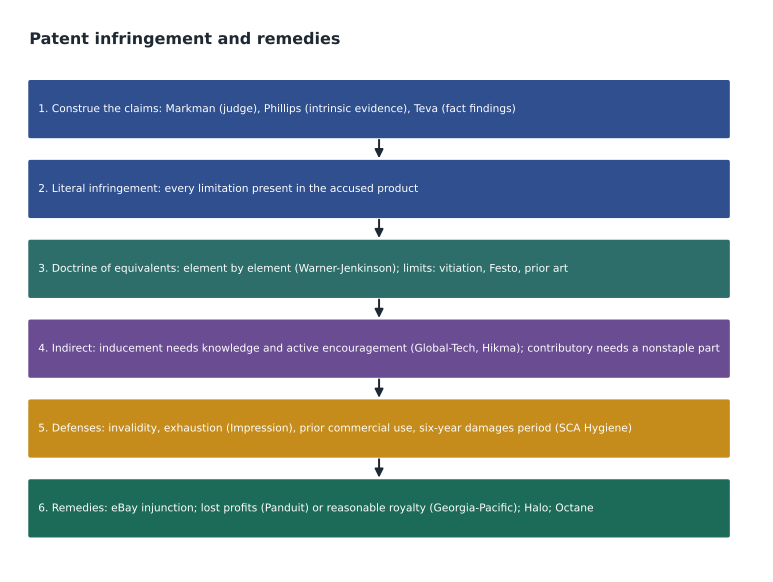
Infringement analysis has two steps: construe the claims, then compare the properly construed claims to the accused product or process. In Markman v. Westview Instruments (1996) the Supreme Court held that claim construction is for the judge, not the jury, and courts now hold Markman hearings early in litigation. Phillips v. AWH Corp. (2005) (en banc) instructs courts to give claim terms the ordinary meaning they would have to a person of ordinary skill reading the claims in the context of the specification and the prosecution history, the intrinsic evidence; dictionaries, treatises and expert testimony are extrinsic evidence of less weight. In Teva Pharmaceuticals v. Sandoz (2015) the Court held that subsidiary factual findings a district judge makes from extrinsic evidence in construing claims are reviewed for clear error, though the ultimate construction is reviewed de novo.
Direct infringement: literal and by equivalents
Under section 271(a), whoever without authority makes, uses, offers to sell or sells a patented invention within the United States, or imports it into the United States, infringes. Intent is irrelevant to direct infringement. Literal infringement requires that the accused product contain every limitation of the claim. HUSHRUN has an outer microphone, an inner microphone and a processor that estimates the fit of the ear canal and selects a profile. But it updates the filter every 25 milliseconds, which is forty times a second, and claim 1 requires at least fifty. It does not literally infringe claim 1.
The doctrine of equivalents allows a finding of infringement when an accused product, though outside the literal claims, contains an equivalent of every claim element. Warner-Jenkinson Co. v. Hilton Davis Chemical Co. (1997) held that equivalence is assessed element by element, not for the invention as a whole, and that the test is whether the differences are insubstantial, often asked as whether the substitute performs substantially the same function in substantially the same way to obtain substantially the same result. The doctrine has limits. It cannot be used to read an element out of the claim entirely, which courts describe as vitiation, and courts are reluctant to stretch a specific numerical limitation, because the patentee chose it. Prosecution history estoppel bars equivalents for subject matter surrendered by narrowing amendments: under Festo Corp. v. Shoketsu Kinzoku Kogyo Kabushiki Co. (2002), a narrowing amendment made for a reason related to patentability creates a presumption that the patentee surrendered all equivalents of the amended element, rebuttable if the equivalent was unforeseeable at the time of the amendment or the amendment's rationale was tangential to it. Breckwood's file history shows that Farrokhzad added the fifty-times-a-second limitation to overcome a prior art reference updating at ten times a second. Keswick will argue Festo bars any claim that forty is equivalent to fifty.
Claim 9 is a different matter. HUSHRUN's accelerometer, pressed against the ear canal wall to detect the vibration of the wearer's voice, is a bone-conduction sensor within the ordinary meaning of the term as the specification uses it, and the processor suppresses the wearer's own voice. Claim 9 has no update-rate limitation. If claim 9 is valid, HUSHRUN likely infringes it literally, which is why its exposure to the obviousness attack from the last lesson matters so much.
Indirect infringement
Section 271(b) makes liable anyone who actively induces infringement. Inducement requires knowledge of the patent and knowledge that the induced acts infringe. Global-Tech Appliances v. SEB (2011) held that willful blindness satisfies the knowledge requirement, and Commil USA v. Cisco Systems (2015) held that a good-faith belief that the patent is invalid is not a defense. In Hikma Pharmaceuticals v. Amarin Pharma (2026) a unanimous Court, in an opinion by Justice Jackson, reversed the Federal Circuit and held that a complaint against a generic drug maker failed to plead inducement plausibly. The generic's label carved out the patented use, and its statements that its product was the generic equivalent of the brand drug, together with its failure to tell doctors not to prescribe it for the patented use, had an obvious innocent explanation; the inquiry is what the defendant itself actively communicated, not how others might read it. Implicit encouragement can still suffice if it is clear and affirmative.
Section 271(c) makes liable anyone who sells a component of a patented invention, or a material for use in a patented process, knowing it to be especially made or adapted for use in an infringement and not a staple article of commerce suitable for substantial noninfringing use. Direct infringement by someone is a prerequisite for both forms of indirect liability. When steps of a method are performed by different actors, the Federal Circuit holds one party liable for direct infringement only if it directs or controls the others' performance or they form a joint enterprise, under Akamai Technologies v. Limelight Networks (2015) (en banc), decided after the Supreme Court in Limelight (2014) held that there can be no inducement without a single direct infringer.
Patent law is territorial, but the statute reaches some foreign conduct. Importing an infringing product into the United States is itself infringement. Section 271(f) makes it infringement to supply from the United States components of a patented invention for combination abroad, and in WesternGeco v. ION Geophysical (2018) the Court allowed recovery of foreign lost profits caused by a section 271(f) infringement. Breckwood's contract manufacturer, Lumenreach Manufacturing in Penang, Malaysia, has been selling overrun HUSHWREN units in Europe. Breckwood's United States patent does not reach those sales, but any units shipped into the United States infringe when imported.
Defenses
The most common defenses are noninfringement and invalidity. Others matter in particular cases. Under the exhaustion doctrine, an authorized sale of a patented item ends the patent owner's rights in that item; Impression Products v. Lexmark International (2017) held that post-sale restrictions cannot be enforced through patent law and that a sale abroad exhausts United States patent rights too, while Bowman v. Monsanto (2013) held that exhaustion does not permit a buyer of patented seeds to make new copies by planting them. A statutory prior commercial use defense in section 273 protects a party that used the invention commercially in the United States at least a year before the patent's effective filing date. The common-law experimental use exception is very narrow; Madey v. Duke University (2002) held it unavailable for research that furthers the user's legitimate business, even a university's. Damages are limited to infringement in the six years before suit under section 286, but laches is not a defense to damages within that period, under SCA Hygiene Products v. First Quality Baby Products (2017). And a patentee who sells patented products without marking them with the patent number, physically or virtually, can recover damages only from actual notice under section 287.
Remedies
Section 283 authorizes injunctions in accordance with the principles of equity. In eBay Inc. v. MercExchange (2006) the Court rejected the Federal Circuit's general rule that a permanent injunction issues once infringement is found, and required the traditional four-factor showing: irreparable injury, inadequacy of damages, a balance of hardships favoring the plaintiff and no disservice to the public interest. Patent owners that practice their inventions and compete directly with the infringer, like Breckwood, obtain injunctions far more often than licensing entities that do not make products.
Section 284 requires damages adequate to compensate for the infringement, but in no event less than a reasonable royalty. A patentee that would have made the infringer's sales may recover lost profits by proving demand for the patented product, the absence of acceptable noninfringing substitutes, the capacity to meet the demand and the amount of profit it would have made, the factors from Panduit Corp. v. Stahlin Bros. (1978). Otherwise courts award a reasonable royalty, typically by reconstructing a hypothetical negotiation between a willing licensor and licensee on the eve of infringement, guided by the fifteen Georgia-Pacific factors. Damages experts often rely on licenses the patentee has granted to others, and in EcoFactor v. Google (2025) the en banc Federal Circuit ordered a new damages trial because the district court had allowed an expert to testify that comparable licenses reflected a per-unit royalty rate the licenses themselves did not support, stressing the trial judge's gatekeeping duty under Federal Rule of Evidence 702.
A court may enhance damages up to three times. Halo Electronics v. Pulse Electronics (2016) rejected a rigid test and held that enhancement is reserved for egregious cases of culpable behavior, typically willful infringement, in the district court's discretion. Under section 285 a court may award attorney fees in exceptional cases; Octane Fitness v. ICON Health and Fitness (2014) defined an exceptional case as one that stands out from others in the strength of a party's position or the unreasonable manner in which it was litigated. A patent owner can also go to the International Trade Commission, which can order infringing imports excluded at the border but cannot award damages; eBay does not apply to exclusion orders.
Worked problem
Breckwood's case against Keswick
Breckwood sued Keswick in the United States District Court for the District of Westmarch on October 5, 2026, alleging infringement of claims 1 and 9 and seeking a preliminary injunction. Advise Breckwood on (a) claim 1, (b) claim 9, (c) Keswick's likely response at the Patent Office, and (d) remedies, including whether Lumenreach's European sales can be reached.
Show solution
- Claim 1: no literal infringement, because HUSHRUN updates forty times a second and the claim requires at least fifty. The doctrine of equivalents faces Festo: the limitation was added to overcome prior art, creating a presumption of surrender that Breckwood must rebut. A numeric limitation chosen to avoid prior art is hard to stretch.
- Claim 9: the accelerometer is a bone-conduction sensor as the specification uses the term, so literal infringement is likely. The fight will be validity under section 103.
- Patent Office: Keswick must file any IPR petition within one year after service of the complaint, so by early October 2027, raising obviousness over the expo slides and its own 2023 application. Under the November 2026 memorandum, the Director first considers discretionary denial (for example, because a trial date is near), then a panel decides the merits.
- Remedies: as a direct competitor practicing its patent, Breckwood has a credible case for irreparable harm under eBay, though a preliminary injunction also requires a likelihood of success, which the obviousness attack undercuts. Damages could be lost profits if Breckwood can satisfy Panduit, or a reasonable royalty. Willfulness requires more than knowledge of the patent; Keswick's continued sales after suit with no reasonable defense could support enhancement under Halo.
- Lumenreach: United States patents do not reach sales in Europe; Breckwood needs foreign patents or its contract to address those. Overrun units imported into the United States infringe on importation, and the ITC could exclude them.
Answer: Claim 9 is the claim to litigate; claim 1 is weakened by Festo. Expect an IPR on claim 9 and plan the litigation schedule around it. Breckwood's status as a practicing competitor is its best asset on remedies.
Common mistakes
MistakeApplying the doctrine of equivalents to the invention as a whole.
InsteadWarner-Jenkinson requires an element-by-element comparison; every limitation must be met literally or by an equivalent.
MistakeIgnoring the file history when arguing equivalents.
InsteadNarrowing amendments made to secure the patent presumptively surrender equivalents under Festo.
MistakeAssuming an injunction follows automatically from infringement.
InsteadeBay requires the four-factor equitable test in every case.
MistakeTreating knowledge of the patent alone as proof of inducement.
InsteadInducement requires active encouragement of infringement by the defendant itself; Hikma (2026) rejects inferring it from neutral statements or failures to disclaim.
MistakeThinking a co-owner needs the other owners' consent to license a patent.
InsteadUnder section 262 each co-owner may exploit and license the patent without consent or accounting.
Summary and key terms
- Prosecution: provisional and nonprovisional applications, publication at about 18 months, office actions, continuations; term 20 years from filing with maintenance fees.
- Inequitable conduct requires but-for materiality and specific intent to deceive (Therasense).
- Inventors own their inventions unless they assign in writing (section 261; Stanford v. Roche); co-owners may exploit without accounting (section 262).
- IPR covers novelty and obviousness over patents and printed publications on a preponderance standard; petitions are due within a year of service; Oil States and Arthrex shape the system; institution practice changed again in November 2026.
- Claim construction is for the judge (Markman), based mainly on intrinsic evidence (Phillips), with deference to subsidiary fact-finding (Teva).
- Infringement is literal or by equivalents element by element (Warner-Jenkinson), limited by vitiation and prosecution history estoppel (Festo).
- Inducement requires knowledge and active encouragement (Global-Tech, Commil, Hikma); contributory infringement requires a nonstaple component.
- Exhaustion after an authorized sale anywhere (Impression Products); six-year damages period without laches (SCA Hygiene); marking.
- Remedies: eBay injunctions, lost profits (Panduit) or reasonable royalty (Georgia-Pacific; EcoFactor on expert gatekeeping), enhanced damages (Halo), fees (Octane), ITC exclusion orders.
- Prosecution history estoppel
- The rule that a patentee cannot recapture through equivalents subject matter surrendered during prosecution.
- Doctrine of equivalents
- Infringement by a product that contains, for each claim element, an equivalent with only insubstantial differences.
- Inter partes review
- A Patent Trial and Appeal Board trial on novelty and obviousness grounds based on prior patents and printed publications.
- Exhaustion
- The rule that an authorized sale ends the patent owner's rights to control the use and resale of the item sold.
- Reasonable royalty
- The minimum damages award, usually based on a hypothetical negotiation on the eve of infringement.
- Willfulness
- Deliberate or intentional infringement that may support enhanced damages under Halo.
- Markman hearing
- A pretrial proceeding in which the judge construes disputed claim terms.
Practice problems
Work each problem on paper first, then reveal the answer to check.
A claim requires a fastener made of steel. The accused product uses a titanium fastener that performs the same function in the same way with the same result. During prosecution the patentee never amended the steel limitation. What doctrine might apply?
Show answer
The doctrine of equivalents, element by element; with no narrowing amendment, Festo's presumption does not arise, though the defendant may argue the claim's specific choice of steel or prior art limits the range of equivalents.
A company buys a patented printer cartridge abroad from the patentee, refills it and sells it in the United States. Can the patentee sue for infringement?
Show answer
Not for the authorized sale's item: Impression Products holds that an authorized sale abroad exhausts United States patent rights, and refilling is repair rather than reconstruction.
A patent owner that does not make products asks for a permanent injunction against a large manufacturer after winning at trial. What test applies and what difficulty will it face?
Show answer
eBay's four-factor test; a nonpracticing owner usually has difficulty showing irreparable harm and inadequacy of money damages.
A defendant was served with an infringement complaint 14 months ago and now wants to file an IPR petition. Can it?
Show answer
Generally no; section 315(b) bars an IPR petition filed more than one year after service of a complaint alleging infringement, though ex parte reexamination remains available.
Lesson quiz · 5 questions
Score 60% or more to complete this lesson.
Create a free account to save your progress, take quizzes and earn a certificate.