
LAWU-312 · Lesson 6 of 12 · 24 min
Secondary liability, platforms and the DMCA
▶ Video coming soon A video version of this lesson is on the way.
By October 2026 Breckwood's head of brand, Ondrea Valcour, had found more than two hundred listings on Bazaarly, a fictional online marketplace, offering HUSHWREN earbuds at about a third of the retail price. Many of the listings used Ilsabet Corrado's river-stone photograph and Breckwood's own product descriptions. Some sold counterfeits made in unknown factories; a few sold genuine overrun units from Lumenreach Manufacturing that had been diverted from Europe. The sellers had names like BestBudsDirect and were based, as far as anyone could tell, in several countries. Valcour asks the question every brand owner asks: why can't we just sue Bazaarly? Ivensen uses the question to introduce the law of secondary liability, the statutory safe harbors that shape the internet, and the Supreme Court's March 2026 decision in Cox Communications v. Sony Music Entertainment.
Why secondary liability matters
Copyright and trademark statutes impose liability on direct infringers: the person who makes the copy or sells the counterfeit. But direct infringers are often numerous, small, anonymous, judgment-proof or abroad, while the businesses that make their infringement possible are few, large and reachable. Secondary liability doctrines decide when those businesses, such as landlords, swap meet operators, equipment makers, internet service providers and platforms, must answer for the infringement of others. The doctrines matter enormously, because they determine who has to police infringement and who bears the cost when no one does. The Copyright Act says nothing explicit about secondary liability; the doctrines come from the common law of torts and from the Supreme Court's reading of the statute.
Copyright: vicarious and contributory liability
Courts have long recognized two forms of secondary copyright liability. Vicarious liability, an outgrowth of respondeat superior, applies to a defendant who has the right and ability to supervise the infringing activity and a direct financial interest in it. In Shapiro, Bernstein and Co. v. H. L. Green Co. (2d Cir. 1963) a department store that leased space to a concessionaire selling bootleg records and took a percentage of its sales was vicariously liable. In Fonovisa v. Cherry Auction (9th Cir. 1996) a swap meet operator that controlled access to its premises, could expel vendors and profited from admission and parking fees was vicariously liable for vendors' sales of counterfeit recordings. Knowledge is not required for vicarious liability.
Contributory liability, rooted in aiding and abetting, has traditionally applied to a defendant who, with knowledge of the infringing activity, induces, causes or materially contributes to it, in the formulation of Gershwin Publishing v. Columbia Artists Management (2d Cir. 1971). The Supreme Court qualified the doctrine in Sony Corp. of America v. Universal City Studios (1984), borrowing the staple article of commerce doctrine from patent law: selling a product capable of substantial noninfringing uses does not make the seller contributorily liable merely because some buyers use it to infringe. In MGM Studios v. Grokster (2005) the Court held that one who distributes a device with the object of promoting its use to infringe copyright, as shown by clear expression or other affirmative steps taken to foster infringement, is liable for the resulting acts of infringement by third parties. Grokster and StreamCast had marketed their peer-to-peer software to former users of Napster, a service the Ninth Circuit had found contributorily and vicariously liable in A&M Records v. Napster (2001), and had built their business models around the volume of infringing use.
Cox Communications v. Sony Music Entertainment (2026)
Cox is one of the largest internet service providers in the United States. Record companies and music publishers sued it for the infringement of its subscribers, who used peer-to-peer software to share music. The plaintiffs relied on hundreds of thousands of notices, sent by an antipiracy vendor, identifying the internet protocol addresses of subscribers allegedly sharing files, and on evidence that Cox rarely terminated the accounts of repeat infringers. In 2019 a jury found Cox liable for willful contributory and vicarious infringement of more than 10,000 works and awarded one billion dollars in statutory damages. The Fourth Circuit in 2024 reversed the vicarious liability verdict, because Cox's monthly subscription fees did not rise or fall with infringement, but upheld contributory liability on the theory that Cox knew of specific infringing subscribers and continued to provide them service, and ordered a new trial on damages.
On March 25, 2026 the Supreme Court vacated the Fourth Circuit's judgment. Writing for the Court, Justice Thomas held that a service provider is contributorily liable for its users' infringement only if it intended that its service be used for infringement, and that such intent can be shown only if the provider induced the infringement or provided a service tailored to infringement. Knowing that some subscribers infringe and continuing to serve them is not enough; general internet access is a service capable of substantial lawful use, and providing it to the public, without more, is not culpable participation in infringement. The Court remanded for further proceedings. Justice Sotomayor, joined by Justice Jackson, concurred only in the judgment. In her view the evidence did not show the culpable intent needed for aiding and abetting, but the majority unnecessarily narrowed secondary liability, ignored other aiding-and-abetting theories that may apply in copyright cases, and undermined the incentives Congress built into the safe harbors of the Digital Millennium Copyright Act.
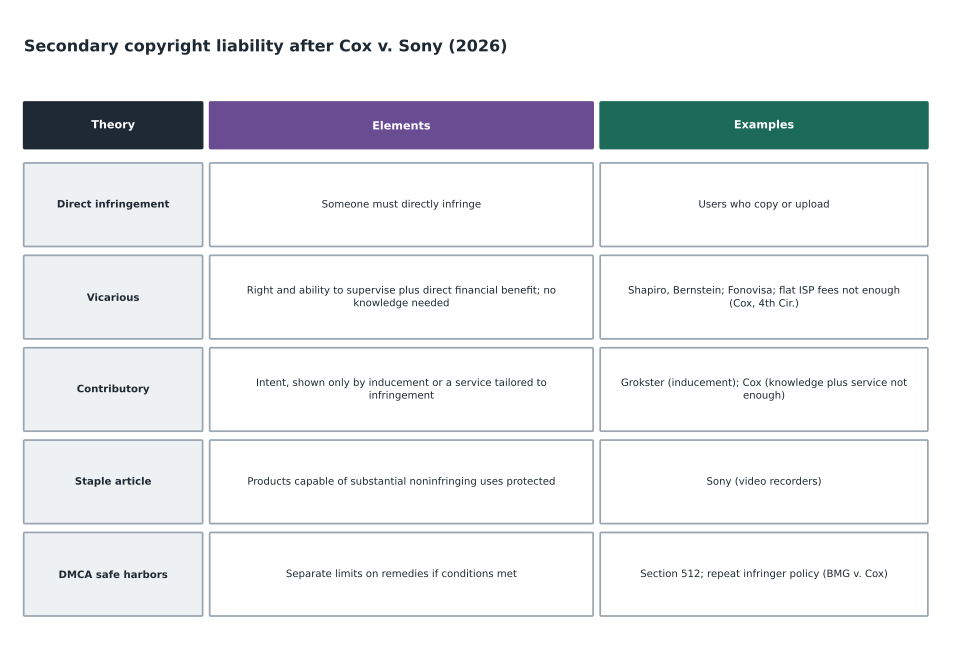
Ivensen asks what Cox means for Bazaarly. Daniel Reyes, the former paralegal, reads the holding aloud and says it sounds like a platform is safe unless it is built for piracy. Ivensen says that is the most important practical effect: a general-purpose marketplace that does not encourage infringement and is not designed around it is unlikely to face contributory copyright liability for its sellers' copying of photographs, even if it knows about specific listings. Vicarious liability remains, and a marketplace that takes a percentage of each sale and controls its sellers through its terms of service looks more like the department store in Shapiro, Bernstein than Cox did. Courts will have to decide whether a commission on sales of infringing goods is a direct financial benefit from the infringement. And the case leaves open how courts will treat services in between, such as file lockers, and how it will apply to generative AI services, a question the class will take up later.
The DMCA safe harbors
Congress addressed online service provider liability in 1998 in Title II of the Digital Millennium Copyright Act, the Online Copyright Infringement Liability Limitation Act, codified at section 512. The statute does not define when a service provider is liable; it creates safe harbors that limit monetary relief, and most injunctive relief, for providers that meet their conditions. There are four: for transitory digital network communications by conduits like internet access providers (section 512(a)); for system caching (512(b)); for information residing on systems or networks at the direction of users, which covers hosting platforms like video sites and marketplaces (512(c)); and for information location tools such as search engines and links (512(d)).
All the safe harbors require that the provider adopt and reasonably implement a policy providing for termination, in appropriate circumstances, of subscribers and account holders who are repeat infringers, and that it accommodate standard technical measures (section 512(i)). Cox had lost its safe harbor in earlier litigation for exactly this reason: in BMG Rights Management v. Cox Communications (4th Cir. 2018) the court held that Cox had not reasonably implemented a repeat infringer policy. The hosting safe harbor of section 512(c) has further conditions. The provider must not have actual knowledge that material on its system is infringing, or awareness of facts or circumstances from which infringing activity is apparent, sometimes called red flag knowledge; upon obtaining such knowledge or receiving a proper notice, it must act expeditiously to remove or disable access to the material; it must not receive a financial benefit directly attributable to the infringing activity where it has the right and ability to control the activity; and it must designate an agent to receive notices, registered with the Copyright Office.
The Second Circuit held in Viacom International v. YouTube (2012) that both actual and red flag knowledge refer to knowledge of specific infringing activity, not general awareness that a platform hosts infringing material, though willful blindness can supply knowledge. The safe harbors also require no monitoring: section 512(m) provides that eligibility does not depend on a provider's monitoring its service or affirmatively seeking facts indicating infringement. The result is the notice-and-takedown system that governs most of the internet.
A takedown notice must be a written communication to the designated agent that identifies the copyrighted work, identifies the infringing material with information reasonably sufficient to locate it, and includes contact information, a statement of good-faith belief that the use is not authorized by the owner, its agent or the law, and a statement, under penalty of perjury, that the complaining party is authorized to act. A user whose material is removed may file a counter-notice; the provider must then restore the material in ten to fourteen business days unless the complainant files suit. Section 512(f) makes liable anyone who knowingly materially misrepresents that material is infringing, or that it was removed by mistake. In Lenz v. Universal Music (9th Cir. 2015) the court held that a copyright owner must consider fair use before sending a takedown notice, in a case involving a home video of a toddler dancing to a Prince song.
For Breckwood, the photograph raises a practical problem it met in the last lesson. Only the owner of the copyright, or someone authorized to act for her, may send a notice, so Breckwood needs Corrado's authorization, which it can get more easily than a full assignment. Breckwood's own product descriptions, written by employees, are its works made for hire, and it can send notices for listings that copy them. Bazaarly will remove the listings when notified and keep its safe harbor if it meets the other conditions, but new listings will appear the next day.
Anticircumvention
Title I of the DMCA added a different kind of protection. Section 1201 prohibits circumventing a technological measure that effectively controls access to a copyrighted work, and trafficking in devices or services designed to circumvent access controls or measures that protect the exclusive rights. These are not infringement claims, and fair use is not a defense to them. Every three years the Librarian of Congress, on the recommendation of the Register of Copyrights, adopts temporary exemptions, which have covered activities such as unlocking phones, repairing devices and good-faith security research. The circuits disagree about whether section 1201 requires a link to infringement: the Federal Circuit in Chamberlain Group v. Skylink Technologies (2004) required a nexus between the circumvention and infringement, while the Ninth Circuit in MDY Industries v. Blizzard Entertainment (2010) rejected that requirement for access controls. Section 1202 separately protects copyright management information, such as names and terms embedded in a work, against knowing removal or falsification that facilitates infringement.
Breckwood's earbud firmware is encrypted and signed, so that only Breckwood's updates will run. A hobbyist who breaks the encryption to load custom noise-cancellation code would circumvent an access control even if he never copied Breckwood's code for distribution. Whether he could claim an exemption depends on the current triennial rulemaking, which has granted exemptions for diagnosing, maintaining and repairing many lawfully acquired devices.
Section 230 and intellectual property
Section 230 of the Communications Decency Act generally protects online services from liability as publishers of content provided by others. But section 230(e)(2) provides that nothing in it shall be construed to limit or expand any law pertaining to intellectual property. Federal copyright and trademark claims against platforms are therefore governed by the doctrines in this lesson, not by section 230. The circuits are divided on whether state-law intellectual property claims, such as right of publicity claims, fall within the exception: the Ninth Circuit in Perfect 10 v. CCBill (2007) read it to cover only federal intellectual property, while the Third Circuit in Hepp v. Facebook (2021) held that a state right of publicity claim was not barred by section 230.
Trademark: secondary liability and counterfeits
Trademark law has its own secondary liability standards. In Inwood Laboratories v. Ives Laboratories (1982) the Court held that a manufacturer or distributor is contributorily liable if it intentionally induces another to infringe a trademark, or if it continues to supply its product to one whom it knows or has reason to know is engaging in trademark infringement. Courts have extended the standard to landlords and online marketplaces that exercise direct control and monitoring over the means of infringement. In Tiffany v. eBay (2d Cir. 2010) the court held that eBay was not contributorily liable for counterfeit Tiffany jewelry sold by its users, because generalized knowledge that some listings were counterfeit was not enough; eBay needed contemporary knowledge of which particular listings were infringing, and it promptly removed listings when Tiffany reported them. There is no statutory notice-and-takedown safe harbor for trademark claims, but marketplaces that respond quickly to specific reports, as eBay did, are rarely held liable.
Counterfeiting, the use of a spurious mark identical with or substantially indistinguishable from a registered mark on the same goods, carries special remedies under the Lanham Act: ex parte seizure orders under section 1116(d), mandatory treble damages or profits and attorney fees for intentional use absent extenuating circumstances, and statutory damages under section 1117(c) of 1,000 to 200,000 dollars per counterfeit mark per type of goods, up to 2,000,000 dollars if willful. Brand owners frequently file a single suit against hundreds of anonymous online sellers, obtain temporary restraining orders freezing the sellers' marketplace accounts, and serve them by email. These mass suits, often called Schedule A cases after the sealed schedule listing the defendants, have become routine in the Northern District of Illinois, though some judges have pushed back on joinder and the breadth of asset freezes. The INFORM Consumers Act, effective in 2023, requires online marketplaces to collect and verify identity and contact information from high-volume third-party sellers, which makes them easier to find.
Worked problem
Advising Breckwood on the Bazaarly listings
Valcour wants to sue Bazaarly for contributory copyright infringement (for the copied photograph and descriptions) and contributory trademark infringement (for the counterfeits), and to get the listings down quickly. Breckwood sent Bazaarly a spreadsheet in October 2026 listing 212 specific listings; Bazaarly removed most of them within three days. Bazaarly takes a 12 percent commission on every sale. Advise Breckwood.
Show solution
- Contributory copyright: under Cox, Bazaarly is liable only if it induced the copying or offers a service tailored to infringement. A general marketplace that removes listings on notice does neither.
- Vicarious copyright: Bazaarly has the right and ability to control sellers through its terms, and its commission rises with sales of infringing listings, arguably a direct financial benefit, a closer question than in Cox. But section 512(c) will likely shield it if it designated an agent, implements a repeat infringer policy and removed listings expeditiously on notice.
- Contributory trademark: under Inwood and Tiffany v. eBay, Bazaarly is liable only if it continued to supply its service to sellers it knew or had reason to know were infringing; it removed the listings when told, so the claim is weak, though Breckwood can push Bazaarly to suspend repeat sellers.
- Practical path: obtain Corrado's authorization and send DMCA notices for photographs and descriptions; use Bazaarly's brand registry; file a counterfeiting suit against the sellers, seeking a TRO freezing their accounts and statutory damages under section 1117(c); record the HUSHWREN registration with Customs to stop counterfeit imports.
Answer: Suing Bazaarly is unlikely to succeed and may not be needed. The law places the burden of identifying specific infringement on the rights holder, and rewards platforms that respond. Breckwood's real targets are the sellers, reached through notices, account freezes and counterfeiting remedies.
Common mistakes
MistakeTreating knowledge of infringing users as enough for contributory copyright liability after 2026.
InsteadCox v. Sony requires intent shown by inducement or a service tailored to infringement; knowledge and failure to terminate are not enough.
MistakeConfusing the DMCA safe harbors with liability rules.
InsteadSection 512 limits remedies for providers that meet its conditions; liability itself is decided under the common-law doctrines.
MistakeForgetting the repeat infringer requirement.
InsteadEvery safe harbor requires a reasonably implemented repeat infringer policy; Cox lost safe harbor protection in BMG v. Cox for failing it.
MistakeInvoking section 230 against a federal copyright or trademark claim.
InsteadSection 230(e)(2) leaves intellectual property law unaffected; circuits split only over state IP claims.
MistakeSending takedown notices for every use of a work.
InsteadLenz requires considering fair use first, and section 512(f) penalizes knowing material misrepresentations.
Summary and key terms
- Vicarious liability requires the right and ability to supervise plus a direct financial benefit (Shapiro, Bernstein; Fonovisa).
- Contributory copyright liability after Cox v. Sony (March 25, 2026, Thomas, J.): intent shown only by inducement (Grokster) or a service tailored to infringement; knowledge plus continued service is not enough; Sony protects products capable of substantial noninfringing uses.
- DMCA section 512 safe harbors cover conduits, caching, hosting and location tools, conditioned on a repeat infringer policy and, for hosting, no specific or red flag knowledge, expeditious removal and a designated agent (Viacom v. YouTube; BMG v. Cox).
- Takedown and counter-notice procedures, section 512(f) misrepresentation liability and the Lenz fair use consideration.
- Section 1201 bans circumvention of access controls and trafficking in circumvention tools, with triennial exemptions; circuits split on a nexus to infringement.
- Section 230 does not apply to federal IP claims.
- Contributory trademark liability requires intentional inducement or continued supply with knowledge of specific infringement (Inwood; Tiffany v. eBay); counterfeiting carries seizure, treble and statutory damages.
- Vicarious liability
- Liability for another's infringement based on the right and ability to supervise and a direct financial benefit.
- Contributory liability
- Liability for culpably participating in another's infringement; in copyright, now requiring intent shown by inducement or tailoring.
- Inducement
- Distributing a product or service with the object of promoting its use to infringe, shown by clear expression or affirmative steps.
- Safe harbor
- A statutory limit on remedies for service providers that meet specified conditions.
- Red flag knowledge
- Awareness of facts or circumstances from which specific infringing activity is apparent.
- Repeat infringer policy
- A policy, reasonably implemented, for terminating users who repeatedly infringe.
- Counterfeit
- A spurious mark identical with or substantially indistinguishable from a registered mark, used on the same goods.
Practice problems
Work each problem on paper first, then reveal the answer to check.
A cloud storage service markets itself as the best place to share new movie releases and pays uploaders for popular files. Is it liable after Cox?
Show answer
Likely yes. Marketing to infringers and paying for popular uploads show inducement under Grokster and a service tailored to infringement, satisfying Cox's intent requirement.
A video platform receives a notice identifying a specific infringing clip and removes it two months later. Does it keep the section 512(c) safe harbor?
Show answer
Probably not for that clip; the provider must act expeditiously after notice, and a two-month delay is unlikely to qualify.
A musician receives a takedown of her video, which uses ten seconds of a song in a critique. What can she do?
Show answer
Send a counter-notice stating a good-faith belief that removal was mistaken; the platform must restore it in 10 to 14 business days unless the owner sues. If the owner ignored fair use, she may have a section 512(f) claim under Lenz.
A landlord rents a stall to a vendor and receives a letter identifying specific counterfeit handbags the vendor sells, but renews the lease. Liability?
Show answer
Contributory trademark liability under Inwood is plausible because the landlord continued to supply its premises with knowledge of specific infringement.
Lesson quiz · 5 questions
Score 60% or more to complete this lesson.
Create a free account to save your progress, take quizzes and earn a certificate.