
LAWU-312 · Lesson 2 of 12 · 25 min
Patents
▶ Video coming soon A video version of this lesson is on the way.
Ivensen opens the second class by passing around copies of Breckwood's patent, which issued on September 15, 2026 after Breckwood paid for prioritized examination. On the first page are the title, the inventor (Kaveh Farrokhzad), the assignee (Breckwood Acoustics, Inc.), the filing dates and an abstract. Then come eleven pages of drawings and a long written description, and at the very end, on the last page and a half, twenty numbered claims. "Everything you have read so far," she tells Section B, "is context. The claims are the patent." Judge Giles Rich of the Federal Circuit's predecessor court liked to say that the name of the game is the claim, and modern patent law takes him at his word: the claims define what the patent owner can exclude others from doing, and every validity and infringement question is asked claim by claim.
Claim 1 recites a method of controlling noise cancellation in an earbud: receiving signals from an outer microphone and an inner microphone, estimating an acoustic transfer function of the wearer's ear canal from those signals, selecting filter coefficients from a stored set of ear-canal profiles based on the estimate, and applying the coefficients to an adaptive filter at least fifty times a second. Claim 9 is an apparatus claim to an earbud with an outer microphone, an inner microphone, a bone-conduction sensor and a processor programmed to perform the method while suppressing the wearer's own voice. Claims 2 through 8 depend from claim 1 and add limitations, such as a particular update rate. The word "comprising" after each preamble is a term of art meaning "including but not limited to": a product with additional features still infringes if it has everything the claim recites. A claim using "consisting of" is closed to additional elements.
The requirements for a patent
To be valid, a claimed invention must satisfy five statutory requirements. It must fall within patent-eligible subject matter under section 101 of the Patent Act. It must be useful, also under section 101. It must be novel under section 102. It must be nonobvious under section 103. And the specification must describe and enable the invention and the claims must be definite, under section 112. Examiners at the Patent and Trademark Office apply these requirements before a patent issues, and an accused infringer can challenge them again in court or before the Patent Trial and Appeal Board. In court an issued patent is presumed valid, and under Microsoft Corp. v. i4i (2011) invalidity must be proved by clear and convincing evidence.
Patent-eligible subject matter
Section 101 makes patentable any new and useful process, machine, manufacture or composition of matter, or any new and useful improvement of one. In Diamond v. Chakrabarty (1980) the Court held that a genetically engineered bacterium that could break down crude oil was a patentable manufacture or composition of matter, quoting legislative history saying that Congress intended patentable subject matter to include anything under the sun that is made by man. But the Court has long recognized three judicial exceptions: laws of nature, natural phenomena and abstract ideas. These are the basic tools of scientific and technological work, and the Court has said that monopolizing them would impede innovation more than it would promote it.
Applying the exceptions has proved difficult, especially for software and diagnostic methods. Gottschalk v. Benson (1972) held unpatentable a method of converting binary-coded decimal numbers to pure binary, because the claim would preempt a mathematical algorithm. Parker v. Flook (1978) rejected a method of updating an alarm limit in a catalytic conversion process where the only novel feature was a formula. Diamond v. Diehr (1981) upheld a method of curing synthetic rubber that used the Arrhenius equation to calculate when to open the press, because the claim as a whole applied the equation in an industrial process. Bilski v. Kappos (2010) held that a method of hedging risk in energy markets was an unpatentable abstract idea, and that the Federal Circuit's machine-or-transformation test, though a useful clue, is not the only test.
The modern framework comes from Mayo Collaborative Services v. Prometheus Laboratories (2012) and Alice Corp. v. CLS Bank International (2014). In Mayo the Court held unpatentable a method of administering a thiopurine drug, measuring the resulting metabolite levels and inferring whether to adjust the dose, because the claims recited a natural correlation plus well-understood, routine and conventional steps. In Association for Molecular Pathology v. Myriad Genetics (2013) the Court held that isolated naturally occurring DNA sequences of the BRCA1 and BRCA2 genes were products of nature and not eligible, while synthetic complementary DNA, which omits the noncoding portions, was eligible. In Alice the Court held that a computer-implemented method of mitigating settlement risk through an intermediary was an abstract idea, and that implementing it on a generic computer added nothing inventive.
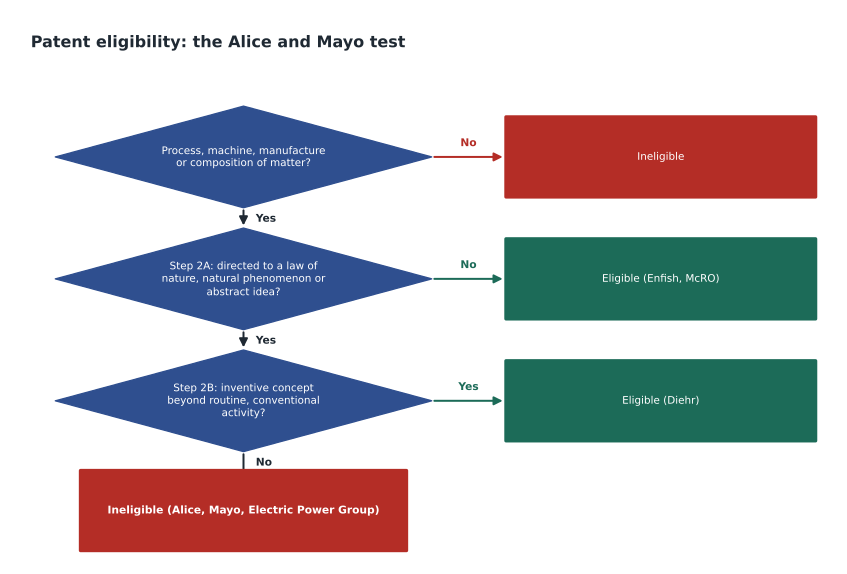
The Alice test has two steps. First, the court asks whether the claim is directed to a patent-ineligible concept. If it is not, the analysis ends and the claim is eligible. If it is, the court asks whether the claim's elements, considered individually and as an ordered combination, contain an inventive concept sufficient to transform the claim into a patent-eligible application. Simply instructing someone to apply an abstract idea on a computer, or adding conventional steps, is not enough. The Federal Circuit has applied the framework in hundreds of cases. It has upheld claims directed to specific improvements in computer functionality, such as the self-referential database table in Enfish v. Microsoft (2016) and the rules-based automation of animated lip synchronization in McRO v. Bandai Namco (2016). It has rejected claims directed to collecting, analyzing and displaying information, as in Electric Power Group v. Alstom (2016), and in American Axle v. Neapco (2019, modified 2020) it held that a method of manufacturing drive shafts was directed to the application of Hooke's law, a decision the Supreme Court declined to review.
Ivensen puts Breckwood's claim 1 on the screen and asks Marcus Webb to argue both sides. For Keswick Sound Systems, Breckwood's competitor, the claim is directed to the abstract idea of measuring something, comparing the measurement to stored data and choosing a setting: mental steps and mathematics performed on generic components. For Breckwood, the claim is directed to a specific technical improvement in how an earbud cancels noise, using particular signals from two microphones to estimate a physical property of the ear canal and to update a filter at a rate no human could match, much like the specific rules in McRO. Webb thinks claim 9, with its bone-conduction sensor and its specific hardware arrangement, is the safer claim on eligibility. Ivensen agrees, and adds that Congress has repeatedly considered bills to rewrite section 101 and abolish the judicial exceptions, but as of November 2026 none has been enacted.
Utility
An invention must also be useful. The bar is low for most mechanical and electrical inventions, but it has teeth in chemistry and biotechnology. In Brenner v. Manson (1966) the Court held that a process for making a steroid was not useful merely because the steroid was the subject of research, because a patent is not a hunting license; the invention must have a specific and substantial use in its current form. The Federal Circuit applied the same idea in In re Fisher (2005) to reject claims to gene fragments whose function was unknown. An invention useful only for illegal or immoral purposes was once held unpatentable, but that doctrine has largely disappeared.
Novelty and the America Invents Act
Novelty asks whether the invention was already known. The America Invents Act of 2011 changed the rules for applications with an effective filing date on or after March 16, 2013, moving the United States from a first-to-invent system to a first-inventor-to-file system. Under section 102(a)(1), a claimed invention is not novel if it was patented, described in a printed publication, in public use, on sale or otherwise available to the public before the effective filing date. Under section 102(a)(2), it is also anticipated by a United States patent or published application naming another inventor that was effectively filed earlier. Prior art is now worldwide: a public use in Malaysia counts as much as one in Westmarch.
Section 102(b)(1) creates a one-year grace period. A disclosure made one year or less before the effective filing date is not prior art if it was made by the inventor or by someone who obtained the subject matter from the inventor, and a third party's disclosure in that year is excluded if the inventor had already publicly disclosed the same subject matter. The grace period is personal and narrow. It protects inventors who publish or present their own work, but it does not protect them from independent third-party disclosures made before their own, and many foreign countries have no comparable grace period, so a disclosure that is harmless in the United States may destroy patent rights abroad.
The on-sale bar has generated its own case law. In Pfaff v. Wells Electronics (1998) the Court held that the bar applies when the invention is the subject of a commercial offer for sale and is ready for patenting, which can be shown by drawings sufficient to let a skilled person make it, even before a prototype exists. In Helsinn Healthcare v. Teva Pharmaceuticals (2019) the Court held that the AIA did not change the pre-AIA rule that a secret sale, one whose terms are confidential, can still trigger the bar. A printed publication need not be printed: the Federal Circuit held in In re Klopfenstein (2004) that a poster displayed for several days at a professional meeting, without restrictions on copying, was a printed publication.
Anticipation is strict. A single prior art reference must disclose every element of the claim, arranged as in the claim, either expressly or inherently, and must enable a skilled person to practice it. A reference that discloses an earbud with two microphones and an adaptive filter does not anticipate claim 1 if it says nothing about estimating the ear-canal transfer function or choosing among stored profiles. But a combination of references may still render the claim obvious, which is where most validity fights are won and lost.
Applying the timeline
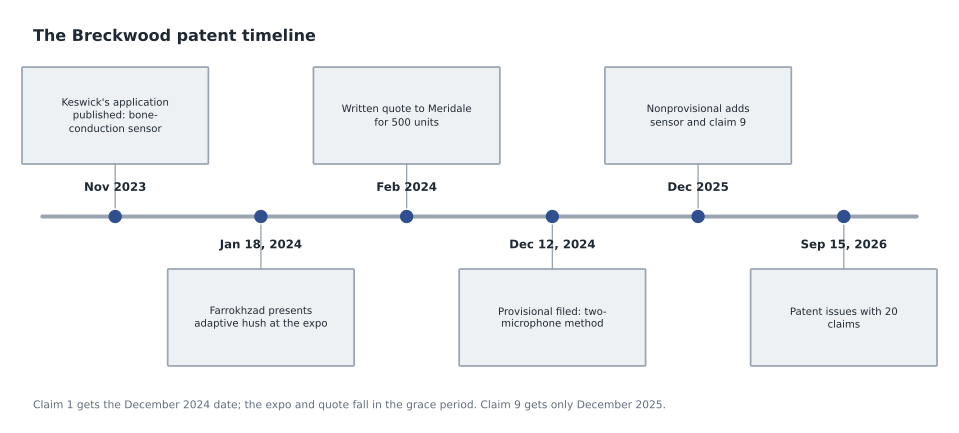
Ivensen walks through Breckwood's dates. On January 18, 2024, Farrokhzad presented adaptive hush on stage at the Prairie Hearing Technology Expo and the slides went online that afternoon. In February 2024 Breckwood sent a written quote offering 500 prototype units to Meridale Audiology Group. Breckwood filed a provisional application on December 12, 2024, describing the two-microphone method, and a nonprovisional application a year later that added the bone-conduction sensor and claim 9. Claim 1 is entitled to the provisional's December 12, 2024 date if the provisional describes and enables it, and both the expo presentation and the quote fall within the year before that date. They are Farrokhzad's own disclosures and are excluded under section 102(b)(1)(A). Claim 9 is different. Its subject matter first appeared in the December 2025 nonprovisional, so its effective filing date is December 2025, and the January 2024 expo slides are more than a year earlier. To the extent the slides disclosed the method recited in claim 9, they are prior art to it. So is Keswick's own patent application, published in November 2023, which shows a running earbud with a bone-conduction sensor used to pick up the wearer's voice.
Nonobviousness
Section 103 denies a patent if the differences between the claimed invention and the prior art are such that the invention as a whole would have been obvious, before the effective filing date, to a person having ordinary skill in the art. Graham v. John Deere sets out the inquiry: determine the scope and content of the prior art, ascertain the differences between the prior art and the claims, resolve the level of ordinary skill, and consider objective indicia, sometimes called secondary considerations, such as commercial success, long-felt but unsolved need, the failure of others and copying. Objective indicia matter only if there is a nexus between them and the claimed features.
KSR International v. Teleflex (2007) rejected the Federal Circuit's rigid requirement that the prior art supply an explicit teaching, suggestion or motivation to combine references. The combination of familiar elements according to known methods is likely to be obvious when it does no more than yield predictable results. A person of ordinary skill is a person of ordinary creativity, not an automaton, and when there is a design need and a finite number of identified, predictable solutions, an approach that is obvious to try may be obvious. KSR also warns against hindsight: the question is what was obvious before the invention, not after it has been explained. For claim 9, Keswick will argue that adding the bone-conduction sensor it had already disclosed to Breckwood's own published method was a predictable combination to suppress the wearer's voice. Breckwood will argue that the expo slides taught away from adding sensors and that HUSHWREN's commercial success flows from the claimed combination.
Disclosure: written description, enablement and definiteness
Section 112(a) requires that the specification contain a written description of the invention and enable a person skilled in the art to make and use it. The Federal Circuit held in Ariad Pharmaceuticals v. Eli Lilly (2010) (en banc) that written description is a separate requirement: the specification must show that the inventor actually possessed the claimed invention. Enablement asks whether a skilled person could practice the full scope of the claims without undue experimentation, a question courts often analyze with the factors from In re Wands (1988). In Amgen Inc. v. Sanofi (2023) the Court unanimously held that Amgen's claims to an entire genus of antibodies, defined by their function of binding to a protein and blocking it, were not enabled, because the specification disclosed only 26 examples and a trial-and-error roadmap for finding others among what might be millions of candidates. The more one claims, the more one must enable.
Section 112(b) requires claims that particularly point out and distinctly claim the invention. Nautilus v. Biosig Instruments (2014) held that a claim is indefinite if, read in light of the specification and prosecution history, it fails to inform skilled artisans about the scope of the invention with reasonable certainty, rejecting the Federal Circuit's more forgiving insolubly ambiguous standard. Claims written in means-plus-function form under section 112(f) are limited to the structures disclosed in the specification and their equivalents; a software claim using that form must disclose an algorithm. The best mode requirement survives in the statute, but since the AIA failure to disclose the best mode is no longer a ground for invalidating an issued patent.
Design patents follow parallel rules. Section 171 protects new, original and ornamental designs for an article of manufacture. In LKQ Corp. v. GM Global Technology Operations (2024) the en banc Federal Circuit overruled the rigid Rosen-Durling test for design patent obviousness and held that the Graham framework, adapted to designs, governs. Breckwood's design patent application on the pebble-shaped charging case, filed in 2025, is still pending.
Worked problem
Testing Breckwood's claims
Keswick's lawyers send Ottavio Pescatore a letter asserting that claims 1 and 9 of Breckwood's patent are invalid. Using the timeline, evaluate their arguments: (a) claim 1 is directed to an abstract idea; (b) the January 2024 expo presentation anticipates claim 1; (c) claim 9 is obvious over the expo slides combined with Keswick's November 2023 published application; (d) the specification's statement that the profiles may be selected by any suitable method makes claim 1 indefinite.
Show solution
- Eligibility: at Alice step one, compare claim 1 to McRO and Enfish on one side and Electric Power Group on the other. Breckwood should stress the specific signals, the physical quantity estimated and the filter update rate. If a court finds it abstract, step two asks whether the ordered combination adds more than conventional components.
- Anticipation by the expo: the presentation was Farrokhzad's own disclosure less than a year before the December 12, 2024 provisional, so it is excluded under section 102(b)(1)(A), provided the provisional supports claim 1 under section 112.
- Obviousness of claim 9: its effective filing date is December 2025, so the expo slides and Keswick's 2023 application are both prior art. Apply Graham and KSR: a skilled engineer seeking to suppress the wearer's voice had a known, predictable solution in the bone-conduction sensor. Breckwood must offer teaching away or objective indicia with a nexus to the claimed combination.
- Indefiniteness: the question under Nautilus is whether claim 1, read in light of the specification, tells skilled artisans its scope with reasonable certainty. Flexibility in how profiles are selected may broaden the claim, which raises enablement and eligibility questions, but breadth alone is not indefiniteness.
Answer: Claim 1's strongest attack is eligibility; its novelty survives because of the grace period. Claim 9 is concrete enough to clear section 101 easily but is exposed to obviousness because it is entitled only to the December 2025 date. The lesson for practice: file early, and put everything in the first application.
Common mistakes
MistakeAnalyzing a patent's validity as a whole.
InsteadValidity and infringement are decided claim by claim; one claim may be invalid while another survives.
MistakeTreating the AIA grace period as protection against any disclosure in the year before filing.
InsteadSection 102(b)(1) excludes the inventor's own disclosures and later third-party disclosures of subject matter the inventor already disclosed, not independent third-party disclosures made first.
MistakeAssuming that a claim gets the filing date of the earliest application in the family.
InsteadEach claim gets the date of the earliest application that describes and enables it under section 112.
MistakeRequiring an explicit teaching to combine references for obviousness.
InsteadKSR rejected a rigid teaching-suggestion-motivation test; predictable combinations of known elements are likely obvious.
MistakeThinking that a few working examples always enable a broad functional genus claim.
InsteadAmgen v. Sanofi requires enabling the full scope of what is claimed; a roadmap for trial and error is not enough for a vast functional genus.
Summary and key terms
- Claims define the invention; independent and dependent claims are analyzed separately, and comprising is open-ended.
- Section 101 covers processes, machines, manufactures and compositions of matter, but not laws of nature, natural phenomena or abstract ideas (Chakrabarty, Benson, Diehr, Bilski).
- Alice and Mayo: ask whether the claim is directed to an exception and, if so, whether it adds an inventive concept beyond the routine; Myriad separates isolated natural DNA from synthetic cDNA.
- Utility requires a specific and substantial use (Brenner v. Manson).
- Under the AIA, prior art is anything publicly available or earlier filed before the effective filing date, subject to a one-year grace period for the inventor's own disclosures; secret sales still count (Helsinn).
- Obviousness follows Graham and KSR, with objective indicia that have a nexus to the claims.
- Section 112 requires written description, enablement of the full scope (Amgen v. Sanofi) and claims definite with reasonable certainty (Nautilus).
- LKQ (2024) applies a Graham-type obviousness analysis to design patents.
- Claim
- A numbered sentence at the end of a patent defining the scope of the exclusive right.
- Effective filing date
- The filing date of the earliest application that supports a claim, which fixes what counts as prior art.
- Anticipation
- Lack of novelty because a single prior art reference discloses every element of a claim.
- Grace period
- The one-year window in section 102(b)(1) during which an inventor's own disclosures are not prior art.
- Person having ordinary skill in the art
- The hypothetical practitioner whose knowledge and creativity set the standard for obviousness and enablement.
- Objective indicia
- Evidence such as commercial success, long-felt need and copying that bears on obviousness.
- Enablement
- The requirement that the specification teach a skilled person to make and use the full scope of the claimed invention without undue experimentation.
Practice problems
Work each problem on paper first, then reveal the answer to check.
A researcher discovers that a certain gut bacterium's level predicts a patient's response to a drug and claims a method of measuring the bacterium and then administering the drug if the level is high. What is the main section 101 issue?
Show answer
Under Mayo, the claim may be directed to a natural correlation; the question is whether the measuring and administering steps add an inventive concept beyond routine, conventional activity.
An inventor publishes an article describing her invention on May 1, 2025 and files an application on April 15, 2026. A competitor independently published the same invention on March 1, 2025. Is the competitor's article prior art?
Show answer
Yes. The competitor's March 2025 disclosure came before the inventor's own public disclosure, so neither grace period exception applies, and it anticipates if it discloses every element.
A company secretly sells its new valve to a distributor under a confidentiality agreement eighteen months before filing. Does the sale matter?
Show answer
Yes. Under Helsinn, a confidential sale can trigger the on-sale bar; because it was more than a year before filing, the grace period does not help.
A patent claims every antibody that binds a particular site on a protein and blocks its function, disclosing 20 examples. What is the vulnerability?
Show answer
Enablement under Amgen v. Sanofi: the claims cover a vast functional genus, and the specification may not enable its full scope without undue experimentation.
Lesson quiz · 5 questions
Score 60% or more to complete this lesson.
Create a free account to save your progress, take quizzes and earn a certificate.