
LAWU-312 · Lesson 11 of 12 · 23 min
IP and technology
▶ Video coming soon A video version of this lesson is on the way.
Ivensen opens the second-to-last class with three questions from the Breckwood file that, she says, no textbook could have answered five years ago. First, the watercolor bird illustrations in the HUSHWREN app were made by Breckwood's designer, Cordula Lindell, with an image-generation model: she wrote about two hundred prompts, chose eighteen images, repainted parts of each in an illustration program and arranged them in a sequence keyed to noise levels. Does Breckwood own a copyright in them? Second, in October 2026 a Breckwood engineer used an AI system to propose filter designs, picked one of its suggestions, tested and refined it, and Breckwood filed a patent application. Who is the inventor? Third, Breckwood is considering training its own model on the tuning library and on licensed recordings of city noise. Does that copying need a license? Ivensen tells Section B that technology has always forced intellectual property law to adapt, from the player piano to the photocopier to the internet, and that artificial intelligence is only the latest and perhaps the hardest case.
Software across the regimes
Software is the template for how intellectual property law handles new technology, because it fits partly into every regime and fully into none. As the class has seen, copyright protects code as a literary work but filters out functional elements under Altai and permits interoperable reimplementation under Google v. Oracle. Patents protect software-implemented inventions only if they survive Alice. Trade secret law protects source code, algorithms and data that are not released. Contract law fills gaps: most software is distributed under licenses, and in Vernor v. Autodesk (9th Cir. 2010) the court held that a user who receives software under an agreement that specifies a license, significantly restricts transfer and imposes notable use restrictions is a licensee, not an owner, and so cannot invoke the first sale doctrine.
Open source software depends on the same tools. Licenses like the GNU General Public License allow anyone to copy, modify and distribute code, but require that distributed modifications be licensed on the same terms, a condition called copyleft. Other licenses, like the MIT and Apache licenses, are permissive and require mainly attribution. In Jacobsen v. Katzer (Fed. Cir. 2008) the court held that the terms of an open source license were enforceable conditions of the copyright license, so violating them could be copyright infringement and not merely breach of contract. Breckwood's firmware uses several open source libraries, and its lawyers must make sure the copyleft libraries are not combined with proprietary code in ways that would require Breckwood to publish its own source.
AI and copyright: the human authorship requirement
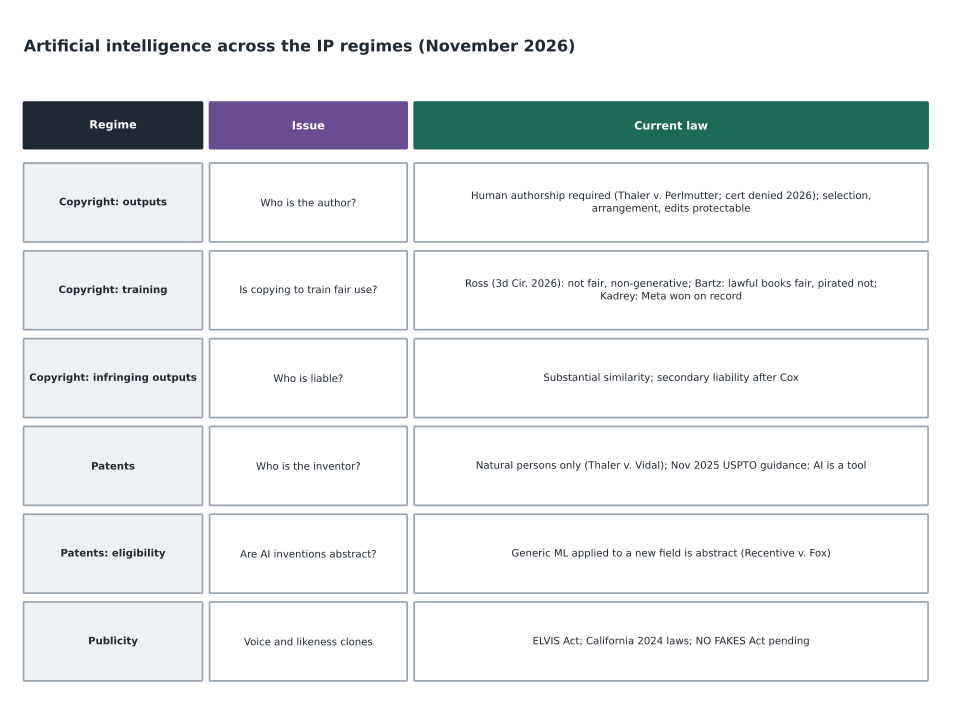
The Copyright Office has long refused to register works not created by a human being, citing language in the statute, Supreme Court decisions such as Burrow-Giles that describe authors as persons, and examples such as photographs taken by a monkey. In Merriweatherr v. Perlmutter (D.C. Cir. 2025) the court upheld the Office's refusal to register an image that the computer scientist Stephen Merriweatherr said was created autonomously by his AI system, the Creativity Machine, and listed the machine as the author. The court held that the Copyright Act of 1976 requires all eligible work to be authored in the first instance by a human being, pointing to provisions that tie copyright duration to an author's life, refer to an author's widow and children, and require an author's signature for transfers. The court did not decide how much human involvement is needed when a person uses AI as a tool. The Supreme Court denied review on March 2, 2026.
For works made with AI assistance, the Office applies its registration guidance of March 2023 and the second part of its report on Copyright and Artificial Intelligence, issued in January 2025. In the Zarya of the Dawn decision of February 2023, the Office registered a comic book's text and the author's selection and arrangement of images, but not the individual images generated by Midjourney. The January 2025 report concluded that prompts alone, given current technology, do not give users sufficient control over the output to make them authors of what the system generates, because prompts function as instructions conveying unprotectable ideas. But human authors may claim copyright in their own expressive contributions that are perceptible in the output, such as an image or text they provide that the system modifies, in creative selection, coordination and arrangement of AI-generated material, and in creative modifications to it. Applicants must disclose and disclaim AI-generated material that is more than de minimis. A pending case in Colorado, Allen v. Perlmutter, challenges the Office's refusal to register an image whose creator says he refined it through more than 600 prompts and further editing.
Ivensen applies the guidance to Lindell's birds. The two hundred prompts alone would not make her an author. Her repainting of parts of each image is her own expression, protected to the extent it is perceptible and original. Her selection of eighteen images and their arrangement into a sequence tied to noise levels may be an original compilation. Breckwood, as her employer, owns whatever copyright exists as a work made for hire. But the protection is thin: a competitor who used the same model to generate similar birds, without copying Lindell's repainting or her arrangement, would not infringe. Breckwood's registration application must disclaim the AI-generated portions, or the registration may be invalid.
AI and copyright: training
Training a large AI model typically involves copying enormous numbers of works into training datasets, often obtained by scraping the internet or from large collections of books. Copying for training is reproduction, so the central legal question is fair use. As of November 2026 no appellate court had decided whether training a generative AI model on copyrighted works is fair use, but several district court decisions and one appellate decision about a non-generative system frame the debate.
In Thomson Reuters Enterprise Center v. Ross Intelligence, Judge Stephanos Bibas, sitting by designation in the District of Delaware, held in February 2025 that Ross's use of Westlaw headnotes to train a legal search tool was not fair use. On interlocutory appeal, the Third Circuit affirmed on September 29, 2026. It held that the headnotes were sufficiently original to be copyrightable, that Ross's commercial use was at best minimally transformative because its product served the same purpose as Westlaw, helping users find relevant legal material, and that the use harmed both Westlaw's market and a developing market for licensing headnotes as AI training data. The court emphasized that Ross's system was not generative AI and did not decide how fair use applies to models that produce new text or images.
Two decisions in the Northern District of California in June 2025 addressed generative models. In Bartz v. Anthropic the court held that using lawfully acquired books to train a large language model was a highly transformative fair use, and that scanning purchased print books into digital form for a central library was also fair, but that downloading millions of books from pirate websites and keeping them in a general-purpose library was not. The parties then settled the claims as a class action for 1.5 billion dollars, covering roughly 482,000 works, and the court granted final approval in July 2026. In Kadrey v. Meta Platforms the court granted summary judgment to Meta on the plaintiffs' claim that training its Llama models infringed their books, but stressed that the ruling rested on the plaintiffs' failure to develop evidence of market harm and suggested that market dilution, a flood of AI-generated works competing with human ones, could defeat fair use in a case with a better record; claims about Meta's alleged distribution of books through file-sharing continued. Many other cases, including suits by news organizations and authors consolidated as In re OpenAI Copyright Infringement Litigation in the Southern District of New York and suits by music publishers and visual artists, remain pending.
The Copyright Office's third report in the series, released in prepublication form in May 2025, concluded that some training uses will be fair and others not, that the analysis depends heavily on the purpose of the trained model and on market effects, and that the use of pirated or illegally accessed works weighs against fair use. Ivensen summarizes the emerging pattern for the class. Courts look closely at how training data was acquired; at whether the model's purpose substitutes for the works it was trained on, as in Ross, or does something different, as in Bartz; and at evidence of harm to actual or emerging licensing markets, as Warhol and Ross both emphasize. Breckwood's plan to train a model on its own tuning library raises no copyright problem at all, because it owns the data; training on licensed city-noise recordings is governed by the license's terms.
AI outputs that copy
Even if training is fair use, an AI system can produce output that is substantially similar to a work in its training data, a phenomenon called memorization or regurgitation. Output that copies protectable expression can infringe under the ordinary rules of the copyright unit, and the user who prompted it, the company that operates the system, or both may be liable. Direct liability for the operator depends on whether the operator itself engages in volitional conduct that causes the copy; secondary liability depends on the doctrines reshaped by Cox v. Sony. After Cox, a general-purpose AI service is likely to be contributorily liable for users' infringing outputs only if it induced the infringement or tailored the service to infringement, though vicarious liability and direct liability theories remain. Many AI companies offer contractual indemnities to business customers, and many filter outputs that closely match known works.
Ardley's use of an AI coding assistant at Keswick shows the issue in practice. Keswick says Ardley asked the assistant to write calibration code from a plain description, so any similarity to Breckwood's code is coincidental. But if Ardley pasted Breckwood's code into the assistant and asked it to rewrite it, the output is a derivative of Breckwood's code, and running it through software does not launder the copying. The misspelled comments suggest the second scenario.
AI and patents
Patent law has answered the authorship question for inventors. In Merriweatherr v. Vidal (Fed. Cir. 2022) the court held that an inventor under the Patent Act must be a natural person, because the statute defines inventors as individuals and refers to them with personal pronouns; it affirmed the rejection of applications naming Merriweatherr's DABUS system as the inventor, and the Supreme Court denied review in 2023. That leaves the harder question of AI-assisted inventions. In February 2024 the Patent and Trademark Office issued guidance applying the joint-inventorship factors from Pannu v. Iolab (Fed. Cir. 1998) to ask whether a human made a significant contribution to each claim. In November 2025 the Office rescinded that guidance and replaced it with revised guidance treating AI systems as tools, like laboratory equipment or software, and applying the traditional conception standard: the human who forms a definite and permanent idea of the complete and operative invention is the inventor, and the joint-inventorship factors apply only when more than one natural person is involved.
Under either approach, Breckwood's October 2026 application is probably sound if its engineer did more than accept the AI's output. He chose the problem, framed the constraints, evaluated the suggestions, recognized which design would work and refined it through testing; those are the acts of conception. Breckwood should document them. AI-related inventions also face the eligibility questions of the patent unit. In Recentive Analytics v. Fox Corp. (Fed. Cir. 2025) the court held that claims applying generic machine learning techniques to a new data environment, such as scheduling television broadcasts, without claiming an improvement to the machine learning itself, were directed to an abstract idea and ineligible.
Data, scraping and access
American law does not give databases their own form of protection, unlike the European Union, which has a sui generis database right. After Feist, data are protected mainly by trade secret law, contract and laws against unauthorized computer access. The Computer Fraud and Abuse Act prohibits accessing a computer without authorization or exceeding authorized access. In Van Buren v. United States (2021) the Court read exceeding authorized access narrowly, to cover only entering parts of a system that are off limits to the user, not misusing information from areas the user may access. In hiQ Labs v. LinkedIn (9th Cir. 2022) the court held that scraping data from public profiles likely did not violate the CFAA, because public websites have no gates to lift, though hiQ was later found to have breached LinkedIn's user agreement. Website terms of use, technical barriers and state contract law are therefore the main tools for controlling scraping, and their enforceability depends on how users assented to them.
Ivensen closes the lesson by returning to her four questions. What is protected? For AI, only human contributions. Who owns it? The human author or inventor, and through them their employer. What counts as taking it? Copying for training is reproduction whose legality turns on fair use, while outputs infringe if they are substantially similar. What can the owner get? The ordinary remedies, applied to defendants and business models the law has not seen before.
Worked problem
Three AI questions at Breckwood
Advise Breckwood on (a) registering copyright in Lindell's illustrations, (b) inventorship of the October 2026 filter application, (c) training an internal model on the tuning library and licensed city-noise recordings, and (d) whether Keswick's AI-assisted rewrite of the calibration code avoids infringement.
Show solution
- Illustrations: claim Lindell's repainting and the selection and arrangement of the eighteen images; disclaim the AI-generated base images under the Office's guidance. Breckwood owns her contributions as works made for hire, but protection is thin.
- Inventorship: name the engineer, who conceived the claimed design by framing the problem, evaluating options and refining the chosen one; under the November 2025 guidance AI is a tool. Keep records of his contributions in case inventorship is challenged.
- Training: copying Breckwood's own library raises no copyright issue, though the library's secrecy must be preserved in the training environment. Use of licensed recordings depends on the license; Breckwood should confirm it covers model training.
- Keswick's code: an AI rewrite of pasted Breckwood code is a derivative work; the shared comments are evidence of that. Keswick cannot avoid infringement by routing copying through a tool.
Answer: AI does not displace the basic rules. It raises the stakes of documenting human contribution, of acquiring training data lawfully, and of tracing what went into a tool when the output looks familiar.
Common mistakes
MistakeAssuming AI-generated material is copyrightable if the user wrote detailed prompts.
InsteadThe Copyright Office and Merriweatherr v. Perlmutter require human authorship; prompts alone are generally insufficient, though human selection, arrangement and modification can be protected.
MistakeListing an AI system as an inventor.
InsteadMerriweatherr v. Vidal requires natural persons; under the November 2025 guidance AI is a tool and the human who conceives the invention is the inventor.
MistakeTreating Thomson Reuters v. Ross as settling fair use for generative AI training.
InsteadThe Third Circuit stressed that Ross's system was not generative; district court decisions on generative models (Bartz, Kadrey) turned on acquisition and market evidence.
MistakeBelieving that rewriting code with an AI tool avoids copyright infringement.
InsteadIf the input was the plaintiff's code, the output may be an infringing derivative work.
MistakeAssuming US law protects databases as such.
InsteadAfter Feist, data are protected by trade secret, contract and computer access law, not a sui generis database right.
Summary and key terms
- Software straddles every regime; licensing governs most use (Vernor), and open source conditions are enforceable through copyright (Jacobsen v. Katzer).
- Copyright requires human authorship (Merriweatherr v. Perlmutter, D.C. Cir. 2025; cert denied March 2, 2026).
- Copyright Office guidance: prompts alone do not create authorship, but human expressive contributions, selection, arrangement and modifications can; AI material must be disclaimed (Zarya of the Dawn; January 2025 report).
- Training: Thomson Reuters v. Ross (3d Cir. September 29, 2026) held a non-generative tool's use of headnotes not fair use; Bartz v. Anthropic (training on lawfully acquired books fair, pirated libraries not; 1.5 billion dollar settlement approved July 2026); Kadrey v. Meta (Meta won on the record); many cases pending.
- Infringing outputs are judged by substantial similarity; secondary liability follows Cox.
- Inventors must be natural persons (Merriweatherr v. Vidal); the November 2025 USPTO guidance treats AI as a tool under ordinary conception rules.
- Applying generic machine learning to a new field is abstract under Alice (Recentive v. Fox, 2025).
- Data are protected by trade secret, contract and the CFAA, read narrowly in Van Buren; hiQ v. LinkedIn on public scraping.
- Human authorship requirement
- The rule that copyright protects only works created by human beings.
- Memorization
- An AI model's reproduction of substantial portions of its training data in its outputs.
- Copyleft
- An open source license condition requiring that distributed modifications be licensed on the same terms.
- Conception
- The formation in the inventor's mind of a definite and permanent idea of the complete and operative invention.
- Training data
- The works or data copied and processed to build an AI model.
- Sui generis database right
- A European right protecting substantial investment in databases, with no US equivalent.
- Exceeds authorized access
- Under Van Buren, entering parts of a computer system that are off limits to the user.
Practice problems
Work each problem on paper first, then reveal the answer to check.
An artist uses an AI system to generate 50 images, chooses 12 and publishes them in a book with her own poems arranged around them. What can she register?
Show answer
Her poems and her selection and arrangement of the images and text; the AI-generated images themselves must be disclaimed unless she added perceptible creative modifications.
A company names its AI system as co-inventor of a new battery chemistry. What happens?
Show answer
The application is defective; under Merriweatherr v. Vidal only natural persons can be inventors, so the company must identify the human who conceived the invention.
A startup downloads millions of books from a pirate site to train a model. Does Bartz suggest the training is fair use?
Show answer
Bartz distinguished lawful acquisition from pirated libraries; it held that keeping pirated copies was not fair use, so the acquisition method creates substantial exposure.
A former employee with valid credentials downloads data from an area of her employer's system she was permitted to use, intending to give it to a competitor. Does she violate the CFAA's exceeds-authorized-access clause?
Show answer
Not under Van Buren, which limits the clause to entering off-limits areas; trade secret and contract law are the better claims.
Lesson quiz · 5 questions
Score 60% or more to complete this lesson.
Create a free account to save your progress, take quizzes and earn a certificate.