
LAWU-312 · Lesson 5 of 12 · 25 min
Copyright infringement and fair use
▶ Video coming soon A video version of this lesson is on the way.
In October 2026 Keswick released an update to its companion app for HUSHRUN. A Breckwood engineer, curious, unpacked the app and found inside a code library whose structure looked familiar: the same unusual sequence of function names, the same order of operations for calibrating a new user's fit, and, in three places, the same typographical error in a code comment, "recieve buffer underun," that appears in Breckwood's firmware repository. The comments matter because Mattheus Ardley, the Breckwood firmware lead who left to join Keswick in July 2026, wrote them. At the same time, a music blogger posted a video review of HUSHWREN that used fifteen seconds of Breckwood's launch video, with commentary, and a Keswick ad agency produced a parody of Breckwood's launch video for HUSHRUN. Ivensen spreads all three on the board and tells Section B that copyright infringement looks simple in the statute and is anything but simple in practice.
The elements of infringement
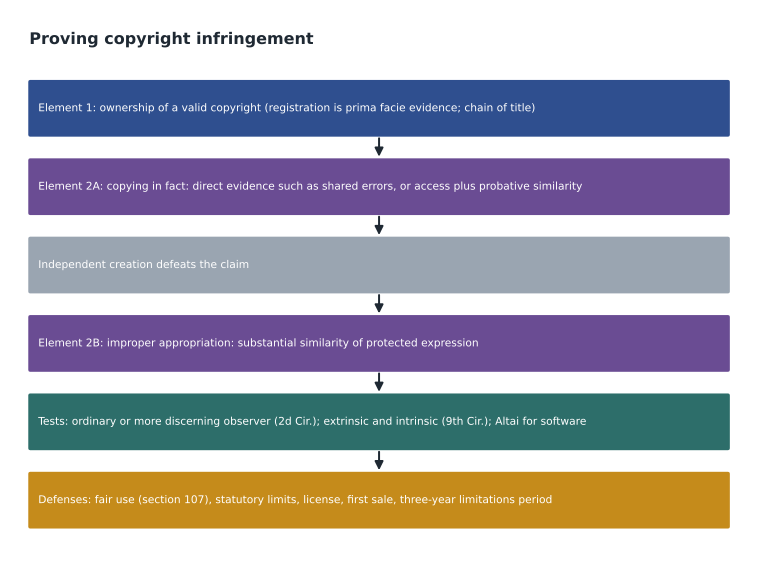
To establish infringement, Feist explained, a plaintiff must prove ownership of a valid copyright and copying of constituent elements of the work that are original. The second element contains two distinct questions, which courts usually separate. The first is copying in fact, sometimes called actual copying: did the defendant derive its work from the plaintiff's, as opposed to creating it independently? The second is improper appropriation: did the defendant take enough protected expression that the works are substantially similar in a legally relevant way? A defendant who copied only unprotected ideas or facts, or only a trivial amount of expression, has copied in fact but not infringed.
Direct evidence of copying is rare, so plaintiffs usually prove copying circumstantially by showing that the defendant had access to the plaintiff's work and that the two works share similarities probative of copying, meaning similarities that are better explained by copying than by coincidence, independent creation or a common source. Access may be shown by a chain of events, such as a manuscript sent to the defendant's company, or by wide dissemination of the plaintiff's work. When similarities are so striking that they preclude independent creation, courts sometimes infer access. Shared errors are especially powerful evidence, which is why map makers and directory publishers have long inserted deliberate mistakes into their works. Copying need not be conscious: in Bright Tunes Music v. Harrisongs Music (S.D.N.Y. 1976) George Harrison was held liable for subconsciously copying "He's So Fine" in "My Sweet Lord."
Improper appropriation is judged by substantial similarity. In the Second Circuit's classic formulation from Arnstein v. Porter (1946), the question is whether the defendant took so much of what is pleasing to the ears of lay listeners that it wrongfully appropriated something that belongs to the plaintiff, judged by the response of the ordinary observer. When a work contains both protectable and unprotectable elements, the Second Circuit uses a more discerning ordinary observer test that sets aside the unprotectable elements. The Ninth Circuit divides the inquiry into an extrinsic test, an objective comparison of specific protectable elements often with expert testimony, and an intrinsic test, the subjective response of the ordinary reasonable person. In Skidmore v. Led Zeppelin (2020) the en banc Ninth Circuit affirmed a jury verdict that "Stairway to Heaven" did not infringe the earlier song "Taurus," abandoned the inverse ratio rule under which strong proof of access reduced the similarity needed, and held that the scope of protection for the earlier work was defined by the deposit copy of the composition filed under the 1909 Act, not by sound recordings.
Software: abstraction, filtration, comparison
Software cases add a further layer, because programs are full of unprotectable elements dictated by efficiency, hardware, compatibility and standard techniques. In Computer Associates v. Altai (1992) the Second Circuit set out a three-step test that most circuits follow. First, abstract the program into levels of generality, from the literal code up through modules and structure to its ultimate function. Second, filter out unprotectable elements at each level: ideas, elements dictated by efficiency, elements required by external factors such as compatibility with other programs or hardware, and elements taken from the public domain. Third, compare what remains, the golden nugget of protectable expression, with the defendant's program. The test makes it hard to win a case based on similarities in overall structure, and easier to win one based on copying of literal code or of creative choices that were not dictated by function.
Applied to Keswick's library, the analysis starts with copying in fact. Ardley had access to Breckwood's code; he wrote much of it. The identical misspelled comments are probative similarities that independent creation cannot explain. The harder question is improper appropriation. Keswick will argue that the calibration sequence is dictated by the physics of measuring an ear canal and by Bluetooth standards, that the function names are short phrases, and that the code itself was rewritten in a different programming style. Breckwood's experts must filter those elements out and show that what remains, such as particular choices in the order of operations and the structure of the data tables, is protectable expression that Keswick took. Shared comments themselves are expression, though a few lines of comments may be too trivial to support liability alone.
Fair use: the statute and its history
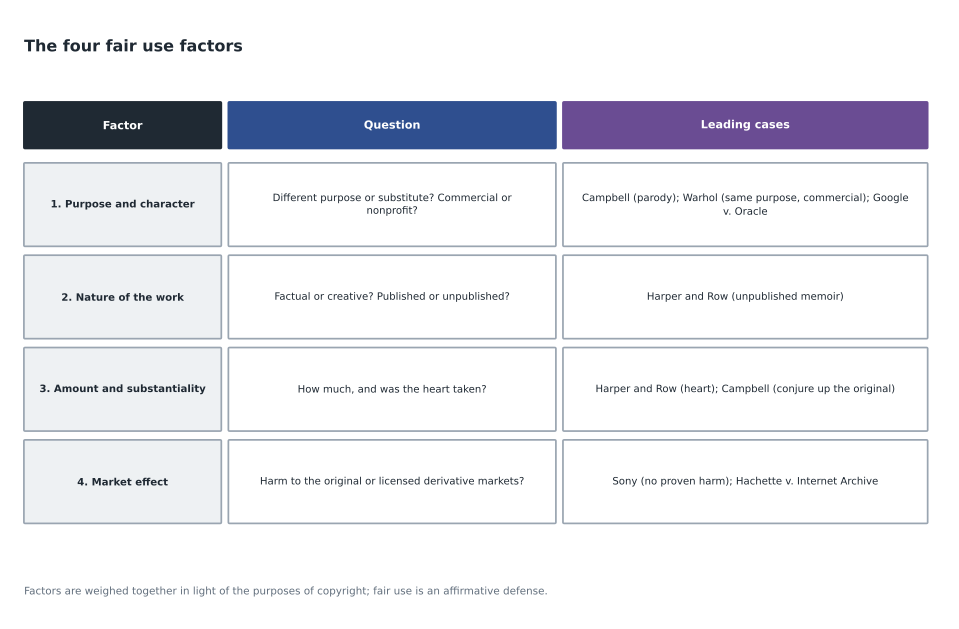
Fair use is a judge-made doctrine that Congress codified in section 107 of the 1976 Act. The statute says that the fair use of a copyrighted work, for purposes such as criticism, comment, news reporting, teaching, scholarship or research, is not an infringement, and directs courts to consider four factors: the purpose and character of the use, including whether it is of a commercial nature or for nonprofit educational purposes; the nature of the copyrighted work; the amount and substantiality of the portion used in relation to the work as a whole; and the effect of the use upon the potential market for or value of the copyrighted work. The factors are not exclusive, and they must be weighed together in light of the purposes of copyright. Fair use is an affirmative defense, and it is decided case by case.
The Supreme Court's major decisions trace the doctrine's development. In Sony Corp. of America v. Universal City Studios (1984) the Court held that home videotaping of broadcast programs for later viewing, called time-shifting, was fair use, and that Sony was therefore not liable for selling video recorders, which were capable of substantial noninfringing uses. In Harper and Row v. Nation Enterprises (1985) the Court held that a magazine's publication of 300 key words from President Ford's unpublished memoir, timed to scoop an authorized excerpt in another magazine, was not fair use, stressing that the work was unpublished and that the magazine took its heart. In Campbell v. Acuff-Rose Music (1994) the Court held that 2 Live Crew's rap parody of Roy Orbison's "Oh, Pretty Woman" could be fair use despite its commercial character, introducing the idea that the central question under the first factor is whether the new work merely supersedes the original or instead adds something new, with a further purpose or different character, altering the first with new expression, meaning or message, a quality the Court called transformative.
Google LLC v. Oracle America (2021) applied fair use to software. Google had copied roughly 11,500 lines of declaring code from the Java SE application programming interface so that programmers familiar with Java could use its familiar method calls when writing apps for Android. Assuming without deciding that the code was copyrightable, the Court held, six to two, that Google's copying was fair use. The declaring code was further from the core of copyright than most programs, because its value derived from the investment of programmers who had learned it; Google took only what was needed to let programmers put their accrued talents to work in a new and transformative program; the amount was small relative to the 2.86 million lines of the whole API; and Android did not substitute for Java in the market for desktop and laptop computers.
Andy Warhol Foundation for the Visual Arts v. Goldsmith (2023) narrowed the reading of transformation that had grown up after Campbell. Lynn Goldsmith photographed the musician Prince in 1981. Vanity Fair licensed the photograph in 1984 as an artist reference for an illustration, and Warhol created a series of sixteen silkscreens and pencil drawings from it. When Prince died in 2016, the Warhol Foundation licensed one of the images, Orange Prince, to Condé Nast for a magazine cover, for a fee, without crediting or paying Goldsmith. The Court, in an opinion by Justice Sotomayor for seven justices, held that the first factor favored Goldsmith as to that specific use. The first factor focuses on the purpose of the particular use challenged, not on the artwork in the abstract; both the photograph and the silkscreen were used to depict Prince in magazine stories about him; the use was commercial; and adding a new meaning or message is not enough on its own if the purposes are substantially the same. A use that shares the purpose of the original is more likely to substitute for it, and the commercial nature of the use weighs against fair use. Justice Kagan, joined by the Chief Justice, dissented, warning that the decision would stifle creativity.
Applying the factors
Ivensen tells the class that three working rules emerge from the cases. First, ask what the defendant's use is for, not what the defendant's work is. Warhol's silkscreen hanging in a museum may be a different use from the same image on a magazine cover. Second, a use with a genuinely different purpose, such as criticism, scholarship, search or interoperability, is more likely to be fair because it is less likely to substitute for the original. Third, the fourth factor considers not only the market for the original but traditional, reasonable or likely to be developed markets for licensed derivatives, which is why courts reject the argument that a use is fair simply because the plaintiff had not yet licensed it.
The appellate cases show the range. In Authors Guild v. Google (2d Cir. 2015) Google's scanning of millions of books to create a searchable index that displayed only short snippets was fair use: search is a highly transformative purpose, and snippets did not provide a market substitute. In Hachette Book Group v. Internet Archive (2d Cir. 2024) the Internet Archive's practice of scanning print books it owned and lending digital copies to one user at a time, called controlled digital lending, was not fair use: the digital copies served the same purpose as the publishers' licensed ebooks and substituted for them. Parody that comments on the original, as in Campbell, gets more latitude than satire that uses a work to comment on something else, because parody needs to mimic its target to make its point.
The blogger's review of HUSHWREN uses fifteen seconds of Breckwood's two-minute launch video to criticize the product's marketing claims. The purpose is criticism and comment, it serves a different function from the promotional video, the amount is no more than needed to make the point, and no one watches a negative review instead of a product launch. The use is very likely fair. Keswick's parody is closer. It mimics Breckwood's video to mock Breckwood's claims, which is parody under Campbell, but it is also an advertisement for a directly competing product, a commercial use with a purpose substantially similar to the original's purpose of selling earbuds. Under Warhol, the commercial and substitutional character of the use weighs heavily against fair use, though a court might still find that the parody's commentary on its target gives it a different purpose.
Other limits and defenses
The Copyright Act contains a long list of specific exceptions besides fair use. Section 110 exempts certain performances and displays in face-to-face teaching, religious services and other settings. Section 117 permits the owner of a copy of a program to make copies necessary to use it and archival copies. Section 120 permits anyone to photograph a building visible from a public place. Licenses, express or implied, are a defense, and a licensee who exceeds the scope of a license may be liable for infringement if the violated term is a limit on the scope of the license rather than an independent covenant. The statute of limitations in section 507(b) is three years after the claim accrued. In Petrella v. Metro-Goldwyn-Mayer (2014) the Court held that laches cannot bar a damages claim brought within the limitations period, and in Warner Chappell Music v. Nealy (2024) the Court held that a copyright plaintiff with a timely claim under the discovery rule may recover damages for infringement no matter when it occurred, assuming without deciding that the discovery rule applies.
Remedies
A court may grant injunctions under section 502, now subject to the eBay four-factor test, as the Second Circuit held in Salinger v. Colting (2010). It may order impoundment and destruction of infringing copies under section 503. Under section 504 the plaintiff may recover its actual damages plus any of the infringer's profits attributable to the infringement and not already counted; the plaintiff proves the infringer's gross revenue, and the infringer must prove its deductible expenses and the portion of profit attributable to factors other than the copyrighted work. Alternatively, a plaintiff whose work was timely registered may elect, at any time before final judgment, statutory damages of 750 to 30,000 dollars per work infringed, increased to as much as 150,000 dollars for willful infringement or reduced to as little as 200 dollars for innocent infringement. Statutory damages are awarded per work, not per copy, which is why they dominate litigation over file sharing and online copying. Under section 505 a court may award attorney fees to the prevailing party, plaintiff or defendant; Fogerty v. Fantasy (1994) requires evenhanded treatment and Kirtsaeng v. John Wiley and Sons (2016) gives substantial weight to the objective reasonableness of the losing party's position. Willful infringement for commercial advantage or private financial gain can also be a federal crime under section 506.
For small disputes, the Copyright Claims Board offers an alternative. Created by the CASE Act of 2020 and operating since 2022, it hears infringement claims, claims of misrepresentation in takedown notices and declarations of noninfringement, with total damages capped at 30,000 dollars per proceeding and statutory damages capped at 15,000 dollars per work. Participation is voluntary: a respondent can opt out within sixty days of being served, and the case then ends without prejudice. Ilsabet Corrado, the photographer, could bring a claim there against the individual counterfeit sellers who copied her photograph, once she registers it.
Worked problem
Breckwood v. Keswick: the copyright claim
Breckwood registered its firmware in 2025 and wants to add a copyright claim against Keswick over the HUSHRUN app library. The library contains about 1,200 lines that perform the same calibration steps as Breckwood's code, in the same order, with three identical misspelled comments; the code itself was rewritten in a different style. Analyze (a) copying in fact, (b) improper appropriation, (c) any fair use defense and (d) remedies.
Show solution
- Copying in fact: Ardley's access is undisputed, and shared errors are classic probative similarities. Keswick can respond only that the similarities stem from common external constraints, which does not explain misspelled comments.
- Improper appropriation: apply Altai. Abstract the code into levels, filter out elements dictated by the physics of calibration, Bluetooth standards and efficiency, and compare the remaining protectable choices. Rewriting in a different style weighs against literal similarity, but nonliteral structural copying of protectable choices can infringe.
- Fair use: Keswick's use is commercial and serves the same purpose as Breckwood's code, to run a competing earbud. Unlike Google v. Oracle, it does not let programmers carry skills to a new platform; it substitutes for Breckwood's product. The fourth factor weighs against Keswick.
- Remedies: registration in 2025 preceded the infringement, so Breckwood may elect statutory damages for one work (the firmware) up to 150,000 dollars if willful, or seek actual damages and Keswick's attributable profits. An injunction requires the eBay showing. Fees are discretionary under section 505.
Answer: The copyright claim is strong on copying in fact and turns on filtration. It complements the patent and trade secret claims, because it does not depend on Breckwood's patent claims surviving and gives Breckwood a theory focused on what Ardley carried away.
Common mistakes
MistakeTreating similarity alone as proof of infringement.
InsteadSeparate copying in fact (access and probative similarity) from improper appropriation (substantial similarity of protected expression).
MistakeCounting unprotectable elements in the similarity comparison.
InsteadFilter out ideas, facts, scenes a faire, merged expression and elements dictated by function, as in Altai and the more discerning observer test.
MistakeCalling any use that adds new meaning transformative.
InsteadAfter Warhol, the first factor asks whether the specific use has a purpose different from the original's; new meaning alone is not enough if the use serves substantially the same purpose.
MistakeAssuming commercial use defeats fair use.
InsteadCommerciality weighs against fair use but is not decisive; Campbell and Google v. Oracle found commercial uses fair.
MistakeCalculating statutory damages per copy.
InsteadStatutory damages are awarded per work infringed, and only for works registered before infringement began or within three months of publication.
Summary and key terms
- Infringement requires a valid copyright and copying of original elements: copying in fact (access and probative similarity) and improper appropriation (substantial similarity).
- Tests: ordinary observer and more discerning observer (Second Circuit), extrinsic and intrinsic (Ninth Circuit); Skidmore abandoned the inverse ratio rule; software uses abstraction, filtration and comparison (Altai).
- Fair use weighs purpose and character, nature of the work, amount and market effect (section 107).
- Sony (time-shifting), Harper and Row (unpublished heart), Campbell (parody and transformation), Google v. Oracle (reimplemented declaring code), Warhol (same-purpose commercial use).
- Authors Guild v. Google (search snippets fair) and Hachette v. Internet Archive (controlled digital lending not fair).
- Limitations: three years; no laches within the period (Petrella); damages not capped at three years for timely discovery-rule claims (Nealy).
- Remedies: eBay injunctions, impoundment, actual damages and profits or statutory damages per work (750 to 30,000; up to 150,000 willful), discretionary fees (Fogerty, Kirtsaeng), criminal liability for willful commercial infringement.
- The Copyright Claims Board hears small claims up to 30,000 dollars, but respondents may opt out.
- Copying in fact
- Proof that the defendant derived its work from the plaintiff's rather than creating it independently.
- Probative similarity
- Similarity that tends to show copying because it is unlikely to result from coincidence or common sources.
- Substantial similarity
- Similarity of protected expression sufficient to make copying wrongful.
- Abstraction-filtration-comparison
- The Altai test for nonliteral copying of software.
- Transformative use
- A use with a further purpose or different character that does not merely supersede the original.
- Statutory damages
- Damages set by the court within a statutory range per work infringed, available only for timely registered works.
- Copyright Claims Board
- A voluntary small-claims tribunal in the Copyright Office created by the CASE Act of 2020.
Practice problems
Work each problem on paper first, then reveal the answer to check.
A songwriter shows that her song was played on local radio twice, and a famous artist's later song shares a common four-note sequence with it. Is that enough to prove infringement?
Show answer
Probably not. Two local plays may not show a reasonable possibility of access, and a short, common sequence is likely unprotectable or explainable by common sources; she must show substantial similarity of protected expression.
A museum displays an artist's silkscreen based on a news photograph, with a placard discussing the artist's commentary on celebrity. How does Warhol bear on the museum's use?
Show answer
Warhol focuses on the specific use; a museum display for commentary may have a different purpose from the photograph's use in news stories and is noncommercial, so the first factor may favor fair use even though the magazine licensing did not.
A website posts full copies of a textbook's chapters for students, without charge. The site argues its use is educational. Is it fair use?
Show answer
Unlikely. The use substitutes for the original in its core market and copies entire chapters; nonprofit educational purpose does not outweigh the market harm and amount.
An infringer has profits of 500,000 dollars from selling posters copied from a photograph registered before infringement. Should the photographer elect statutory damages?
Show answer
Probably not; statutory damages are capped at 150,000 dollars per work even if willful, while actual damages and attributable profits could be much higher.
Lesson quiz · 5 questions
Score 60% or more to complete this lesson.
Create a free account to save your progress, take quizzes and earn a certificate.