
LAWU-312 · Lesson 12 of 12 · 25 min
Capstone: an intellectual property audit and litigation problem
▶ Video coming soon A video version of this lesson is on the way.
For the last class Ivensen sets the Breckwood file aside and hands out a new one, the kind of problem, she says, that walks into a small firm on an ordinary Tuesday. Every fact is invented. Section B's job is to write the memo a partner would want: for each asset and each threat, identify what is protected, who owns it, what counts as taking it and what the client can get, then rank the risks and recommend a plan. She reminds the class to answer issue by issue, to state the governing rule before applying it, to say what facts are missing and to finish with advice the client can act on.
The Corvina file
Corvina Games LLC is a seven-person video game studio in Brennan Falls, Westmarch, founded in 2023 by Iolanthe Vey, a former animator. Its first game, LANTERNFALL, a fantasy exploration game in which the player carries a lantern through procedurally generated caves, launched on personal computers in February 2026 and has sold about 400,000 copies. Corvina filed an intent-to-use application to register LANTERNFALL for computer game software and downloadable games in October 2025; it was published for opposition in May 2026 and registered in August 2026. Corvina also sells LANTERNFALL plush toys and posters.
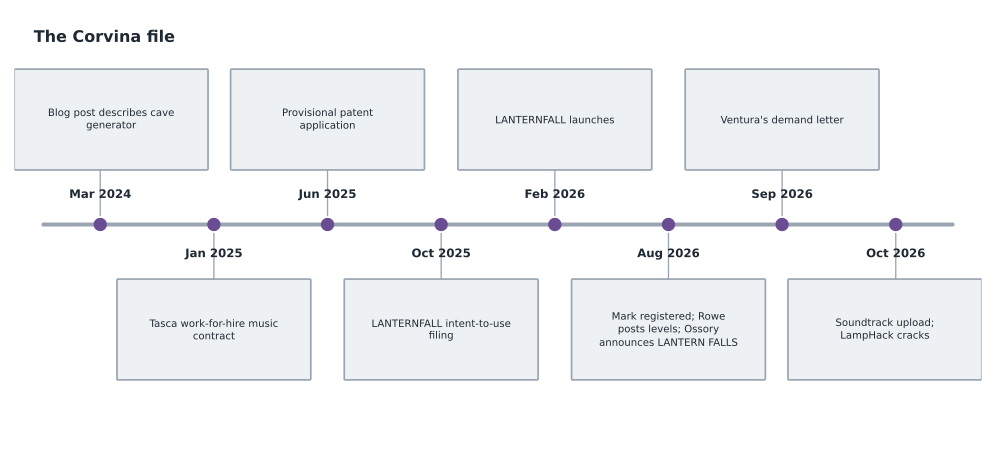
The game's cave generator uses a method Vey invented: the light radius of the player's lantern seeds a random number generator that builds the next cave section only within the lit area, so that caves are generated as the player sees them. Vey described the method in detail, with diagrams, in a public development blog post in March 2024. Corvina filed a provisional patent application on the method in June 2025 and a nonprovisional application in June 2026; claim 1 recites the method of generating a game environment by seeding a generator with a light-radius value and generating terrain only within the lit area.
The game's music was written by Ruben Tasca, a freelance composer, under a contract signed in January 2025 that says all compositions and recordings are works made for hire for Corvina as part of an audiovisual work. The character art was hand-drawn by Vey. The cave backgrounds were generated with an image model from Vey's prompts and then painted over by Corvina's artist, an employee. Corvina has registered the game, including its code, as an audiovisual work and a computer program; its application listed Vey and Corvina as authors and did not mention the AI-generated backgrounds.
Jessamy Rowe worked on LANTERNFALL as an independent contractor level designer from 2024 to May 2026 under a short agreement containing a nondisclosure clause and no intellectual property assignment. She designed some of the hand-built boss levels in the game and most of an unreleased expansion, files for which sat on Corvina's shared drive, where every contractor had access. In May 2026 she left; in August she joined Ossory Interactive, a large mobile game publisher, and posted screenshots and two complete level maps from the unreleased expansion on her portfolio website.
On August 3, 2026 Ossory announced LANTERN FALLS: KINGDOMS, a mobile strategy game set in a city lit by floating lanterns, with a logo featuring a lantern similar in shape to Corvina's. Its press release called the game "a light-filled adventure for fans of cave exploration games." Ossory plans a launch in early 2027.
LANTERNFALL's comic sidekick, Kiko the Lamplighter, has a purple mohawk and shouts "Light it up, lanterns!" before every fight. Kiko Ventura, a popular game streamer with a purple mohawk, has used "Light it up!" as his catchphrase for years. Vey says she was a fan of his streams. In September 2026 Ventura's lawyer sent Corvina a letter claiming that the character appropriates his identity and demanding a licensing fee.
Finally, in October 2026 a user uploaded LANTERNFALL's entire 70-minute soundtrack to a video-sharing platform, and a website called LampHack began offering cracked copies of the game that bypass its online license check, alongside a banner reading "Upload your cracks here. Top uploaders get premium access." Vey's question to the firm, on November 2, 2026, is simple: what do we own, what can we stop, and what should we worry about?
Issue 1: the patent application
What is protected? Claim 1 recites a method performed by a computer running a game. The first question is eligibility. Under Alice, Ossory or an examiner will argue that generating content only where the player can see it is an abstract idea, a rule of game design implemented on a generic computer, much as claims to rules for playing games have repeatedly been held abstract. Corvina's best response, following McRO and Enfish, is that the claim recites a specific technical technique for generating terrain that reduces the processing and memory needed, an improvement in how the computer itself operates. The outcome is uncertain and depends on how the specification describes the technical benefit.
Novelty is the more serious problem. Vey's March 2024 blog post described the method in detail with diagrams. It is a printed publication. The grace period of section 102(b)(1)(A) excludes the inventor's own disclosures made one year or less before the effective filing date, but the June 2025 provisional was filed about fifteen months after the post. The post is therefore prior art to Corvina's own claims, and if it disclosed every element of claim 1, it anticipates. Even if some element is missing, the post plus general knowledge of procedural generation may make the claim obvious under KSR. Unless the nonprovisional claims add a genuinely new feature not in the post, the patent strategy is likely to fail. Corvina should not spend more money on it without a new invention, and should treat the method as unprotected know-how and rely on the game's other assets. The lesson Ivensen wants the class to draw is the one Breckwood almost learned: publish after you file, not before.
Issue 2: copyright in the game
Who owns what? The code written by Corvina's employees is a work made for hire owned by Corvina. Vey's character art is hers by creation, but as a founder working for her company she is likely an employee for this purpose, or at least has assigned or will assign to Corvina; the firm should confirm with a written assignment. Tasca's music is different from the freelance photograph in the Breckwood file. A work specially commissioned as part of a motion picture or other audiovisual work is one of the nine statutory categories, a video game is an audiovisual work, and the parties signed a writing calling the music a work made for hire. Corvina is therefore the author of the compositions and recordings. Rowe's levels are the weak point. She was an independent contractor under the Reid factors, level designs are not clearly within a commissioned category unless treated as contributions to the audiovisual work, and her agreement contains no work-for-hire language and no assignment. She probably owns the copyright in the levels she designed, subject to an implied nonexclusive license for Corvina to use them in LANTERNFALL. That license likely covers the released game but may not cover the unreleased expansion, and it certainly does not let Corvina stop others using the levels.
The AI-generated backgrounds raise the registration question from the last lesson. Under the Copyright Office's guidance, the model's output is not protected, but the employee artist's paint-over is, to the extent it is original and perceptible. Corvina's registration failed to disclose and disclaim the AI-generated material. Under Unicolors a registration survives inaccuracies included without knowledge that they were inaccurate, and Corvina may have been unaware of the disclosure requirement; but the Office's guidance has been public since 2023, and an infringer will argue Corvina knew. The safe course is to file a supplementary registration correcting the application before suing anyone.
Issue 3: Rowe and the unreleased expansion
Corvina's strongest claim against Rowe and Ossory is trade secret misappropriation, not copyright. The unreleased expansion levels have independent economic value from secrecy, because rivals could copy the design and Corvina's launch would lose its surprise. Corvina's measures were thin: an NDA, but files open to every contractor on a shared drive. Under Rockwell, reasonableness is judged by cost and circumstance, and a seven-person studio is not expected to run the security of a multinational, but a court could find that unrestricted access defeats protection. Rowe acquired the files lawfully but under a contractual duty of secrecy; posting two complete maps on her website is disclosure in breach of that duty and therefore misappropriation. Ossory is liable only if it used the information knowing or having reason to know of the breach; nothing yet suggests it has. The posting also creates urgency, because public disclosure, even wrongful, can destroy a secret. Corvina should demand immediate removal and, if Rowe refuses, seek a temporary restraining order under the DTSA and Westmarch's UTSA. Copyright is awkward here, because Rowe may own the copyright in levels she designed; a court is unlikely to find that she infringed her own work, though the nondisclosure clause is a contract claim.
Issue 4: LANTERNFALL and LANTERN FALLS: KINGDOMS
Corvina's registered mark is at least suggestive and probably arbitrary for games, and registration gives it nationwide priority from its October 2025 filing date. Applying the likelihood-of-confusion factors: the marks are nearly identical in sound and differ only by a space and a letter; the goods are related, since both are video games, though one is a PC exploration game and the other a mobile strategy game, and consumers know that publishers release games in many genres; channels overlap through online stores; the lantern logos are similar; and Ossory's press release, invoking fans of cave exploration games, suggests an intent to trade on Corvina's popularity. Reverse confusion is the real danger. Ossory's marketing budget could make consumers believe that LANTERNFALL is a spinoff of Ossory's game. A survey would help, and Ossory has not launched yet, so there is time to seek a preliminary injunction, aided by the Trademark Modernization Act's presumption of irreparable harm once likely success is shown.
Ossory may argue that a game title is an expressive work protected by Rogers v. Grimaldi. After Jack Daniel's, that argument fails if Ossory uses LANTERN FALLS as a designation of source for its own game, and a title used for a game series, a logo and merchandise is a source identifier. The ordinary confusion analysis applies. Corvina should also consider whether Ossory has applied to register its mark; if so, it can oppose the application before the Trademark Trial and Appeal Board, and a Board decision on confusion could later have preclusive effect under B and B Hardware. Dilution is unavailable, because LANTERNFALL is not a household name among the general consuming public.
Issue 5: Kiko Ventura's demand
Ventura's claim is a state right of publicity claim and possibly a Lanham Act false endorsement claim. The character evokes his identity: the purple mohawk, the name Kiko and a catchphrase built on his own. But the use is in an expressive work, a video game, not an advertisement. Under the transformative use test of Comedy III, the question is whether the character adds significant creative elements beyond a mere likeness. Kiko the Lamplighter is a cartoon sidekick in a fantasy world, not a realistic depiction of Ventura doing what he is known for, unlike the football players in Hart v. Electronic Arts and the NCAA case, so the transformative use defense is strong. False endorsement requires likely confusion about Ventura's sponsorship; the firm should ask whether Corvina's marketing has used the character, the name or the catchphrase in ways that suggest Ventura endorses the game, because advertising is where an expressive work loses protection. The firm should advise Vey not to pay but to avoid using Kiko in promotional materials until the dispute is resolved, and to consider renaming the character in future releases as a low-cost precaution.
Issue 6: the uploaded soundtrack and LampHack
Corvina owns the soundtrack as a work made for hire. The upload of the full soundtrack infringes the reproduction and public performance rights, and fair use is out of the question: it copies everything, for no transformative purpose, and substitutes for the soundtrack album. Corvina should send a takedown notice under section 512(c)(3) to the platform's designated agent; the platform will keep its safe harbor if it removes the upload expeditiously. If the user sends a counter-notice, Corvina must sue within ten to fourteen business days to keep it down.
LampHack is a different kind of defendant. Its banner soliciting cracks and rewarding top uploaders is the kind of clear expression and affirmative step that showed inducement in Grokster, and after Cox v. Sony inducement remains a basis for contributory liability; the service also looks tailored to infringement. LampHack is also trafficking in circumvention of an access control in violation of section 1201, which requires no proof of infringement under the Ninth Circuit's view and is not subject to fair use. The DMCA safe harbors are unlikely to help a site that encourages infringement and does not remove it. The practical obstacles are identifying LampHack's operators and reaching them; Corvina can subpoena the hosting provider and domain registrar under section 512(h), send notices to the site's host and seek orders against its domain.
Ranking the risks and the plan
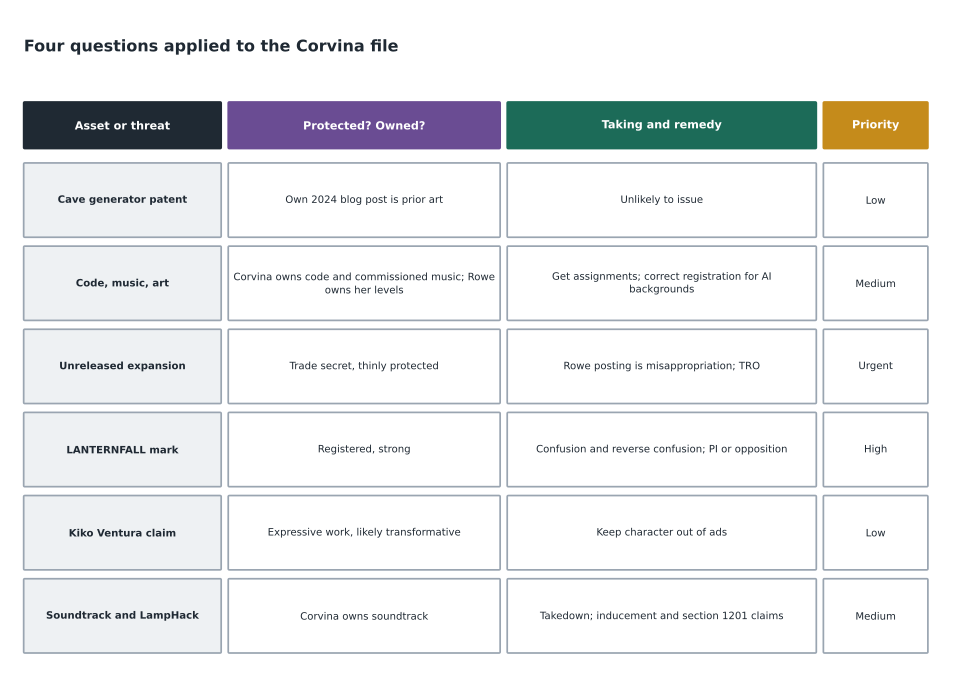
Ivensen asks the class to finish as a partner would, with priorities. The most urgent matter is the expansion levels, because every day they remain online the trade secret erodes; Corvina should demand removal today and be ready to seek a TRO. The most valuable matter is LANTERNFALL, because the brand is the studio's main asset and Ossory has not launched; Corvina should send a cease-and-desist letter, check the register for Ossory's application and prepare for a preliminary injunction motion supported by a survey. Housekeeping matters come next: written assignments from Vey and Rowe (Rowe may demand payment, which may be worth it), a supplementary copyright registration disclaiming the AI-generated backgrounds, tighter access controls and an IP assignment clause in every future contractor agreement. The soundtrack upload is a routine takedown. LampHack is worth pursuing if its operators can be found. Ventura's claim is weak but cheap to manage. The patent application, by contrast, is probably not worth further investment.
Daniel Reyes says that what strikes him is how much depended on paperwork signed before anyone thought about litigation: Tasca's contract saved the music, Rowe's contract lost the levels, and Vey's blog post cost her a patent. Ivensen agrees and says that is the point of the course. Intellectual property disputes are won in court, but they are usually decided years earlier, in the decisions about what to disclose, what to keep secret, what to register and what to get in writing.
Worked problem
Writing the memo's conclusion
Draft the bottom line of the memo to Iolanthe Vey in five sentences or fewer.
Show solution
- Lead with the most urgent action: removal of the expansion levels and a possible TRO under the DTSA.
- State the strongest claim: trademark infringement against LANTERN FALLS: KINGDOMS before launch, with reverse confusion as the main theory.
- Identify ownership gaps to close: assignments from Vey and Rowe and a corrected copyright registration.
- Flag the low-value matters: the patent application and the Ventura demand.
- Give a timeline: within days for the levels, weeks for the trademark motion.
Answer: Act today to get the unreleased levels taken down, because each day online erodes the trade secret. LANTERNFALL is your strongest asset, and Ossory's planned 2027 launch gives you time to stop LANTERN FALLS: KINGDOMS before it confuses your players. Corvina owns its code and music but not Rowe's levels, and its copyright registration must be corrected to disclaim the AI-generated backgrounds. The cave generator patent is unlikely to issue because of your March 2024 blog post, and Ventura's demand is weak if you keep Kiko out of advertising. Routine takedowns will deal with the soundtrack, and LampHack is worth pursuing if we can identify its operators.
Common mistakes
MistakeAnalyzing every asset under one regime.
InsteadAsk the four questions for each asset under each regime that might apply, then focus on the one that gives the best remedy.
MistakeAssuming the company owns everything made for it.
InsteadCheck employment status, the statutory categories and written assignments; contractors often own what they made.
MistakeForgetting that the inventor's own publication can bar a patent.
InsteadThe grace period lasts one year; a publication more than a year before filing is prior art.
MistakeTreating a game title as automatically protected by Rogers.
InsteadAfter Jack Daniel's, a title used as a source identifier for a series and merchandise gets the ordinary confusion analysis.
MistakeEnding without a plan.
InsteadRank the matters by urgency and value and tell the client what to do first.
Summary and key terms
- Organize an IP memo by asset and threat, asking what is protected, who owns it, what counts as taking it and what the owner can get.
- Patents: an inventor's own publication more than a year before filing is prior art; eligibility for game and software methods is uncertain under Alice.
- Copyright ownership turns on employment, the commissioned-work categories (an audiovisual work qualifies) and written assignments; AI-generated material must be disclaimed in registrations.
- Trade secrets need reasonable measures; wrongful public posting requires immediate action.
- Trademarks: registered marks give nationwide priority; consider reverse confusion; Rogers does not apply to source-identifying uses after Jack Daniel's.
- Right of publicity claims against expressive works face the transformative use test; advertising is the danger zone.
- Online infringement: takedown notices for hosts; inducement and section 1201 claims against piracy sites; section 512(h) subpoenas to identify operators.
- Finish with a ranked plan, because most IP outcomes are fixed by earlier choices about disclosure, secrecy, registration and contracts.
- IP audit
- A systematic review of a client's intellectual property assets, ownership, protection and risks.
- Supplementary registration
- A filing that corrects or amplifies information in an existing copyright registration.
- Cease-and-desist letter
- A demand that a party stop allegedly infringing conduct, often the first step before litigation.
- Opposition
- A proceeding before the TTAB challenging a published trademark application.
- Section 512(h) subpoena
- A subpoena to a service provider to identify an alleged infringer, issued on a valid takedown notice.
- Reverse confusion
- Confusion caused when a larger junior user overwhelms a smaller senior user's mark.
- Transformative use test
- The test asking whether an expressive work adds significant creative elements beyond a person's likeness.
Practice problems
Work each problem on paper first, then reveal the answer to check.
Suppose Corvina's contract with Rowe had said that all levels were works made for hire but Corvina had never signed it, only Rowe. Would Corvina own the levels?
Show answer
Section 101 requires a written instrument signed by both parties for a commissioned work made for hire; a writing signed only by Rowe could still operate as a transfer under section 204(a), which requires only the owner's signature, if it contains transfer language.
Ossory files an application to register LANTERN FALLS: KINGDOMS. What can Corvina do at the Patent and Trademark Office?
Show answer
File an opposition within the opposition period, arguing likelihood of confusion under section 2(d) with its registered mark; the decision may later have preclusive effect under B and B Hardware.
Rowe removes the maps from her site after Corvina's letter, but they were up for six weeks and were copied to fan forums. Is the trade secret lost?
Show answer
Possibly; wide public dissemination may destroy secrecy even if it was wrongful. Corvina may still recover damages for the misappropriation, but injunctive protection of the secret may no longer be available.
Ventura's lawyer argues that the character is used on the game's box art and store page. Does that change the analysis?
Show answer
It strengthens his claim; promotional uses look more like advertising, where the transformative use defense is weaker and false endorsement is more plausible, though using a character from the game to advertise the game is often still protected.
Lesson quiz · 5 questions
Score 60% or more to complete this lesson.
Create a free account to save your progress, take quizzes and earn a certificate.