
LAWU-312 · Lesson 4 of 12 · 25 min
Copyright
▶ Video coming soon A video version of this lesson is on the way.
Ivensen begins the copyright unit with three items from the Breckwood file laid out on the lectern: a printout of a few pages of firmware source code, a glossy photograph of the HUSHWREN earbuds resting on a river stone, and the HUSHWREN companion app open on a tablet, showing a series of small watercolor-style illustrations of birds that change as the noise level changes. "All three of these are copyrighted," she says, "or at least two and a half of them are. The harder question, as usual, is who owns them." Priya Natarajan asks whether Breckwood registered them. Ivensen says that is the third question, not the first, because in American copyright law protection begins the moment a work is fixed, long before anyone fills out a form.
Subject matter: original works of authorship fixed in a tangible medium
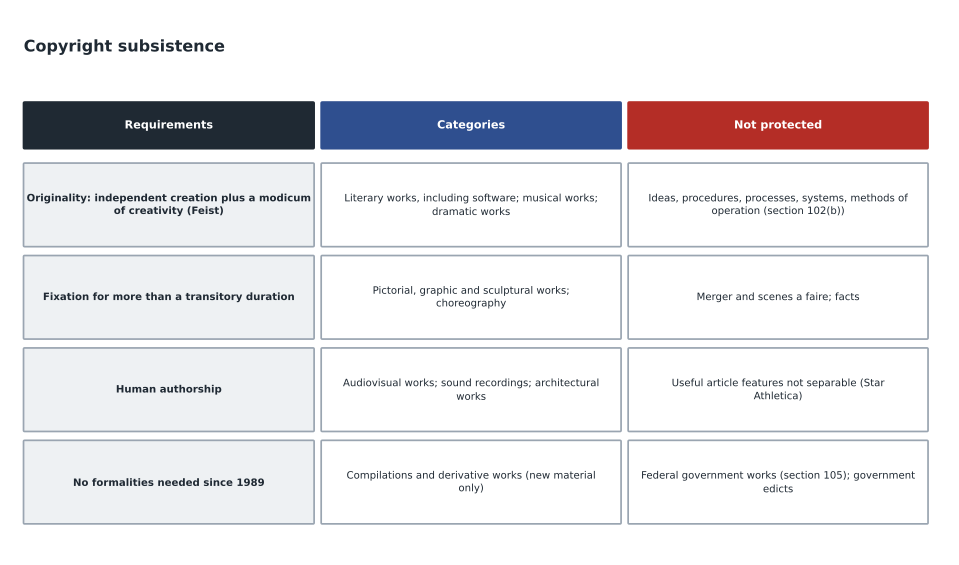
Section 102(a) of the Copyright Act of 1976 protects original works of authorship fixed in any tangible medium of expression from which they can be perceived, reproduced or otherwise communicated, directly or with a machine. The statute lists eight categories, which are illustrative rather than exclusive: literary works, musical works, dramatic works, pantomimes and choreographic works, pictorial, graphic and sculptural works, motion pictures and other audiovisual works, sound recordings and architectural works. Computer programs are literary works. A musical work (the composition) and a sound recording (a particular recorded performance) are separate works with separate owners and rights, a distinction that matters constantly in the music business.
Originality has two parts, as Feist Publications v. Rural Telephone Service (1991) explained. The work must be independently created by the author, not copied, and it must possess at least some minimal degree of creativity. The bar is low; the vast majority of works make the grade easily, as they possess some creative spark, no matter how crude, humble or obvious. But an alphabetical listing of names and telephone numbers does not, because alphabetical order is an age-old practice and the facts themselves were not created by anyone. Courts do not judge artistic merit. In Bleistein v. Donaldson Lithographing Co. (1903) Justice Holmes warned that it would be dangerous for judges to decide the worth of pictorial illustrations, and upheld copyright in circus posters. In Burrow-Giles Lithographic Co. v. Sarony (1884) the Court held that a photograph of Oscar Wilde was an original work because the photographer posed the subject, arranged the costume, light and background, and so was its author. The same reasoning supports copyright in the photograph of the earbuds on the river stone.
Fixation requires embodiment in a copy or phonorecord that is sufficiently permanent or stable to permit the work to be perceived for more than a transitory duration. An improvised speech that no one records is not fixed; a live broadcast is fixed if it is being recorded simultaneously. Courts have held that loading a program into a computer's random access memory can create a fixed copy, as in MAI Systems v. Peak Computer (9th Cir. 1993), while the Second Circuit held in Cartoon Network v. CSC Holdings (2008) that data held in a buffer for about 1.2 seconds was not fixed.
What copyright does not protect
Section 102(b) provides that copyright protection does not extend to any idea, procedure, process, system, method of operation, concept, principle or discovery, regardless of how it is described or embodied. The principle goes back to Baker v. Selden (1879), in which the Court held that a book explaining a bookkeeping system gave its author no exclusive right to the system or to the ruled forms needed to use it. Related doctrines fill out the idea-expression distinction. Under the merger doctrine, when an idea can be expressed in only one or a few ways, the expression merges with the idea and is unprotected, or protected only against virtually identical copying. Under scenes a faire, stock elements that naturally follow from a setting or subject, such as a car chase in a police thriller or common user interface conventions, are unprotected.
For software, these doctrines do much of the work. In Lotus Development Corp. v. Borland International (1st Cir. 1995), aff'd by an equally divided Court (1996), the court held that a spreadsheet program's menu command hierarchy was an unprotectable method of operation. Most courts instead filter out unprotectable elements using the abstraction-filtration-comparison test from Computer Associates v. Altai (2d Cir. 1992), which the class will meet again when it studies infringement. Breckwood's firmware is protected as a literary work, but the adaptive hush method it carries out is not; only the particular code is.
Useful articles present a related problem. Copyright protects the design of a useful article, such as a lamp or a garment, only to the extent the design incorporates pictorial, graphic or sculptural features that can be identified separately from, and are capable of existing independently of, the utilitarian aspects of the article. Star Athletica v. Varsity Brands (2017) simplified the test: a feature is protected if it can be perceived as a two- or three-dimensional work of art separate from the useful article, and would qualify as a protectable work on its own or in another medium if imagined separately. The Court held that the stripes, chevrons and color blocks on cheerleading uniforms qualified. The pebble shape of Breckwood's charging case, by contrast, is the shape of the case itself, so it is a matter for design patent and trade dress law rather than copyright.
Some works are excluded altogether. Under section 105, works of the United States government, prepared by federal officers or employees as part of their official duties, are not protected. Under the government edicts doctrine, judges and legislators cannot be authors of the works they create in the course of their official duties; in Georgia v. Public.Resource.Org (2020) the Court held that annotations to Georgia's official code, prepared by a commission acting for the legislature, were not copyrightable. The Copyright Office will register a work only if it was created by a human being, a requirement the class will examine closely when it turns to artificial intelligence.
Compilations and derivative works
A compilation is a work formed by collecting and assembling preexisting materials or data that are selected, coordinated or arranged so that the resulting work as a whole is original. A derivative work is based on one or more preexisting works, such as a translation, a film adaptation or a new version of a program. Under section 103, copyright in either extends only to the material contributed by the new author and does not extend to the preexisting material. Copyright in a compilation of facts is therefore thin: it protects the original selection and arrangement but not the facts, which anyone may extract and rearrange. Breckwood's library of 40,000 ear-canal measurements is at most a thin compilation, and its real protection is trade secret law.
Authorship and ownership
Section 201(a) vests copyright initially in the author or authors of the work. Coauthors of a joint work, one prepared by two or more authors with the intention that their contributions be merged into inseparable or interdependent parts of a unitary whole, are co-owners. Courts usually require that each joint author contribute independently copyrightable expression and that the parties intended to be coauthors, as in Childress v. Taylor (2d Cir. 1991) and Aalmuhammed v. Lee (9th Cir. 2000), where a consultant who suggested scenes for the film Malcolm X was held not to be a joint author because the director retained creative control. Joint owners may each use and license the work nonexclusively, but, unlike patent co-owners, must account to the others for profits.
The most important rule of ownership is the work made for hire doctrine. Under section 101 a work is made for hire if it is prepared by an employee within the scope of employment, or if it is specially ordered or commissioned for use in one of nine listed categories (such as a contribution to a collective work, part of a motion picture, a translation or a compilation) and the parties expressly agree in a signed writing that it will be a work made for hire. For a work made for hire, the employer or commissioning party is the author. In Community for Creative Non-Violence v. Reid (1989) the Court held that whether someone is an employee turns on the general common law of agency, weighing factors such as the hiring party's right to control the manner and means of the work, the skill required, who provides the tools, the location of the work, the duration of the relationship, the method of payment and the provision of employee benefits and tax treatment. A sculptor commissioned to create a statue was an independent contractor, so he owned the copyright.
Copyright ownership can be transferred, in whole or in part, but under section 204(a) a transfer of ownership, including an exclusive license, requires a writing signed by the owner. A nonexclusive license needs no writing and may be implied from conduct, for example when a client requests and pays for a work and the creator delivers it intending the client to use it. Authors who transfer their rights have an inalienable right under section 203 to terminate the transfer during a five-year window beginning thirty-five years after the grant, a right that cannot be waived by contract and that does not apply to works made for hire. Termination has become important to musicians and authors of works from the late 1970s and 1980s.
Ivensen applies the rules to the three items on the lectern. Most of the firmware was written by Breckwood's salaried engineers using company equipment as part of their jobs; it is a work made for hire and Breckwood is its author. But one module, the code that manages the Bluetooth connection, was written in 2022 by Benno Merriweather, a freelance developer paid by the hour under a two-page statement of work that says nothing about intellectual property. Software is not one of the nine commissioned-work categories, so even a written work-for-hire clause would not have helped unless the module counted as a contribution to a collective work or a compilation. Merriweather owns the copyright in his module, and Breckwood has at most an implied nonexclusive license to use it as delivered. The photograph of the earbuds on the river stone was taken by Ilsabet Corrado, a freelance photographer whose email said only "use them on your site and in your ads." She owns it, and Breckwood has a nonexclusive license. That will matter when Breckwood wants to sue the counterfeit sellers who copied the photograph, because only the legal or beneficial owner of an exclusive right may sue for infringement under section 501(b).
The exclusive rights
Section 106 gives the copyright owner six exclusive rights: to reproduce the work in copies or phonorecords; to prepare derivative works; to distribute copies to the public by sale or other transfer of ownership, or by rental, lease or lending; to perform the work publicly, for literary, musical, dramatic, choreographic and audiovisual works; to display the work publicly; and, for sound recordings, to perform the work publicly by means of a digital audio transmission. Each right has limits. Under the first sale doctrine of section 109, the owner of a lawfully made copy may sell or otherwise dispose of that copy without the copyright owner's permission, and in Kirtsaeng v. John Wiley and Sons (2013) the Court held that the doctrine applies to copies lawfully made abroad. The public performance right reaches transmissions to the public; in American Broadcasting Cos. v. Aereo (2014) the Court held that a service transmitting broadcast television to subscribers over the internet from individual tiny antennas performed publicly, because it looked like a cable system.
Authors of certain works of visual art, such as paintings, drawings and sculptures in single copies or limited signed editions of 200 or fewer, also have moral rights of attribution and integrity under section 106A, added by the Visual Artists Rights Act of 1990. In Castillo v. G and M Realty (2d Cir. 2020) a building owner who whitewashed aerosol art on the walls of a warehouse complex known as 5Pointz was held liable for statutory damages of 6.75 million dollars, because the works had achieved recognized stature.
Formalities
Older American law made copyright depend on formalities: publication with proper notice and timely renewal. The 1976 Act, effective in 1978, made protection automatic upon fixation, and the Berne Convention Implementation Act, effective March 1, 1989, made the copyright notice optional for works published after that date. A copyright notice still has value, because it defeats a defense of innocent infringement. Registration remains important for three reasons. For United States works, registration (or refusal of registration) is a prerequisite to filing an infringement suit under section 411(a); in Fourth Estate Public Benefit Corp. v. Wall-Street.com (2019) the Court held that registration occurs when the Copyright Office registers the work, not when the application is filed. A registration made before or within five years of first publication is prima facie evidence of validity. And under section 412, statutory damages and attorney fees are available only if the work was registered before the infringement began or within three months after first publication. In Unicolors v. H and M Hennes and Mauritz (2022) the Court held that a registration remains valid despite inaccurate information that the applicant included without knowing it was inaccurate, whether the mistake was one of fact or of law.
Duration
For works created on or after January 1, 1978, copyright lasts for the life of the author plus seventy years, or, for joint works, seventy years after the death of the last surviving author. Works made for hire, anonymous and pseudonymous works last ninety-five years from first publication or one hundred twenty years from creation, whichever expires first. All terms run to the end of the calendar year. Works published before 1978 are governed by transitional rules; the practical result is that works published in the United States with proper formalities between 1928 and 1977 are protected for ninety-five years from publication, so works published in 1930 entered the public domain on January 1, 2026. Sound recordings fixed before February 15, 1972 were protected only by state law until the Music Modernization Act of 2018 brought them under a federal scheme with staggered terms.
Worked problem
Who owns what at Breckwood
Breckwood wants to (a) sue a seller on the Bazaarly marketplace who copied the river-stone photograph into counterfeit listings, (b) relicense its firmware, including Merriweather's Bluetooth module, to a hearing-aid maker, and (c) sue a competitor that copied the app's onboarding screens, which were written by a Breckwood designer and registered in 2025. Advise Breckwood.
Show solution
- Photograph: Corrado took it as a freelancer; it is not a work made for hire. Her email granted at most a nonexclusive license, which does not permit Breckwood to sue under section 501(b). Breckwood should obtain a written assignment or exclusive license from Corrado (section 204(a)), or ask her to sue; she must register before suing.
- Merriweather's module: Merriweather was an independent contractor under the Reid factors and software is not a commissioned-work category, so he is the author and owner. Breckwood's implied nonexclusive license probably covers using the module in its own products but not sublicensing it to a third party. It should obtain a written assignment now.
- Onboarding screens: created by an employee within the scope of employment, a work made for hire owned by Breckwood. Registration in 2025 satisfies section 411(a); if registration preceded the infringement, statutory damages and fees are available under section 412. Breckwood must still separate protectable expression from unprotectable ideas and interface conventions.
Answer: Copyright arises automatically, but ownership follows the work-for-hire rules and the writing requirement. Breckwood owns what its employees made, and needs written assignments from the freelancers before it can relicense or sue.
Common mistakes
MistakeAssuming that whoever pays for a work owns the copyright.
InsteadA commissioned work is made for hire only if it falls in one of nine categories and the parties sign a writing; otherwise the creator owns it unless rights are assigned in writing.
MistakeTreating effort or expense as a basis for copyright.
InsteadFeist rejected sweat of the brow; protection requires originality, and facts are never protected.
MistakeSaying copyright requires registration or notice.
InsteadProtection is automatic on fixation; registration is required to sue on a United States work and to obtain statutory damages and fees.
MistakeLetting a nonexclusive licensee sue infringers.
InsteadOnly the legal or beneficial owner of an exclusive right may sue under section 501(b).
MistakeProtecting the shape of a useful article through copyright.
InsteadOnly separable artistic features qualify under Star Athletica; the overall shape of a functional product belongs to design patent and trade dress law.
Summary and key terms
- Copyright protects original works of authorship fixed in a tangible medium (section 102(a)); originality means independent creation and a modicum of creativity (Feist).
- Section 102(b) excludes ideas, procedures, processes, systems and methods of operation (Baker v. Selden; Lotus); merger and scenes a faire limit protection further.
- Useful articles are protected only for separable artistic features (Star Athletica); federal government works and government edicts are excluded (Georgia v. Public.Resource.Org).
- Compilation and derivative work copyrights cover only new material (section 103).
- The author owns the copyright, but the employer is the author of a work made for hire (CCNV v. Reid); transfers require a signed writing; nonexclusive licenses may be implied.
- Authors can terminate transfers after 35 years under section 203.
- Section 106 rights: reproduction, derivative works, distribution, public performance, public display and digital audio transmission; first sale (Kirtsaeng) and VARA moral rights.
- Registration is needed to sue on United States works (Fourth Estate) and for statutory damages and fees (section 412); Unicolors forgives good-faith mistakes.
- Term: life plus 70 years, or 95/120 years for works made for hire; works published in 1930 entered the public domain on January 1, 2026.
- Originality
- Independent creation plus a modicum of creativity.
- Fixation
- Embodiment in a copy or phonorecord stable enough to be perceived for more than a transitory duration.
- Merger doctrine
- The rule that expression is unprotected when the underlying idea can be expressed in only one or a few ways.
- Work made for hire
- A work prepared by an employee within the scope of employment, or a specially commissioned work in a listed category with a signed agreement.
- Joint work
- A work prepared by two or more authors intending their contributions to merge into a unitary whole.
- First sale doctrine
- The rule that the owner of a lawfully made copy may resell or dispose of it without permission.
- Termination right
- An author's nonwaivable right to end a transfer 35 years after it was made.
Practice problems
Work each problem on paper first, then reveal the answer to check.
A company compiles a list of every restaurant in a city with its address and hours, in alphabetical order, after months of work. A competitor copies the data into its own app with a different layout. Is there infringement?
Show answer
Probably not. The facts are unprotected, and alphabetical arrangement lacks originality under Feist; any copyright in the selection is thin and was not copied.
A magazine pays a freelance writer for an article and later reprints it in an anthology without asking. The writer signed nothing. Who owns the copyright?
Show answer
The writer. Without a signed work-for-hire agreement or written transfer, the magazine has at most an implied nonexclusive license, which may not extend to the anthology.
A photographer registers a photo three years after an infringer began using it online. What remedies remain?
Show answer
Actual damages and the infringer's profits and an injunction; statutory damages and attorney fees are unavailable under section 412 because registration came after infringement began.
A furniture maker claims copyright in the curved shape of a chair's legs. What is the test?
Show answer
Star Athletica: whether the curve can be perceived as a work of art separate from the chair and would qualify as a sculptural work on its own; a shape that is simply the useful article's form is not protected.
Lesson quiz · 5 questions
Score 60% or more to complete this lesson.
Create a free account to save your progress, take quizzes and earn a certificate.