
LAWU-312 · Lesson 10 of 12 · 23 min
Right of publicity and false advertising
▶ Video coming soon A video version of this lesson is on the way.
Keswick's launch advertisement for HUSHRUN, which ran online and on streaming television from September 2026, shows a runner on a foggy bridge at dawn while a husky alto voice sings, over a slow drumbeat, "hush, run, hush, run, let the city fade." Anyone who listens to popular music would think the voice belongs to Wynona Marquand, a Nashville singer known for exactly that breathy, low register. It does not. Keswick had asked Marquand to appear in its campaign in the spring of 2026, and her manager declined. Keswick's agency then produced the vocal with an AI voice model trained, according to a later trade press report, on her published recordings. In small type during the final two seconds of the ad, a line reads "Vocal performance is AI-generated. Wynona Marquand is not affiliated with Keswick." The ad ends with a claim in large type: "Blocks 2x more noise than HUSHWREN. Lab tested." Breckwood's engineers say their own tests show nothing of the kind.
Ivensen says the ad raises two bodies of law that sit at the edges of intellectual property. The first is the right of publicity, which belongs to Marquand. The second is false advertising, which Breckwood can enforce. Both are forms of unfair competition, and both have been reshaped by technology and the First Amendment.
The right of publicity
The right of publicity protects a person's interest in controlling the commercial use of his or her identity, such as name, likeness, voice, signature and other distinctive personal attributes. It grew out of the privacy tort of appropriation, one of the four privacy torts William Prosser described in 1960, but courts came to see it as a property-like right in the commercial value of identity rather than a protection of dignity. The Second Circuit used the phrase right of publicity in Haelan Laboratories v. Topps Chewing Gum (1953), holding that a baseball player could grant an exclusive right to use his photograph on trading cards. The right is entirely a creature of state law. About half the states recognize it by statute, by common law or both; New York protects living persons through sections 50 and 51 of its Civil Rights Law, and California protects them by statute (Civil Code section 3344) and at common law, and protects deceased personalities for seventy years after death (section 3344.1). Postmortem rights, their duration and whether they pass by will vary widely from state to state.
The elements, in a typical formulation, are use of the plaintiff's identity, appropriation of its commercial value for the defendant's advantage, lack of consent and resulting injury. Identity is construed broadly. In Midler v. Ford Motor Co. (9th Cir. 1988) the court held that Ford's advertising agency violated California common law by hiring a backup singer to imitate Bette Midler's distinctive voice in a commercial after Midler declined to participate: when a distinctive voice of a professional singer is widely known and is deliberately imitated in order to sell a product, the sellers have appropriated what is not theirs. In Waits v. Frito-Lay (9th Cir. 1992) the court upheld a verdict for Tom Waits against a snack company whose ad featured an imitation of his gravelly voice, under both the right of publicity and Lanham Act false endorsement. In White v. Samsung Electronics America (9th Cir. 1992) a robot dressed in a wig, gown and jewelry turning letters on a game show set was held to evoke Vanna White's identity, over a dissent by Judge Kozinski warning that the majority was creating a right to everything that reminds the public of a celebrity.
Marquand's facts track Midler and Waits closely: a distinctive voice, a deliberate imitation, a refusal to endorse and a commercial use to sell a product. The new element is that the imitation was produced by software trained on her recordings rather than by a human sound-alike. Ivensen says the cases suggest that makes no difference to the core claim, because the wrong is the appropriation of the voice's commercial value, not the method of imitation. Keswick's tiny disclaimer will not cure the appropriation, though it may bear on the false endorsement claim.
Digital replicas and new statutes
Legislatures have begun to address AI-generated voices and likenesses directly. Tennessee's Ensuring Likeness, Voice and Image Security Act of 2024, known as the ELVIS Act, added voice to the state's statutory right of publicity, defined to include a simulation of a person's voice, and created liability not only for unauthorized commercial use but also for distributing technology whose primary purpose is producing a particular person's voice or likeness without authorization. Marquand lives in Nashville, so Tennessee law is likely to govern her claim, and under the ELVIS Act it is even stronger than under Midler. In 2024 California enacted statutes requiring specific, informed consent and representation for contract provisions authorizing digital replicas of performers, and extending its postmortem right to digital replicas of deceased personalities. Several other states have followed with laws on digital replicas or election deepfakes.
Congress has not yet created a federal right. The NO FAKES Act, which would create a federal right to authorize digital replicas of one's voice and visual likeness, with a notice-and-takedown system for online services and exceptions for news, commentary, parody and documentaries, was reintroduced in May 2026 and approved unanimously by the Senate Judiciary Committee in June 2026, but as of November 2026 it has not been enacted. Separately, the TAKE IT DOWN Act of 2025 made it a federal crime to publish nonconsensual intimate images, including AI-generated ones, and requires covered platforms to remove them within 48 hours of a valid request. That statute does not reach commercial uses like Keswick's ad.
The First Amendment and the right of publicity
The right of publicity can conflict with free expression, because people's identities are the raw material of news, biography, art and satire. The Supreme Court has decided only one right of publicity case. In Zacchini v. Scripps-Howard Broadcasting (1977) a television station broadcast the entire fifteen-second act of a human cannonball, and the Court held that the First Amendment did not immunize it from liability, because broadcasting the whole act threatened its economic value in the same way as broadcasting a whole copyrighted performance. Lower courts have developed tests for expressive works. The California Supreme Court in Comedy III Productions v. Gary Saderup (2001) asked whether a work adds significant creative elements so that it is transformed into something more than a mere celebrity likeness or imitation, and held that charcoal drawings of the Three Stooges reproduced on T-shirts were not transformative. The Third Circuit in Hart v. Electronic Arts (2013) and the Ninth Circuit in In re NCAA Student-Athlete Name and Likeness Licensing Litigation (2013) applied the transformative use test to hold that video games realistically depicting college football players in their actual settings were not protected. Newsworthiness, biography, commentary and parody are generally protected; commercial advertising is not, which is why Marquand's claim against an advertisement is far stronger than a claim against a satirical song about her would be.
False endorsement
A celebrity whose identity is used to suggest that she endorses a product also has a federal claim for false endorsement under section 43(a)(1)(A) of the Lanham Act, because the statute reaches uses likely to cause confusion as to the affiliation, connection or association of the defendant with another person, or as to the sponsorship or approval of the defendant's goods. Courts adapt the likelihood-of-confusion factors, treating the celebrity's persona as the mark and asking about its recognition among the relevant audience, the similarity of the imitation and evidence that consumers believed the celebrity endorsed the product. Marquand can bring this claim in federal court alongside her state claim. Keswick's disclaimer will be its main defense: courts ask whether a disclaimer is prominent enough, and timed early enough, to dispel the confusion an ad creates, and a two-second line in small type at the end of a thirty-second spot rarely is.
False advertising under section 43(a)(1)(B)
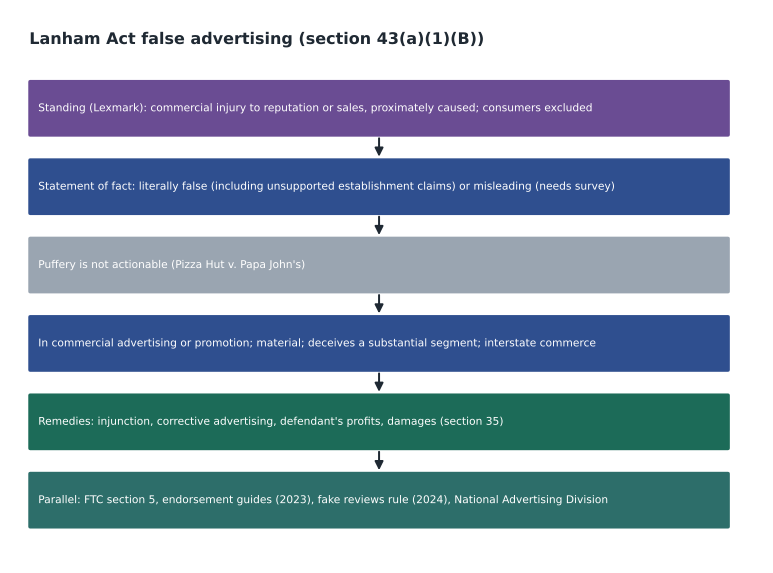
Section 43(a)(1)(B) creates a civil claim against anyone who, in commercial advertising or promotion, misrepresents the nature, characteristics, qualities or geographic origin of his or her or another person's goods, services or commercial activities. Courts list the elements as a false or misleading statement of fact about a product, made in commercial advertising or promotion, that is material to purchasing decisions, that actually deceives or has a tendency to deceive a substantial segment of the audience, that is placed in interstate commerce and that has caused or is likely to cause injury to the plaintiff. Comparative advertising is lawful and encouraged when it is truthful; a competitor may name HUSHWREN to compare products, so long as the comparison is accurate.
Statements fall into two categories. A literally false statement, either on its face or by necessary implication, is actionable without evidence of consumer reaction, and some courts presume deception and materiality for it. A statement that is literally true or ambiguous but misleading requires extrinsic evidence, usually a consumer survey, that a substantial portion of the audience took away the false message. Claims that a product has been tested or proven, called establishment claims, are literally false if the tests do not support them or do not exist; the plaintiff can win by showing that the defendant's tests were unreliable or did not prove the proposition asserted. Puffery, meaning vague, subjective or exaggerated claims that no reasonable buyer would rely on as fact, is not actionable. In Pizza Hut v. Papa John's International (5th Cir. 2000) the slogan "Better Ingredients. Better Pizza." was puffery on its own, though the court recognized that comparative claims about specific ingredients could make it misleading in context.
Keswick's ad makes both kinds of claims. "Blocks 2x more noise than HUSHWREN. Lab tested." is a specific, measurable comparative claim with an explicit reference to testing, a classic establishment claim. If Keswick's tests were not reliable, or did not compare the products under comparable conditions, the claim is literally false. Breckwood will need to show what Keswick's tests were, which discovery will reveal, and its own testing will help show they could not have supported the claim. The ad's tagline elsewhere, "the most comfortable earbuds ever made," is likely puffery.
Who may sue
In Lexmark International v. Static Control Components (2014) the Court rejected the competing standing tests the circuits had used and held that a plaintiff under section 43(a) must allege an injury to a commercial interest in reputation or sales, which places it within the statute's zone of interests, and that the injury must be proximately caused by the deception, which ordinarily occurs when deception of consumers causes them to withhold trade from the plaintiff. Direct competitors usually satisfy both requirements, but a plaintiff need not be a direct competitor; Static Control, which made components for remanufacturers of Lexmark cartridges, had standing to sue over Lexmark's statements that its products were illegal. Consumers cannot sue under the Lanham Act; they must use state consumer protection statutes. In POM Wonderful v. Coca-Cola (2014) the Court held that the Food, Drug, and Cosmetic Act does not preclude a Lanham Act false advertising claim challenging a food label, because the statutes complement each other.
Regulators and self-regulation
Private false advertising suits operate alongside public enforcement. Section 5 of the Federal Trade Commission Act prohibits unfair or deceptive acts or practices, and the FTC enforces it against false or unsubstantiated advertising, requiring advertisers to have a reasonable basis for objective claims before making them. The FTC's Guides Concerning the Use of Endorsements and Testimonials in Advertising, revised in 2023, say that an endorsement must reflect the honest opinions of the endorser and that advertisers must disclose material connections. In 2024 the FTC adopted a rule banning fake consumer reviews and testimonials, including reviews by people who do not exist or are generated by artificial intelligence, and certain undisclosed insider reviews. There is no private right of action under the FTC Act. Many advertising disputes between competitors are resolved by the National Advertising Division, a self-regulatory body that reviews whether advertising claims are substantiated and refers noncompliant advertisers to the FTC.
Remedies
A false advertising plaintiff may seek an injunction, including corrective advertising, and the monetary remedies of section 35: the defendant's profits, damages and costs, subject to the principles of equity, with discretion to enhance damages and, in exceptional cases, to award fees. Courts often require proof of actual consumer deception or willfulness before awarding money, though practice varies by circuit. Right of publicity remedies depend on state law and typically include injunctions, damages measured by the fair market value of the use (what the celebrity would have charged), the defendant's profits attributable to the use, and sometimes statutory or punitive damages. Waits recovered more than two million dollars, including damages for injury to his reputation and punitive damages.
Worked problem
The HUSHRUN advertisement
Advise (a) Wynona Marquand on her claims against Keswick and its agency, and (b) Breckwood on its claims against Keswick arising from the ad. Consider the disclaimer and the comparative claim.
Show solution
- Marquand, right of publicity: under Tennessee's ELVIS Act and the Midler line, a deliberate simulation of her distinctive voice in an ad after she declined to endorse is an unauthorized commercial use of her identity. The AI method does not change the appropriation. The agency that produced the vocal and any vendor whose tool's primary purpose was cloning her voice may also be liable under the ELVIS Act.
- Marquand, false endorsement: the voice is recognizable to the audience, and listeners likely believed she was singing for Keswick; a two-second disclaimer in small type at the end does not dispel confusion created by thirty seconds of her apparent voice. She can sue under section 43(a)(1)(A).
- First Amendment: the use is commercial advertising, not news, commentary or art, so Zacchini, Comedy III and the transformative use test offer Keswick little.
- Breckwood, false advertising: the 2x lab-tested claim is an establishment claim; if Keswick's testing does not support it, it is literally false and no survey is needed. Breckwood, a direct competitor losing sales, has standing under Lexmark. It can seek a preliminary injunction, corrective advertising and Keswick's profits. The comfort tagline is puffery.
- Alternatives: Breckwood could challenge the claim at the National Advertising Division, which is faster and cheaper but provides no damages, and could alert the FTC.
Answer: Marquand has strong state and federal claims; Breckwood has a strong establishment-claim case. The disclaimer is too late and too small to help Keswick with either.
Common mistakes
MistakeTreating the right of publicity as a federal right.
InsteadIt is state law, varying widely in scope and postmortem duration; the NO FAKES Act had not been enacted as of November 2026.
MistakeThinking only a person's name or photograph is protected.
InsteadCourts protect distinctive voices (Midler, Waits) and other attributes that evoke identity (White v. Samsung).
MistakeRequiring a consumer survey for every false advertising claim.
InsteadLiterally false statements, including unsupported establishment claims, need no extrinsic evidence of deception.
MistakeLetting consumers sue under section 43(a)(1)(B).
InsteadLexmark requires a commercial injury to reputation or sales; consumers rely on state law.
MistakeAssuming any disclaimer cures confusion or appropriation.
InsteadA disclaimer must be prominent and timely enough to dispel confusion, and it does not cure an unauthorized commercial use of identity.
Summary and key terms
- The right of publicity protects the commercial value of identity under state law (Haelan; New York Civil Rights Law sections 50 and 51; California Civil Code sections 3344 and 3344.1).
- Voice and other evocations of identity are protected (Midler, Waits, White v. Samsung).
- Tennessee's ELVIS Act (2024) protects voice, including simulations, and reaches tools whose primary purpose is cloning; California's 2024 statutes regulate digital replicas; the federal NO FAKES Act was pending as of November 2026.
- First Amendment limits: Zacchini (whole act broadcast not protected) and the transformative use test (Comedy III, Hart, NCAA); advertising is least protected.
- False endorsement claims under section 43(a)(1)(A) treat the persona as the mark.
- False advertising under section 43(a)(1)(B): a false or misleading statement of fact in commercial advertising, material, deceptive, in commerce, causing injury; literal falsity versus misleading claims; establishment claims; puffery is not actionable (Pizza Hut).
- Standing requires a commercial injury within the zone of interests, proximately caused (Lexmark); the FDCA does not bar Lanham claims (POM Wonderful).
- The FTC enforces section 5, its endorsement guides (2023) and its 2024 fake reviews rule; the National Advertising Division resolves many competitor disputes.
- Right of publicity
- A state-law right to control the commercial use of one's name, likeness, voice and other indicia of identity.
- Digital replica
- A computer-generated simulation of a person's voice or likeness.
- Transformative use test
- A First Amendment test asking whether a work adds significant creative elements beyond a mere likeness.
- False endorsement
- A Lanham Act claim for uses of a person's identity likely to cause confusion about sponsorship or approval.
- Establishment claim
- An advertising claim that a product's superiority has been proven by tests or studies.
- Puffery
- Vague or exaggerated subjective claims that no reasonable buyer would treat as fact.
- Zone of interests
- The range of interests a statute protects, which a plaintiff must fall within to sue.
Practice problems
Work each problem on paper first, then reveal the answer to check.
A car company hires a voice actor to imitate a famous singer's distinctive voice in an ad after the singer refused. What claims does the singer have?
Show answer
A right of publicity claim under Midler and Waits, and a Lanham Act false endorsement claim if listeners likely believed she endorsed the car.
A novelist writes a satirical novel in which a real celebrity appears as a character. Does the celebrity have a right of publicity claim?
Show answer
Unlikely to succeed; expressive works such as novels and satire are strongly protected, and the use is not commercial advertising; the transformative use test would also favor the novelist.
An ad says a supplement is clinically proven to double energy, citing one small unblinded study. A competitor sues. What theory?
Show answer
An establishment claim that is literally false if the study does not reliably prove the claim; the competitor need not show consumer confusion by survey.
A consumer who bought a product because of a false ad wants to sue under the Lanham Act. Can she?
Show answer
No. Under Lexmark, Lanham Act standing requires an injury to a commercial interest; she must use state consumer protection law.
Lesson quiz · 5 questions
Score 60% or more to complete this lesson.
Create a free account to save your progress, take quizzes and earn a certificate.