
LAWU-311 · Lesson 9 of 12 · 24 min
Expert witnesses at trial
▶ Video coming soon A video version of this lesson is on the way.
In many modern trials the decisive witnesses are experts. In Delgado, no one saw the inside of the battery pack catch fire; the case will turn on whether the jury believes the plaintiff's expert, Dr. Samuel Achterberg, who will testify that an internal short in cell 23 caused thermal runaway, or Kestrelwerk's thermal engineer, Dr. Anja Brenner. In State v. Pike, the cause of Lou Abbott's death depends on medical testimony about his heart disease, the shove and the delay before help arrived. Cadwallader begins the expert unit with a question: "Who decides whether an expert's opinion is good enough to hear?" Several students answer "the jury." "Half right," he says. "The judge decides whether the jury may hear it at all. The jury decides whether to believe it. Your job is to win both."
The admissibility standard: Rule 702
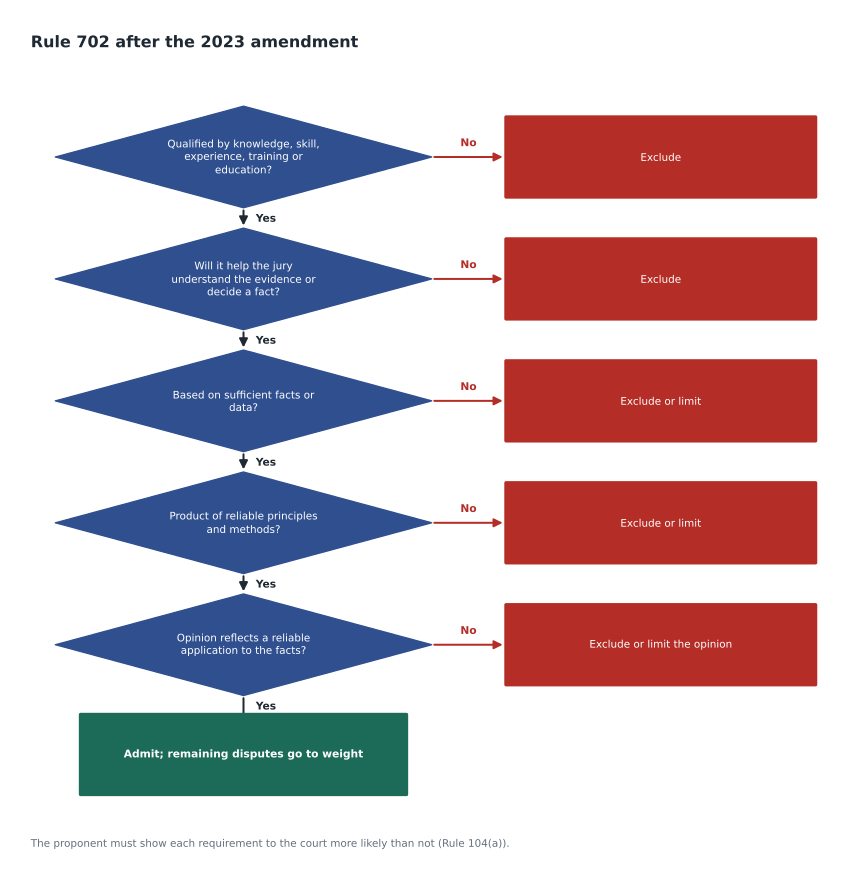
Rule 702 governs expert testimony in federal court. As amended effective December 1, 2023, it provides that a witness who is qualified as an expert by knowledge, skill, experience, training or education may testify in the form of an opinion or otherwise if the proponent demonstrates to the court that it is more likely than not that: (a) the expert's scientific, technical or other specialized knowledge will help the trier of fact to understand the evidence or to determine a fact in issue; (b) the testimony is based on sufficient facts or data; (c) the testimony is the product of reliable principles and methods; and (d) the expert's opinion reflects a reliable application of the principles and methods to the facts of the case.
The 2023 amendment made two clarifications. First, it stated expressly that the proponent must establish each requirement by a preponderance of the evidence, the Rule 104(a) standard, responding to the committee's concern that many courts had treated questions about the sufficiency of an expert's basis and the application of the methodology as questions of weight for the jury rather than admissibility for the judge. Second, it revised subdivision (d) to emphasize that the opinion itself must reflect a reliable application, so that an expert may not reach a conclusion that goes beyond what the methodology can reliably support. The committee note explains that once the court finds the threshold met, remaining disputes go to weight; but the threshold questions are for the judge.
The amendment built on three Supreme Court cases. In Daubert v. Merrell Dow Pharmaceuticals, Inc., 509 U.S. 579 (1993), the Court held that the Federal Rules of Evidence superseded the general acceptance test of Frye v. United States (D.C. Cir. 1923) and assigned the trial judge a gatekeeping role, listing factors such as whether the theory or technique can be and has been tested, whether it has been subjected to peer review and publication, its known or potential error rate and the existence of standards controlling its operation, and its general acceptance in the relevant community. In General Electric Co. v. Joiner, 522 U.S. 136 (1997), the Court held that appellate courts review a trial court's decision to admit or exclude expert testimony for abuse of discretion, and observed that nothing requires a court to admit opinion evidence connected to existing data only by the expert's say-so; a court may conclude that there is simply too great an analytical gap between the data and the opinion. In Kumho Tire Co. v. Carmichael, 526 U.S. 137 (1999), the Court held that the gatekeeping obligation applies to all expert testimony, not only scientific testimony, and that the Daubert factors may be applied flexibly. Many states follow Daubert; some, including several large states, retain the Frye test or a variant, and lawyers must know which standard applies in their courts.
The bases of expert opinion: Rules 703 to 705
Rule 703 allows an expert to base an opinion on facts or data the expert has been made aware of or personally observed. If experts in the particular field would reasonably rely on those kinds of facts or data in forming an opinion, they need not be admissible for the opinion to be admitted. But if the facts or data would otherwise be inadmissible, the proponent of the opinion may disclose them to the jury only if their probative value in helping the jury evaluate the opinion substantially outweighs their prejudicial effect. The rule prevents a party from using an expert as a conduit for inadmissible hearsay.
In criminal cases, the Confrontation Clause adds a further limit. In Smith v. Arizona, 602 U.S. 779 (2024), the Court held that when an expert conveys an absent analyst's statements in support of the expert's opinion, and the statements support that opinion only if true, the statements are offered for their truth; if they are testimonial, the defendant has a right to confront the analyst. The Court remanded for the state court to decide whether the absent analyst's notes and report were testimonial. After Smith, prosecutors cannot avoid confrontation by having a substitute expert relay another analyst's findings as the basis for the substitute's opinion. In Pike, if the original medical examiner, Dr. Irene Castellan, has retired abroad and her successor, Dr. Victor Lindahl, will testify to the cause of death, the State must consider which parts of Castellan's autopsy report Lindahl may rely on and convey, and whether the report is testimonial.
Rule 704(a) provides that an opinion is not objectionable just because it embraces an ultimate issue, so an expert may testify that a product was defective or that a death was caused by blunt-force trauma. Rule 704(b) creates an exception in criminal cases: an expert may not state an opinion about whether the defendant did or did not have a mental state or condition that constitutes an element of the crime or a defense; those matters are for the jury alone. Experts also may not tell the jury what legal standard to apply or what result to reach, which courts often treat as unhelpful under Rule 702 rather than barred by Rule 704. Rule 705 allows an expert to state an opinion and give the reasons without first testifying to the underlying facts or data, unless the court orders otherwise, though the expert may be required to disclose them on cross.
Pretrial disclosure
Expert testimony is shaped by pretrial disclosure rules. In federal civil cases, Rule 26(a)(2)(B) requires a written report from a retained expert containing a complete statement of all opinions and the basis and reasons for them, the facts or data considered, exhibits that will be used, the witness's qualifications including publications in the previous ten years, a list of cases in which the witness testified as an expert in the previous four years, and a statement of compensation. Rule 26(b)(4) protects drafts of reports and most communications between the party's attorney and the retained expert, with exceptions for compensation, facts or data the attorney provided and the expert considered, and assumptions the attorney provided and the expert relied on. Testimony beyond the scope of the report can be excluded under Rule 37(c)(1). In federal criminal cases, Rule 16, as amended effective December 1, 2022, requires both sides to disclose, on request, a complete statement of all opinions the expert will give, the bases and reasons for them, the witness's qualifications including publications in the previous ten years, and a list of cases in which the witness testified in the previous four years, signed by the witness.
Direct examination of an expert
An expert's direct examination has a different shape from a lay witness's. The lawyer must establish qualifications, but juries lose interest quickly in long recitations of degrees. Many lawyers cover qualifications briefly and in a way tied to the issues: not every publication, but the work most relevant to battery fires. Some courts discourage or forbid tendering a witness as an expert in front of the jury, on the theory that a judicial declaration that the witness is an expert can seem like an endorsement; in those courts the lawyer simply proceeds to the opinion after laying the foundation, and the opponent objects if it believes the foundation is inadequate.
A common structure for expert direct, sometimes described as teaching, is: who the expert is and why the expert was asked to help; the opinion, stated early and plainly; the basis, explained in steps the jury can follow, often with demonstratives; the reasons the other side's theory is wrong; and the opinion restated at the end. Experts should speak to the jury, not to the lawyer, and should translate technical terms into everyday language. A good expert direct uses analogies, diagrams and models. Rule 107 illustrative aids are especially valuable here, and Rule 1006 summaries can present data compactly.
Lawyers should bring out an expert's weaknesses on direct. If the expert is paid, say so: "Dr. Achterberg, are you being compensated for your time?" If the expert's testing differed in some respect from the conditions of the actual fire, explain why the difference does not matter. Juries trust experts who acknowledge limits.
Challenging experts before trial
The most powerful attack on an expert often comes before trial, in a motion to exclude under Rule 702, commonly called a Daubert motion. The court may decide the motion on the papers or hold an evidentiary hearing. A successful motion can end a case: if the plaintiff's causation expert is excluded, the defendant will usually win summary judgment. A partially successful motion can limit an expert to the opinions the methodology supports, which may change the theory of the case. After the 2023 amendment, lawyers frame these motions around the specific requirements: the proponent has not shown by a preponderance that the opinion rests on sufficient facts or data, or that it reflects a reliable application of the methods to the facts.
Cross-examining an expert
Cross-examination of an expert is a specialized skill. Lawyers rarely win by trying to out-argue an expert on the expert's own subject. Instead they use a set of familiar lines of attack, chosen from the theory of the case.
- Bias and compensation: fees for the case, the share of the expert's income from litigation, the proportion of work for plaintiffs or defendants, and any relationship with the party or its lawyers.
- Qualifications: gaps between the expert's training and the specific question (an electrical engineer opining on cell chemistry), lack of hands-on experience, or credentials that are less relevant than they sound.
- Assumptions and facts: the facts the expert assumed, which the examiner can show are disputed or wrong; facts the expert did not consider; and how the opinion would change if the assumption failed.
- Methodology: departures from the expert's own field's standards, from the expert's usual practice, or from published protocols; testing that did not replicate the relevant conditions.
- Learned treatises: under Rule 803(18), statements in a treatise, periodical or pamphlet may be read into evidence if called to the expert's attention on cross (or relied on on direct) and established as a reliable authority by the expert's admission, another expert's testimony or judicial notice. The statements are substantive evidence, but may be read and not received as exhibits.
- Prior inconsistent opinions: the expert's earlier testimony, articles or reports taking a different position.
- Concessions: points of agreement that help the cross-examiner's theory, often the most valuable part of an expert cross. "You agree that thermal runaway can also be caused by external damage." "You agree that the battery management system records were destroyed in the fire."
Worked problem
Cross-examining Dr. Achterberg
In Delgado, Dr. Samuel Achterberg will testify that an internal short in cell 23 caused the fire, based on his examination of the remains and four exemplar tests on new Trail 750 packs. In discovery Kestrelwerk learned that his exemplar tests used a charging profile different from the one the Trail 750's charger actually uses: he charged the cells at a higher current to accelerate results. He bills 650 dollars an hour and has testified for plaintiffs in battery cases thirty-one times in the past four years and for defendants twice. Before trial, Kestrelwerk moved to exclude his opinion under Rule 702; the court denied the motion but limited him to testifying that an internal short was the most likely cause, not that a design defect caused the short. Outline a cross for Marcus Webb, representing Kestrelwerk.
Show solution
- Begin with concessions, while the witness is cooperative: thermal runaway can result from internal defects, external damage, overcharging or third-party chargers; the battery management system data did not survive the fire; he did not test cell 23 before the fire, because no one could.
- Methodology chapter, the strongest attack: "Your exemplar tests used a charging current higher than the Trail 750 charger delivers." "You chose that current." "You chose it to get results faster." "The cells in Rosa Delgado's garage were never charged at that current." Stop there; the argument that the tests do not fit the facts, the analytical gap of Joiner and the reliable-application point of Rule 702(d), is for closing.
- Respect the court's limit: if Achterberg drifts toward saying the design caused the short, object immediately as beyond the court's Rule 702 ruling and ask for an instruction.
- Bias chapter, short: thirty-one cases for plaintiffs and two for defendants in four years; 650 dollars an hour; the total billed in this case. Keep the tone factual.
- Learned treatise, if available: if a recognized battery-safety handbook states that accelerated charging tests may not reproduce field failure modes, establish its authority through Dr. Brenner on direct or through Achterberg's admission, and read the passage.
- End on the strongest point: "You cannot tell this jury that the Trail 750's design caused cell 23 to short." Only if the court's ruling and his deposition guarantee the answer.
Answer: The cross obtains concessions first, attacks the fit between his accelerated tests and the actual charging conditions without asking him to agree that the tests are unreliable, uses the court's limiting ruling, shows his litigation pattern and fees briefly, and ends on the limit of his opinion. The analytical gap is argued in closing.
Court-appointed experts and special issues
Rule 706 allows the court to appoint an expert of its own choosing, on motion or on its own, and requires that the expert advise the parties of findings, be available for deposition and testimony, and be subject to cross-examination by any party. Courts use the power sparingly, usually in complex cases where the parties' experts are far apart. The court may disclose to the jury that the court appointed the expert.
Expert testimony also raises recurring issues in particular kinds of cases. In criminal cases, forensic evidence such as DNA, fingerprints, firearms identification and digital forensics is subject to the same Rule 702 standards, and defense lawyers increasingly challenge the reliability of pattern-matching disciplines and the way examiners state their conclusions. In civil cases, damages experts, including economists and life-care planners, often present some of the most consequential testimony, and courts scrutinize the assumptions behind their projections. In both settings the lawyer's task is the same: understand the expert's method well enough to explain it, defend it or show where it fails.
Common mistakes
MistakeTreating questions about an expert's data and application as matters of weight for the jury.
InsteadAfter the 2023 amendment, the proponent must show each Rule 702 requirement, including sufficient basis and reliable application, by a preponderance to the judge.
MistakeUsing an expert to relay inadmissible hearsay to the jury.
InsteadRule 703 permits disclosure of inadmissible bases only if their value in evaluating the opinion substantially outweighs their prejudicial effect, and Smith v. Arizona limits conveying testimonial statements in criminal cases.
MistakeAsking an expert on cross to agree that the expert's own method is unreliable.
InsteadEstablish the facts showing the gap, such as different test conditions, and argue unreliability in closing.
MistakeOffering a treatise as an exhibit under Rule 803(18).
InsteadLearned treatise statements may be read into evidence but not received as exhibits.
MistakeLetting a criminal expert testify that the defendant intended to kill.
InsteadRule 704(b) bars expert opinions on whether a criminal defendant had the required mental state.
Summary and key terms
- Rule 702, as amended in 2023, requires the proponent to show by a preponderance that the expert is qualified and that the testimony helps, rests on sufficient facts or data, uses reliable methods and reliably applies them.
- Daubert made the judge a gatekeeper, Joiner set abuse-of-discretion review and recognized the analytical gap, and Kumho extended gatekeeping to all expert testimony.
- Rule 703 allows reliance on inadmissible facts of a kind experts reasonably rely on, but limits disclosing them to the jury.
- Smith v. Arizona (2024) holds that an expert's conveyance of an absent analyst's statements as the basis for an opinion offers them for their truth for Confrontation Clause purposes.
- Rule 704(a) permits ultimate-issue opinions; Rule 704(b) bars opinions on a criminal defendant's mental state.
- Civil Rule 26(a)(2)(B) requires detailed reports from retained experts; Criminal Rule 16 (amended 2022) requires a complete statement of opinions and bases.
- Expert direct teaches: brief relevant qualifications, the opinion early, the basis in steps, and the weaknesses addressed.
- Expert cross uses concessions, bias, qualifications, assumptions, methodology, learned treatises under Rule 803(18) and prior inconsistent opinions.
- Gatekeeping
- The trial judge's duty under Rule 702 to admit only reliable and helpful expert testimony.
- Daubert motion
- A motion to exclude or limit expert testimony under Rule 702.
- Analytical gap
- A disconnect between an expert's data and conclusion that justifies exclusion (Joiner).
- Frye test
- The older general acceptance test for scientific evidence, still used in some states.
- Basis evidence
- The facts or data underlying an expert's opinion, governed by Rule 703.
- Ultimate issue
- A factual question the jury must decide; experts may address it except a criminal defendant's mental state.
- Learned treatise
- A reliable authority whose statements may be read into evidence under Rule 803(18).
- Court-appointed expert
- An expert chosen by the court under Rule 706, subject to deposition and cross by all parties.
Practice problems
Work each problem on paper first, then reveal the answer to check.
A plaintiff's toxicologist relies on animal studies at doses far higher than the plaintiff's exposure. What argument does Joiner support?
Show answer
That there is too great an analytical gap between the studies and the opinion about the plaintiff, so the court may exclude it; after 2023, the proponent must show by a preponderance that the opinion reliably applies the methods to the facts.
In a criminal trial, a substitute analyst testifies that, based on the original analyst's notes, the substance was methamphetamine. What issue does Smith v. Arizona raise?
Show answer
The notes support the opinion only if true, so they are offered for their truth; if testimonial, the defendant has a right to confront the original analyst.
May a defense expert in an insanity case testify that the defendant could not appreciate the wrongfulness of his conduct?
Show answer
No. Rule 704(b) bars an expert opinion on whether the defendant had the mental state or condition constituting an element or defense; the expert may describe the diagnosis and its characteristics.
How does a cross-examiner use a learned treatise with an expert who refuses to concede that it is authoritative?
Show answer
By establishing its authority through another expert or judicial notice, under Rule 803(18), and then reading the relevant statement into evidence.
Lesson quiz · 5 questions
Score 60% or more to complete this lesson.
Create a free account to save your progress, take quizzes and earn a certificate.