
LAWU-311 · Lesson 4 of 12 · 23 min
Opening statements
▶ Video coming soon A video version of this lesson is on the way.
Cadwallader gives his demonstration opening without notes, standing a few steps from the jury box, in a soft voice that makes the class lean forward. He is playing plaintiff's counsel in Delgado, and he begins not with the law, the parties or the word "evidence" but with a moment: "At 9:47 on a Tuesday night in March, Rosa Delgado's neighbor's doorbell camera recorded a flash of light in her garage." Four minutes later he stops and asks Section B what they remember. Almost everyone remembers the doorbell camera, the burns to her hands and the engineer's email. Few remember that he mentioned the burden of proof, though he did. "That is the lesson," he says. "The jury remembers the story you tell. The rest is housekeeping, and you must still do it."
What an opening statement is for
An opening statement tells the jury what the evidence will show. Its purpose is to give jurors a framework for understanding the testimony and exhibits to come, which in a long trial may arrive out of order, through witnesses whose relevance is not obvious until later. It is the jury's first sustained encounter with each side's case theory, and the research on primacy suggests that first impressions matter: jurors who have a coherent story in mind are better able to fit the evidence into it, and they may resist evidence that does not fit.
The opening statement is not evidence, and the court will tell the jury so, usually in the preliminary instructions and again in the final charge. It is also not argument. The traditional line is that an opening may state the facts the lawyer expects to prove and may preview the inferences the evidence will support, but may not argue: it may not urge conclusions, attack witnesses' credibility in characterizing terms, discuss the law at length, or appeal to emotion untied to the evidence. The line is not always sharp, and judges vary in how strictly they enforce it. A sentence such as "You will hear Kestrelwerk's own engineer write that the company was pushing these cells harder than the datasheet allowed" previews evidence. A sentence such as "Kestrelwerk is a company that cares more about profits than people" is argument, and invites an objection.
The promise rule
The most important rule of opening is to promise only what the lawyer can deliver. Model Rule 3.4(e) forbids a lawyer at trial to allude to any matter that the lawyer does not reasonably believe is relevant or that will not be supported by admissible evidence. A lawyer who tells the jury that a witness will testify to a fact, and then fails to produce the witness or the fact, has handed the opponent an argument for closing: "Remember what counsel promised you in opening? Where was it?" The consequences can be worse than embarrassment. A reference in opening to evidence the court has excluded, or to evidence the lawyer has no good-faith basis to expect, can lead to a curative instruction or a mistrial.
Two Supreme Court cases show how improper openings can end trials. In United States v. Dinitz, 424 U.S. 600 (1976), defense counsel's opening statement included matters the trial judge regarded as improper, and after the judge expelled the lawyer from the courtroom the defendant moved for a mistrial; the Court held that the Double Jeopardy Clause did not bar a retrial, because the defendant himself had sought the mistrial and the judge's conduct was not intended to provoke it. In Arizona v. Washington, 434 U.S. 497 (1978), defense counsel told the jury in opening that the prosecution had hidden evidence in an earlier trial; the trial court granted the prosecutor's motion for a mistrial, and the Supreme Court held that the trial judge's finding of manifest necessity deserved great deference, so retrial was permitted. For a criminal defendant, a mistrial caused by defense counsel's improper opening is rarely a gift: the defendant usually faces trial again, and the next jury will hear the prosecution's case presented with the benefit of a rehearsal.
Courts have also long recognized that an opening can sometimes decide a case outright. In Best v. District of Columbia, 291 U.S. 411 (1934), the Supreme Court acknowledged that a court may direct a verdict on the basis of counsel's opening statement where the statement establishes that the party cannot prevail, while cautioning that the power should be exercised carefully and only where the statement makes the absence of a claim clear. Modern practice rarely sees such rulings, but the principle reinforces the point that what a lawyer says in opening can bind the client. Statements of fact in opening may also be treated as judicial admissions in some circumstances, so a lawyer should not concede a point casually.
| Proper in opening | Improper in opening |
|---|---|
| "You will hear the engineer's email." | "The engineer's email proves Kestrelwerk is lying." |
| "The evidence will show the light was green when he entered the intersection." | "No honest person could believe their witness." |
| Previewing reasonable inferences from the expected evidence | Arguing conclusions or attacking credibility in characterizing terms |
| Briefly stating the claims and the burden of proof | Lengthy explanation of the law or quoting instructions not yet given |
| Showing exhibits the court has admitted or cleared in advance | Referring to evidence excluded in limine or not expected to be admitted |
| Acknowledging a weakness and explaining how the evidence answers it | Stating personal belief in the client's cause (Model Rule 3.4(e)) |
Structure
There is no single correct structure, but most effective openings share a shape. They begin with a strong first minute that introduces the theme and the human story. They introduce the people, so that the jury knows who is who before witnesses take the stand. They describe the scene, often with a diagram or photograph if the court permits. They tell the story of what happened, in an order chosen for clarity and impact. They explain the disputed issues and why the evidence resolves them in the client's favor. They address the weaknesses the jury will hear about. And they end by telling the jury what the lawyer will ask them to decide, often returning to the theme.
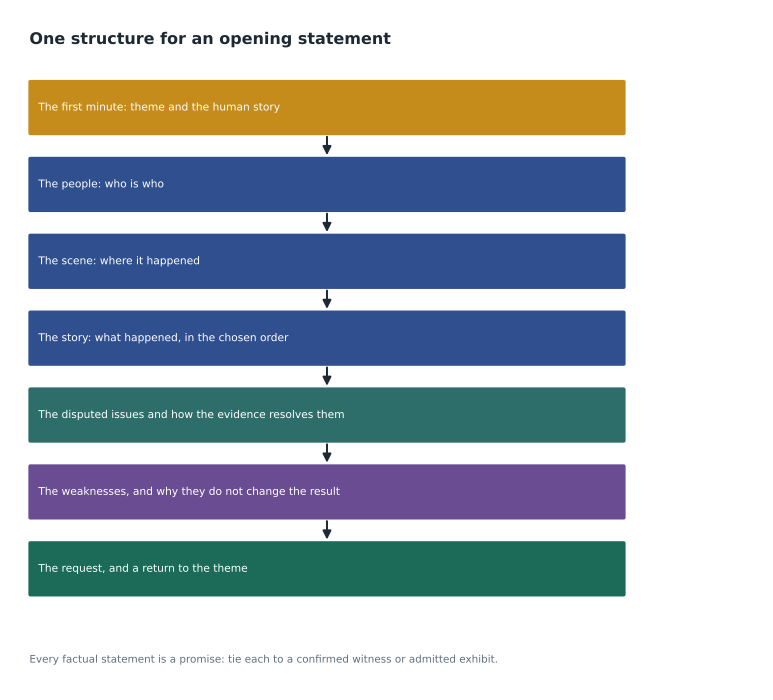
Many trial lawyers favor telling the story in the present tense or with sensory detail, because it helps jurors imagine events as they happened. "Rosa plugs in the charger, waits for the green light, and goes inside to make dinner" is more vivid than "The plaintiff testified that she charged the battery in her garage." But vividness has limits. Each detail is a promise: if Rosa will not testify that she waited for the green light, the lawyer cannot say she did. Lawyers therefore write openings from the witness outlines and exhibits, not from memory, and revise them after the court's rulings in limine.
The phrase "the evidence will show" deserves a word. Some lawyers use it repeatedly to signal that they are previewing evidence rather than arguing, and some judges expect it. But constant repetition dulls the story. Cadwallader's approach is to use the phrase once or twice at the outset, and to use it again whenever a sentence gets close to argument, as a reminder to everyone, including the lawyer, of what an opening is.
Length, delivery and visual aids
Openings should be as long as the case requires and no longer. Many courts set time limits, and even where they do not, jurors' attention fades. A short trial may need an opening of ten or fifteen minutes; a complex commercial case may need an hour. Lawyers should practice aloud, time themselves and cut. Delivery matters: eye contact with jurors, a steady pace, pauses before important points, and movement only with purpose. Reading an opening from a script signals that the lawyer does not know the case; most lawyers work from an outline or a few key phrases.
Visual aids can make an opening far more effective, but they must be handled carefully. Lawyers should disclose them to the other side and, ideally, obtain the court's approval before trial. Exhibits that have been admitted or pre-admitted, or that the opponent has stipulated to, may usually be shown. Exhibits whose admissibility is disputed should not be displayed until the court rules. Illustrative aids, such as a timeline or a diagram of the intersection, fall under Rule 107 since 2024 and must be fair summaries of the evidence the lawyer expects to present. A timeline that includes facts no witness will establish is a promise the lawyer cannot keep, and the opposing lawyer may use it in closing.
Dealing with weaknesses
Every case has weaknesses, and the opening is often the best place to deal with them. Jurors who first learn of a damaging fact from the opponent may wonder why the lawyer hid it; jurors who hear it first from the lawyer, with an explanation, are more likely to accept the explanation. This is the opening's version of drawing the sting. A plaintiff's lawyer in Delgado might say: "Kestrelwerk will tell you that two other Trail 750 batteries caught fire after owners dropped them or used a different charger. That is true. You will also hear that Rosa never dropped her bike, and that she used the charger Kestrelwerk supplied." Research on stealing thunder suggests that disclosing negative information first can reduce its impact, although the effect depends on the case and the way the information is presented.
Weaknesses should not be overemphasized. A lawyer who spends half the opening explaining away bad facts has let the opponent set the agenda. The skill is to acknowledge the fact briefly, give the jury the reason it does not change the result, and move back to the theory.
Worked problem
The first three minutes in Delgado
Priya Natarajan is assigned to give the plaintiff's opening in Delgado v. Kestrelwerk. The court has excluded the June 2026 firmware update under Rule 407 and the insurer's letter under Rule 409, and has admitted the 2024 recall only for notice, with a limiting instruction. Draft and critique the outline of her first three minutes.
Show solution
- First sentence: the moment. "At 9:47 on a Tuesday night in March, a doorbell camera next door recorded a flash in Rosa Delgado's garage." This is admissible evidence the jury will see, and it starts the story at its emotional center.
- The people: Rosa, an emergency room nurse; Kestrelwerk, the German company that designed and made the battery; Ridgeline Cycle Supply, the Ohio shop that sold it. Keep descriptions neutral and accurate; the jury will form its own views of each.
- The theme: "Kestrelwerk knew its cells were being pushed past their limits, and it did not tell anyone." Priya must be sure the evidence supports each part: the engineer's email supports the first half; the absence of any warning on the product supports the second.
- The road map: what the jury will hear from Rosa, her partner, the fire marshal, Kestrelwerk's own documents and Dr. Achterberg. Each witness is a promise, so the list must match the witness order.
- What she must not say: nothing about the firmware update, because it was excluded; nothing about the insurer's offer; and if she mentions the 2024 recall, she should frame it as notice, consistent with the limiting instruction, and should not suggest that Kestrelwerk recalled the Trail 750.
- The weakness: the two earlier fires reported by owners involved a dropped bike and a third-party charger. Priya addresses them in a sentence and contrasts Rosa's careful charging, which her partner observed for eight months.
Answer: Priya's first three minutes start with the doorbell video, introduce the parties, state a theme the evidence will support, preview the witnesses, and address the weakest point. She avoids every excluded subject and treats the recall only as notice. Each factual statement is tied to a witness or exhibit she has confirmed will be admitted.
The defense opening
Defense lawyers face a strategic choice in many courts: open immediately after the plaintiff or prosecution, or reserve the opening until the start of the defense case. Federal practice leaves the timing to the court's discretion, and many judges allow a defense to reserve. Most civil defense lawyers open immediately, because a jury that hears only one side's story for days may make up its mind. Criminal defense lawyers face a different calculation. Because the defendant has no burden and may decide not to present evidence, an immediate opening that promises a defense case can create expectations the defense later decides not to meet. A common middle path is to open immediately, focus on the prosecution's burden and the weaknesses in its proof, and avoid promising specific defense evidence, especially the defendant's own testimony, until the defense is sure it will be presented.
In State v. Pike, Jordan Kimura opens for the defense right after the State. He reminds the jury that the burden is on the State to prove each element beyond a reasonable doubt; he concedes that his client went to Riverside Salvage to steal copper; and he tells the jury that the question they will have to answer is not whether there was a theft but who shoved Lou Abbott, and whether the State can prove that the shove, rather than Abbott's heart disease and the forty minutes that passed before anyone called for help, caused his death. He does not tell the jury that Devon Pike will testify. He does tell them that they will hear Abbott say to the ambulance crew that he did not get a good look at the men, which the defense will elicit on cross.
Objecting during opening
Lawyers rarely object during an opponent's opening, both from courtesy and because jurors may see objections as an attempt to hide something. But objections are sometimes necessary: when the opponent argues, refers to excluded evidence, misstates the law or states a personal opinion. The objection should be short ("Objection, argument") and, if the problem is serious, followed by a request to approach. Where the opponent refers to excluded evidence, the lawyer must object promptly and ask for a curative instruction or a mistrial, or risk waiving the issue. Lawyers who choose not to object to minor overreaching often make a note and use it in closing: "In opening, counsel told you that you would hear from the company's safety director. You never did."
Common mistakes
MistakePromising testimony or exhibits the lawyer is not sure will be admitted.
InsteadEvery factual statement in opening is a promise; tie each to a confirmed witness or admitted exhibit (Model Rule 3.4(e)).
MistakeUsing the opening to argue the inferences and attack witnesses.
InsteadPreview the evidence and the reasonable inferences; save argument and credibility attacks for closing.
MistakeDisplaying a disputed exhibit before the court rules on it.
InsteadShow only admitted, stipulated or pre-cleared exhibits and illustrative aids that fairly reflect the expected evidence.
MistakeSaving every weakness for the opponent to reveal.
InsteadAddress significant weaknesses briefly in opening and explain why they do not change the result.
MistakeA criminal defense lawyer promising that the defendant will testify.
InsteadAvoid promising defense evidence, especially the defendant's testimony, until the decision is final.
Summary and key terms
- An opening statement previews the evidence and gives jurors a framework; it is neither evidence nor argument.
- Lawyers may state the facts they expect to prove and preview reasonable inferences, but may not argue, attack credibility in characterizing terms or state personal opinions.
- The promise rule: refer only to matters the lawyer reasonably believes will be supported by admissible evidence (Model Rule 3.4(e)).
- Improper openings can cause mistrials; Dinitz and Arizona v. Washington show that retrial usually follows.
- Best v. District of Columbia recognizes that an opening can, in rare cases, support a directed verdict.
- A common structure moves from a strong first minute through the people, the scene, the story, the disputed issues and weaknesses to a request.
- Visual aids must be disclosed and must fairly reflect expected evidence; illustrative aids fall under Rule 107.
- Defense lawyers choose whether to open immediately or reserve; criminal defense lawyers should avoid promising evidence they may not present.
- Opening statement
- Counsel's preview of the evidence at the start of a party's case, not evidence and not argument.
- Promise rule
- The principle that a lawyer must deliver the evidence promised in opening, grounded in Model Rule 3.4(e).
- Reserving the opening
- A defense choice to give its opening at the start of its own case rather than after the plaintiff's opening.
- Stealing thunder
- Disclosing damaging information first to reduce its impact.
- Curative instruction
- An instruction telling the jury to disregard improper statements or evidence.
- Manifest necessity
- The standard under which a court may declare a mistrial over a criminal defendant's objection without barring retrial.
- Judicial admission
- A formal concession by a party or counsel that removes a fact from dispute.
- Road map
- The part of an opening that tells the jury what witnesses and evidence it will hear.
Practice problems
Work each problem on paper first, then reveal the answer to check.
In opening, a prosecutor says, "The defendant is a liar, and you'll see that." What objection is available?
Show answer
Argument, and an improper personal opinion on credibility under Model Rule 3.4(e). Defense counsel should object and request a curative instruction.
Why might a civil defense lawyer decline to reserve the opening?
Show answer
Because jurors may form firm views during days of the plaintiff's case if they hear no competing story, so most civil defendants open immediately.
Plaintiff's counsel tells the jury in opening that a safety expert will testify, but the court later excludes the expert. What can defense counsel do in closing?
Show answer
Remind the jury, within the court's rulings, that counsel promised evidence that never came, and argue that the plaintiff failed to prove what it said it would. Defense counsel should not comment on the reason for exclusion.
May a lawyer show a timeline in opening that includes an event no witness will testify to?
Show answer
No. An illustrative aid must fairly reflect the evidence the lawyer expects to present; an unsupported entry is an improper promise and invites objection.
Lesson quiz · 5 questions
Score 60% or more to complete this lesson.
Create a free account to save your progress, take quizzes and earn a certificate.