
LAWU-311 · Lesson 5 of 12 · 23 min
Direct examination
▶ Video coming soon A video version of this lesson is on the way.
Cadwallader calls direct examination "the part of trial that lawyers think is easy and juries know is not." On direct the lawyer's own witness tells the story, and the lawyer's job is to stay out of the way while making sure the story is complete, clear, admissible and memorable. The best direct examinations look like conversations in which a credible person explains what happened. Behind them is careful work: an outline built from the theory and the proof chart, questions designed to draw out facts in the witness's own words, exhibits integrated at the right moments, and anticipation of every objection the other side may make. In the Thursday exercise Marcus Webb conducts the direct of Rosa Delgado, played by a volunteer from the law school's clinic staff, and the class reviews the video afterward with the sound off. "Watch who the jury would be looking at," Cadwallader says. "If it's the lawyer, the lawyer is talking too much."
The rules: personal knowledge, competence and the form of questions
The evidence rules set the frame. Under Rule 601, every person is competent to be a witness unless the rules provide otherwise, though in civil cases state law governs competency for claims and defenses on which state law supplies the rule of decision. Under Rule 602, a lay witness may testify to a matter only if evidence is introduced sufficient to support a finding that the witness has personal knowledge of it, and the witness's own testimony may supply that evidence. Under Rule 603, the witness must give an oath or affirmation to testify truthfully. Laying the foundation for personal knowledge is therefore the first task with nearly every witness: where were you, what could you see or hear, and why were you paying attention.
Rule 611 governs the mode and order of examining witnesses. Under Rule 611(a), the court should exercise reasonable control to make the examination and presentation effective for determining the truth, to avoid wasting time, and to protect witnesses from harassment or undue embarrassment. Under Rule 611(c), leading questions should not be used on direct examination except as necessary to develop the witness's testimony. Ordinarily the court should allow leading questions on cross-examination, and when a party calls a hostile witness, an adverse party, or a witness identified with an adverse party. Courts commonly permit leading on direct for preliminary or undisputed matters, to direct the witness's attention to a subject, for witnesses with difficulty communicating such as young children, and where a witness's memory is exhausted.
A leading question is one that suggests the answer. "You plugged the charger in at about six, didn't you?" is leading; "What did you do when you got home?" is not. Questions that begin with who, what, when, where, why, how, describe and explain are generally not leading. The concern is that a friendly lawyer can put words into a cooperative witness's mouth, and the jury will hear the lawyer's version rather than the witness's. A lawyer who leads on direct invites objections, and a sustained objection in front of the jury can make it seem that the lawyer does not trust the witness. Even when leading would be allowed, it is often a poor tactic: jurors want to hear the witness, not the lawyer.
The opposite problem is the narrative. A question such as "Tell us everything that happened that night" may draw an objection that it calls for a narrative, because the opponent cannot anticipate and object to inadmissible matter before the jury hears it. Courts have discretion under Rule 611(a) to allow narrative answers from a well-prepared witness, and some judges permit them for short passages. The skill is to ask open questions with a narrow scope: "What happened after you went inside?" rather than "What happened that night?"
Structure
Most direct examinations follow a common structure. The lawyer introduces the witness and lets the jury learn who the witness is. The lawyer accredits the witness, showing why the witness's account deserves belief: the opportunity to observe, the reason to remember, the lack of bias. The lawyer sets the scene, so that the jury can picture the place before the action begins. The lawyer then takes the witness through the action, slowly and in detail at the important moments. Finally the lawyer covers the aftermath, which in a personal injury case includes the injuries, treatment and effect on the person's life.
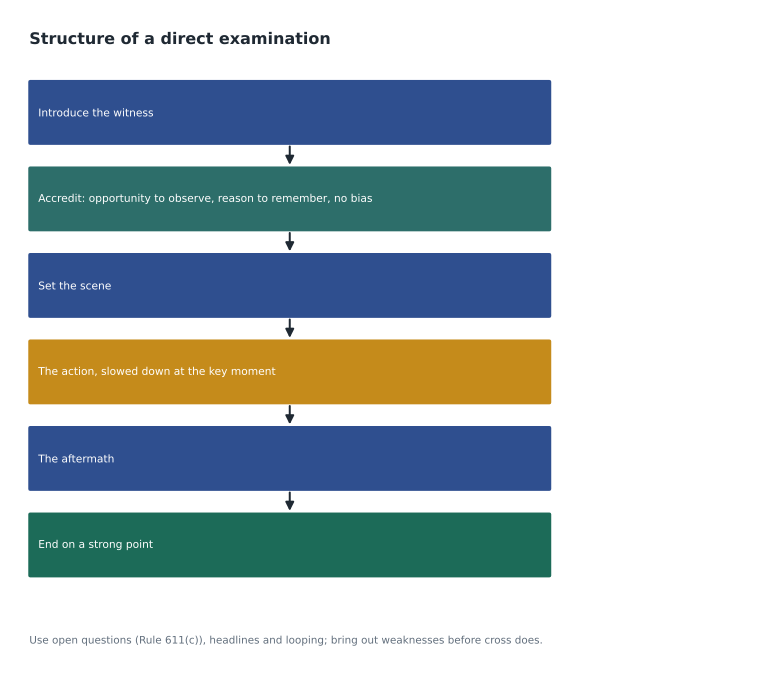
Lawyers use several techniques to make direct testimony clear. Headlines, or transitional statements, tell the jury where the examination is going: "Ms. Delgado, I want to turn now to the night of the fire." Many judges permit short headlines as a form of question; some prefer a question ("Let's talk about the night of the fire. Where were you at about six o'clock?"). Looping repeats a key word from an answer in the next question: "You saw a flash. What color was the flash?" Slowing down at the key moment lets the jury experience it: rather than "What happened then?" the lawyer asks a series of short questions about each second. And the lawyer chooses what to leave out. A witness need not tell the jury every fact the witness knows, only the ones the theory needs.
Direct examinations should begin and end with strength, consistent with primacy and recency. A strong first impression helps the jury trust the witness; a strong final answer stays with the jury when the cross begins. Cadwallader also teaches students to anticipate cross by bringing out weaknesses on direct. If Rosa Delgado will be asked on cross whether she ever left the battery charging overnight, the jury should hear first, from her, that she never did and why.
Exhibits on direct
Most exhibits come in through direct examination. The lawyer marks the exhibit, shows it to opposing counsel, asks the witness to identify it, lays the foundation for authentication and any hearsay exception, and offers it. The foundations are the subject of the next lesson. On direct, the art lies in timing and use: an exhibit should arrive at the point in the story where it helps the jury understand, and once it is admitted the lawyer should use it, for example by having the witness mark a diagram, read a key sentence from a document or narrate a video. An exhibit that is admitted and never shown to the jury has wasted the time spent on its foundation.
Refreshing recollection
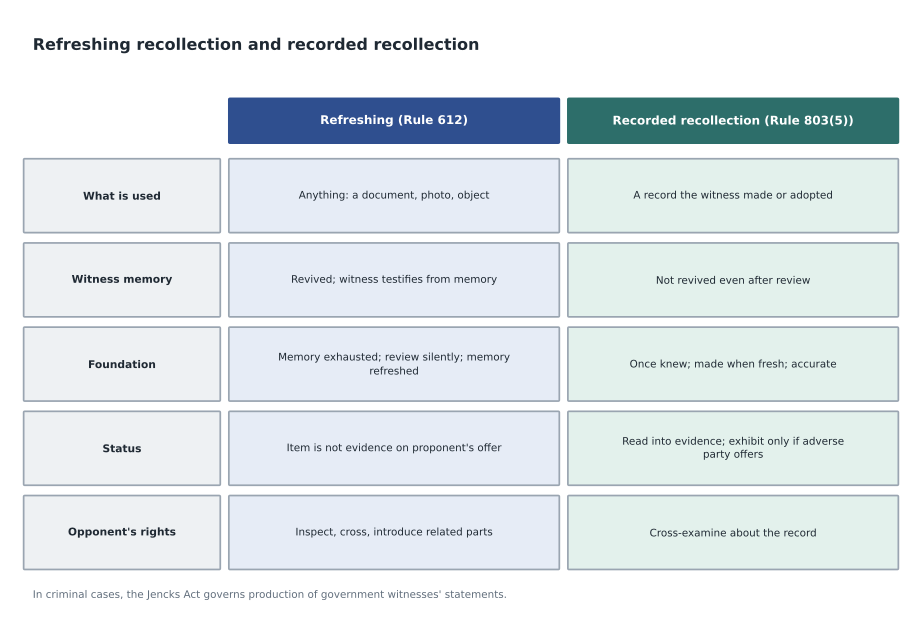
Witnesses forget. When a witness on the stand cannot remember a detail, the lawyer may try to refresh the witness's memory. Almost anything can be used: a document, a photograph, a song. The procedure is to establish that the witness does not remember, to show the witness the item (without reading it aloud or showing it to the jury), to ask the witness to read it silently and look up, and then to ask whether the witness's memory is refreshed. If it is, the witness testifies from present memory, and the item itself is not evidence. If the witness merely reads from the item, the memory has not been refreshed.
Rule 612 protects the opponent when a witness uses a writing to refresh memory. If the witness uses a writing to refresh memory while testifying, the adverse party is entitled to have the writing produced at the hearing, to inspect it, to cross-examine the witness about it and to introduce in evidence any portion that relates to the witness's testimony. If the witness used the writing before testifying, the same rights arise if the court decides that justice requires them. In criminal cases, Rule 612 yields to the Jencks Act, 18 U.S.C. section 3500, which governs production of statements of government witnesses. The before-testifying branch matters in practice: documents a lawyer gives a witness to review in preparation, even privileged ones, may have to be produced if the court decides justice requires it, so lawyers think carefully about what they use to prepare.
Recorded recollection
Sometimes refreshing fails. The witness looks at the document, looks up and says, "I'm sorry, I still don't remember." The lawyer may then be able to use the document itself under the hearsay exception for recorded recollection in Rule 803(5). The exception covers a record that is on a matter the witness once knew about but now cannot recall well enough to testify fully and accurately, that was made or adopted by the witness when the matter was fresh in the witness's memory, and that accurately reflects the witness's knowledge. If admitted, the record may be read into evidence, but may be received as an exhibit only if offered by an adverse party. That last limit keeps the jury from giving a document more weight than live testimony by taking it into the jury room.
Worked problem
Refreshing Ray Dunleavy
In State v. Pike, the State calls Ray Dunleavy, the truck driver who found Lou Abbott. On direct the prosecutor, played by Daniel Reyes, asks what time Dunleavy called 911. Dunleavy says, "I don't remember exactly. Sometime after midnight." Dunleavy wrote the time, 12:14 a.m., on the back of his delivery log that night while he waited for the ambulance. How should the prosecutor proceed, and what may defense counsel do?
Show solution
- Establish the failure of memory: "Do you remember the exact time?" "No." "Is there anything that would help you remember?" "I wrote it on my log."
- Mark the log for identification, show it to defense counsel, and hand it to the witness. "Please read the back of the log to yourself and look up when you're done." The prosecutor does not read it aloud.
- Ask: "Does that refresh your memory about when you called 911?" If yes: "What time did you call?" "12:14." The witness now testifies from refreshed memory, and the log is not admitted on the prosecutor's offer.
- If the memory is not refreshed, lay the Rule 803(5) foundation: Dunleavy once knew the time, cannot now recall it well enough, wrote it himself while waiting for the ambulance, and wrote it accurately. The prosecutor may then read the entry into evidence; the log itself becomes an exhibit only if the defense offers it.
- Defense rights: because Dunleavy used the log while testifying, Rule 612 entitles defense counsel to inspect it, to cross-examine about it and to introduce any portion relating to his testimony. If the log contains other relevant entries, such as a note that Abbott said he "didn't see their faces," the defense may introduce that portion.
Answer: The prosecutor should try refreshing first, with the log shown only to the witness; if that works, Dunleavy testifies from memory. If it fails, the log entry can be read into evidence under Rule 803(5). Either way, Rule 612 gives the defense the right to inspect and use the log, which may help the defense.
Redirect examination
After cross, the party who called the witness may conduct redirect. Redirect is ordinarily limited to matters raised on cross, and its purposes are to repair damage, to explain apparent inconsistencies and to put cross-examination points in context. A good redirect is short. It asks one or two questions that let the witness explain what cross suggested: "Counsel asked whether you told the officer you weren't sure about the time. Why weren't you sure then?" Lawyers should resist the urge to repeat the direct, which rarely helps and may irritate the jury and the judge.
Redirect is also where rehabilitation occurs. If cross-examination has attacked the witness's character for truthfulness, Rule 608(a) permits evidence of the witness's truthful character, but only after an attack. If cross has charged that the witness recently fabricated testimony or was influenced by a motive, a prior consistent statement may be admissible as substantive evidence under Rule 801(d)(1)(B)(i). The Supreme Court held in Tome v. United States, 513 U.S. 150 (1995), that such a statement must have been made before the alleged motive to fabricate arose. Since a 2014 amendment, Rule 801(d)(1)(B)(ii) also admits prior consistent statements as substantive evidence when offered to rehabilitate the witness's credibility on another ground, such as a charge of inconsistency or faulty memory. Under either branch, the witness must testify and be subject to cross-examination about the prior statement.
Special witnesses
Some witnesses need special handling. Children may require leading questions, breaks and, in some cases, alternative procedures such as testimony by closed-circuit television when a court finds case-specific necessity, as the Supreme Court required in Maryland v. Craig, 497 U.S. 836 (1990), and reaffirmed in Pitts v. Mississippi (2025), which held that a trial court must make such a finding before screening a child witness from the defendant. Witnesses who need an interpreter must have one qualified and sworn under Rule 604. Witnesses who testify remotely require the court's permission; Federal Rule of Civil Procedure 43(a) allows testimony by contemporaneous transmission from a different location for good cause in compelling circumstances and with appropriate safeguards. Hostile witnesses and adverse parties may be led, which changes the examination from a conversation into a controlled series of facts, much like cross-examination.
Calling the adverse party is a powerful tool in civil cases. In Delgado, the plaintiff may call Kestrelwerk's product manager as an adverse witness and lead him through the late-2025 production surge and the shortened thermal test cycles. The risk is that the witness will use open moments to explain, and the defense will then conduct what amounts to a friendly direct when its turn comes. Lawyers who call adverse witnesses keep the questions tight and the examination short.
Objections the direct examiner should expect
The examining lawyer should anticipate the objections the opponent is likely to make and design questions to avoid them. Common objections to direct examination include leading, calls for a narrative, lack of personal knowledge, speculation, hearsay, improper lay opinion under Rule 701, assumes facts not in evidence, asked and answered, and improper bolstering (vouching for the witness's credibility before it has been attacked). A well-prepared lawyer can respond to most of them by rephrasing. If an objection to leading is sustained, the cure is almost always to begin the question again with "what" or "how." If a hearsay objection is sustained, the lawyer may need to establish a foundation for an exception or offer the statement for a nonhearsay purpose, and should be ready to explain that purpose at the bench.
Common mistakes
MistakeLeading a friendly witness through the important facts.
InsteadRule 611(c) limits leading on direct; use open questions so the witness, not the lawyer, tells the story.
MistakeAsking the witness to read from a document used to refresh memory.
InsteadRefreshed testimony comes from present memory; the witness reads silently, looks up and then testifies.
MistakeOffering a recorded recollection as an exhibit for the jury room.
InsteadUnder Rule 803(5) the record is read into evidence and becomes an exhibit only if the adverse party offers it.
MistakeGiving a witness privileged notes to review the night before testimony without considering Rule 612.
InsteadThe court may order production of writings used to refresh before testifying if justice requires; choose preparation materials with that in mind.
MistakeRepeating the entire direct on redirect.
InsteadRedirect is limited to the scope of cross and should repair specific damage briefly.
Summary and key terms
- Direct examination lets the lawyer's own witness tell the story; the lawyer's goal is clarity, completeness and admissibility.
- Rules 601 to 603 require competence, personal knowledge and an oath; personal knowledge is the first foundation for most witnesses.
- Rule 611(c) bars leading on direct except as necessary, and permits leading of hostile witnesses, adverse parties and those identified with them.
- A common structure moves through introduction, accreditation, scene, action and aftermath, using headlines, looping and slowing down.
- Refreshing recollection uses any item to revive present memory; Rule 612 gives the adverse party rights to the item, and the Jencks Act governs in criminal cases.
- Recorded recollection under Rule 803(5) admits a fresh, accurate record of a forgotten matter, read into evidence and received as an exhibit only on the adverse party's offer.
- Redirect is limited to the scope of cross; prior consistent statements may rehabilitate under Rule 801(d)(1)(B), subject to Tome's premotive rule for fabrication charges.
- Special witnesses may require leading, interpreters, remote testimony under Civil Rule 43(a) or protective procedures supported by case-specific findings (Craig; Pitts).
- Direct examination
- The questioning of a witness by the party who called the witness.
- Leading question
- A question that suggests the answer.
- Accrediting a witness
- Showing why a witness's account deserves belief, such as opportunity to observe and lack of bias.
- Headline
- A short transition telling the jury what subject the examination will cover next.
- Looping
- Repeating a key word from a witness's answer in the next question to emphasize it.
- Refreshing recollection
- Using an item to revive a witness's present memory; the item is not evidence.
- Recorded recollection
- A hearsay exception under Rule 803(5) for a fresh, accurate record of a matter the witness can no longer recall.
- Redirect examination
- Questioning by the calling party after cross, limited to matters raised on cross.
Practice problems
Work each problem on paper first, then reveal the answer to check.
On direct, plaintiff's counsel asks, "And then you saw the battery catch fire, right?" What is the objection, and how should counsel rephrase?
Show answer
Leading. Counsel should ask, for example, "What did you see next?"
A witness reviews her own diary the night before testifying. On cross, opposing counsel asks for the diary. Must it be produced?
Show answer
Under Rule 612(a)(2), the court may order production if it decides justice requires it, because the witness used the writing to refresh memory before testifying.
A police officer cannot remember the license plate he wrote in his report at the scene, even after reading the report. How can the plate number be proved?
Show answer
Through Rule 803(5), if the officer made the record when the matter was fresh and it accurately reflects his knowledge. The entry may be read into evidence; the report itself becomes an exhibit only if the opponent offers it. In a criminal case, the report's use against the defendant may also raise issues under Rule 803(8).
On cross, defense counsel suggests that the plaintiff invented her account of the fire after hiring a lawyer. What can plaintiff's counsel do on redirect?
Show answer
Offer a prior consistent statement made before the alleged motive arose, such as her statement to the fire marshal the night of the fire, as substantive evidence under Rule 801(d)(1)(B)(i), consistent with Tome.
Lesson quiz · 5 questions
Score 60% or more to complete this lesson.
Create a free account to save your progress, take quizzes and earn a certificate.