
LAWU-311 · Lesson 12 of 12 · 26 min
Capstone: trying the case
▶ Video coming soon A video version of this lesson is on the way.
The last weeks of Trial Advocacy are a full mock trial in a file Section B has never seen. Professor Lucinda Hartigan, who taught the class Evidence after nine years on a state trial bench, presides. Volunteers from the law school staff and the community play the witnesses and sit as jurors. Priya Natarajan and Jordan Kimura represent the plaintiff; Daniel Reyes and Marcus Webb represent the defendants; Hannah Lindqvist serves as Hartigan's law clerk and writes the bench memos on the motions in limine. Before the trial, each team must file a trial plan memorandum. Cadwallader hands out the file and tells them that the memo is the real exam: "Anyone can stand up. The question is whether you know, before you stand, what you need, how you will get it in, and what the other side will do." This lesson sets out the file and then works through the plan, issue by issue, in memo form.
The file: Asamoah v. Bellwick Linen Service, Inc. and Colby Kestle
The case is entirely fictional and is set in the fictional State of Westmarch, in the city of Brennan Falls. For the exercise, Westmarch's rules of civil procedure and evidence are identical to the federal rules, including the amendment to Rule 801(d)(1)(A) effective December 1, 2026, which Westmarch has adopted on the same terms. Westmarch follows modified comparative fault: a plaintiff whose fault is greater than the combined fault of the defendants recovers nothing, and otherwise the plaintiff's damages are reduced in proportion to her share of fault. Bellwick admits that Kestle was acting within the scope of his employment, so Bellwick is vicariously liable for any negligence by Kestle.
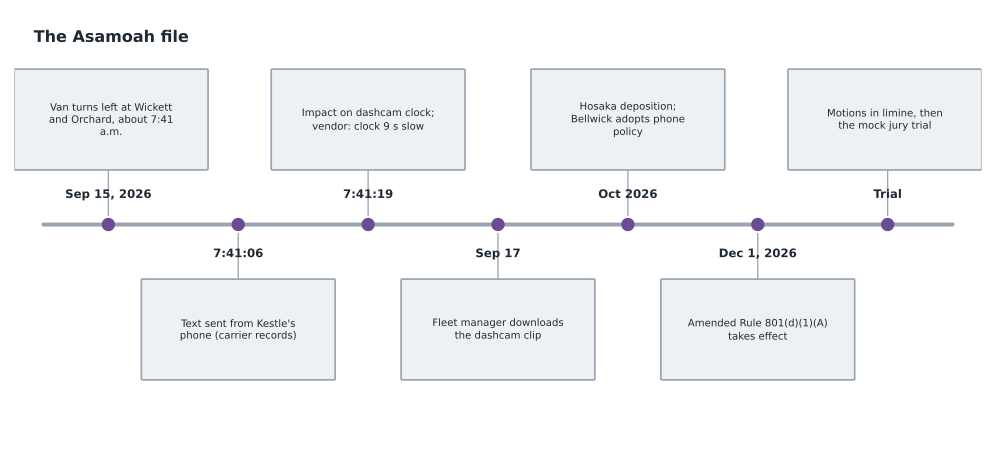
- The crash. At about 7:41 a.m. on Tuesday, September 15, 2026, Abena Asamoah, 52, a middle school librarian, was crossing Wickett Avenue northbound in the marked crosswalk at its signalized intersection with Orchard Street. A white Bellwick Linen Service box van driven by Colby Kestle, 24, was traveling eastbound on Orchard and turned left onto Wickett, crossing the crosswalk. The van struck Asamoah. The morning sun was low in the east, roughly in Kestle's line of sight as he approached the turn.
- Injuries. Asamoah suffered a fractured tibial plateau in her right knee and a fractured left wrist. Her surgeon, Dr. Farhan Talwar, repaired the knee with plates and screws. She missed nine weeks of work. Medical bills are about 68,000 dollars and lost wages about 14,500 dollars. Dr. Talwar expects post-traumatic arthritis and a likely knee replacement within ten to fifteen years.
- The dashcam. The van had a forward-facing dashcam that records continuously and saves a clip when it detects a sudden deceleration. The saved clip shows the turn and the impact. Bellwick's fleet safety manager, Iona Quayle, downloaded the clip from the camera vendor's cloud portal two days later. The clip's timestamp shows impact at 7:41:19. The camera's clock is set by the vendor's system, and Quayle has a vendor report showing the clock had drifted 9 seconds slow at the last synchronization.
- The text message. Kestle's company phone records, produced by the carrier with a custodian's certification, show a text message sent from the phone at 7:41:06. Kestle says he dictated it by voice at the red light on Orchard before the light turned green, telling his dispatcher he was running five minutes late, and that his hands were on the wheel during the turn.
- The pedestrian signal. City timing sheets for the intersection, produced by the city traffic engineer, show that the Wickett crosswalk displays WALK for 7 seconds, then a flashing DON'T WALK for 16 seconds, then a steady DON'T WALK, and that the eastbound Orchard left turn is permissive (yielding to pedestrians) during that phase. The signal controller does not keep a log of individual cycles.
- Mortimer Hosaka. Hosaka, 68, a retired machinist, was waiting at the bus shelter on the corner. Officer Haddix's body camera recorded Hosaka telling her at the scene: "The little walking man was lit. She had the walk. That van just came around." At his deposition in October 2026, Hosaka said, "I think it was flashing when she started, the hand. I'm not sure." Hosaka's nephew has worked as a Bellwick driver for two years.
- Kendall Ruskin. Ruskin, Bellwick's newest delivery helper, was in the passenger seat three weeks into the job. He will testify that Kestle had both hands on the wheel, that their light was green and that the pedestrian "came out of nowhere." Officer Haddix's report quotes Ruskin at the scene: "I was looking at the route sheet. I heard the bang."
- Statements at the scene. Asamoah says that Kestle knelt beside her and said, "I'm so sorry, I didn't see you, the sun was right in my eyes." Kestle admits saying he was sorry but does not remember the rest. Asamoah was wearing a navy coat and had one wireless earbud in, playing an audiobook at what she says was low volume.
- After the crash. In October 2026 Bellwick adopted a policy forbidding drivers to send or dictate messages while the vehicle is in traffic, including at red lights, and requiring phones to be mounted. Kestle received a speeding ticket in 2024 for going 12 miles per hour over the limit on a highway. Bellwick is insured.
- Experts. The plaintiff's accident reconstructionist, Dr. Renske Szymanek, will use the dashcam frames to calculate the van's speed through the turn (about 17 miles per hour), the time from the start of the turn to impact, and, by correcting the dashcam clock for the vendor's 9-second drift, the timing of the text relative to the turn. The defense's human factors expert, Everard Yeats, will testify about sun glare at that time and direction, perception-reaction time and the conspicuity of a pedestrian in a dark coat.
The assignment
Each team must write a trial plan memorandum addressing: (1) its case theory and theme; (2) jury selection issues; (3) its motions in limine and its responses to the other side's; (4) the foundations for the key exhibits; (5) the examination plan for Hosaka and Ruskin, including impeachment; (6) the expert issues; and (7) an outline of closing, including damages and comparative fault. The model plaintiff's memo below is the one Cadwallader distributes after the trial, annotated with the defense's responses.
Worked problem
Plaintiff's trial plan memorandum (model answer)
Prepare the plaintiff's trial plan in Asamoah v. Bellwick Linen Service, Inc. and Colby Kestle, analyzing each issue in IRAC form and noting the defense's likely responses.
Show solution
- I. Theory and theme. Issue: what story explains all the evidence and satisfies the elements of negligence and damages while defeating comparative fault? Rule: the plaintiff must prove duty, breach, causation and damages by a preponderance; a left-turning driver must yield to pedestrians lawfully in the crosswalk. Application: the plaintiff's theory is that Kestle, running late and dictating a text, turned into the crosswalk with the sun in his eyes without slowing to make sure it was clear, while Asamoah crossed on the WALK signal. The theme: "He was in a hurry, and he turned anyway." The theory accounts for the bad facts: the navy coat and the earbud do not matter if she had the signal and he did not look. Conclusion: build the trial around the signal timing, the text and the apology.
- II. Jury selection. Issue: how should the plaintiff identify bias and respond to discriminatory strikes? Rule: voir dire under Rule 47(a); challenges for cause; peremptories under the governing statute; Batson applies to civil litigants under Edmonson. Application: plaintiff's counsel will ask about experiences with distracted driving, commercial drivers, pedestrians and lawsuits, and will listen for jurors who believe pedestrians are responsible for their own safety. If the defense strikes a disproportionate number of Black jurors, counsel should object, make a record of the pattern, and use comparative juror analysis at step three, as in Miller-El and Flowers. Conclusion: prepare a seating chart and notes adequate to support or answer a Batson objection.
- III. Motions in limine. (a) Bellwick's new phone policy. Rule 407 excludes subsequent remedial measures offered to prove negligence or culpable conduct. The policy was adopted after the crash and is excluded for that purpose, unless Bellwick disputes the feasibility of such a policy or the plaintiff needs it to impeach; the plaintiff should not count on either. (b) Kestle's 2024 speeding ticket. Under Rule 404(b) it is inadmissible to show that he is a careless driver; no permitted purpose applies, and a traffic citation is not a conviction usable under Rule 609. The plaintiff should not offer it. (c) Insurance. Rule 411 excludes evidence of liability insurance to prove negligence; both sides should be bound by an order. (d) The apology. Kestle's statement "I'm so sorry, I didn't see you, the sun was right in my eyes" is an opposing party's statement under Rule 801(d)(2)(A) against Kestle; it is also admissible against Bellwick under Rule 801(d)(2)(D) as a statement by its employee on a matter within the scope of employment. Westmarch has no apology statute in this exercise. (e) The earbud. The defense may offer it on comparative fault; the plaintiff should not seek exclusion, which would fail, but should address it in opening. Conclusion: seek definitive rulings on (a) to (c) under Rule 103(b) and confirm the admissibility of (d).
- IV. Exhibit foundations. (a) The dashcam clip: authenticate under Rule 901(b)(9) through Iona Quayle, who can describe how the system records, how she downloaded the clip and that it was not altered; or obtain a Rule 902(13) or (14) certification with notice; and use the pictorial testimony theory through Asamoah or Hosaka for what the scene looked like. (b) The carrier records: business records under Rule 803(6) with a Rule 902(11) certification and advance notice; the custodian need not appear. (c) The city timing sheets: a public record under Rule 803(8)(A)(i) or a business record of the city, authenticated by certification under Rule 902(4) or through the traffic engineer. (d) The body camera video of Hosaka's statement: authenticated through Officer Haddix. Conclusion: send the Rule 902 notices and obtain stipulations to authenticity where possible, saving trial time for the disputed issues.
- V. Hosaka and Ruskin. Hosaka is likely to testify at trial, consistent with his deposition, that the hand was flashing. The plaintiff calls him anyway, because his scene statement is the best evidence that Asamoah had the walk. Under Rule 607 the plaintiff may impeach its own witness. Using commit, credit and confront, counsel commits him to his trial testimony, credits the scene statement (minutes after the crash, before anyone had talked to him, recorded on body camera) and confronts him with it, after giving him an opportunity to explain or deny it under Rule 613(b), then plays the clip. Because the trial occurs after December 1, 2026, the scene statement is not hearsay under amended Rule 801(d)(1)(A): Hosaka testifies and is subject to cross about it, and it is inconsistent with his testimony. The jury may therefore use it as proof that the WALK signal was lit, not only to doubt his trial testimony. Counsel also brings out bias: his nephew drives for Bellwick. The subterfuge limit on Rule 607 should not apply, because the statement is now substantively admissible and Hosaka has other relevant testimony about the scene. For Ruskin, cross is short and constructive-destructive: he is new, he works for Bellwick, and he told the officer he was looking at the route sheet and "heard the bang" (a prior inconsistent statement, now also substantive), so he cannot say what Kestle's hands were doing or where Asamoah came from.
- VI. Experts. Issue: will Dr. Szymanek's speed and timing opinions be admitted, and what do they show? Rule: under Rule 702 as amended in 2023, the plaintiff must show by a preponderance that her opinions rest on sufficient facts or data and reliably apply accepted reconstruction methods; under Rule 703 she may rely on data of a kind reconstructionists reasonably rely on. Application: the defense will move to exclude her timing opinion on the ground that correcting the dashcam clock by the vendor's last-synchronization drift is speculative. The plaintiff's response is that the drift figure comes from the vendor's own report, the correction is a simple, testable calculation, and any uncertainty goes to weight. But the plaintiff's team must also work through what the correction shows. The dashcam frames show the van leaving the stop line about 11 seconds before impact. Uncorrected, the 7:41:06 text was sent 13 seconds before the displayed impact time of 7:41:19, about the moment the van began to move, which supported an argument that Kestle was finishing a message as he pulled away. If the clock runs 9 seconds slow, the true impact time is about 7:41:28, so the text was sent about 22 seconds before impact, while the van was still stopped at the red light, just as Kestle says. Conclusion: the correction helps the defense. The plaintiff drops the argument that Kestle was texting as he turned, keeps Szymanek's speed and turn-timing opinions, and shifts the theory to glare and failure to look, supported by the apology.
- VII. Closing outline. Theme: "He turned anyway." Questions for the jury: Did Asamoah have the WALK signal? Did Kestle fail to yield? What is fair compensation? Evidence on the signal: Hosaka's scene statement, now substantive; the signal timing; Szymanek's calculation of the time from the start of the turn to impact, consistent with a crossing begun on WALK. Evidence on failure to yield: the apology ("I didn't see you, the sun was right in my eyes"), which shows he turned without being able to see the crosswalk; the instruction that a driver who cannot see must slow or stop. Comparative fault: the earbud did not prevent her from seeing a van in front of her, and the coat did not matter to a driver who was not looking. Damages: medical bills and lost wages from the evidence; future arthritis and knee replacement from Dr. Talwar; noneconomic damages argued as the court permits in Westmarch. Request: a verdict assigning fault to the defendants and full damages.
Answer: The model plan builds the case around the signal and the apology, uses the 2026 amendment to Rule 801(d)(1)(A) to make Hosaka's body camera statement substantive evidence, secures definitive rulings excluding the phone policy, the speeding ticket and insurance, authenticates the key exhibits through Rule 902 certifications and a knowledgeable witness, and, after working through the clock drift carefully, abandons a texting theory that the evidence turns out not to support. That last decision is the lesson Cadwallader emphasizes most: the theory must follow the evidence.
The defense plan in brief
The defense memo, written by Daniel Reyes and Marcus Webb, takes the opposite view at each step. Its theory is that Asamoah stepped into the crosswalk late, on a flashing hand, wearing dark clothing and listening to an audiobook, at a moment when the sun made her nearly impossible to see, and that Kestle, driving slowly and lawfully, could not have avoided her. Its theme: "A terrible accident, not a careless driver." It plans to emphasize Hosaka's trial testimony and deposition, to argue that the scene statement was made in shock and before he had thought about what he saw, and to point out that Westmarch's comparative fault rule reduces any award by her share. It moves to exclude Dr. Szymanek's clock correction and, when the plaintiff abandons the texting theory, moves in limine to bar any suggestion that Kestle was texting during the turn, a motion the plaintiff does not oppose.
The defense also decides how to handle the apology. Bellwick cannot keep it out, so the defense will draw the sting in opening: "You'll hear that Colby said he was sorry. Of course he did. He's a decent young man who had just hit someone with his van. Being sorry is not the same as being careless." And the defense prepares Everard Yeats to explain that glare can make a pedestrian effectively invisible for a second or more, which the defense argues makes the collision unavoidable rather than negligent. The plaintiff's response, planned in the memo, is that a driver who cannot see where he is turning must slow down or wait until he can.
What the trial taught
After the jury of volunteers returns its verdict (finding both defendants negligent, assigning 20 percent fault to Asamoah and awarding damages reduced accordingly), Hartigan and Cadwallader lead a debrief. Hartigan's comments are those of a trial judge. She praises the parties for resolving most foundation issues by stipulation and certification, which allowed the trial to focus on the disputed facts. She notes that both sides made specific objections and asked for definitive rulings, so the record would have been clean on appeal. She criticizes one speaking objection and one question on cross that assumed a fact not in evidence.
Cadwallader's comments are about persuasion. He points out that the jurors, in their own debrief, said the most important evidence was Hosaka's body camera statement, and that they understood they could rely on it because Priya had explained, in closing, the instruction that they could consider it for its truth. They said the apology mattered more than anything the experts said. They found the defense's "terrible accident" theme sympathetic but not persuasive, because the defense never explained why a driver who could not see kept turning. And several said the earbud bothered them, which is why they assigned some fault to Asamoah, despite the plaintiff's argument.
He ends the course where he began. "You will forget most of the rules we covered by the time you try your first case, and you will look them up. What you must not forget is the sequence: theory first, then the law that governs every stage, then the evidence you can actually get admitted, and only then the performance. And when the evidence changes, as it did here with the dashcam clock, change your theory. The jury will forgive you for having a smaller case. It will not forgive you for promising one you cannot prove."
Common mistakes
MistakeBuilding the plaintiff's case around texting before checking the clock correction.
InsteadTest every important inference against the evidence before committing to it in opening; here the drift correction supported the defense's timing.
MistakeNot calling Hosaka because his trial testimony is unfavorable.
InsteadUnder amended Rule 801(d)(1)(A), his inconsistent body camera statement is substantive evidence if he testifies and is cross-examinable, and Rule 607 permits impeaching one's own witness.
MistakeOffering Bellwick's post-crash phone policy to prove negligence.
InsteadRule 407 excludes subsequent remedial measures for that purpose.
MistakeCalling a records custodian to authenticate the carrier records.
InsteadA Rule 902(11) certification with advance notice authenticates business records without a live witness.
MistakeIgnoring the earbud and the navy coat in the plaintiff's opening.
InsteadAddress weaknesses that bear on comparative fault early and explain why they do not change the result.
Summary and key terms
- A trial plan begins with a theory and theme that fit the elements and account for the bad facts.
- Jury selection planning includes questions aimed at the theory and records adequate to support or answer a Batson objection.
- Motions in limine should secure definitive rulings on subsequent remedial measures, other acts and insurance.
- An opposing party's statement, such as an apology at the scene, is admissible against the party and, through Rule 801(d)(2)(D), against its employer.
- Rule 902 certifications and stipulations can resolve most foundation issues before trial.
- Since December 1, 2026, a testifying witness's unsworn prior inconsistent statement is substantive evidence under Rule 801(d)(1)(A).
- Expert calculations must survive Rule 702 and must be checked carefully; the direction of a correction can change which side it helps.
- The theory must follow the evidence; abandoning an unsupported theory preserves credibility for the strong ones.
- Trial plan memorandum
- A written plan analyzing the theory, jury selection, motions, exhibits, examinations, experts and closing.
- Vicarious liability
- Liability of an employer for an employee's negligence within the scope of employment.
- Modified comparative fault
- A rule reducing a plaintiff's recovery by her share of fault and barring recovery if her fault exceeds a threshold.
- Permissive left turn
- A turn allowed on a green signal while yielding to oncoming traffic and pedestrians.
- Conspicuity
- How readily a person or object can be seen and noticed.
- Perception-reaction time
- The time between a hazard's appearance and the driver's response.
- Clock drift
- The difference between a device's recorded time and true time, which must be corrected when synchronizing evidence.
- Stipulation to authenticity
- An agreement that an exhibit is genuine, removing the need for a foundation witness.
Practice problems
Work each problem on paper first, then reveal the answer to check.
Why may the plaintiff call Hosaka even though his trial testimony will hurt her?
Show answer
Rule 607 allows any party to impeach a witness, and under amended Rule 801(d)(1)(A) his body camera statement is substantive evidence because he testifies and is subject to cross about it. He also has other relevant testimony about the scene, so the call is not a subterfuge.
Is Kestle's apology admissible against Bellwick?
Show answer
Yes, under Rule 801(d)(2)(D), as a statement by Bellwick's employee on a matter within the scope of his employment, made while he was employed.
The defense offers Ruskin's testimony that the pedestrian came out of nowhere. How does the plaintiff use his statement to the officer?
Show answer
As a prior inconsistent statement, using commit, credit and confront with an opportunity to explain or deny; since December 1, 2026, the statement that he was looking at the route sheet is also substantive evidence.
If the dashcam clock runs 9 seconds slow, is the true impact time earlier or later than the displayed 7:41:19?
Show answer
Later, at about 7:41:28. That places the 7:41:06 text about 22 seconds before impact, consistent with Kestle's account that he dictated it at the red light.
Lesson quiz · 5 questions
Score 60% or more to complete this lesson.
Create a free account to save your progress, take quizzes and earn a certificate.