
LAWU-311 · Lesson 3 of 12 · 25 min
Jury selection
▶ Video coming soon A video version of this lesson is on the way.
On the morning of the jury selection exercise, Cadwallader fills the back rows of the moot courtroom with volunteers from the law school staff and the first-year class, each holding a card with a short invented biography. "You are not choosing jurors," he tells Section B. "No one in this courtroom gets to choose a jury. You are removing the people who cannot be fair to your client, and you are learning enough about everyone else that your opening does not land on deaf ears." Jordan Kimura, the Army veteran who leads the study group, asks why lawyers talk about picking a jury at all. "Because it sounds better than what we do," Cadwallader says. "The honest word is deselection."
Where jurors come from
Jury selection begins long before anyone enters the courtroom. In federal court the Jury Selection and Service Act of 1968, 28 U.S.C. sections 1861 and following, declares a policy that litigants are entitled to juries selected at random from a fair cross section of the community, and requires each district to adopt a written plan for selecting jurors, usually drawing names from voter registration lists supplemented by other sources. States have their own statutes and plans. The Sixth Amendment's guarantee of an impartial jury in criminal cases includes a fair cross-section requirement for the pool from which juries are drawn, as the Supreme Court held in Taylor v. Louisiana, 419 U.S. 522 (1975), though not a right to a petit jury of any particular composition. Under Duren v. Missouri, 439 U.S. 357 (1979), a defendant establishes a prima facie fair cross-section violation by showing that a distinctive group is underrepresented in venires in relation to its share of the community and that the underrepresentation results from systematic exclusion in the selection process.
Summoned jurors form the venire, or panel. Many courts send written questionnaires in advance or on the first day, asking about occupation, education, prior jury service, experience with the courts and, in longer or sensitive trials, case-specific topics. The judge typically screens out jurors who qualify for hardship excuses before questioning on the merits begins.
How many jurors, and how they decide
In federal civil cases, Federal Rule of Civil Procedure 48 provides that a jury must begin with at least six and no more than twelve members, that each juror must participate in the verdict unless excused, and that unless the parties stipulate otherwise the verdict must be unanimous and returned by a jury of at least six. There are no alternates in federal civil practice in the traditional sense; instead courts seat extra jurors who all deliberate if they remain. In federal criminal cases, Federal Rule of Criminal Procedure 23(b) calls for twelve jurors, with limited provision for eleven, and Rule 24(c) allows up to six alternates. The Sixth Amendment requires unanimity for a conviction of a serious offense in state as well as federal court, as the Court held in Ramos v. Louisiana, 590 U.S. 83 (2020). States may use six-person juries in some criminal cases, under Williams v. Florida, 399 U.S. 78 (1970), but not five, under Ballew v. Georgia, 435 U.S. 223 (1978). State civil juries vary widely in size and in whether they must be unanimous.
Voir dire
Voir dire is the questioning of prospective jurors to uncover grounds for challenge. Under Federal Rule of Civil Procedure 47(a) and Federal Rule of Criminal Procedure 24(a), the court may examine prospective jurors itself or permit the attorneys to do so; if the court examines, it must permit the parties to ask further questions it considers proper or must itself ask any of their additional questions it considers proper. Many federal judges conduct most of the questioning themselves and allow limited attorney follow-up. State courts vary widely: in some, lawyers conduct extended voir dire; in others, the judge does nearly all of it.
Whoever asks, the lawyer's goals are the same. The first is to identify jurors who should be excused for cause. The second is to gather information to use peremptory challenges intelligently. The third, which some judges limit, is to begin educating the panel about the issues and to start a relationship of trust. Cadwallader is blunt that the third goal must never become argument: judges will cut off lawyers who use voir dire to preview evidence or to seek commitments on how jurors would vote on specific facts.
The core technique is to get jurors talking. Open-ended questions produce information; leading questions produce agreement. "How do you feel about lawsuits against companies?" will teach a lawyer more than "You can be fair to a company, can't you?" Good voir dire lawyers ask about experiences before attitudes, because experiences are easier to discuss and predict attitudes reliably. They thank jurors who give unpopular answers, so that others feel safe to speak. They ask the panel as a group and then follow up individually. And they listen, because the most important information often comes in an aside. In a sensitive case, lawyers may ask the court to question certain jurors individually, outside the presence of the panel, so that one juror's strong views or personal experience do not affect others.
Lawyers also research jurors, within limits. ABA Formal Opinion 466 (2014) concluded that a lawyer may review a juror's or prospective juror's publicly available internet presence, but may not communicate with the juror, including by sending an access request to view a private social media account, and that a passive review that triggers an automatic notice to the juror is not itself a communication by the lawyer. Some courts restrict or regulate juror research by order, and lawyers must comply. Model Rule 3.5 forbids communication with jurors and prospective jurors during the proceeding except as permitted by law or court order.
Challenges for cause
A challenge for cause asks the court to excuse a juror who cannot be impartial. Grounds include actual bias shown by the juror's answers, implied bias arising from a relationship such as kinship to a party or a financial interest in the outcome, and statutory disqualifications such as lack of citizenship or inability to understand English. The number of challenges for cause is unlimited. The judge decides them, and appellate courts review with deference because the judge saw the juror's demeanor.
The legal standard asks whether the juror's views would prevent or substantially impair the performance of the juror's duties in accordance with the instructions and oath. That formulation comes from Wainwright v. Witt, 469 U.S. 412 (1985), a capital case about jurors' views on the death penalty, and courts use similar language generally. Jurors frequently give equivocal answers, saying that they have strong feelings but would try to be fair. Many judges then attempt rehabilitation, asking whether the juror can set aside the feeling and decide on the evidence. Lawyers who want a juror excused try to lock in the bias before rehabilitation by having the juror explain it in the juror's own words, and by asking whether the juror would want someone with the same view on the jury if the juror were the party. Lawyers who want a juror kept emphasize the juror's willingness to follow the instructions.
Peremptory challenges
Peremptory challenges allow a party to strike a limited number of jurors without stating a reason. In federal civil cases, 28 U.S.C. section 1870 gives each party three peremptory challenges, with the court able to treat several plaintiffs or defendants as a single party or to allow additional challenges. In federal criminal cases, Federal Rule of Criminal Procedure 24(b) gives each side twenty peremptory challenges when the government seeks the death penalty; for other felonies, the government has six and the defendant or defendants jointly ten; and for misdemeanors, each side has three. Additional peremptories are available for alternates.
Peremptories are not constitutionally required. In Rivera v. Illinois, 556 U.S. 148 (2009), the Court reiterated that there is no freestanding constitutional right to peremptory challenges and held that a state court's good-faith error in denying a defendant's peremptory challenge, where the jury that sat was impartial, did not require automatic reversal under the federal Constitution. In 2021 the Arizona Supreme Court went further and amended its rules to eliminate peremptory challenges in both criminal and civil trials, effective January 1, 2022, the first state to do so. Elsewhere peremptories remain, but they are subject to the equal protection limits that follow.
Batson and its descendants
In Batson v. Kentucky, 476 U.S. 79 (1986), the Supreme Court held that the Equal Protection Clause forbids a prosecutor to use peremptory challenges to exclude jurors because of their race. Later cases extended the rule to civil litigants (Edmonson v. Leesville Concrete Co., 500 U.S. 614 (1991)), to criminal defendants (Georgia v. McCollum, 505 U.S. 42 (1992)), and to strikes based on sex (J.E.B. v. Alabama ex rel. T.B., 511 U.S. 127 (1994)). Whether Batson reaches other characteristics, such as religion, is not settled by the Supreme Court, and lower courts have divided.
A Batson challenge proceeds in three steps. First, the opponent of the strike must make a prima facie showing that the strike was based on race or sex, which can rest on the pattern of strikes, the questions asked and the surrounding circumstances. Second, the striking party must offer a race-neutral or sex-neutral explanation; at this step the explanation need not be persuasive or even plausible, so long as it is neutral on its face (Purkett v. Elem, 514 U.S. 765 (1995)). Third, the trial court decides whether the opponent has proved purposeful discrimination, weighing the credibility of the explanation in light of all the circumstances. The burden of persuasion stays with the opponent of the strike throughout.
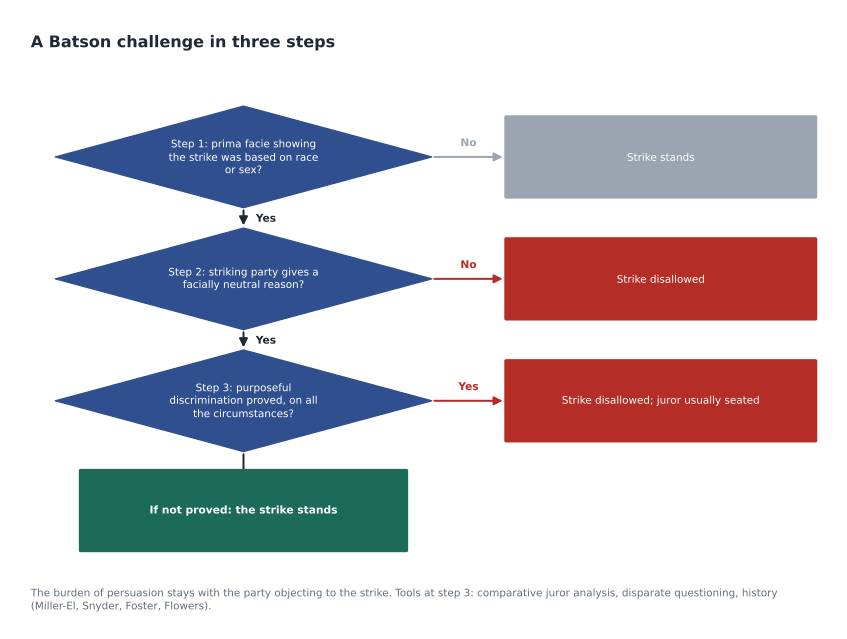
The third step is where cases are won and lost, and the Supreme Court's later decisions show the tools courts use. In Miller-El v. Dretke, 545 U.S. 231 (2005), the Court relied on comparative juror analysis: if a prosecutor's stated reason for striking a Black juror applies equally to a white juror the prosecutor accepted, that is evidence of pretext. The Court also considered the prosecutor's disparate questioning of Black and white jurors and the office's history of discriminatory practices. In Snyder v. Louisiana, 552 U.S. 472 (2008), the Court found that the trial court clearly erred in accepting a prosecutor's explanation that a juror seemed nervous and might be worried about missing student teaching, where the explanation was implausible and applied equally to accepted white jurors. In Foster v. Chatman, 578 U.S. 488 (2016), the prosecution's own jury selection notes, obtained years later, marked Black jurors' names and showed that the stated reasons were pretextual.
Flowers v. Mississippi, 588 U.S. 284 (2019), drew these strands together. Curtis Flowers was tried six times for the same murders by the same lead prosecutor. Across the trials the prosecutor struck 41 of the 42 Black prospective jurors he could have struck; at the sixth trial he struck five of six. Writing for a 7 to 2 majority, Justice Kavanaugh held that the trial court committed clear error in finding no discrimination as to one juror. The Court considered the history of the prosecutor's strikes across the trials, his disparate questioning (he asked the five struck Black jurors far more questions than the seated white jurors), and comparisons with white jurors who shared the characteristics he cited. The Court emphasized that it was not breaking new legal ground but applying Batson's established principles to an extraordinary record.
Several states have concluded that Batson's intent standard is too hard to satisfy and have adopted rules that ask a different question. Washington's General Rule 37, adopted in 2018, asks whether an objective observer aware that implicit, institutional and unconscious biases have resulted in unfair exclusion could view race or ethnicity as a factor in the strike, and it presumptively invalidates certain historically discriminatory reasons, such as a juror's distrust of police or living in a high-crime neighborhood. California's Code of Civil Procedure section 231.7, enacted in 2020, applies a similar objective standard in criminal trials. Connecticut's Practice Book section 5-12 took effect in 2022, and New Jersey adopted Rule 1:8-3A after its supreme court's decision in State v. Andujar (2021). Lawyers must know which standard governs in the courtroom where they try cases.
Worked problem
A Batson objection in State v. Pike
In the mock jury selection for State v. Pike, the venire includes three Black prospective jurors. The prosecutor, played by Hannah Lindqvist, uses peremptory challenges on two of them: Juror 8, a postal carrier who said a cousin was once wrongly arrested, and Juror 14, a nurse who said she would want to hear from the defendant. The prosecutor accepted Juror 21, a white retired engineer who said his son was once arrested for a drunk-driving charge that was dismissed. Defense counsel Jordan Kimura objects under Batson. How should the hearing go?
Show solution
- Step one. Defense counsel points out that the prosecutor struck two of the three Black jurors, a rate far above her strike rate for white jurors, and asks the court to find a prima facie case. Many courts would find the pattern sufficient; some judges skip straight to asking for reasons, which moots step one.
- Step two. The prosecutor explains that Juror 8 has a family member who was wrongly arrested and may distrust police, and that Juror 14 said she would want to hear from the defendant, which suggests she may hold the defendant's silence against him in a way that confuses the burden of proof, or may not accept the instruction on the right not to testify. Both reasons are facially race-neutral.
- Step three. Defense counsel responds with comparative analysis. Juror 21 also has a close family member with a contested arrest, yet the prosecutor accepted him; that undercuts the first reason. On the second reason, defense counsel notes that Juror 14 immediately added that she would follow the judge's instruction, and that the prosecutor did not ask any white juror the same question. Counsel also asks the court to consider how many questions the prosecutor asked each juror.
- The court decides. The judge must evaluate the prosecutor's credibility and the plausibility of the reasons in light of all the circumstances, making findings on the record for each juror. If the court finds purposeful discrimination as to either juror, the strike is disallowed; the usual remedy is to seat the juror, though some courts may instead discharge the panel.
Answer: The strike of Juror 8 is vulnerable because the stated reason applies equally to an accepted white juror, the kind of comparison that persuaded the Court in Miller-El and Flowers. The strike of Juror 14 is stronger if her answer genuinely suggested difficulty with the burden of proof, but disparate questioning would weigh against it. In a state using Washington's GR 37, the first reason would be presumptively invalid as a historically discriminatory justification.
Strategy and procedure for exercising strikes
Courts use different systems for exercising peremptories, and the system shapes strategy. In a struck-jury system, the court qualifies a group large enough to produce a jury after all strikes, and the parties then exercise their strikes from the whole group, often alternately and in writing. Each side knows who will replace a struck juror. In a strike-and-replace system (sometimes called the jury box system), the court seats a group in the box, the parties strike from it, and struck jurors are replaced from the venire one at a time, so a party does not know who will take the seat. Lawyers must learn the local practice in advance and must also know whether unused strikes are lost or can be saved for later rounds.
Lawyers decide strikes by ranking jurors on the issues the case theory identifies, not on crude demographic guesses. In Delgado, plaintiff's counsel worries most about jurors who believe injured people should simply have been more careful and about engineers who may defer to a manufacturer's testing; defense counsel worries about jurors who distrust large corporations or who have had a product injure them. Each side also thinks about leadership: a juror likely to become the foreperson, or to dominate deliberations, matters more than one likely to follow. And each side keeps records, because a Batson objection may come at any time and the lawyer must be able to articulate the actual, neutral reason for every strike.
Jury selection does not end at the swearing of the jury. Jurors may have to be excused during trial for illness, misconduct or newly discovered bias, and lawyers must watch for signs that a juror is not following the court's instructions, for example by researching the case. After the verdict, Rule 606(b) generally bars inquiry into the jury's deliberations, but in Peña-Rodriguez v. Colorado, 580 U.S. 206 (2017), the Court held that the Sixth Amendment requires an exception where a juror makes a clear statement indicating that he relied on racial stereotypes or animus to convict a criminal defendant. Earlier, in Tanner v. United States, 483 U.S. 107 (1987), the Court had upheld the no-impeachment rule against a claim that jurors were intoxicated during trial, so the Peña-Rodriguez exception is narrow.
Common mistakes
MistakeUsing voir dire to argue the case or extract promises about specific facts.
InsteadVoir dire seeks information about bias; judges cut off argument and commitment questions.
MistakeAsking leading questions that invite jurors to agree they can be fair.
InsteadOpen-ended questions about experiences reveal attitudes and grounds for challenge.
MistakeAssuming a facially neutral reason ends a Batson challenge.
InsteadNeutrality satisfies only step two; at step three the court weighs credibility, comparisons and disparate questioning.
MistakeSending a friend request to a prospective juror to see a private profile.
InsteadABA Formal Opinion 466 permits review of public information but treats an access request as a forbidden communication.
MistakeBelieving that a federal civil jury may return a nonunanimous verdict by default.
InsteadRule 48 requires a unanimous verdict unless the parties stipulate otherwise.
Summary and key terms
- Jury pools must reflect a fair cross section of the community (Taylor, Duren); the federal system operates under the Jury Selection and Service Act.
- Federal civil juries have six to twelve members and must be unanimous absent stipulation; criminal convictions for serious offenses require unanimity (Ramos).
- Voir dire may be conducted by the judge or counsel under Civil Rule 47(a) and Criminal Rule 24(a); its purpose is to reveal bias.
- Challenges for cause are unlimited and ask whether a juror's views would prevent or substantially impair the juror's duties.
- Peremptory challenges are limited by statute and rule (28 U.S.C. section 1870; Criminal Rule 24(b)) and are not constitutionally required; Arizona eliminated them in 2022.
- Batson forbids race-based strikes, extended to civil cases, defendants and sex; its three steps leave the burden of persuasion with the objector.
- Miller-El, Snyder, Foster and Flowers show the role of comparative juror analysis, disparate questioning and history in proving discrimination.
- Several states use an objective-observer standard instead of Batson's intent test, including Washington's GR 37 and California's section 231.7.
- Venire
- The panel of prospective jurors summoned for a trial.
- Voir dire
- The questioning of prospective jurors to uncover grounds for challenge.
- Challenge for cause
- A request to excuse a juror who cannot be impartial, unlimited in number and decided by the judge.
- Peremptory challenge
- A strike of a prospective juror without stating a reason, limited in number and subject to Batson.
- Batson challenge
- An objection that a peremptory strike was based on race or sex, resolved in three steps.
- Comparative juror analysis
- Comparing a struck juror with accepted jurors who share the characteristic cited as the reason for the strike.
- Rehabilitation
- Questioning a juror who expressed bias to determine whether the juror can nonetheless follow the instructions.
- Struck-jury system
- A method in which parties exercise strikes from a full qualified group, knowing who will replace each struck juror.
Practice problems
Work each problem on paper first, then reveal the answer to check.
In a federal felony trial with one defendant, how many peremptory challenges does each side ordinarily have?
Show answer
Under Criminal Rule 24(b)(2), the government has six and the defendant has ten, plus additional challenges for alternates.
A prosecutor explains a strike of a Black juror by saying the juror wore sunglasses during questioning. Does that end the Batson inquiry?
Show answer
No. The reason is facially neutral, satisfying step two, but at step three the court must decide whether it is credible, considering whether the prosecutor accepted comparable jurors and all other circumstances.
A civil defendant uses peremptories to strike every woman on the panel. May the plaintiff object?
Show answer
Yes. Edmonson applies Batson to civil litigants, and J.E.B. forbids strikes based on sex.
After a verdict, a juror reports that another juror said during deliberations that the defendant was guilty because of his ethnicity. May the court consider the report?
Show answer
Yes. Peña-Rodriguez creates a Sixth Amendment exception to the no-impeachment rule for clear statements showing reliance on racial stereotypes or animus to convict.
Lesson quiz · 5 questions
Score 60% or more to complete this lesson.
Create a free account to save your progress, take quizzes and earn a certificate.